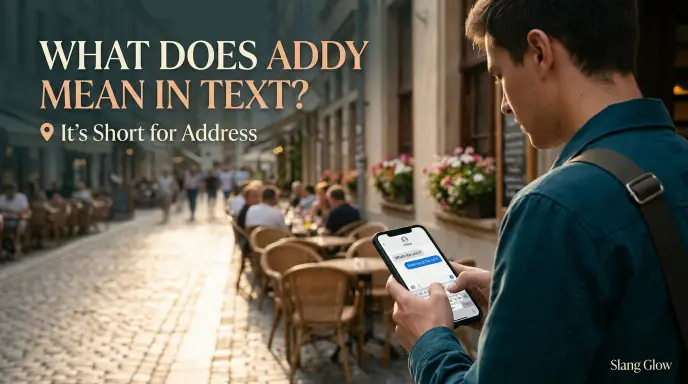
Addy in text usually means “address,” especially when someone asks where a person lives or where an event is taking place. You may see it in text messages, Snapchat chats, Instagram DMs, or conversations about meeting friends. In some other contexts, the word can have a different meaning.
People often search for “addy” after receiving a message such as “What’s the addy?” or “Send me the addy.” These phrases usually mean that someone wants the address of a home, meeting place, or event.
However, addy is informal shorthand, not an acronym with a full form. Its meaning can change depending on the conversation, so it is useful to understand the words around it before replying.
This guide explains the common meanings of addy, how people use it in online conversations, and how to respond when someone asks for an addy.
What Does Addy Mean in Text Messages?
In everyday texting, addy most commonly means “address.” It is an informal shortening used when someone wants an address or location, such as the place where friends plan to meet. Cambridge Dictionary also recognizes addy as an informal word for an address, particularly an email address. <Cite refs={[“turn447741search6″,”turn447741search14”]}/>
For example, if a friend texts, “What’s the addy for the party?” they are asking where the party will take place.
Here are three important points to remember:
- Address: Addy usually refers to an address or the location someone needs to find.
- Casual communication: People use it in informal messages because it sounds shorter and more relaxed than “address.”
- Context matters: The conversation helps you identify If the person means a home address, an event location, or an email address.
Consider this example:
Emma: “Are you coming to the birthday party?”
Sophie: “Yes! Send me the addy.”
Meaning: Sophie wants the address of the place where the birthday party will happen.
The word does not have a secret meaning in this conversation. It is simply a casual way to ask for an address.
However, it is important to be careful when sharing your own address. Only share private location information with people you trust and when you feel comfortable doing so. If an unfamiliar person asks for your home address, you do not have to provide it.
What Does Addy Stand for in Online Slang?
Addy is a shortened form of “address,” rather than an acronym made from several words. It is commonly used in casual conversations, direct messages, group chats, and informal online communication.
Although the address meaning is common, addy can have other meanings in particular contexts. For example, it is sometimes used as slang for a prescription stimulant medication. If a message discusses medication or drugs, the word may not refer to an address. The surrounding conversation is important.
Here are three things to understand:
- Address: The usual meaning when people discuss meeting places, homes, or email details.
- Informal shorthand: Addy is a casual word, not a formal way to write an address in official documents.
- Other meanings: In specialized conversations, addy may refer to something else, so avoid assuming one definition always applies.
For example, a friend might text, “Can you send me the addy for the restaurant?” The context clearly points to a location.
On the other hand, a message about a medicine may use the same word differently. Do not assume the address meaning when the rest of the message points to another subject.
When the intended meaning is unclear, asking the sender what they mean is the simplest way to avoid confusion.
Where Do People Use Addy in Text Messages?
People use addy in many forms of informal communication. The word usually means address, regardless of which messaging platform someone uses. The exact type of address depends on the conversation.
Here are some common situations:
- Text messages: Friends may ask for an addy before meeting at a particular place.
- Snapchat: Someone might message “What’s the addy?” when making plans.
- Instagram: Users may ask for an event address or a location in direct messages.
- WhatsApp: People may share the address of a restaurant, birthday party, or gathering.
- Email conversations: Addy can refer to an email address when someone is discussing where to send a message.
For example:
Noah: “We’re meeting at the café on Saturday.”
Liam: “Cool, what’s the addy?”
Meaning: Liam wants the café’s address so he knows where to meet everyone.
You may also see phrases such as “drop the addy” or “send me your addy.” Both commonly ask someone to share an address.
The meaning can be slightly different depending on the situation. Someone asking for a restaurant’s addy wants the venue’s address, while someone asking for an email addy wants an email address.
Always check what kind of address the person needs before sharing information. This is especially important if a request comes from someone you do not know well.
What Does Addy Mean on TikTok, Snapchat, and Instagram?
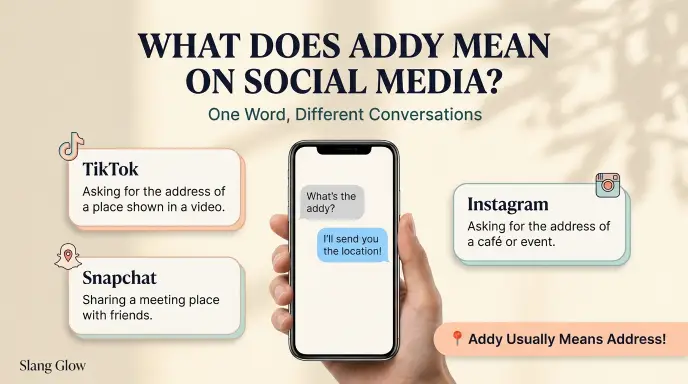
On social media, addy usually means an address or location when people are arranging plans or discussing an event. The platform does not give the word a completely different meaning by itself.
Here is how you might see it used:
- TikTok: Someone may ask for the addy of a publicly announced event or a place mentioned in a video.
- Snapchat: A friend may ask for the address of a meeting place.
- Instagram: A user might ask for an event venue’s address in a direct message.
- WhatsApp: Friends may exchange location details while arranging a get together.
- SMS messages: Someone may use addy as a short form of address when making plans.
For example:
Mia: “That café in your story looks amazing!”
Olivia: “It is! Want the addy?”
Mia: “Yes, please.”
Meaning: Olivia is offering to share the café’s address.
The same word may appear in other types of online conversations, so context still matters. A post about a meeting place will usually make the address meaning clear.
Keep your privacy in mind when using social media. You can share a public venue’s address without sharing your personal home address. If someone asks for private location information and you are unsure about sharing it, it is okay to say no.
Real Chat Examples of Addy in Text Messages
The following conversations show how addy can appear naturally in everyday messages. Each example includes the meaning so you can understand how the word works in different situations.
Example 1: Asking About a Party
Emma: “Are you coming to my birthday party?”
Sophie: “Definitely! What’s the addy?”
Meaning: Sophie is asking for the address of the birthday party.
Example 2: Planning to Meet Friends
Noah: “Let’s meet at the new restaurant tonight.”
Liam: “Sounds good. Send me the addy.”
Meaning: Liam wants the restaurant’s address so he can find it.
Example 3: Visiting a Friend
Mia: “You should come over this weekend!”
Olivia: “Sure, can you send me your addy?”
Meaning: Olivia is asking for the address of Mia’s home. Since this involves a private address, it should only be shared when Mia is comfortable doing so.
Example 4: Finding a Café
Ryan: “I found a cute café near the park.”
Leo: “What’s the addy? I’d love to check it out.”
Meaning: Leo wants the café’s location.
Example 5: Asking for an Email Address
Ava: “I’ll email you the pictures later.”
Ella: “Do you have my email addy?”
Meaning: Ella is asking If Ava has her email address.
These examples show that addy usually replaces the word “address” in casual communication. It makes messages shorter without changing the basic meaning.
Remember that not every use of addy refers to a physical location. If the topic is email, the person may mean an email address. If the conversation concerns another subject, check the surrounding words before deciding what the sender means.
How Should You Reply When Someone Uses Addy?
Your response depends on what the person means by addy and why they are asking. If someone wants an address for a meeting, you can share the appropriate public location or ask which place they mean. If the context is unclear, a short question can prevent confusion.
Here are some natural ways to respond:
- Casual reply: “Sure, I’ll send you the location.”
- Friendly reply: “I’ll share the café’s address with you.”
- Clarifying reply: “Which addy do you need?”
- Privacy conscious reply: “I’ll send you the meeting place, but I don’t share my home address.”
Example 1: Asking for a Party Address
Emma: “What’s the addy for the party?”
Sophie: “I’ll send you the venue’s address.”
Meaning: Emma wants to know where the party will take place.
Example 2: Asking for a Restaurant Location
Noah: “Can you drop the addy for that restaurant?”
Liam: “Sure, I’ll send you the location.”
Meaning: Noah is asking Liam to share the restaurant’s address.
Example 3: When the Meaning Is Unclear
Mia: “Send me your addy.”
Olivia: “Do you mean my email address or a physical address?”
Meaning: Olivia asks for clarification before sharing information.
Remember: You can ask what someone means before responding. You should also feel comfortable protecting your private address or other personal information.
Is Addy Rude or Offensive in Text?
Addy is generally not rude or offensive when it means “address.” It is an informal word that people commonly use when arranging plans or asking where something is located.
However, the word can have other meanings in particular contexts. For example, it is sometimes used as slang for a prescription medication. When the conversation is about medicine, the intended meaning may be different from an address.
Three points are worth remembering:
- Ordinary use: Asking “What’s the addy?” is usually a casual way to request an address.
- Context matters: The abbreviation may carry another meaning in a conversation about a different subject.
- Personal boundaries: Someone asking for your home address does not automatically mean you have to share it.
Is Addy Appropriate at School or Work?
The word is usually fine in casual messages between people who understand it. However, “address” is clearer in formal emails, school assignments, business documents, and official communication.
For example, instead of writing, “Send me the addy for the meeting,” you could write, “Could you please send me the meeting location?”
Choose the wording that fits your audience. Informal shorthand may feel natural with friends, while complete words are often better in professional situations.
Who Uses the Word Addy?
People use addy in everyday conversations because it is a short, informal way to refer to an address. It is not limited to one generation or a particular social media platform.
You might encounter it in these situations:
- Friends and classmates: They may ask for a venue’s address when arranging to meet.
- Social media users: People may request the location of a café, event, or place shown in a post.
- Adults and professionals: Some people use addy in casual conversations about addresses or contact details.
Is Addy a Gen Z Expression?
Addy is not exclusive to Gen Z. It is an informal shortening of address that people can use in everyday English, including text messages and online conversations.
Younger users may encounter it on TikTok, Snapchat, or Instagram, but the word is not tied to one age group. Its meaning depends on what the person is discussing.
The subject of the conversation is more useful than the sender’s age when interpreting addy. If friends are planning a gathering, it probably means the location. If the topic is different, check the surrounding words.
Where Did the Word Addy Come From?
Addy developed as an informal shortening of “address.” Like many shortened words, it makes everyday communication quicker and less formal.
People use shortened forms when exchanging information in conversations, notes, and messages. Addy is one such form, rather than an acronym formed from the first letters of several words.
Three details help explain its use:
- Informal shortening: Addy is a casual variation of address.
- Everyday communication: It is convenient when people are arranging meetings or sharing contact details.
- Online use: Text messages and social media provide familiar settings for shortened words like addy.
Does Addy Have a Specific Internet Origin?
There is no single social media platform that can be identified as the source of the word’s everyday address meaning. It is better understood as an informal word that people also use online.
The alternative meanings of addy may have separate histories and uses. For that reason, it would be inaccurate to claim that every use of addy originated from texting or social media.
Addy vs. Other Common Texting Abbreviations
Addy differs from common texting abbreviations because it is a shortened word rather than an initialism like IDK or BRB.
| Term | Meaning | Type | Typical Use |
| Addy | Address | Informal shortened word | Asking for a location or contact address |
| IDK | I don’t know | Abbreviation | Expressing uncertainty |
| IDC | I don’t care | Abbreviation | Expressing a lack of concern |
| IMO | In my opinion | Abbreviation | Sharing an opinion |
| BRB | Be right back | Abbreviation | Saying someone will return shortly |
These terms serve different purposes:
- Addy refers to an address in common everyday usage.
- IDK and IDC express a response or attitude.
- IMO and BRB communicate an opinion or a temporary absence.
For example, “What’s the addy?” asks for an address, while “IDK where we’re meeting” means the sender does not know the meeting place.
Do not treat these terms as interchangeable. Understanding what each word communicates makes text messages easier to interpret.
A Real World Example of Addy in a Conversation
Imagine that two friends are planning to meet at a café on Saturday. One friend has found a place online but has not shared its location yet.
Emma: “That café you mentioned looks nice.”
Sophie: “It is! Want to meet there on Saturday?”
Emma: “Sure. Send me the addy.”
Sophie: “I’ll send you the café’s location.”
In this conversation, addy means the café’s address. The discussion about meeting at a specific place makes the intended meaning clear.
Now imagine someone sends, “Do you have my email addy?” In that situation, they are asking about an email address rather than a physical location.
The surrounding message tells you which kind of address is meant. When the context remains unclear, asking a follow up question is better than making an assumption.
Frequently Asked Questions About Addy
Q.1. What does addy mean in text messages?
Addy usually means address. It is an informal word people use when asking for the location of a home, event, restaurant, or another place. It can also refer to an email address.
Q.2. What does addy mean on TikTok?
On TikTok, addy often means address, particularly when people ask for the location of an event or place shown in a video. The context can reveal other meanings.
Q.3. Is addy considered slang?
Yes. Addy is an informal shortening of address. It is a word rather than an acronym with a full form.
Q.4. Is addy rude or offensive?
It is generally not rude when used to mean address. However, the word can have other meanings in particular contexts, so consider the whole message.
Q.5. How should you reply when someone asks for the addy?
You can share the appropriate location if you are comfortable doing so, or ask which address they need. Avoid sharing private information with people you do not trust.
Q.6. Does addy always mean address?
No. Address is a common meaning, but addy can refer to other things in specialized conversations, including slang related to a prescription medication. The context determines the likely meaning.
Final Takeaway
Addy most commonly means “address” in text messages. People use it when asking for a location, arranging to meet, or exchanging contact details.
You may see it in everyday texts, Snapchat conversations, Instagram DMs, and other informal online communication. Although the word is usually harmless, it can have other meanings in particular contexts.
Read the full message before assuming what the sender means, and protect your privacy when sharing an address. If the intended meaning is unclear, simply ask for clarification.
SEE MORE!

Hi, I’m James Parker, a writer passionate about modern slang, internet culture, and social media language. I enjoy researching trending words and explaining their meanings in simple, easy to understand English. My goal is to help readers confidently understand and use slang in everyday conversations, texting, and online platforms.