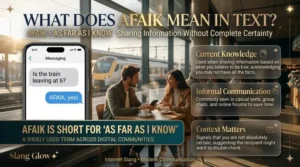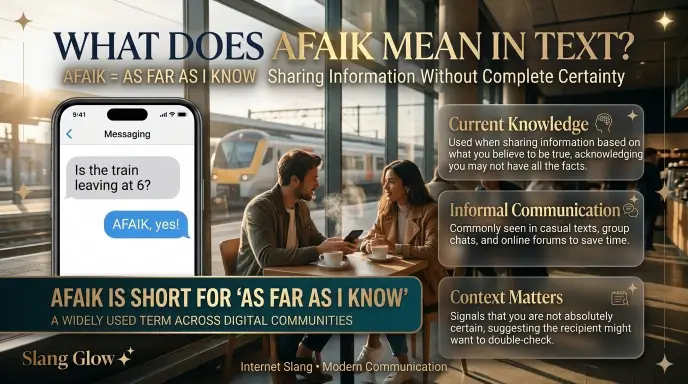
AFAIK in text stands for “As Far As I Know.” People use this abbreviation when sharing information they believe is correct but are not completely certain about. You may see it in text messages, Snapchat conversations, Instagram comments, and online discussions.
Instead of typing the complete phrase, someone can simply write AFAIK to make a message shorter. It helps communicate that a statement is based on what the sender currently knows.
For example, if someone asks If a store is open and you reply, “AFAIK, it closes at 9,” you are sharing what you believe to be true without claiming that you have confirmed it.
AFAIK is a common internet abbreviation, not a rude expression or a swear word. Understanding it can make everyday online conversations easier to follow.
What Does AFAIK Mean in Text Messages?
In everyday texting, AFAIK means “As Far As I Know.” It is used when someone shares information based on their current knowledge but wants to leave room for the possibility that something may be different. Cambridge Dictionary defines it as a written abbreviation used when someone believes something is true but is not completely certain.For example, if a friend asks, “Is the library open today?” you might reply, “AFAIK, it closes at 6 PM.”
This means that you believe the library closes at 6 PM, but you are not claiming to have checked its current hours.
Here are three important points to remember:
- Sharing knowledge: AFAIK introduces information based on what someone currently knows.
- Showing uncertainty: It indicates that the sender may not have every detail confirmed.
- Casual communication: It saves time when writing messages, comments, and online replies.
Consider this conversation:
Emma: “Is the school event happening tomorrow?”
Sophie: “AFAIK, yes. Nobody has announced a change.”
Meaning: Sophie believes the event is still scheduled for tomorrow, but she is not completely certain.
AFAIK does not necessarily mean that someone is confused or has no idea. It simply makes their statement less absolute.
The main purpose of AFAIK is to share information while acknowledging that it may not be completely confirmed.
What Does AFAIK Stand for in Online Slang?
AFAIK is an initialism formed from the first letters of “As Far As I Know.” Unlike ordinary shortened words, each letter represents part of the original phrase.
People commonly use it when answering questions, correcting information, or sharing something they have heard.
Here are three common situations:
- Answering a question: Someone uses AFAIK before giving an answer they believe is correct.
- Sharing information: It helps communicate what the sender currently knows.
- Avoiding absolute claims: It shows that the information may not be fully confirmed.
For example:
Alex: “Has the new movie been released?”
Jordan: “AFAIK, it comes out next Friday.”
Meaning: Jordan believes the movie will be released next Friday but has not necessarily confirmed the date.
AFAIK is sometimes confused with other abbreviations, especially IDK. However, they communicate different ideas:
- AFAIK: As far as I know.
- IDK: I don’t know.
- IMO: In my opinion.
The difference is important. AFAIK introduces information that someone believes to be correct, while IDK directly expresses a lack of knowledge.
AFAIK is useful when you want to answer someone without pretending to know everything for certain.
Where Do People Use AFAIK?
AFAIK appears in different types of digital communication, especially when people want to share information quickly. It is not restricted to one messaging application or social media platform.
Here are some places where you may encounter it:
- Text messages: Friends may use AFAIK when answering questions about plans, events, or everyday information.
- Snapchat: Someone might use it in a quick conversation when explaining what they currently know.
- Instagram: It may appear in comments or direct messages when users discuss information or share opinions.
- WhatsApp: People can use AFAIK in group chats while discussing plans or answering questions.
- Online discussions: Users may include it when responding to questions or explaining something they believe is correct.
For example:
Mia: “Is everyone coming to the meeting?”
Olivia: “AFAIK, everyone has confirmed.”
Meaning: Olivia believes everyone is attending based on the information available to her.
The abbreviation can make a message shorter, but it also changes how the statement sounds. It communicates that the sender is not claiming complete certainty.
What Does AFAIK Mean on TikTok, Snapchat, and Instagram?
On social media, AFAIK generally keeps the same meaning: “As Far As I Know.” The platform does not usually change the definition, although the surrounding conversation can explain why someone uses it.
Here are some examples of how it may appear:
- TikTok: Someone might write AFAIK when responding to a question in a comment.
- Snapchat: Friends may use it when discussing plans or sharing information.
- Instagram: Users may include it in captions, comments, or direct messages when explaining something they believe is correct.
- WhatsApp: People may use AFAIK to answer questions without claiming complete certainty.
- SMS messages: The abbreviation can make everyday responses quicker and shorter.
For example:
Noah: “Did the new episode come out today?”
Liam: “AFAIK, it was released yesterday.”
Meaning: Liam believes the episode was released yesterday, but he is not presenting the information as completely confirmed.
You may also see AFAIK at the beginning or end of a sentence. Its position does not usually change the main meaning.
AFAIK is an abbreviation for expressing limited knowledge, not a secret code with a different meaning on every social media platform.
Real Chat Examples of AFAIK in Text Messages
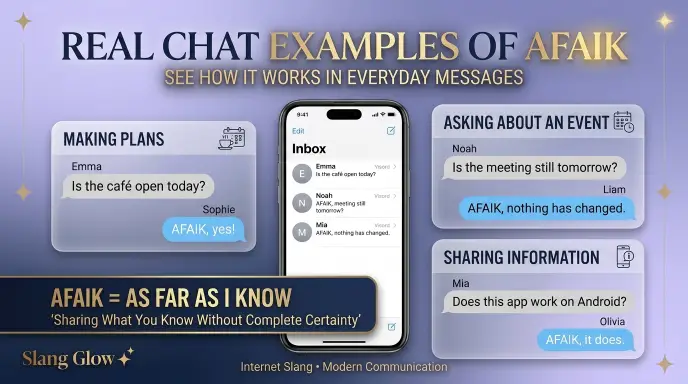
The following conversations show how people might use AFAIK in everyday messages. Each example explains the meaning in simple language.
Example 1: Asking About an Event
Emma: “Is the school event happening tomorrow?”
Sophie: “AFAIK, yes. Nobody has changed the schedule.”
Meaning: Sophie believes the event is still happening tomorrow based on the information she has.
Example 2: Talking About a Store
Noah: “Is the store open on Sunday?”
Liam: “AFAIK, it closes at 8 PM.”
Meaning: Liam believes the store closes at 8 PM but may not have checked the latest schedule.
Example 3: Discussing a Movie
Mia: “Has the new movie been released?”
Olivia: “AFAIK, it’s coming out next week.”
Meaning: Olivia shares the release date she currently believes is correct.
Example 4: Checking Meeting Plans
Ryan: “Are we still meeting at the same place?”
Leo: “AFAIK, nothing has changed.”
Meaning: Leo believes the original meeting arrangement is still valid.
Example 5: Answering a General Question
Ava: “Does this app work on Android?”
Ella: “AFAIK, yes. It should work on most Android phones.”
Meaning: Ella believes the app supports Android devices, although she is not claiming to have checked every device.
These examples show that AFAIK helps people share what they know without making an overly certain statement. It is especially useful when information may change or when someone is relying on what they have heard.
More Real Chat Examples of AFAIK in Text Messages
AFAIK is useful when someone wants to share information without claiming that everything is completely confirmed. These additional conversations show how it fits into everyday messaging.
Example 6: Asking About Homework
Emma: “Is the homework due tomorrow?”
Sophie: “AFAIK, we have until Friday.”
Meaning: Sophie believes the deadline is Friday based on the information she has.
Example 7: Discussing a New Restaurant
Noah: “Does that restaurant serve breakfast?”
Liam: “AFAIK, yes. I saw it on their menu.”
Meaning: Liam believes breakfast is available but is not completely certain.
Example 8: Talking About a School Holiday
Mia: “Do we have classes on Monday?”
Olivia: “AFAIK, no. It’s a holiday.”
Meaning: Olivia shares what she currently knows about the school schedule.
Example 9: Asking About a New Phone
Ryan: “Does this phone support wireless charging?”
Leo: “AFAIK, it does.”
Meaning: Leo believes the phone has that feature but may not have checked the specifications.
Example 10: Discussing a Movie Release
Ava: “Is the new movie coming out this month?”
Ella: “AFAIK, it’s scheduled for next month.”
Meaning: Ella shares the release information she currently believes is correct.
These examples show that AFAIK makes a statement sound less definite. It is especially useful when someone is sharing information they believe to be accurate but have not fully verified.
How Should You Reply When Someone Uses AFAIK?
Your response depends on the information the other person is sharing. Since AFAIK means “As Far As I Know,” the sender is usually giving an answer based on their current knowledge.
Here are four natural ways to respond:
- Casual reply: “Okay, thanks for letting me know!”
- Friendly reply: “That makes sense. I’ll check too.”
- Funny reply: “So, that’s your best guess? 😂”
- Neutral reply: “Are you sure, or should we confirm?”
Example 1: Confirming Information
Emma: “AFAIK, the event starts at 5 PM.”
Sophie: “Perfect, thanks!”
Meaning: Sophie accepts the information while understanding that it may need confirmation.
Example 2: Asking for More Details
Noah: “AFAIK, the shop is closed today.”
Liam: “Did you check its opening hours?”
Meaning: Liam wants to make sure the information is correct.
Example 3: Sharing the Same Understanding
Mia: “AFAIK, everyone has completed the assignment.”
Olivia: “That’s what I heard too.”
Meaning: Olivia agrees with Mia based on the information they both have.
You do not need to use another abbreviation in your reply. Simple expressions such as “Got it,” “Thanks,” and “I’ll check” work perfectly well.
Is AFAIK Rude or Offensive in Text?
AFAIK is generally not rude or offensive. It is a neutral internet abbreviation that helps someone communicate what they currently know without sounding completely certain.
However, the way it is used can sometimes affect the tone of a message.
Here are three things to understand:
- Neutral communication: AFAIK is usually a polite way to introduce information.
- Showing uncertainty: It tells the reader that the information may not be fully confirmed.
- Potential misunderstanding: Someone might interpret a short answer as dismissive if the conversation requires a more detailed explanation.
Is AFAIK Appropriate at School or Work?
Yes. AFAIK can be used in informal workplace messages, group chats, and online discussions. However, spelling out the complete phrase may be better when communicating with people who are unfamiliar with internet abbreviations.
For example:
Instead of writing:
“AFAIK, the meeting starts at 10.”
You could write:
“As far as I know, the meeting starts at 10.”
AFAIK is suitable for many casual and professional digital conversations, but complete wording is often clearer in formal emails, reports, and official documents.
Who Uses the Abbreviation AFAIK?
AFAIK is used by people who communicate through text messages, online discussions, and digital platforms. It is not limited to one age group or a particular social media community.
You may encounter it in these situations:
- Everyday texters: Friends use it when answering questions or sharing information.
- Students: Classmates may use it when discussing assignments, schedules, or school announcements.
- Online communities: People may include it when responding to questions or explaining something they believe is correct.
- Workplace conversations: Employees may use it when sharing updates without claiming complete certainty.
Is AFAIK a Gen Z Expression?
AFAIK is not exclusive to Gen Z. It is an established internet abbreviation that has been used in online communication for many years.
Younger users may encounter it in social media comments and group chats, while older internet users may recognize it from email discussions, forums, and online messaging.
AFAIK belongs to general internet shorthand rather than one particular generation. Its purpose remains the same: introducing information based on what the sender currently knows.
Where Did AFAIK Come From?
AFAIK developed as a shortened form of “As Far As I Know.” It became part of internet shorthand because people wanted quicker ways to communicate common expressions in text based conversations.
The abbreviation is associated with early online communication, including internet discussions, email exchanges, and chat rooms. However, there is no widely established account identifying one specific person or exact date as its creator.
Three details help explain its development:
- Shortened language: AFAIK uses the first letters of the original phrase.
- Online communication: Internet users adopted abbreviations to make messages quicker and shorter.
- Continued use: The expression remains useful because it communicates uncertainty in just four letters.
Did AFAIK Originate on Social Media?
No. AFAIK is older than modern social media platforms such as TikTok and Instagram. It belongs to the broader history of internet shorthand.
As online communication developed, abbreviations became familiar ways of expressing everyday thoughts without typing complete phrases.
Its popularity is connected to convenience and clarity rather than one specific social media trend.
AFAIK vs. Other Common Texting Abbreviations
AFAIK is different from other common abbreviations because it specifically introduces information based on someone’s current knowledge.
| Term | Meaning | Type | Typical Usage |
| AFAIK | As Far As I Know | Initialism | Sharing information with some uncertainty |
| IDK | I Don’t Know | Initialism | Expressing a lack of knowledge |
| IMO | In My Opinion | Initialism | Introducing a personal opinion |
| FYI | For Your Information | Initialism | Sharing useful information |
| BRB | Be Right Back | Initialism | Saying someone will return shortly |
These abbreviations have different purposes:
- AFAIK introduces information that the sender believes is correct.
- IDK expresses uncertainty or a lack of knowledge.
- IMO introduces an opinion, while FYI shares information.
For example, “AFAIK, the shop closes at 8 PM” means the sender believes that closing time is correct.
In contrast, “IDK when the shop closes” means the sender does not know the closing time.
AFAIK does not guarantee that information is accurate. It simply tells the reader that the statement reflects the sender’s current understanding.
A Real World Example of AFAIK in a Conversation
Imagine that two classmates are discussing an upcoming school event. One student has heard that the schedule has changed, but the information has not been officially confirmed.
Emma: “Do you know what time the event starts tomorrow?”
Sophie: “AFAIK, it starts at 9 AM.”
Emma: “Did the teacher confirm that?”
Sophie: “Not yet, but that’s the latest information I have.”
Emma: “Okay, I’ll check the class group too.”
In this conversation, Sophie uses AFAIK because she is sharing information she currently believes to be correct without claiming complete certainty.
This is exactly why the abbreviation is useful in everyday communication. It helps people share what they know while leaving room for corrections or updates.
Frequently Asked Questions About AFAIK
Q.1. What does AFAIK mean in text messages?
AFAIK stands for “As Far As I Know.” People use it when sharing information they believe is correct but have not completely confirmed.
Q.2. What does AFAIK mean on TikTok?
On TikTok, AFAIK usually means “As Far As I Know.” It is commonly used when someone shares information or responds to a question.
Q.3. Is AFAIK considered slang?
Yes. AFAIK is a common internet abbreviation or initialism used in text messages, online discussions, and casual digital communication.
Q.4. Is AFAIK rude or offensive?
No. AFAIK is generally neutral and non offensive. It simply communicates that someone is sharing information based on their current knowledge.
Q.5. How should you reply when someone uses AFAIK?
You can respond with “Thanks for letting me know,” “Okay, I’ll check,” or ask for confirmation if the information is important.
Q.6. Does AFAIK mean the same as IDK?
No. AFAIK means “As Far As I Know,” while IDK means “I Don’t Know.” The first shares what someone believes they know, while the second expresses a lack of knowledge.
Final Takeaway
AFAIK means “As Far As I Know” and is used to share information without claiming complete certainty. It appears in text messages, social media comments, group chats, and online discussions.
People use it when answering questions, explaining something they have heard, or sharing information that may need confirmation.
The easiest way to understand AFAIK is to remember that it means someone is sharing what they currently know, not necessarily stating a confirmed fact.
LEARN MORE!

Hi, I’m James Parker, a writer passionate about modern slang, internet culture, and social media language. I enjoy researching trending words and explaining their meanings in simple, easy to understand English. My goal is to help readers confidently understand and use slang in everyday conversations, texting, and online platforms.