ACT in text can refer to the ACT college admissions test, the ordinary English word “act,” or a specific action or behavior. Its meaning depends on the conversation. When someone uses “act” in a message, they may be talking about behavior, performing, or pretending.
You might see ACT in text messages, school group chats, Instagram comments, TikTok posts, or conversations about exams. The capitalized form ACT often refers to the college admissions test used in the United States, while lowercase “act” is usually an ordinary English word.
People also use phrases such as “stop acting like that,” “it’s just an act,” or “act normal” in everyday conversations. These expressions have different meanings, even though they contain the same word.
This guide explains what ACT can mean in text messages, how people use it in different situations, and how to recognize the intended meaning through simple examples.
What Does ACT Mean in Text Messages?
ACT does not have one universal slang meaning in texting. In most messages, it either refers to the ordinary English word “act” or appears as an abbreviation connected to a particular subject, such as an exam.
The word “act” can mean to behave in a particular way, do something, or perform in a play or film. It can also describe behavior that hides someone’s real feelings or intentions.
Here are three meanings to keep in mind:
- Behavior: “Act normal” means to behave normally.
- Taking action: “We need to act now” means that something needs to be done.
- The ACT test: In a school or college admissions conversation, ACT can refer to a standardized test used in the United States.
For example, if your friend texts, “Why do you act like that?” they are asking about your behavior. If a classmate says, “I’m preparing for the ACT,” they are most likely talking about the exam.
Capitalization and context can help you understand the intended meaning. However, people do not always follow capitalization rules in casual messages, so the surrounding words are usually more useful than the letters alone.
What Does Act Mean in Everyday Chat Slang?
In casual conversations, “act” usually relates to someone’s behavior or the way they present themselves. The word itself is not a special texting abbreviation, but it appears in many informal expressions.
Here are three common phrases you may encounter:
- Act normal: Behave in an ordinary or expected way.
- Stop acting like that: Change the behavior that the speaker is commenting on.
- It’s just an act: Someone’s behavior may be pretend rather than a true reflection of their feelings.
For example:
Alex: “Why are you acting so quiet today?”
Jordan: “I’m just tired.”
Meaning: Alex is asking about Jordan’s behavior, not using a secret slang code.
In another conversation, someone might say, “Don’t act like you didn’t know.” This means the speaker believes the other person already knew something.
The word “act” can express different ideas depending on the sentence. It might refer to behaving, taking action, performing, or pretending. You need the full phrase to understand which meaning applies.
What Does ACT Mean on TikTok, Snapchat, and Instagram?
On social media, the meaning of ACT depends on If someone is discussing behavior, school exams, or a particular expression. The platform does not give the word one fixed slang definition.
Here are some situations where you might encounter it:
- TikTok: A caption such as “Why do you act like this?” may refer to someone’s funny, unusual, or confusing behavior.
- Snapchat: A friend might text, “Act normal when we get there,” meaning to behave normally in a particular situation.
- Instagram: Someone may write, “It’s all an act,” suggesting that a person’s behavior is not genuine.
- WhatsApp: A message such as “Stop acting like you don’t know” refers to how someone is behaving.
- School group chats: ACT may refer to the college admissions test when students discuss exam preparation.
For example:
Mia: “Why did you act so surprised?”
Olivia: “Because I honestly didn’t expect it!”
Meaning: Mia is asking about Olivia’s reaction to something unexpected.
In a different conversation, a student might write, “My ACT is next month.” Here, ACT refers to an exam rather than someone’s behavior.
Always read the message as a whole. If the conversation is about personal behavior, the ordinary verb is probably intended. If it is about college applications, the test meaning is more likely.
Real Chat Examples of ACT in Text Messages
These examples show how “act” and ACT can appear in everyday messages. Each conversation provides context so you can understand the intended meaning.
Example 1: Talking About Behavior
Emma: “Why do you act differently around those people?”
Sophie: “I don’t mean to. I just feel nervous.”
Meaning: Emma is asking why Sophie’s behavior changes around certain people.
Example 2: Asking Someone to Behave Normally
Noah: “Please act normal when my friends arrive.”
Liam: “I’ll try! 😂”
Meaning: Noah wants Liam to behave normally when they meet his friends.
Example 3: Discussing Pretend Behavior
Mia: “Do you think he’s really upset?”
Olivia: “Maybe it’s just an act.”
Meaning: Olivia suggests that the person’s behavior might not reflect how he genuinely feels.
Example 4: Encouraging Action
Ryan: “We keep talking about the problem, but nothing changes.”
Leo: “We need to act now.”
Meaning: Leo believes they should take action instead of continuing to discuss the problem.
Example 5: Talking About an Exam
Ava: “Are you taking the ACT this year?”
Ella: “Yes, I’m getting ready for it.”
Meaning: Ava is asking about the college admissions test, not someone’s behavior.
These examples show that ACT does not always mean the same thing in a message. The word can refer to behavior or action, while capitalized ACT may refer to an exam.
When the meaning is unclear, check the topic of the conversation or ask the sender what they mean.
More Real Chat Examples of ACT in Text Messages
The meaning of “act” becomes clearer when you look at the entire conversation. These additional examples show how people use the word when discussing behavior, feelings, decisions, and school.
Example 6: Talking About Feelings
Mia: “You don’t have to act happy if you’re having a bad day.”
Emma: “Thanks. I just need some time.”
Meaning: Mia is telling Emma that she does not need to pretend to feel happy.
Example 7: Discussing a Friendship
Noah: “Why did he act like he didn’t recognize me?”
Liam: “Maybe he didn’t see you.”
Meaning: Noah is asking about someone’s behavior during an interaction.
Example 8: Encouraging Someone to Take Action
Alex: “We keep saying we want to improve our grades.”
Jordan: “Then we need to act on it.”
Meaning: Jordan means they should take practical steps instead of only talking about their goals.
Example 9: Talking About a Performance
Ava: “Did you watch the school play?”
Sophie: “Yes! Everyone acted really well.”
Meaning: Here, “acted” refers to performing roles in a play.
Example 10: Discussing the ACT Exam
Ryan: “I’m worried about my ACT next month.”
Leo: “Make a study plan and practice regularly.”
Meaning: Ryan is talking about the ACT college admissions test used in the United States.
These examples show that the word “act” can refer to behavior, pretending, taking action, or performing. When written as ACT in a school related conversation, it may refer to the exam.
How Should You Reply When Someone Uses ACT?
Your response depends on the sentence in which the word appears. If someone comments on your behavior, you can ask what they mean. If they use “act” in an ordinary sentence, respond to the message rather than treating the word as a special code.
Here are four natural ways to respond:
- Casual reply: “What do you mean?”
- Friendly reply: “I’m just being myself.”
- Clarifying reply: “Which part are you talking about?”
- Exam related reply: “I’m preparing for it. Do you have any study tips?”
Example 1: Someone Comments on Your Behavior
Friend: “Why do you act so quiet around new people?”
You: “I’m just shy until I get to know them.”
Meaning: You explain why your behavior changes around unfamiliar people.
Example 2: Someone Says “Act Normal”
Friend: “Act normal when we meet everyone.”
You: “I’ll just be myself!”
Meaning: You respond to a request about how to behave in a particular situation.
Example 3: Someone Mentions the ACT Exam
Friend: “Are you taking the ACT this year?”
You: “I’m still deciding If to take it.”
Meaning: You respond to a question about the exam.
You do not need to use slang to reply naturally. A clear answer is often the easiest way to keep the conversation going.
Is ACT Rude or Offensive in Text?
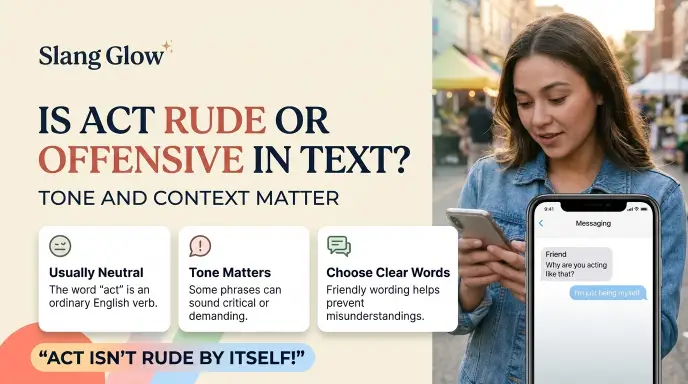
The word “act” is not inherently rude or offensive. It is a regular English verb, but the tone of a sentence can make it sound friendly, critical, or demanding.
For example, “Act carefully” may be a useful warning, while “Stop acting like you know everything” can sound confrontational.
Here are three things to consider:
- Friendly use: “Just act naturally” can encourage someone to relax.
- Critical use: “Why do you act like that?” may sound judgmental depending on the situation.
- Neutral use: “We need to act quickly” simply means that action is needed soon.
Is ACT Appropriate at School or Work?
Yes. The ordinary word “act” is appropriate in formal and informal communication. However, phrases that criticize someone’s behavior may sound impolite if they are not phrased carefully.
For example, instead of saying, “Stop acting confused,” you could say, “Would you like me to explain that again?”
The context and wording determine the tone, not the word “act” by itself.
Who Uses ACT in Messages?
People of different ages use the word “act” because it is part of everyday English. It appears in ordinary conversations, online posts, school discussions, and workplace communication.
Three common groups of situations include:
- Everyday conversations: People discuss how someone behaves or reacts.
- Social media users: People use expressions such as “act normal,” “it’s just an act,” and “act like you don’t care.”
- Students: People may use ACT when discussing the college admissions test.
Is ACT a Gen Z Texting Term?
ACT is not exclusively a Gen Z expression. The word “act” has long been part of English, although phrases containing it can become popular in particular online communities.
For example, “It’s giving an act” or similar informal wording may appear in internet conversations, but that does not give ACT one universal slang definition.
The capitalized form may also refer to the ACT exam in educational contexts.
The subject of the conversation is more useful than the sender’s age when identifying the meaning.
Where Did the Word ACT Come From?
The word “act” did not originate as a texting abbreviation or a recent internet trend. It comes from the history of English and has long been used to describe doing something, behaving in a particular way, or performing.
Over time, the word developed several related uses. People can act on a decision, act naturally, act in a performance, or put on an act by pretending to feel or behave a certain way.
Three points explain its everyday use:
- Ordinary English: “Act” is a regular verb with several established meanings.
- Figurative use: The expression “it’s just an act” can suggest that someone’s behavior is not genuine.
- Modern texting: People use the same word in messages, captions, and informal online expressions.
Did ACT Originate as Internet Slang?
No, the ordinary word “act” predates modern texting and social media. Online conversations use existing English words in different ways, and certain phrases may gain popularity over time.
ACT, when used to refer to the American college admissions exam, is a separate abbreviation with its own educational context.
It is more accurate to explain these established uses than to claim that ACT has one hidden internet origin.
ACT vs. Other Common Texting Abbreviations
ACT differs from common texting abbreviations because “act” is usually an ordinary English word, while the others shorten longer phrases.
| Term | Meaning | Type | Typical use |
| ACT | Act; or the ACT exam in educational contexts | Word or initialism | Behavior, action, performance, or an exam |
| IDK | I don’t know | Abbreviation | Expressing uncertainty |
| IDC | I don’t care | Abbreviation | Expressing a lack of concern |
| IMO | In my opinion | Abbreviation | Sharing a personal view |
| BRB | Be right back | Abbreviation | Saying someone will return soon |
These terms have different purposes:
- ACT usually appears as part of an ordinary sentence, such as “Act carefully.”
- IDK and IDC express a person’s response or attitude.
- IMO and BRB communicate an opinion or explain that someone will return shortly.
For example, “We need to act now” means that action is required. “IDK what to do” means the sender does not know what action to take.
Do not assume that every capitalized word is texting slang. Some terms, including ACT, may be capitalized because they are names or established initialisms.
A Real World Example of ACT in a Conversation
Imagine that two classmates are preparing for a school presentation. One student is worried about speaking in front of the class.
Emma: “I’m nervous about presenting tomorrow.”
Lily: “Just act naturally and speak slowly.”
Emma: “I’ll try. I practiced my presentation twice.”
Lily: “You’ll feel more comfortable once you begin.”
In this conversation, “act” means to behave in a particular way. Lily is encouraging Emma to remain natural rather than pretend to be someone else.
Now consider a different situation:
Alex: “I’m studying for the ACT.”
Jordan: “How is your preparation going?”
Here, ACT refers to the college admissions test.
The full sentence reveals which meaning applies. Reading the surrounding words helps you avoid confusing the ordinary verb with the exam’s name.
Frequently Asked Questions About ACT in Text
What does ACT mean in text messages?
ACT usually refers to the ordinary English word “act,” meaning to behave, do something, or perform. In educational conversations, ACT may refer to a college admissions test.
What does ACT mean on TikTok?
There is no single universal TikTok meaning for ACT. It may refer to behavior or appear in an expression such as “act normal,” depending on the video or comment.
Is ACT considered slang?
The word “act” itself is not slang. It is an ordinary English word, although it appears in informal expressions and internet conversations.
Is ACT rude or offensive?
No, not by itself. However, sentences such as “Stop acting like that” can sound critical depending on the tone and situation.
How should you reply when someone uses ACT?
Read the complete sentence and reply according to its meaning. If someone comments on your behavior, ask what they mean. If they mention the ACT exam, respond to the educational topic.
Final Takeaway
ACT in text usually refers to the ordinary English word “act,” but capitalized ACT can also refer to a college admissions test. The intended meaning depends on the topic and the sentence.
You may encounter the word in everyday chats, social media posts, school discussions, and conversations about behavior. It does not have one universal hidden slang meaning.
Read the complete message before interpreting the word. When the context is unclear, asking the sender for clarification is the simplest solution.
FIND MORE!

Hi, I’m James Parker, a writer passionate about modern slang, internet culture, and social media language. I enjoy researching trending words and explaining their meanings in simple, easy to understand English. My goal is to help readers confidently understand and use slang in everyday conversations, texting, and online platforms.