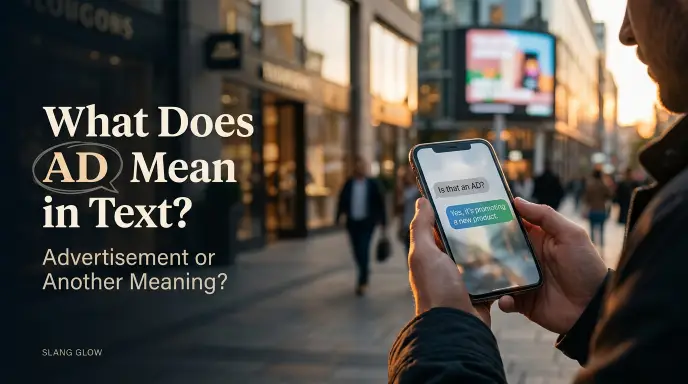
AD in text usually means “advertisement,” which is a message or piece of content promoting a product, service, or brand. You may see it in text messages, TikTok videos, Instagram posts, or online comments. In other contexts, AD can have different meanings, so the surrounding conversation matters.
People often search for this abbreviation after seeing it in a social media caption, sponsored post, or conversation about online promotions. Because AD is short and easy to type, it can appear in several kinds of digital communication.
However, AD does not always mean advertisement. When written as A.D. in a historical date, it stands for Anno Domini, a Latin phrase traditionally used to identify years in the Christian calendar. The intended meaning depends on how the letters are used.
This guide explains the common meanings of AD, how people use it in everyday messages, and how to understand and respond to it in different situations.
What Does AD Mean in Text Messages?
In everyday digital communication, AD most commonly means “advertisement.” An advertisement is content designed to promote a product, service, event, or business. People may use AD when discussing commercials, sponsored posts, promotional videos, or online marketing.
For example, if someone texts, “I think that video is an AD,” they probably mean the video is promoting a product or brand rather than being ordinary content.
The word ad is a common informal shortening of advertisement. You may encounter it in online articles, videos, websites, apps, and private messages.
Here are three important points to remember:
- Advertisement: AD can refer to promotional content that introduces or promotes something.
- Sponsored content: On social media, the abbreviation may appear when someone discusses a paid promotion or branded post.
- Context matters: AD can have other meanings in historical, medical, business, or technical conversations.
For example, a friend might text, “That skincare post looks like an AD.” They are suggesting that the post may be promotional content.
The most likely meaning depends on the topic of the message. If someone is discussing a sponsored video, advertisement is a reasonable interpretation. If they are discussing history or a technical subject, another meaning may fit better.
What Does AD Stand for in Online Chats?
In online conversations, AD often refers to an advertisement, but it can also appear as an abbreviation for another term. It is not a texting acronym with one universal meaning in every situation.
The most useful interpretations to recognize are:
- Advertisement: A promotional message about a product, service, or business.
- Anno Domini: A historical dating abbreviation used with years in the traditional Christian calendar.
- Other specialized meanings: In medical, business, or technology discussions, AD may represent a different term.
For example:
Example 1: Talking About Social Media
Emma: “Why does this influencer keep showing the same product?”
Lily: “It might be an AD.”
Meaning: Lily thinks the content may be promoting a product.
Example 2: Discussing History
Noah: “The building dates back to 150 AD.”
Liam: “That’s a long time ago!”
Meaning: AD is being used as a historical date abbreviation, not as a reference to advertising.
These examples show that the same letters can represent different ideas. Capitalization can offer a clue, but it is not always reliable because people often type messages quickly.
Always consider the full sentence before choosing a meaning. A message about promotions will usually point toward advertisement, while a year in a history discussion may point toward the historical abbreviation.
What Does AD Mean on TikTok, Snapchat, and Instagram?
On social media, AD commonly appears in discussions about promotions, sponsored content, and online advertising. The meaning usually depends on what the post or conversation is about rather than the platform itself.
Here are some common situations where you might encounter it:
- TikTok: Someone may call a product focused video an AD because it appears to promote a brand or service.
- Snapchat: A friend might mention an AD when discussing promotional content they saw in an app or story.
- Instagram: AD may appear in conversations about branded posts, product promotions, or advertisements.
- WhatsApp: People may use the abbreviation while sharing a promotional message or discussing an online offer.
- SMS text messages: Someone might write “I saw an AD for that movie” when talking about an advertisement they watched.
For example:
Mia: “How did you hear about that new phone?”
Olivia: “I saw an AD for it online.”
Meaning: Olivia discovered the phone through an advertisement.
On social media, the abbreviation may also appear in discussions about if content is promotional. However, seeing AD mentioned does not automatically prove that a post is sponsored. The person may simply be talking about an advertisement they encountered.
The platform alone does not determine the meaning. Read the words surrounding AD to decide if the sender means an advertisement or something else.
Real Chat Examples of AD in Text Messages
These examples show how people might use AD in ordinary digital conversations. Each message provides enough context to understand the likely meaning.
Example 1: Talking About an Online Promotion
Emma: “Did you see that new shoe video?”
Sophie: “Yes, I think it was an AD.”
Meaning: Sophie believes the video was promotional content for a shoe brand.
Example 2: Sharing a Product Discovery
Noah: “How did you find that headphones brand?”
Liam: “I saw an AD for it while watching a video.”
Meaning: Liam discovered the brand through an advertisement.
Example 3: Discussing Repeated Advertising
Mia: “Why does this game keep showing me the same thing?”
Olivia: “It’s probably another AD.”
Meaning: Olivia is referring to a repeated advertisement shown in the game.
Example 4: Asking About Sponsored Content
Ryan: “Is this creator actually recommending the product?”
Leo: “It looks like an AD, but check the post for details.”
Meaning: Leo thinks the content may be promotional and suggests checking the context.
Example 5: Talking About a Movie Promotion
Ava: “I saw an AD for a new movie last night.”
Ella: “Was the trailer good?”
Meaning: Ava saw an advertisement promoting a movie.
These examples show that AD usually refers to an advertisement when the conversation involves products, videos, brands, or promotions. It does not automatically mean that someone is using secret slang.
The examples are illustrative rather than a guarantee that every sender uses the abbreviation in exactly the same way. When the context is unclear, asking what AD means can prevent confusion.
How Should You Reply When Someone Uses AD?
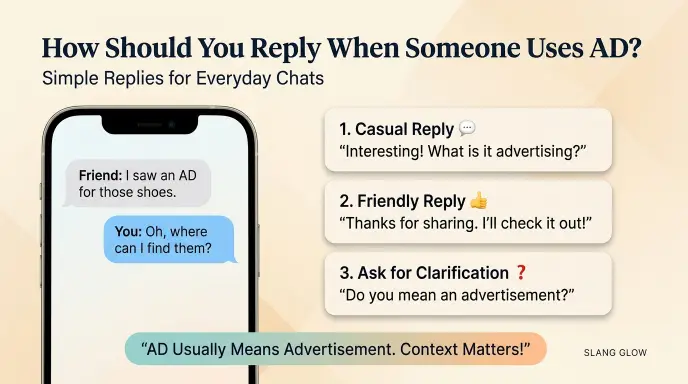
Your response depends on what the sender means by AD. If they are talking about an advertisement, you can respond to the product, video, or promotion they mentioned. If the abbreviation appears in a different context, you may need to ask for clarification.
Here are four natural ways to respond:
- Casual reply: “Oh, I saw that ad too!”
- Friendly reply: “That product looks interesting.”
- Neutral reply: “Where did you see the ad?”
- Clarifying reply: “What do you mean by AD here?”
Example 1: Discussing an Advertisement
Emma: “I saw an AD for a new movie.”
Sophie: “Really? Was the trailer interesting?”
Meaning: Sophie responds to Emma’s mention of a movie advertisement.
Example 2: Talking About a Product
Noah: “This phone keeps appearing in ads.”
Liam: “Maybe the company is promoting its new model.”
Meaning: Liam recognizes that Noah is talking about advertisements.
Example 3: Understanding an Unfamiliar Message
Mia: “Someone wrote AD in our group chat.”
Olivia: “What were you talking about?”
Meaning: Olivia asks for context because AD can have different meanings.
You do not need to use abbreviations to reply naturally. A clear response is usually enough to keep the conversation going.
Is AD Rude or Offensive in Text?
AD is not generally rude or offensive when it means advertisement. It is a common abbreviation used in conversations about products, services, promotions, and marketing.
However, the tone of a message depends on the complete sentence rather than the abbreviation alone.
Keep these three points in mind:
- Ordinary use: Referring to an advertisement is generally neutral.
- Promotional messages: An ad may be unwanted or annoying, but the word itself is not an insult.
- Context matters: If AD has a different meaning in a particular conversation, its tone may depend on that use.
Is AD Appropriate at School or Work?
Yes. AD is commonly used in informal messages, marketing discussions, and conversations about promotional material.
In formal writing, spelling out “advertisement” may be clearer, particularly if the audience is unfamiliar with the abbreviation. In historical writing, use the appropriate form, such as A.D., when referring to the traditional dating convention.
Choose wording that suits your audience. Clear language can prevent misunderstandings in assignments, professional emails, and workplace conversations.
Who Uses the Abbreviation AD?
People use AD in many settings because advertisements are a normal part of digital life. The abbreviation is not limited to one age group or social media platform.
You may encounter it in these situations:
- Social media users: People may call promotional videos or sponsored content ads.
- Students and everyday texters: They may use AD when discussing a commercial, product promotion, or historical date.
- Business professionals: Marketing teams may use ad as shorthand when talking about campaigns and promotional content.
Is AD a Gen Z Texting Term?
AD is not exclusive to Gen Z. The word “ad” is a long established shortening of “advertisement,” and people of different ages use it.
Younger users may encounter the abbreviation in social media videos and online promotions, while adults may use it in everyday conversations or professional settings.
The topic of the message matters more than the sender’s age. If the conversation is about a product or promotional video, advertisement is a likely meaning.
Where Did the Abbreviation AD Come From?
The lowercase word “ad” is a shortened form of “advertisement.” People use this shorter form because it is convenient in conversation and writing.
The uppercase form A.D. has a separate historical use. It comes from the Latin phrase Anno Domini, traditionally used when dating years in the Christian calendar.
Three points explain these uses:
- Advertisement: “Ad” developed as a short form of “advertisement.”
- Historical dates: A.D. is a traditional dating abbreviation derived from Latin.
- Modern communication: People often write “ad” when discussing marketing and promotional content online.
Did AD Originate as Internet Slang?
No, the abbreviation did not originate as a modern texting trend. The shortened word “ad” existed before social media and messaging apps became popular.
Online communication simply provides another place where people use it. The historical abbreviation A.D. also has a different background and should not automatically be interpreted as advertising.
The surrounding words help distinguish these meanings. A sentence about a product usually points to an advertisement, while a historical date points to the traditional calendar abbreviation.
AD vs. Other Common Texting Abbreviations
AD differs from everyday texting abbreviations because it generally refers to an advertisement or another context specific term rather than a common conversational response.
| Term | Meaning | Type | Typical Usage | Popularity |
| AD | Advertisement | Abbreviation | Talking about promotions | Common |
| IDK | I don’t know | Texting abbreviation | Expressing uncertainty | Widely recognized |
| IDC | I don’t care | Texting abbreviation | Expressing a lack of concern | Widely recognized |
| IMO | In my opinion | Texting abbreviation | Sharing an opinion | Widely recognized |
| BRB | Be right back | Texting abbreviation | Saying someone will return shortly | Widely recognized |
These terms serve different purposes:
- AD refers to promotional content in many everyday conversations.
- IDK and IDC express a response or attitude.
- IMO and BRB help communicate an opinion or a temporary absence.
For example, “I saw an AD for those shoes” refers to an advertisement. In contrast, “IDK which shoes to buy” expresses uncertainty.
These abbreviations are not interchangeable. Understanding what each one communicates helps you interpret messages correctly.
A Real World Example of AD in Text
Imagine that two friends are chatting about a new movie. One of them has seen a promotional video online and wants to tell the other about it.
Emma: “I saw an AD for a new movie yesterday.”
Sophie: “Was it a full trailer?”
Emma: “Yes, it showed some of the main characters.”
Sophie: “I’ll look for it later.”
In this conversation, AD means advertisement. The movie promotion provides enough context to understand the abbreviation.
Now imagine that two students are studying history and read a date containing A.D. In that situation, the abbreviation has a historical meaning rather than referring to a promotion.
The same letters can appear in different contexts, so read the complete sentence before deciding what they mean.
Frequently Asked Questions About AD
What does AD mean in text messages?
AD usually means advertisement when people discuss promotions, products, or videos. In another context, it may have a different meaning.
What does AD mean on TikTok?
AD commonly refers to an advertisement or promotional content. The exact meaning depends on the video, caption, or comment.
Is AD considered slang?
“Ad” is an informal shortening of “advertisement.” It is an abbreviation rather than a secret texting code.
Is AD rude or offensive?
No, the abbreviation is not generally rude or offensive when used to mean advertisement. The tone depends on the complete message.
How should you reply when someone uses AD?
Respond to the advertisement they mention, or ask what they mean if the context is unclear.
Does AD always mean advertisement?
No. AD can have other meanings in historical, technical, and specialized contexts. Read the surrounding words to identify the intended meaning.
Final Takeaway
AD most commonly means “advertisement” in everyday digital conversations. People use it when talking about promotional videos, products, services, and marketing content.
However, the abbreviation has other meanings in historical and specialized contexts. It is not a universal texting code, so the subject of the conversation is the best clue.
When the meaning is unclear, read the full message or ask the sender for clarification. This simple step helps you understand the message without making unnecessary assumptions.
LEARN MORE!

Hi, I’m James Parker, a writer passionate about modern slang, internet culture, and social media language. I enjoy researching trending words and explaining their meanings in simple, easy to understand English. My goal is to help readers confidently understand and use slang in everyday conversations, texting, and online platforms.