ADK in text may mean “ain’t doing nothing” in some online slang discussions, referring to someone who is not doing anything at the moment. However, ADK is not a widely standardized texting abbreviation, so its meaning can vary between conversations and online communities.
You may encounter ADK in messages, group chats, social media comments, or conversations with friends. Because the abbreviation is less familiar than LOL or BRB, you may need to look at the surrounding words to understand what someone means.
Some online sources associate ADK with being inactive or relaxing, while other sources list different meanings. A small 2025 study of digital slang among Malaysian adolescents also mentions ADK with the meaning “I don’t know,” showing that usage can vary by community.
The most important thing to remember is that ADK does not have one universally accepted meaning in texting. The sentence, conversation topic, and shared understanding between the people messaging can help you interpret it correctly.
What Does ADK Mean in Text Messages?
In some informal online conversations, ADK is used to mean “ain’t doing nothing,” or not doing anything at the moment. This interpretation appears in some online slang references, but it is not a standard abbreviation used by everyone.For example, if someone asks, “What are you doing today?” and the other person replies with ADK, they might mean they have no particular plans.
However, do not assume that this interpretation fits every message. The person may be using a personal abbreviation, a community specific term, or a different meaning entirely.
Here are three important points to remember:
- Possible slang meaning: ADK may mean “ain’t doing nothing” in some casual chats.
- Not universally recognized: Many people may not know this abbreviation or may use it differently.
- Context matters: The surrounding words help you decide what the sender probably intends.
For example:
Emma: “Hey, what are you doing this afternoon?”
Sophie: “ADK, just chilling.”
Possible meaning: Sophie is saying that she has nothing particular planned and is relaxing.
Because ADK is uncommon, the clearest way to understand it is to consider the entire conversation. If the message still seems confusing, asking the sender what they mean is better than guessing.
What Does ADK Stand for in Online Slang?
ADK is an initialism made from three letters, but it does not have one fixed full form in online communication. Some online slang references associate it with “ain’t doing nothing,” while other communities may assign different meanings to the same letters.
The reported meanings should be treated carefully because online abbreviations are not always consistent. A phrase listed on one website may be unfamiliar to people in another community.
Here are three possibilities to keep in mind:
- “Ain’t doing nothing”: A reported informal interpretation referring to having nothing to do.
- Community specific shorthand: A group of friends may use ADK for a phrase or inside joke that outsiders do not recognize.
- Another intended abbreviation: The sender may have typed ADK when they meant a different abbreviation, so the surrounding sentence is important.
For example, consider this conversation:
Alex: “What’s up? What are you doing?”
Jordan: “Nothing much, just relaxing.”
Meaning: Jordan is saying that there is nothing particular happening. If ADK appeared in this exchange, the conversation might support an interpretation related to having nothing to do.
However, this example illustrates the possible meaning rather than establishing that everyone uses ADK that way.
Do not treat ADK as a confirmed synonym for every other texting abbreviation. If someone uses it in an unfamiliar way, asking for clarification can prevent misunderstandings.
Where Do People Use ADK?
ADK may appear in informal digital communication, but there is not enough reliable evidence to say that it is widely used on every major social media platform. Its use can depend on the particular community, the people involved, and the meaning they have in mind.
You might encounter an unfamiliar abbreviation like ADK in these situations:
- Private messages: Friends may use shorthand that they understand from previous conversations.
- Group chats: A small group may use a personal abbreviation or inside joke.
- Social media comments: Users may encounter unfamiliar abbreviations in posts and discussions.
- Gaming conversations: Online communities sometimes use specialized shorthand that is familiar to their members.
- SMS messages: People may shorten phrases in casual messages, although not every abbreviation becomes widely recognized.
For example:
Mia: “Are you coming out today?”
Olivia: “Not sure. What’s everyone planning?”
Mia: “We’re just hanging out.”
The conversation is about free time and plans. If ADK appeared in a similar exchange, it might be intended as shorthand for having nothing to do, but the context alone would not prove that meaning.
The platform does not determine what ADK means. Read the full message, consider the topic, and ask the sender if the abbreviation remains unclear.
What Does ADK Mean on TikTok, Snapchat, and Instagram?
On social media, ADK does not have one clearly established meaning that applies to every post or comment. You may see it in a casual discussion, but it is important not to assume that all TikTok, Snapchat, or Instagram users understand it the same way.
Here are some ways to interpret the abbreviation when you encounter it:
- TikTok: Check the video’s topic, caption, and comments to see If ADK is being used as a community specific abbreviation.
- Snapchat: If a friend sends ADK in a private chat, consider what you were discussing before the message arrived.
- Instagram: Look at the caption or conversation around the abbreviation rather than assigning a meaning based only on the platform.
- WhatsApp: A group may use its own shorthand, especially if its members share jokes or familiar expressions.
- SMS text messages: The words before and after ADK can help you identify what the sender intends.
For example:
Noah: “What are you doing this evening?”
Liam: “Nothing planned yet.”
Meaning: Liam has no specific plans for the evening. This is the kind of conversation in which someone might intend an abbreviation related to having nothing to do, although the meaning of ADK would still need to be confirmed.
Do not assume ADK is a universal TikTok or Gen Z code. The reliable approach is to use the conversation as your guide and ask for clarification when necessary.
Real Chat Examples of ADK in Text Messages
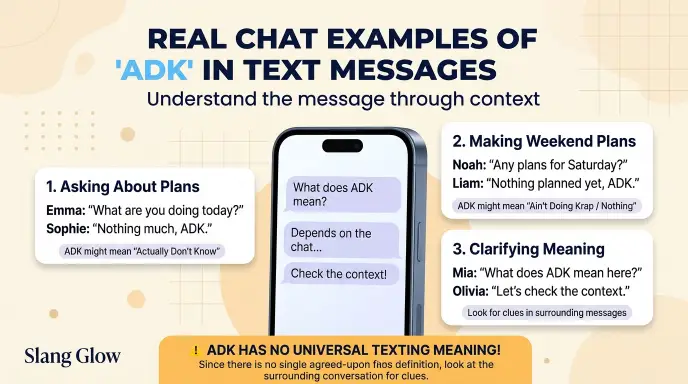
The following examples illustrate situations in which someone might encounter ADK. Since its texting meaning is not standardized, the examples involving “ain’t doing nothing” are hypothetical illustrations of that reported interpretation, not proof that all users understand the abbreviation this way.
Example 1: Asking About Someone’s Plans
Emma: “What are you doing after school?”
Sophie: “ADK, probably just relaxing.”
Possible meaning: Sophie is indicating that she has no particular plans.
Example 2: Talking About the Weekend
Noah: “Any plans for Saturday?”
Liam: “Nothing yet. I might stay home.”
Meaning: Liam has not made any plans for Saturday. If someone used ADK in this context, it might be intended to convey a similar idea.
Example 3: Checking in With a Friend
Mia: “Hey, what are you up to?”
Olivia: “Just hanging out at home.”
Meaning: Olivia is relaxing and has no specific activity planned.
Example 4: Talking in a Group Chat
Ryan: “Anyone doing anything tonight?”
Leo: “Not really. I’m free.”
Meaning: Leo has no particular plans and may be available to do something.
Example 5: Asking About Free Time
Ava: “Want to do something this afternoon?”
Ella: “Maybe! I don’t have anything planned.”
Meaning: Ella is free at the moment and is open to making plans.
These examples provide context for the idea of having nothing to do, but they should not be mistaken for evidence that ADK has a standardized meaning in every conversation.
When you see ADK in a real message, use the complete conversation to interpret it. If the sender appears to mean something different, ask them what the abbreviation stands for rather than relying on a guess.
How Should You Reply When Someone Uses ADK?
Your response depends on what the sender means by ADK. Since the abbreviation does not have one universally recognized texting meaning, it is better to understand the conversation before replying.
Here are some simple ways to respond:
- Casual reply: “Not much, just relaxing.”
- Friendly reply: “What are you up to?”
- Funny reply: “Same here, just chilling!”
- Clarifying reply: “What does ADK mean?”
Example 1: Talking About Free Time
Emma: “What are you doing today?”
Sophie: “Nothing much, just relaxing.”
Meaning: Sophie explains that she does not have anything particular planned. If someone uses ADK in this situation, they might intend a similar meaning, but it is worth confirming.
Example 2: Asking About an Unfamiliar Abbreviation
Noah: “Hey, what does ADK mean?”
Liam: “I’m not sure. Where did you see it?”
Meaning: Liam asks for context instead of guessing what the letters stand for.
Example 3: Chatting With a Friend
Mia: “Are you busy right now?”
Olivia: “Nope, what’s up?”
Meaning: Olivia is available to talk. This illustrates the kind of conversation where an abbreviation about having nothing to do might appear.
The best reply is one that fits the conversation. You do not need to use ADK yourself if the meaning is unclear.
Is ADK Rude or Offensive in Text?
ADK is not inherently rude or offensive, but its tone depends on how someone uses it. Because the abbreviation has different possible meanings, it is difficult to judge a message from those three letters alone.
Here are three things to consider:
- Neutral use: Someone may use ADK as shorthand in a casual conversation.
- Unclear meaning: A recipient may misunderstand the abbreviation if they are unfamiliar with it.
- Context matters: The complete sentence helps reveal If the sender is being friendly, serious, or sarcastic.
Is ADK Appropriate at School or Work?
ADK may be understandable between friends who share the same abbreviation, but it is better to use clear wording in school assignments, professional emails, and formal conversations.
For example, instead of sending an unfamiliar abbreviation, you could write, “I’m not doing anything right now,” if that is what you intend to say.
Clear language reduces confusion, especially when you are communicating with people who may not know your shorthand.
Who Uses the Abbreviation ADK?
ADK may appear in informal messages, but there is not enough reliable evidence to say that it is widely used by a particular age group or on every social media platform.
You may encounter unfamiliar abbreviations such as ADK in these situations:
- Private messages: Friends may use shorthand that makes sense within their conversations.
- Group chats: Members may develop their own expressions or inside jokes.
- Online communities: Some groups use abbreviations that are unfamiliar to people outside their community.
Is ADK a Gen Z Texting Term?
ADK should not automatically be described as a standard Gen Z expression. Its meaning and popularity can vary by community, and the available evidence does not establish that all young people use it in the same way.
Some online references associate ADK with “ain’t doing nothing,” while others list different interpretations. It is therefore safer to explain the uncertainty instead of presenting one meaning as universally accepted.
The surrounding conversation is more useful than assuming the sender’s age determines the meaning.
Where Did ADK Come From?
The exact origin of ADK as an informal texting abbreviation is unclear. There is no well established account identifying one person, platform, or moment when this particular usage began.
Internet abbreviations often develop within small groups before appearing elsewhere. Some stay limited to a particular community, while others become widely understood.
Three points help explain why the origin is difficult to establish:
- Informal communication: People sometimes shorten phrases when messaging friends.
- Community differences: The same letters may have different meanings in different groups.
- Changing online language: New abbreviations appear, and some disappear without developing a widely recognized definition.
Does ADK Have One Confirmed Full Form?
No single full form can be confidently presented as the universal meaning of ADK in text messages.
Some online references list “ain’t doing nothing,” but that interpretation is not a standardized definition recognized by everyone. Other meanings may be local, personal, or specific to a particular conversation.
Avoid treating an uncertain online definition as a proven origin. If a sender uses ADK, their own explanation is the clearest way to establish what they meant.
ADK vs. Other Common Texting Abbreviations
ADK differs from familiar texting abbreviations because its meaning is less standardized. The following table compares it with commonly recognized terms.
| Term | Meaning | Type | Typical usage |
| ADK | Possible informal meanings vary | Context dependent abbreviation | Depends on the sender |
| IDK | I don’t know | Texting abbreviation | Expressing uncertainty |
| IDC | I don’t care | Texting abbreviation | Expressing a lack of concern |
| IMO | In my opinion | Texting abbreviation | Sharing a personal opinion |
| BRB | Be right back | Texting abbreviation | Saying someone will return shortly |
These abbreviations serve different purposes:
- IDK has a widely recognized meaning: “I don’t know.”
- IDC communicates a lack of concern: The intended tone still depends on context.
- ADK is less standardized: You may need more information before interpreting it correctly.
For example, “IDK what to do” clearly expresses uncertainty. If someone simply sends “ADK,” the meaning is less clear without the rest of the conversation.
Do not treat ADK as interchangeable with IDK or other familiar abbreviations. Check the context before deciding what the sender intended.
A Real World Example of ADK in a Conversation
Imagine two friends are messaging after school and making plans for the afternoon.
Emma: “What are you doing later?”
Sophie: “Nothing much. Why?”
Emma: “Want to watch a movie?”
Sophie: “Sure, that sounds fun!”
In this conversation, Sophie explains that she has no particular plans. If someone used ADK in a similar exchange, they might intend to communicate that idea, but the abbreviation itself would need clarification.
Now consider another situation:
Noah: “Someone sent me ADK. Do you know what it means?”
Liam: “I’m not sure. Ask them what they meant.”
The second conversation shows why context matters. Without knowing how the sender uses the abbreviation, it is not possible to identify its meaning with confidence.
When interpreting unfamiliar slang, it is better to ask a simple question than to make an assumption that changes the meaning of the conversation.
Frequently Asked Questions About ADK
Q.1. What does ADK mean in text messages?
ADK has several reported interpretations. Some online sources use it to mean “ain’t doing nothing,” but this is not a universally recognized texting definition.
Q.2. What does ADK mean on TikTok?
ADK does not have one established meaning across TikTok. Check the video, caption, and surrounding comments to understand how it is being used.
Q.3. Is ADK considered slang?
ADK may be used as informal, community specific shorthand. Its meaning can vary, so not everyone will recognize it.
Q.4. Is ADK rude or offensive?
ADK is not inherently offensive. Its tone depends on the meaning intended by the sender and the surrounding message.
Q.5. How should you reply when someone texts ADK?
If you do not understand it, ask, “What do you mean by ADK?” This helps you avoid guessing incorrectly.
Q.6. Does ADK always mean “ain’t doing nothing”?
No. ADK does not have one confirmed, universal meaning in texting. Other interpretations may exist in different communities.
Final Takeaway
ADK is an uncommon texting abbreviation whose meaning depends on context. Some online sources associate it with “ain’t doing nothing,” but that interpretation is not universally recognized.
You may encounter it in private messages or online discussions where people use informal shorthand. Its meaning should not be assumed simply because it appears in a text message.
Read the full conversation and ask for clarification when necessary. This is the most reliable way to understand an unfamiliar abbreviation without spreading an uncertain definition.
FIND MORE!

Hi, I’m James Parker, a writer passionate about modern slang, internet culture, and social media language. I enjoy researching trending words and explaining their meanings in simple, easy to understand English. My goal is to help readers confidently understand and use slang in everyday conversations, texting, and online platforms.