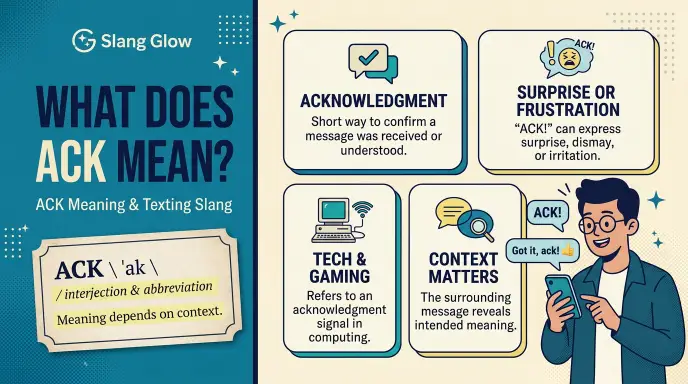
ACK in text usually means “acknowledged,” which tells someone that you received or understood their message. People may use it in online chats, text messages, emails, and work conversations when they want to confirm information quickly. However, “ack!” can also express surprise, frustration, or mild disgust.
You may see ACK in private messages, gaming chats, online discussions, or conversations about plans. Because the term is less familiar than abbreviations such as LOL and BRB, its meaning may not be immediately clear to everyone.
In some conversations, ACK works like saying “Got it” or “Understood.” In other situations, someone may write “Ack!” as an emotional reaction to something unexpected or annoying. These uses have different meanings, so the surrounding words matter.
This guide explains what ACK means in text messages, how people use it on social media, and how to respond when someone sends it to you.
What Does ACK Mean in Text Messages?
In everyday digital communication, ACK most commonly means “acknowledged” or “acknowledge.” It confirms that someone has received a message, noticed information, or understood an instruction. It is particularly useful when a short confirmation is enough.
For example, if your friend texts, “Meet me outside the library at 3 PM,” you could reply, “ACK,” to show that you received the information.
According to common online slang references, ACK can also express dismay, surprise, or mild alarm when written as an exclamation. 【turn875009search0】【turn875009search1】
Here are three important points to remember:
- Message received: ACK can tell the sender that their message reached you.
- Information understood: It can confirm that you understand an instruction or update.
- Emotional reaction: “Ack!” may express surprise, frustration, or disgust rather than acknowledgment.
For example, imagine a classmate sends you the updated meeting time for a school project. Replying “ACK” may mean that you have noted the new information.
However, ACK is not as universally recognized as “OK” or “Got it.” If the other person does not know the abbreviation, a complete response may be clearer.
The key is to understand If ACK confirms information or expresses a reaction. The sentence and situation usually provide the best clues.
What Does ACK Stand for in Online Chats?
ACK is an abbreviation associated with acknowledgment, meaning the act of confirming that information has been received or understood. It is not always used as a modern texting slang expression; it also has a long history in computing and other forms of digital communication.
In ordinary chats, the abbreviation may be used to keep a conversation brief. In technical settings, ACK can refer to an acknowledgment signal that confirms receipt of data.
Consider these common uses:
- Acknowledgment: Someone confirms that they received an update.
- Agreement or understanding: A person signals that they understand what was explained, although ACK does not necessarily mean they agree.
- Emotional exclamation: “Ack!” can express surprise, dismay, or irritation.
For example:
Alex: “Please bring your notebook to the group meeting tomorrow.”
Jordan: “ACK.”
Meaning: Jordan is confirming that they have received the instruction.
There is an important difference between understanding and agreement. If someone sends ACK after you explain a plan, they may simply be saying that they understand what you said. It does not automatically mean they support the plan.
ACK is best understood as a brief acknowledgment, unless the conversation clearly shows that it is being used as an emotional reaction.
Where Do People Use ACK in Messages?
ACK can appear in different forms of digital communication, including text messages, emails, work chats, and online communities. Its meaning generally depends on If the sender is confirming information or reacting to something.
Here are some situations where you might encounter it:
- Text messages: A person may reply with ACK after receiving an update or instruction.
- Email and work chats: Someone may use it to confirm that they have seen a message or task assignment.
- Gaming conversations: Players may use ACK to acknowledge a teammate’s instruction or confirm a plan.
- Online discussions: Someone may write “Ack!” to express frustration, surprise, or mild disgust.
- Technical communication: ACK can refer to a signal confirming that data has been received.
For example, a team member might write, “The meeting has moved to Friday.” A colleague could reply, “ACK,” to confirm that they have noted the change.
On the other hand, someone who sees an unexpected result might write, “Ack! I wasn’t expecting that.”
The platform does not determine the meaning on its own. Read the complete message and consider the conversation before deciding what ACK means.
What Does ACK Mean on TikTok, Snapchat, and Instagram?
On social media, ACK may appear in direct messages, comments, gaming discussions, or posts where people react to something surprising. However, it is not a universally popular slang term with one fixed meaning on every platform.
Its interpretation depends on the way it is used:
- TikTok: Someone might write “Ack!” in a comment to express surprise, frustration, or an uncomfortable reaction.
- Snapchat: A person could use ACK as a quick confirmation, although some users may not recognize it.
- Instagram: ACK may appear in a private chat when someone acknowledges information or reacts to something unexpected.
- WhatsApp: Friends or group members may use it to confirm that they have received an update.
- SMS text messages: ACK can serve as a brief acknowledgment, especially when the message does not require a detailed answer.
For example:
Mia: “The teacher moved our presentation to Monday.”
Olivia: “ACK, thanks for telling me.”
Meaning: Olivia has received and noted the update.
Now consider a different message:
Emma: “I just spilled coffee on my notes!”
Lily: “Ack! That sounds frustrating.”
Here, ACK expresses a reaction rather than a simple confirmation.
Do not assume that everyone uses ACK the same way. If the abbreviation makes a message confusing, asking the sender what they mean is a simple way to clear things up.
Real Chat Examples of ACK in Text Messages
The following conversations demonstrate how ACK may appear in everyday messaging. Some examples show acknowledgment, while others illustrate its use as an emotional exclamation.
Example 1: Confirming Plans
Alex: “Let’s meet at the library at 4 PM.”
Jordan: “ACK, see you there.”
Meaning: Jordan confirms that they have received the meeting information.
Example 2: Acknowledging an Update
Mia: “The group project deadline has changed to Thursday.”
Sophie: “ACK, thanks for letting me know.”
Meaning: Sophie has received and noted the new deadline.
Example 3: Following an Instruction
Noah: “Please send me the notes before class tomorrow.”
Liam: “ACK, I’ll send them tonight.”
Meaning: Liam acknowledges the request and says what he plans to do.
Example 4: Reacting to a Surprise
Emma: “I just found out we have a surprise quiz!”
Olivia: “Ack! I wasn’t ready for that.”
Meaning: Olivia is expressing surprise and mild frustration.
Example 5: Confirming a Group Message
Ryan: “Everyone, the meeting is now in Room 12.”
Leo: “ACK.”
Meaning: Leo is confirming that he has received the location update.
These examples show that ACK can communicate different things depending on how it appears in a message. When it follows an instruction or update, it often confirms receipt. When it appears as “Ack!” in a reaction, it may express surprise or frustration.
How Should You Reply When Someone Uses ACK?
Your response depends on If ACK means “acknowledged” or expresses a reaction such as surprise or frustration. When someone uses it to confirm a message, you can reply naturally or continue the conversation.
Here are some simple responses:
- Casual reply: “Okay, thanks!”
- Friendly reply: “Great, just let me know if you need anything.”
- Confirmation: “Perfect, see you there.”
- Clarifying reply: “Do you mean you understand, or are you surprised?”
Example 1: Confirming a Plan
Alex: “I’ll meet you outside the library at 4 PM.”
Jordan: “ACK, see you then.”
Meaning: Jordan is confirming that the message has been received and understood.
Example 2: Reacting to Unexpected News
Mia: “I just realized our assignment is due tomorrow!”
Olivia: “Ack! I thought we had another week.”
Meaning: Olivia is expressing surprise and mild frustration rather than simply acknowledging a message.
Example 3: Responding to an Instruction
Noah: “Please send me the project notes tonight.”
Liam: “ACK, I’ll send them.”
Meaning: Liam acknowledges the request and confirms what he plans to do.
You do not need to reply with ACK yourself. Words such as “Okay,” “Got it,” and “Understood” are clearer alternatives for most everyday conversations.
Is ACK Rude or Offensive in Text?
ACK is generally not rude or offensive when it means “acknowledged.” It is a brief way to confirm that someone has received information. However, because the abbreviation is not familiar to everyone, it can sometimes sound abrupt or confusing.
When written as “Ack!”, it may express disgust, dismay, surprise, or frustration. Consider these situations:
- Neutral use: “ACK, I’ll be there at 5.” This confirms a plan.
- Surprised reaction: “Ack! I forgot my notebook.” This expresses sudden frustration.
- Potentially abrupt use: Replying only “ACK” to a friendly, detailed message may seem impersonal to someone who does not recognize the abbreviation.
Is ACK Appropriate at School or Work?
ACK can be useful in technical conversations, project updates, and brief workplace messages when everyone understands its meaning.
However, “Received,” “Got it,” and “Understood” are often clearer choices when communicating with teachers, colleagues, or people unfamiliar with texting shorthand.
For example, instead of replying “ACK” to a teacher’s instructions, you could write, “Understood. I’ll complete the assignment by Thursday.”
The abbreviation itself is not disrespectful, but clarity and tone matter. Use a full response when the situation calls for a polite or professional answer.
Who Uses ACK in Messages?
ACK appears in several forms of digital communication, including online chats, technical discussions, emails, and text messages. It is not limited to a particular age group or social media platform.
People may use it in different situations:
- Everyday texters: Some people use ACK to confirm information quickly.
- Gaming and online communities: It can acknowledge instructions or show that a message has been noticed.
- Work and technical discussions: People may use it to indicate that they have received a request or update.
The abbreviation may be more familiar to people who regularly use online shorthand or technical terminology. Other people may not recognize it immediately.
Is ACK a Gen Z Texting Term?
ACK is not exclusive to Gen Z. It has been used in computer and internet communication for decades, although its familiarity varies between communities.
Unlike some newer social media expressions, ACK has an established technical meaning related to acknowledgment. It can also be used as an emotional exclamation in informal writing.
Someone’s age does not determine how they use ACK. The conversation and the person’s communication habits provide better clues.
Where Did ACK Come From?
ACK has a longer history than modern texting apps. It is associated with the word “acknowledge” and has been used in computing to indicate that information has been received.
In computer communication, an acknowledgment can confirm receipt of data. The short form ACK is also associated with a character in the ASCII character set used in computer systems.
The exclamation “ack!” has a separate history in informal English. It is used to express feelings such as surprise or disgust, and its use has also appeared in comic and internet culture.
Three points explain its development:
- Technical acknowledgment: ACK became a short form associated with confirming receipt or understanding.
- Online communication: The abbreviation was useful in messages where a quick acknowledgment was enough.
- Emotional expression: “Ack!” can also function as an interjection that expresses surprise, dismay, or frustration.
Why Do People Write “Ack!” Instead of “ACK”?
Capitalization and punctuation can provide a clue, although they do not guarantee the intended meaning.
- ACK: Often used as a short acknowledgment, especially in technical or concise communication.
- Ack!: Often used as an emotional reaction.
- ACK? May be used informally to check If someone is present or responding.
These are common patterns, not strict rules. A person’s writing style and the surrounding message may change how the abbreviation should be interpreted.
ACK vs. Other Common Texting Abbreviations
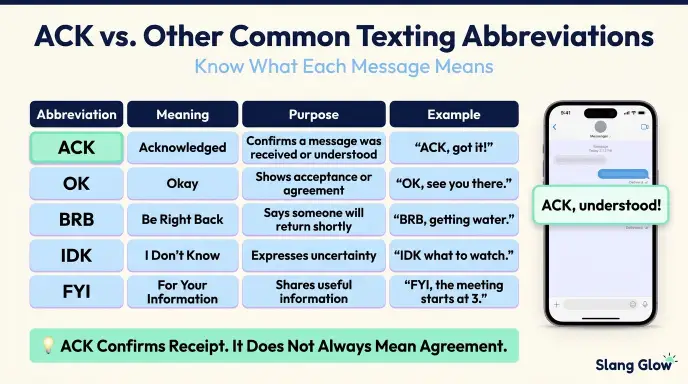
ACK is different from abbreviations such as LOL and BRB because its main purpose is often to confirm receipt or understanding rather than describe laughter or a temporary absence.
| Term | Meaning | Main use |
| ACK | Acknowledged | Confirms receipt or understanding |
| OK | Okay | Shows acceptance or agreement |
| BRB | Be right back | Says someone will return shortly |
| IDK | I don’t know | Expresses uncertainty |
| LOL | Laughing out loud | Expresses amusement or laughter |
| FYI | For your information | Introduces useful information |
These terms have different purposes:
- ACK confirms that information has been received or understood.
- OK can communicate acceptance or agreement.
- BRB tells someone that the sender will return shortly.
For example, if someone gives you a meeting time, ACK can confirm that you have noted it. If you want to express agreement with a suggestion, “OK” may sound more natural.
Do not assume that ACK always means agreement. Someone can acknowledge your message without agreeing with what it says.
A Real World Example of ACK in Text
Imagine that a group of students is arranging a meeting for a school project. One student sends an update in the group chat.
Emma: “Our meeting is moved to Friday at 3 PM.”
Lily: “ACK, thanks for the update.”
Noah: “Got it. I’ll be there.”
Emma: “Great!”
In this conversation, Lily uses ACK to confirm that she has received the new information. Noah expresses the same general idea in more familiar words.
Now consider a different situation:
Mia: “I just found out the presentation is tomorrow!”
Olivia: “Ack! I thought it was next week.”
Here, Olivia is expressing surprise and frustration.
Both conversations can be understood correctly because the context shows what ACK is doing. In the first, it confirms information. In the second, it expresses a reaction.
Frequently Asked Questions About ACK
What does ACK mean in text messages?
ACK usually means “acknowledged” or confirms that a message has been received or understood. It can also express surprise, dismay, or frustration when written as an exclamation.
What does ACK mean on social media?
ACK may be used to confirm a message or react to something unexpected. The exact meaning depends on the post, conversation, and community using it.
Is ACK considered slang?
ACK is an abbreviation used in digital and technical communication. Its emotional exclamation form is also used informally in online conversations.
Is ACK rude or offensive?
ACK is generally neutral when used as an acknowledgment. However, it may sound abrupt or confusing to someone unfamiliar with the abbreviation.
How should you reply when someone texts ACK?
You can respond with “Okay,” “Thanks for confirming,” or “Got it.” If the meaning is unclear, ask the sender what they mean.
Does ACK mean agreement?
Not necessarily. ACK usually confirms receipt or understanding, but it does not automatically mean agreement. Someone can acknowledge an instruction without agreeing with it.
Final Takeaway
ACK in text usually means “acknowledged,” confirming that someone has received or understood a message. It can also express surprise, frustration, or dismay when written as “Ack!”
You may encounter it in everyday chats, gaming conversations, technical discussions, and workplace messages. The abbreviation is not generally offensive, although it may seem abrupt when used without explanation.
To understand ACK correctly, look at the surrounding words and the purpose of the conversation. When you need a clearer response, “Got it,” “Understood,” or “Okay” are simple alternatives.
Learn more!

Hey, I’m Emily. I’ve spent way too many hours scrolling TikTok and group chats trying to figure out what people actually mean by half the slang flying around — and somewhere along the way that turned into a whole thing I write about now. I cover internet slang, TikTok trends, and how words shift meaning practically overnight online.