AF in text usually means “as f*,” a shortened form of a swear phrase used to emphasize something.** It means “very,” “extremely,” or “really” and often appears in text messages, TikTok comments, Instagram captions, and Snapchat chats.
For example, when someone writes “I’m tired AF,” they mean they are extremely tired. The abbreviation makes a statement sound stronger and more expressive.
You may see AF written in uppercase or lowercase. Both forms generally communicate the same meaning in casual online conversations.
Unlike abbreviations such as LOL and BRB, AF contains a reference to profanity, so it is important to understand its tone before using it in a message.
What Does AF Mean in Text Messages?
In everyday texting, AF stands for “as f*” and works as an intensifier**, meaning it makes the word before it sound stronger. It is commonly used to express strong feelings, opinions, or reactions. <Cite refs={[“turn776297search0″,”turn776297search8”]}/>
For example, “This movie is funny AF” means the movie is extremely funny.
Here are three important points to remember:
- Strong emphasis: AF makes a description sound more intense.
- Informal language: It is mainly used in casual messages and social media conversations.
- Profanity connection: Although abbreviated, it represents a swear phrase and can sound inappropriate in formal situations.
Consider this conversation:
Emma: “How was the concert?”
Sophie: “It was amazing AF!”
Meaning: Sophie means the concert was extremely amazing or enjoyable.
AF usually comes after an adjective or descriptive word. It does not normally work as a complete sentence by itself.
For example:
- Cute AF: Extremely cute.
- Cold AF: Extremely cold.
- Funny AF: Extremely funny.
The main purpose of AF is to add extra emphasis to a statement. The surrounding words explain what the person feels strongly about.
What Does AF Stand for in Online Slang?
AF is an initialism for “as f*”**, a shortened form of a profane English expression. In online slang, it works similarly to words such as “very,” “really,” and “extremely.”
People use it when they want to make a description sound stronger without writing a longer sentence.
Here are three common ways to understand it:
- Emphasis: It adds intensity to an adjective.
- Emotion: It can communicate excitement, frustration, happiness, or tiredness.
- Casual expression: It is commonly found in informal digital communication.
For example:
Alex: “I’m hungry AF.”
Jordan: “Same! I haven’t eaten in hours.”
Meaning: Alex is saying that they are extremely hungry.
It is important to understand that AF is not the same as AFK. AFK means “away from keyboard,” while AF is generally an intensifier in texting. <Cite refs={[“turn776297search11″,”turn776297search12”]}/>
Do not confuse these two abbreviations. Just one additional letter changes the meaning completely.
Where Do People Use AF in Text Messages?
People use AF across different forms of digital communication when they want to emphasize a feeling or description. It is particularly common in casual conversations rather than formal writing.
Here are some places where you may encounter it:
- Text messages: Friends may use AF to describe feelings, experiences, or opinions.
- Snapchat: Someone might write “I’m bored AF” in a private message.
- Instagram: Users may include AF in captions or comments to add emphasis.
- TikTok: The abbreviation may appear in video captions, comments, and reactions.
- WhatsApp: Friends may use it when chatting informally.
For example:
Mia: “That sunset looks beautiful AF.”
Olivia: “I know! The colors are amazing.”
Meaning: Mia is emphasizing how beautiful the sunset looks.
Remember that the abbreviation represents profanity even when the full phrase is not written. It is better suited to casual conversations than formal communication.
What Does AF Mean on TikTok, Snapchat, and Instagram?
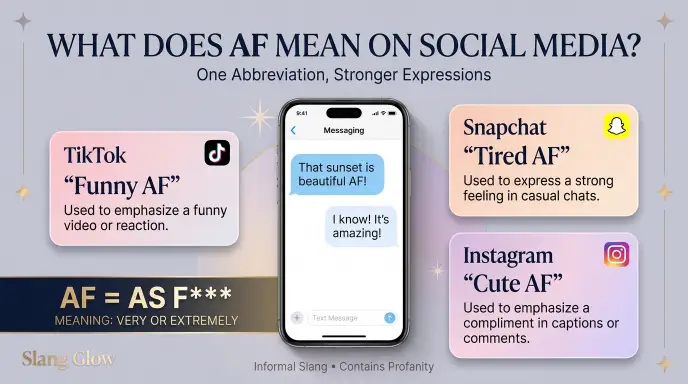
On social media, AF usually has the same meaning: it emphasizes the word or description that comes before it. The platform does not give it a completely different definition.
Here are some common examples:
- TikTok: Someone may comment “Funny AF” when reacting to an entertaining video.
- Snapchat: A friend might write “I’m tired AF” in a private conversation.
- Instagram: Someone may use “Cute AF” in a caption or comment.
- WhatsApp: Friends may use AF to emphasize their feelings.
- SMS messages: The abbreviation may appear in casual messages between people who understand its meaning.
For example:
Noah: “Did you enjoy the movie?”
Liam: “Yes! It was interesting AF.”
Meaning: Liam is saying that the movie was extremely interesting.
AF can make a message sound playful, excited, or dramatic. However, its tone depends on the word it modifies and the situation.
Although AF is common in informal online conversations, it is not suitable for every audience. Some readers may find its connection to profanity inappropriate.
Real Chat Examples of AF in Text Messages
The following conversations show how people use AF to express strong feelings and descriptions. Each example includes a simple explanation so beginners can understand the intended meaning.
Example 1: Talking About Being Tired
Emma: “How was your day?”
Sophie: “I’m tired AF today.”
Meaning: Sophie is saying that she feels extremely tired.
Example 2: Describing Something Funny
Noah: “Did you watch that comedy video?”
Liam: “Yes! It was funny AF.”
Meaning: Liam found the video extremely funny.
Example 3: Complimenting Something
Mia: “What do you think of my new shoes?”
Olivia: “They’re stylish AF!”
Meaning: Olivia thinks the shoes are extremely stylish.
Example 4: Talking About the Weather
Ryan: “Is it cold outside?”
Leo: “Cold AF. Take a jacket!”
Meaning: Leo is saying that the weather is extremely cold.
Example 5: Sharing Excitement
Ava: “Are you excited about the trip?”
Ella: “Excited AF! I can’t wait.”
Meaning: Ella is expressing a very high level of excitement.
These examples show that AF strengthens the description before it. It can communicate positive or negative feelings, depending on the sentence.
More Real Chat Examples of AF in Text Messages
AF can appear in many kinds of casual conversations. People use it to make descriptions stronger and express their feelings more clearly.
Here are five additional examples:
Example 6: Talking About Food
Emma: “This pizza is delicious AF!”
Sophie: “I know! It’s so good.”
Meaning: Emma thinks the pizza is extremely delicious.
Example 7: Expressing Frustration
Noah: “This traffic is annoying AF.”
Liam: “Yeah, we’ve been waiting forever.”
Meaning: Noah is saying that the traffic is extremely annoying.
Example 8: Complimenting a Picture
Mia: “Did you see her new pictures?”
Olivia: “Yes, they look amazing AF!”
Meaning: Olivia thinks the pictures look extremely amazing.
Example 9: Talking About Schoolwork
Ryan: “That assignment was difficult AF.”
Leo: “I struggled with it too.”
Meaning: Ryan found the assignment extremely difficult.
Example 10: Expressing Happiness
Ava: “I’m happy AF about the good news!”
Ella: “That’s wonderful! Congratulations!”
Meaning: Ava is expressing a very high level of happiness.
The main purpose of AF is to add emphasis. It can make a message sound more excited, frustrated, positive, or dramatic depending on the words around it.
How Should You Reply When Someone Uses AF?
Your response depends on what the person is describing. Since AF makes a statement stronger, you can respond to the feeling or opinion behind the message.
Here are some natural ways to reply:
- Casual reply: “I know, right?”
- Friendly reply: “That’s awesome!”
- Funny reply: “You’re definitely making a big statement!”
- Neutral reply: “Really? What happened?”
Example 1: Someone Says They’re Tired AF
Emma: “I’m tired AF today.”
Sophie: “You should get some rest.”
Meaning: Sophie understands that Emma feels extremely tired.
Example 2: Someone Says Something Is Funny AF
Noah: “That video was funny AF.”
Liam: “I couldn’t stop laughing!”
Meaning: Liam agrees that the video was extremely funny.
Example 3: Someone Uses AF as a Compliment
Mia: “Your new shoes look cool AF.”
Olivia: “Thank you! Glad you like them.”
Meaning: Olivia responds positively to Mia’s enthusiastic compliment.
You do not need to use profanity in your reply just because someone else uses AF. You can respond naturally with ordinary words.
Is AF Rude or Offensive in Text?
AF is considered informal and mildly vulgar because it represents a phrase containing the f word. Although many people use it casually online, others may consider it inappropriate or disrespectful.
Its tone depends on the conversation, the audience, and the relationship between the people messaging.
Here are three important points:
- Casual conversations: Friends may use AF to express strong feelings or reactions.
- Formal communication: The abbreviation is generally unsuitable for professional emails, official messages, or school assignments.
- Audience matters: Some people are comfortable with casual profanity, while others prefer polite language.
Is AF Appropriate at School or Work?
It is generally better to avoid AF in formal settings because it represents profanity, even when the full phrase is not written.
For example, instead of writing:
“I’m tired AF.”
You could write:
“I’m extremely tired today.”
Using alternatives such as “very,” “really,” or “extremely” makes your message more appropriate for different audiences.
The important thing is to understand the tone before using the abbreviation. What sounds normal between close friends may not be suitable in a classroom or workplace.
Who Uses AF in Text Messages?
AF appears in informal digital communication among people who use casual internet language. It is not limited to one generation, although familiarity with it can vary between individuals and communities.
You may encounter it in these situations:
- Friends: People use AF to make everyday descriptions more expressive.
- Social media users: It appears in captions, comments, reactions, and casual posts.
- Online communities: People may use it when sharing opinions, emotions, or humorous reactions.
Is AF a Gen Z Texting Term?
AF is not exclusive to Gen Z. It has been used in informal internet communication for years and is familiar to people from different age groups.
Younger social media users may encounter it in captions and comments, while other users may use it in ordinary messages.
AF is an informal internet abbreviation, not a term belonging to only one generation.
Where Did AF Come From?
AF developed as a shortened written form of the expression “as f***.” It became recognizable in informal digital communication because people often use short expressions to make their messages quicker and more expressive.
The full phrase existed in spoken English before modern social media. The exact date when AF became widely used online is difficult to establish.
Three points help explain its development:
- Shortened expression: AF uses the first letters of the words in the phrase.
- Online communication: Text messages and social media made short expressions convenient for casual conversations.
- Expressive language: People adopted it to emphasize descriptions, opinions, and feelings.
Why Do People Write AF Instead of the Full Phrase?
People often prefer abbreviations because they are quicker to type and familiar to other users.
For example, writing “funny AF” is shorter than writing the complete profane expression.
AF allows people to communicate strong emphasis without spelling out the full phrase. However, readers can still understand that it represents profanity.
AF vs. Other Common Texting Abbreviations
AF is different from common texting abbreviations because it works as an intensifier rather than communicating a complete response.
| Term | Meaning | Type | Typical Usage |
| AF | As f*** | Profane intensifier | Adding strong emphasis |
| IDK | I don’t know | Abbreviation | Expressing uncertainty |
| IDC | I don’t care | Abbreviation | Expressing a lack of concern |
| IMO | In my opinion | Abbreviation | Sharing an opinion |
| BRB | Be right back | Abbreviation | Saying someone will return |
These terms have different purposes:
- AF adds intensity to a description or statement.
- IDK and IDC communicate a person’s response or attitude.
- IMO and BRB help express an opinion or explain temporary absence.
For example, “I’m hungry AF” means someone is extremely hungry, while “IDK what to eat” means the person is unsure.
Do not confuse AF with AFK. AFK stands for “away from keyboard” and has a completely different meaning.
A Real World Example of AF in a Conversation
Imagine two friends are discussing a new movie they watched over the weekend.
Emma: “Did you enjoy the movie?”
Sophie: “Yes! It was funny AF.”
Emma: “I agree. The comedy scenes were amazing.”
Sophie: “I want to watch it again!”
In this conversation, Sophie uses AF to emphasize how much she enjoyed the movie.
Now consider another situation:
Noah: “This homework is difficult AF.”
Liam: “Same. Some questions are really confusing.”
Here, AF emphasizes frustration about the difficulty of the homework.
Both conversations demonstrate that AF makes the description stronger. The word before it helps readers understand if the person is expressing excitement, frustration, or another feeling.
Frequently Asked Questions About AF
Q.1. What does AF mean in text messages?
AF usually stands for “as f*.”** It is used to mean “very” or “extremely” and adds emphasis to a statement.
Q.2. What does AF mean on TikTok?
On TikTok, AF usually adds emphasis to a description or reaction. For example, “funny AF” means extremely funny.
Q.3. Is AF considered slang?
Yes. AF is a common informal internet abbreviation used in text messages, captions, and social media comments.
Q.4. Is AF rude or offensive?
AF represents a profane expression. Some people use it casually, but others may consider it inappropriate, especially in formal situations.
Q.5. How should you reply when someone uses AF?
You can respond naturally with phrases such as “I know, right?”, “That’s true,” or “Really?” depending on the conversation.
Q.6. Does AF mean the same thing as AFK?
No. AF means “as f*,” while AFK means “away from keyboard.”** They are two different abbreviations.
Final Takeaway
AF in text usually means “as f*” and is used to make a description or feeling sound stronger.** People commonly include it in casual messages, online comments, and social media captions.
You may see phrases such as “tired AF,” “funny AF,” or “happy AF” in everyday digital conversations. Although the abbreviation is widely recognizable, it represents profanity and may not be appropriate for every audience.
Understand the tone before using it. In formal situations, words such as “very,” “really,” and “extremely” are clearer and more appropriate alternatives.
READ MORE!

Hi, I’m James Parker, a writer passionate about modern slang, internet culture, and social media language. I enjoy researching trending words and explaining their meanings in simple, easy to understand English. My goal is to help readers confidently understand and use slang in everyday conversations, texting, and online platforms.