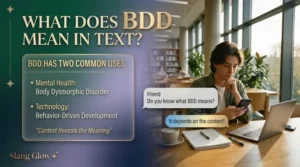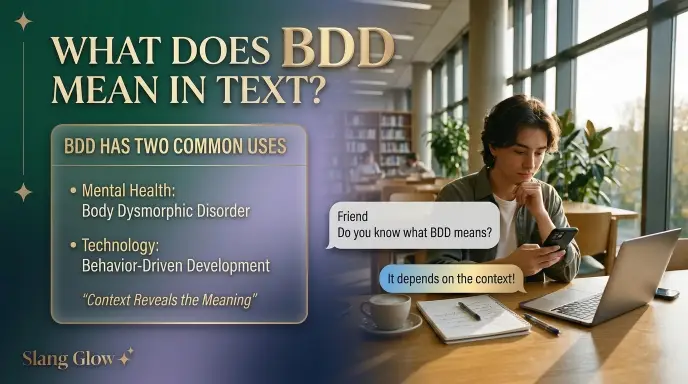
BDD in text most commonly stands for “Body Dysmorphic Disorder,” a mental health condition involving persistent worries about perceived aspects of physical appearance. You may see this abbreviation in text messages, social media discussions, health related posts, or conversations about mental health.
People often search for BDD after encountering it in an online comment or message without knowing what the three letters represent. Unlike everyday texting shortcuts such as LOL and BRB, BDD is generally a medical or psychological abbreviation rather than casual internet slang.
In technology discussions, BDD can also mean “Behavior Driven Development,” a software development approach. Therefore, the subject of the conversation is important when interpreting it.
This guide explains the common meanings of BDD, how people use it in online conversations, and how to understand the abbreviation through simple examples.
What Does BDD Mean in Text Messages?
In health related conversations, BDD stands for “Body Dysmorphic Disorder.” It refers to a mental health condition in which someone experiences significant and persistent concerns about aspects of their appearance. These concerns can cause emotional distress and affect everyday activities. <Cite refs={[“turn596391search2″,”turn596391search1”]}/>
For example, someone might write, “I read an article about BDD and mental health.” In this sentence, BDD refers to the condition rather than a casual texting expression.
Here are three important points to remember:
- Mental health term: BDD is an abbreviation for Body Dysmorphic Disorder.
- Not ordinary slang: It is generally used in health, educational, and awareness related discussions.
- Context matters: In technology conversations, the same letters can have a different meaning.
Consider this conversation:
Emma: “What does BDD mean in that mental health article?”
Sophie: “It stands for Body Dysmorphic Disorder.”
Meaning: Sophie is explaining the medical abbreviation used in the article.
It is also important not to assume that someone has BDD simply because they mention the term. They may be discussing an article, asking a vocabulary question, or sharing educational information.
Understanding the abbreviation does not mean diagnosing anyone. A medical condition can only be properly assessed by a qualified professional.
What Does BDD Stand for in Online Chats?
BDD is an initialism formed from the first letters of a longer term. Its meaning depends on the subject being discussed.
The two useful meanings to recognize are:
- Body Dysmorphic Disorder: A mental health condition involving significant concerns about perceived aspects of appearance.
- Behavior Driven Development: A software development approach in which software requirements are described through expected behavior and examples.
- Context specific abbreviation: In some groups or technical discussions, BDD may represent another specialized term.
For example:
Health related conversation
Alex: “I saw BDD mentioned in a mental health discussion.”
Jordan: “It means Body Dysmorphic Disorder.”
Meaning: The conversation is about mental health terminology.
Technology conversation
Mia: “Our development team uses BDD.”
Olivia: “Are you talking about Behavior Driven Development?”
Meaning: In this situation, BDD refers to a software development approach.
These examples show why the surrounding words matter. A health discussion and a software development discussion can use the same abbreviation for completely different subjects.
Do not automatically treat BDD as internet slang. Check the topic before deciding which meaning applies.
Where Do People Use BDD?
BDD may appear in different forms of digital communication, especially when people discuss mental health, education, or technology. The subject of the conversation usually determines its meaning.
Here are some situations where you might encounter it:
- Text messages: Someone may use BDD when discussing a mental health topic or sharing educational information.
- Snapchat: Friends might mention the abbreviation while discussing something they read or learned.
- Instagram: It may appear in educational captions, awareness posts, or discussions about psychology.
- WhatsApp: People may use BDD when sharing articles or discussing health related information.
- Technology discussions: Software developers may use BDD when talking about development methods.
For example:
Noah: “I found an interesting article explaining BDD.”
Liam: “Was it about mental health?”
Meaning: The conversation suggests that BDD refers to Body Dysmorphic Disorder, although the article’s subject confirms the interpretation.
In a technology group, however, BDD may refer to Behavior Driven Development.
The platform alone does not determine what BDD means. Read the complete sentence and consider the topic before interpreting the abbreviation.
What Does BDD Mean on TikTok, Snapchat, and Instagram?
On social media, BDD can appear in educational posts, mental health discussions, and technology related conversations. It does not have one separate, universally recognized slang meaning on every platform.
Here are some contexts where you might encounter it:
- TikTok: Someone may mention BDD in an educational video about mental health terminology.
- Snapchat: A friend might use the abbreviation while discussing an article or unfamiliar term.
- Instagram: BDD may appear in informational captions, awareness content, or psychology related discussions.
- WhatsApp: People may share information about BDD in private chats or group conversations.
- Online communities: Software related groups may use BDD to mean Behavior Driven Development.
For example:
Emma: “I saw BDD mentioned in an educational post.”
Sophie: “It was probably explaining Body Dysmorphic Disorder.”
Meaning: Sophie is identifying the likely health related meaning based on the subject of the post.
However, not every mention of BDD relates to mental health. If the post discusses software testing or programming, the intended meaning may be different.
Avoid assuming that someone has a particular condition just because they mention BDD. They may simply be discussing the term or sharing educational information.
Real Chat Examples of BDD in Text Messages
These examples show how BDD may appear in conversations about mental health terminology and technology. They are simple, non graphic examples that help explain the different meanings.
Example 1: Asking About an Unfamiliar Term
Emma: “What does BDD stand for?”
Sophie: “In a mental health context, it means Body Dysmorphic Disorder.”
Meaning: Sophie explains the health related abbreviation.
Example 2: Sharing an Educational Article
Noah: “I read an article about BDD today.”
Liam: “What was it about?”
Meaning: Noah is referring to an article discussing the mental health condition.
Example 3: Discussing Mental Health Awareness
Mia: “I saw BDD mentioned in an awareness post.”
Olivia: “It’s a mental health abbreviation.”
Meaning: Mia and Olivia are discussing the meaning of a health related term.
Example 4: Talking About Software Development
Ryan: “Our team is learning BDD.”
Leo: “Is that Behavior Driven Development?”
Meaning: In this technology conversation, BDD refers to a software development approach.
Example 5: Clarifying a Message
Ava: “Someone sent me BDD, but I don’t understand it.”
Ella: “What were you discussing when they sent it?”
Meaning: Ella asks for context because the abbreviation has more than one possible meaning.
These examples show that BDD is not always used in the same way. The surrounding conversation helps you identify if someone is discussing mental health, software development, or another subject.
More Real Chat Examples of BDD in Text Messages
BDD can appear in conversations about mental health, education, and technology. These additional examples show how the abbreviation may be used in different situations.
Example 6: Asking About Mental Health
Emma: “Have you heard about BDD?”
Sophie: “Yes, I’ve seen it mentioned in mental health articles.”
Meaning: Emma is asking about the mental health abbreviation.
Example 7: Sharing Information
Noah: “I found a useful explanation of BDD online.”
Liam: “Was it about Body Dysmorphic Disorder?”
Meaning: Liam is checking if Noah is discussing the mental health condition.
Example 8: Discussing a Learning Topic
Mia: “Our teacher mentioned BDD today.”
Olivia: “What subject were you studying?”
Meaning: Olivia asks for context because BDD can refer to different topics.
Example 9: Talking About Programming
Ryan: “We started using BDD for our new project.”
Leo: “That sounds like Behavior Driven Development.”
Meaning: Ryan and Leo are discussing a software development approach.
Example 10: Understanding an Online Post
Ava: “I keep seeing BDD in different posts.”
Ella: “The meaning probably depends on what each post discusses.”
Meaning: Ella explains that the abbreviation can have different interpretations.
These examples demonstrate that BDD needs context. The same three letters can refer to a mental health term or a software development concept.
How Should You Reply When Someone Uses BDD?
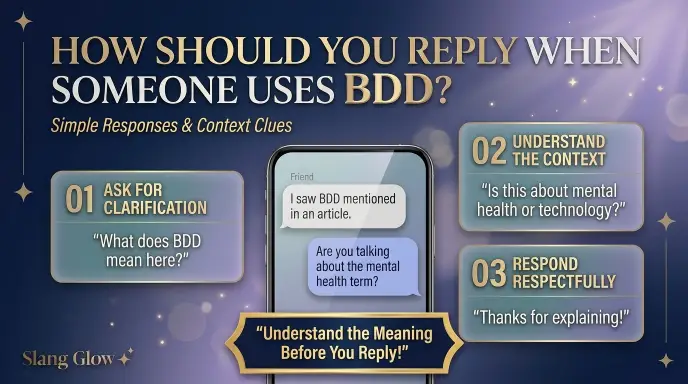
Your response depends on the conversation in which BDD appears. Someone may be discussing mental health terminology, sharing educational information, or talking about software development.
Here are four natural ways to respond:
- Casual reply: “What does BDD stand for?”
- Friendly reply: “I have seen that abbreviation before!”
- Neutral reply: “Are you talking about the mental health term?”
- Clarifying reply: “Do you mean Body Dysmorphic Disorder or Behavior Driven Development?”
Example 1: Asking for Clarification
Emma: “I read something about BDD.”
Sophie: “What does BDD mean in that article?”
Meaning: Sophie asks for the full meaning before discussing the topic.
Example 2: Discussing an Educational Post
Noah: “I saw a post explaining BDD.”
Liam: “Was it about mental health?”
Meaning: Liam wants to understand the subject of the post.
Example 3: Talking About Technology
Mia: “Our team is learning BDD.”
Olivia: “Are you learning Behavior Driven Development?”
Meaning: Olivia identifies the likely technical meaning.
You do not need to guess when someone uses an unfamiliar abbreviation. Asking a simple question is often the easiest way to understand the message.
Is BDD Rude or Offensive in Text?
BDD is not generally considered rude or offensive. It is an abbreviation used in mental health and technology discussions rather than a swear word or a typical insult.
However, when someone uses it to discuss a mental health condition, the surrounding language should remain respectful.
Here are three important points:
- Neutral terminology: BDD is commonly used as a shortened form of an established term.
- Respectful communication: Avoid using mental health conditions as jokes or labels for other people.
- Different meanings: In technology discussions, BDD has a separate technical meaning.
Is BDD Appropriate at School or Work?
Yes. BDD can be appropriate in educational, health related, and professional discussions when it is relevant to the subject.
For example, a student may encounter BDD while studying mental health terminology. A software developer may use the same abbreviation while discussing development methods.
Use the complete term when your audience may not recognize the abbreviation. This makes communication clearer and reduces confusion.
Who Uses the Abbreviation BDD?
BDD appears in different communities because it has meanings in more than one subject. It is not limited to one age group or a particular social media platform.
You may encounter it in these situations:
- Students: They may see BDD in educational material about psychology or computer science.
- Mental health discussions: People may use the abbreviation when discussing Body Dysmorphic Disorder.
- Software professionals: Developers may use BDD when discussing Behavior Driven Development.
- Online communities: Users may encounter the abbreviation in articles, comments, and educational posts.
Is BDD a Gen Z Texting Term?
BDD is not specifically a Gen Z expression. It is better understood as a subject specific abbreviation rather than a popular youth texting shortcut.
Younger internet users may encounter it on TikTok, Instagram, or other platforms, but that does not make it a universal slang expression.
The topic of the conversation is more important than the sender’s age. A mental health discussion and a programming discussion will usually point toward different meanings.
Where Did the Abbreviation BDD Come From?
BDD does not have one single origin as an internet slang term. Its meanings come from established fields, particularly mental health and software development.
In mental health, BDD is shortened from Body Dysmorphic Disorder. In software development, it stands for Behavior Driven Development.
Three points help explain its background:
- Mental health terminology: BDD is used as a shorter form of the name of a recognized mental health condition.
- Software development: BDD is also an established term for an approach to describing and testing software behavior.
- Online communication: People use these shortened forms in messages because they are quicker than writing the complete terms.
Did BDD Originate as Internet Slang?
No, BDD should not be described as a slang expression that originated on TikTok or another social media platform. Its established meanings come from specialized subjects.
The abbreviation can appear in internet conversations, but its use online does not mean that it was invented by social media users.
There is no single confirmed origin for BDD as a universal texting abbreviation. It is more accurate to explain its established meanings separately.
BDD vs. Other Common Texting Abbreviations
BDD differs from familiar texting shortcuts because it generally refers to a specific subject rather than a common conversational phrase.
| Term | Meaning | Type | Typical Usage |
| BDD | Body Dysmorphic Disorder or Behavior Driven Development | Subject specific abbreviation | Health or technology discussions |
| IDK | I Don’t Know | Texting abbreviation | Expressing uncertainty |
| IMO | In My Opinion | Texting abbreviation | Sharing an opinion |
| BRB | Be Right Back | Texting abbreviation | Saying someone will return |
| FYI | For Your Information | Texting abbreviation | Sharing information |
These terms have different purposes:
- BDD identifies a specific health or technology subject.
- IDK and IMO communicate uncertainty or an opinion.
- BRB and FYI help manage everyday conversations.
For example, someone may write “I am learning BDD” in a software discussion, while another person may write “IDK what that means” when they do not understand an abbreviation.
Do not treat BDD as interchangeable with everyday texting shortcuts. Its intended meaning depends on the subject being discussed.
A Real World Example of BDD in a Conversation
Imagine that two classmates are discussing an educational article about mental health terminology.
Emma: “I found an article that mentions BDD.”
Sophie: “What does it stand for?”
Emma: “Body Dysmorphic Disorder.”
Sophie: “Oh, now I understand why the article was discussing mental health.”
In this conversation, BDD refers to the mental health condition. The subject of the article makes the intended meaning clear.
Now consider a different situation:
Alex: “Our software team is using BDD.”
Jordan: “Do you mean Behavior Driven Development?”
Here, BDD refers to a software development approach rather than a health related term.
Both conversations show why context is important. Understanding the topic helps you identify which meaning of the abbreviation applies.
Frequently Asked Questions About BDD
Q.1. What does BDD mean in text messages?
BDD commonly stands for Body Dysmorphic Disorder in mental health discussions. In technology conversations, it can mean Behavior Driven Development.
Q.2. What does BDD mean on TikTok?
BDD does not have one universal TikTok slang meaning. It may refer to Body Dysmorphic Disorder in educational posts or another subject depending on the content.
Q.3. Is BDD considered slang?
BDD is generally a subject specific abbreviation, not a common texting slang expression like LOL or BRB.
Q.4. Is BDD rude or offensive?
No. BDD is not inherently offensive. It should be used respectfully when discussing mental health.
Q.5. How should you reply when someone uses BDD?
You can ask, “What does BDD mean in this conversation?” This helps identify the intended meaning.
Q.6. Does BDD always mean Body Dysmorphic Disorder?
No. BDD can also mean Behavior Driven Development in software related discussions. The surrounding topic determines which meaning applies.
Final Takeaway
BDD most commonly refers to Body Dysmorphic Disorder in mental health discussions, but it can also mean Behavior Driven Development in technology. The intended meaning depends on the subject and surrounding conversation.
You may encounter the abbreviation in text messages, educational articles, social media posts, or professional discussions. It is not a universal texting slang expression with one fixed definition.
Check the context before interpreting BDD. When the meaning is unclear, ask the sender what they mean rather than making assumptions.
SEE MORE!

Hi, I’m James Parker, a writer passionate about modern slang, internet culture, and social media language. I enjoy researching trending words and explaining their meanings in simple, easy to understand English. My goal is to help readers confidently understand and use slang in everyday conversations, texting, and online platforms.