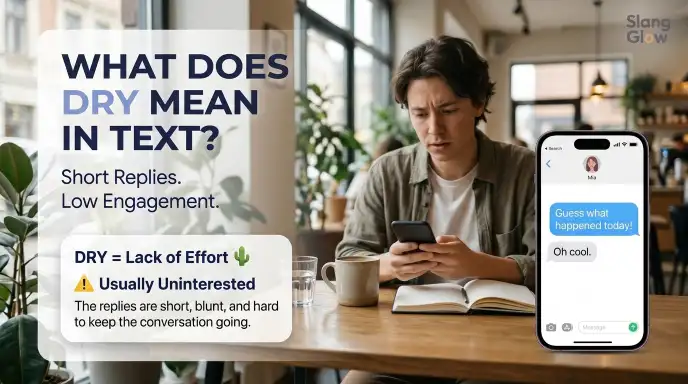
Being dry in text means replying with short, dull, or unenthusiastic messages that do not give the other person much to continue the conversation. Replies such as “okay,” “yeah,” “lol,” or “cool” may seem dry when they lack details or interest.
You may see this expression in text messages, TikTok comments, Snapchat conversations, Instagram DMs, and other online chats. People often use it when a conversation feels one sided or when someone gives very little response to an interesting message.
However, being dry does not always mean someone is angry or uninterested. They may be busy, tired, distracted, or simply someone who prefers short messages. The meaning depends on the person and the conversation.
In this guide, you will learn what being dry means in text, how to recognize dry replies, and how people use the expression in everyday conversations and on social media.
What Does Being Dry Mean in Text Messages?
In texting, being dry means responding with little detail, emotion, or effort to keep a conversation going. Someone who texts dry may answer your question but add nothing that encourages another message.
For example, imagine you send your friend a message saying, “I finally passed my exam! I’m so happy!” Your friend replies, “Nice.”
The reply is not necessarily rude, but it may feel dry because you shared exciting news and received a very short response.
Here are three common signs of dry texting:
- Short replies: The person frequently responds with one or two words, such as “okay,” “sure,” or “yeah.”
- Little engagement: They rarely ask questions or add details that help the conversation continue.
- Low enthusiasm: Their messages may seem flat when you expect a more expressive response.
The important thing is that a short message does not automatically count as dry texting. If someone answers a simple question with “yes” or “no,” that may be completely normal.
The pattern of communication matters more than one individual reply. A person who consistently gives minimal answers may come across as dry, while someone who usually writes detailed messages might simply be having a busy day.
What Does Dry Texting Mean in Everyday Chats?
Dry texting is the act of sending very brief or low engagement messages that can make a conversation difficult to continue. It often happens when one person provides little information or does not show much interest in the topic through their replies.
For example:
Alex: “What did you do over the weekend?”
Jordan: “Nothing.”
Alex: “Did you watch the new movie?”
Jordan: “No.”
Alex: “Oh, okay.”
In this conversation, Alex keeps trying to start a discussion, but Jordan gives very little information in return. Jordan’s replies may therefore feel dry.
Here are three ways to recognize the expression in everyday communication:
- One sided conversations: One person keeps asking questions while the other gives minimal answers.
- Closed responses: Replies answer the question without adding a new detail or asking anything back.
- Flat reactions: Messages such as “cool” or “nice” may end a conversation rather than encourage it to continue.
Still, people have different texting styles. Some are naturally brief, and others prefer longer conversations. A short reply may also happen because someone is concentrating on schoolwork, spending time with family, or taking a break from their phone.
Dry texting describes how a conversation feels, not necessarily why someone is replying that way.
Is Being Dry Slang or an Abbreviation?
Being dry is an informal slang expression, not an acronym or abbreviation with a full form. It uses the ordinary word “dry” in a figurative way to describe communication that feels dull, flat, or lacking in engagement.
The related phrase “dry texting” describes sending very short messages, sometimes with one word replies that may suggest a lack of interest. The Cambridge Dictionary’s language blog discussed this expression in its November 2025 new words feature.
For example, someone might say, “Why are you being so dry today?” when they feel that the other person’s replies are unusually short.
The expression can describe a single message or an ongoing conversation. It does not automatically prove that the sender dislikes the other person.
Being dry is about the style and feel of the replies, not a special hidden meaning behind the words.
What Does Being Dry Mean on TikTok, Snapchat, and Instagram?
On social media, being dry usually describes messages or reactions that seem brief, uninterested, or difficult to respond to. The expression can appear in jokes, comments about friendships, and discussions about everyday communication.
However, being dry does not have a completely different meaning on every platform. People generally use it to describe the way someone communicates.
Here is how you might encounter it on popular platforms:
- TikTok: Someone may discuss a dry conversation in a video about texting habits or show examples of replies that make a chat go quiet.
- Snapchat: A person might complain that their friend keeps responding with “k,” “yeah,” or a single emoji.
- Instagram: Someone may describe a direct message as dry when the other person gives short answers without continuing the discussion.
- WhatsApp: Friends may use the phrase when one person asks questions while the other provides little information.
- SMS text messages: A conversation can feel dry when one person repeatedly responds with short, flat messages.
For example, imagine you send a friend a funny story on Snapchat, and they respond only with “lol.” You might call the reply dry if you expected them to react to the story or say something more.
On the other hand, your friend may genuinely find the story funny but have nothing else to add.
The platform alone cannot tell you If someone is interested in the conversation. Read the messages together and consider how the person normally communicates before interpreting their replies.
Real Chat Examples of Being Dry
The easiest way to understand this expression is to look at how short replies affect everyday conversations. The following examples show situations where a message might feel dry and explain what the conversation communicates.
Example 1: Asking About Someone’s Day
Emma: “How was your day? Did anything exciting happen?”
Lily: “Good.”
Meaning: Lily gives a very short answer without sharing any details. Emma may find it difficult to continue the conversation because she has little information to respond to.
Example 2: Sharing Exciting News
Noah: “I finally got the game I’ve wanted for months!”
Ryan: “Cool.”
Meaning: Ryan acknowledges Noah’s news but does not add much enthusiasm or ask a follow up question. His reply may feel dry, although he might simply be busy.
Example 3: Trying to Make Plans
Mia: “Do you want to go to the café this weekend?”
Olivia: “Maybe.”
Meaning: Olivia gives an uncertain, brief answer without explaining her plans. Mia may not know If Olivia wants to go or would prefer a different time.
Example 4: Starting a Conversation
Jake: “Hey! What are you doing today?”
Leo: “Nothing.”
Meaning: Leo answers the question but does not share more information or ask Jake anything in return. The conversation may stop unless one of them introduces another topic.
Example 5: Sharing a Funny Story
Ava: “You won’t believe what happened at school today 😂”
Sophie: “Lol.”
Meaning: Sophie reacts briefly but does not ask what happened. Ava may feel that Sophie is not engaging with the story, even though Sophie might simply be distracted.
These examples illustrate an important point: a reply can feel dry without being intentionally rude. A person’s mood, schedule, usual communication style, and interest in the topic can all affect how they respond.
More Real Chat Examples of Dry Texting
Dry texting can happen in different situations, including friendships, everyday conversations, and discussions about plans. These additional examples show how a conversation may feel when someone gives very little information.
Example 6: Planning a Weekend Activity
Maya: “Want to go shopping with me on Saturday?”
Zoe: “Idk.”
Meaning: Zoe gives an uncertain answer without explaining why. Maya may struggle to decide If to make other plans.
Example 7: Talking About a Favorite Show
Ethan: “I just finished the best show ever. Have you watched it?”
Oliver: “Nope.”
Meaning: Oliver answers the question but does not ask about the show or continue the discussion. The reply may feel dry in this context.
Example 8: Checking on a Friend
Grace: “Hey, you seem quiet today. Is everything okay?”
Chloe: “I’m fine.”
Meaning: Chloe gives a brief response without explaining how she feels. She might want privacy, or she might simply prefer not to discuss it over text.
Example 9: Sharing a Personal Achievement
Daniel: “I finally learned how to drive on the highway!”
Michael: “Nice.”
Meaning: Michael acknowledges Daniel’s achievement but does not offer much reaction. Daniel might have expected a more enthusiastic response.
Example 10: Continuing a Casual Chat
Ella: “What are you planning to do during the holidays?”
Sophie: “Nothing much.”
Meaning: Sophie provides little information, so Ella may need to ask another question to keep the conversation going.
These examples demonstrate that dry texting depends on the overall exchange. A short reply can seem uninterested, but it does not prove that someone wants to end the conversation.
How to Reply When Someone Is Being Dry
When someone sends short or unenthusiastic messages, you do not have to work harder and harder to keep the conversation alive. A simple reply, a different question, or a little space may be enough.
Choose your response according to the situation:
- Casual reply: “Haha, okay. What’s your plan for later?”
- Friendly reply: “You seem a little quiet today. Everything good?”
- Funny reply: “Your messages are giving one word challenge 😂.”
- Neutral reply: “No worries. Talk to you later.”
- Direct reply: “I’m finding it hard to keep this conversation going. Are you busy?”
For example:
Alex: “How was your weekend?”
Jordan: “Good.”
Alex: “Glad to hear that! Did you do anything fun?”
Jordan: “Not really.”
Alex: “No problem. We can chat another time.”
Alex gives Jordan an opportunity to share more but does not force the conversation to continue.
A good reply respects both people’s comfort and time. You can show interest without feeling responsible for carrying every conversation by yourself.
Should You Ask Someone Why They Are Dry Texting?
You can ask if the change is noticeable and the relationship matters to you. It is usually better to ask calmly rather than accuse the other person of ignoring you.
For example, you might say, “Hey, you’ve seemed a little quiet lately. Is everything okay?”
This gives the person room to explain If they are busy, tired, distracted, or dealing with something else. They may also simply have a brief texting style.
If they do not want to talk, respect that choice. One dry conversation is not enough to determine someone’s feelings or intentions.
Is Being Dry Rude or Offensive in Text?
Being dry is not automatically rude or offensive. It describes how a message or conversation feels, rather than proving that the sender has a bad intention.
A brief reply may sound cold in one conversation but perfectly normal in another. For instance, replying “Okay” to a simple instruction is often reasonable. Replying “Okay” to a long, emotional message might feel less supportive if the sender expected a thoughtful response.
Three factors can affect how a message comes across:
- The topic: Serious or personal messages may call for more care than simple questions.
- The person’s usual style: Someone who normally writes short messages may not intend to sound uninterested.
- The conversation pattern: Repeatedly giving minimal answers while the other person tries to connect may make the exchange feel one sided.
Is Dry Texting Safe to Use at School or Work?
The phrase itself is generally fine to use in casual conversation. You might tell a friend, “This chat is getting dry,” when neither person has much to say.
At school or work, however, it is often more helpful to explain the communication problem directly. Instead of telling a classmate that they are dry, you could say, “Could you give me a little more detail so I understand?”
Focus on the communication rather than labeling the person. This reduces the chance of making someone feel criticized for being naturally quiet or brief.
Who Uses the Term Dry Texting?
People of different ages use expressions such as dry texting when discussing communication habits. The term is especially familiar in online conversations about friendship, dating, and social interactions.
You may encounter it in:
- Teen and young adult conversations: Friends may talk about short replies, awkward chats, or conversations that stop quickly.
- Gen Z social media posts: Users may make videos or jokes about one word replies and conversations that feel difficult to maintain.
- Everyday messaging: People of any age may use the expression when a text exchange feels unusually flat or one sided.
Is Dry Texting a Gen Z Expression?
The phrase is often discussed in modern online culture, including conversations about relationships and social media. However, short or low engagement replies existed long before smartphones and texting apps.
It is not limited to one generation. People may describe a conversation as dry whenever replies seem to offer little interest or detail.
The expression describes a communication style, not a particular age group. If the term is useful depends on the context and what someone is trying to explain.
Where Did the Expression Dry Texting Come From?
The expression combines the ordinary word “dry,” meaning something without moisture, with “texting,” the act of sending written messages electronically. In this expression, dry is used figuratively to describe communication that feels flat, dull, or lacking in energy.
The phrase became familiar through discussions of digital conversations and social interactions. However, there is no single, reliably established person or moment that can be credited with inventing it.
Three points help explain the expression:
- Figurative language: Dry describes a conversation that lacks liveliness or engagement.
- Digital communication: Text messages do not include all the facial expressions, gestures, or vocal cues people use in face to face conversations.
- Modern online use: Social media discussions have helped spread the phrase as people talk about texting habits.
Does Dry Texting Have a Clear Origin?
The exact origin of the modern phrase is uncertain. It is safest to describe it as an informal expression that developed around digital communication rather than claiming that a specific platform or person created it.
The underlying idea is straightforward: some conversations feel dry when the messages provide little information, reaction, or opportunity to continue.
A phrase can have a clear everyday meaning even when its exact origin is unknown. There is no need to invent a precise origin story to understand how people use it today.
Dry Texting vs. Other Common Texting Terms
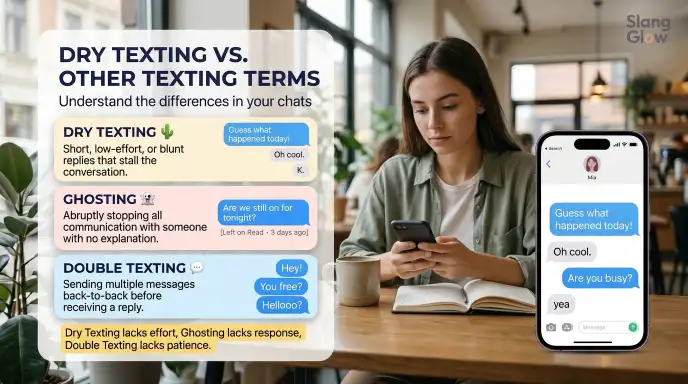
Dry texting is different from common abbreviations that communicate a specific response or action. Some short replies may contribute to a dry conversation, but the abbreviations themselves do not automatically mean that someone is being dry.
| Term | Meaning | Type | Typical use |
| Dry texting | Sending brief or low engagement replies | Informal expression | Describes how a conversation feels |
| IDK | I don’t know | Abbreviation | Expresses uncertainty |
| IDC | I don’t care | Abbreviation | Expresses a lack of concern |
| IMO | In my opinion | Abbreviation | Introduces a personal view |
| BRB | Be right back | Abbreviation | Says someone will return shortly |
For example, replying “IDK” may feel dry when someone is asking for a thoughtful opinion, but it may be completely appropriate when the sender genuinely does not know the answer.
Similarly, “BRB” is a useful way to tell someone that you need to step away from a conversation. It does not mean you are being dry.
Dry texting describes the overall communication, while abbreviations have their own meanings. Consider the full exchange before judging the tone of a message.
A Real World Example of Dry Texting
Imagine two classmates arranging a study session for an upcoming test. One student wants to decide where and when to meet, so they send a few messages to plan the details.
Ava: “Do you want to study together tomorrow?”
Noah: “Sure.”
Ava: “Great! Should we meet at the library around three?”
Noah: “Okay.”
Ava: “Do you need help with any chapters?”
Noah: “No.”
Ava may feel that the conversation is dry because she is asking the questions and receiving only brief answers. Still, Noah might be busy or may already understand what he wants to study.
Ava could send one clear follow up, such as, “Let me know if you want to meet at a different time.” She can then allow Noah to respond when he is ready.
This situation shows why a dry conversation does not automatically reveal someone’s feelings. It may reflect their texting habits, their availability, or their level of interest in that particular discussion.
Frequently Asked Questions About Dry Texting
What does being dry mean in text messages?
Being dry means replying with short, dull, or low engagement messages that may make a conversation difficult to continue.
What does dry texting mean on TikTok?
On TikTok, dry texting usually refers to conversations in which someone sends brief or unenthusiastic replies. Videos may use the phrase humorously to show awkward chats.
Is dry texting slang?
Yes. Dry texting is an informal expression used to describe a style of communication. It is not an acronym or abbreviation.
Is being dry rude or offensive?
Not necessarily. A short reply may feel cold, but the sender may be busy, tired, or naturally brief. The complete conversation helps determine the tone.
How should you reply when someone is dry?
You can ask a friendly question, check If they are okay, or politely end the conversation for now. You do not need to keep forcing the chat.
Does dry texting mean someone is not interested in you?
No. Dry texting alone does not prove a lack of interest. Consider the person’s usual communication style and the wider context before making assumptions.
Final Takeaway
Being dry in text means communicating with short, flat, or low engagement replies that can make a conversation feel one sided. You may notice it when someone repeatedly answers with very little detail or does not help keep a discussion going.
However, a short message does not always indicate rudeness, anger, or a lack of interest. People have different texting habits, and their availability or mood can affect how they respond.
If a conversation feels dry, try a natural follow up or ask If everything is okay. If the other person does not seem ready to talk, give them space.
The most important thing is to look at the overall pattern rather than judge someone’s feelings from one short reply.
DISCOVER MORE!

Hi, I’m James Parker, a writer passionate about modern slang, internet culture, and social media language. I enjoy researching trending words and explaining their meanings in simple, easy to understand English. My goal is to help readers confidently understand and use slang in everyday conversations, texting, and online platforms.