Can you understand the slang that appears in memes, gaming chats, TikTok comments, and everyday online conversations? This Gen Alpha slang quiz puts your knowledge to the test with popular words that have become part of modern internet culture.
Some terms are easy to recognize, while others can be confusing without context. A word may even have a different meaning depending on how someone uses it.
For this first round, choose the answer you think is correct before checking the answer key. Do not worry if you miss a few online slang changes quickly, and many expressions come from specific memes or communities.
What Is Gen Alpha Slang?
Gen Alpha slang refers to informal words, phrases, abbreviations, and expressions commonly associated with younger internet users.
Much of this vocabulary spreads through short form videos, gaming, memes, social platforms, and online communities.
Some expressions are newly created, while others are older slang that gained a fresh meaning online.
Why Is Gen Alpha Slang So Hard to Learn?
Internet language can be difficult because meaning often depends on context.
A person may use a word seriously, ironically, as a joke, or simply because it became popular in a meme. New expressions can also spread very quickly.
That means recognizing a word is not always enough. You need to understand what the speaker means in that particular situation.
Gen Alpha Slang Quiz: Round 1
1. What Does “Rizz” Mean?
A. Charm or ability to attract someone
B. Feeling tired
C. Winning a game
D. Being confused
2. What Does “Sigma” Often Mean Online?
A. Someone portrayed as independent or confident
B. A type of video
C. A funny mistake
D. A gaming level
3. What Does “Aura” Mean in Slang?
A. A person’s perceived presence or coolness
B. A private message
C. A computer setting
D. A type of music
4. What Does “Skibidi” Refer To?
A. A viral internet meme or style of humor
B. A formal greeting
C. A school subject
D. A sports move
5. What Can “Ohio” Mean in Meme Culture?
A. Something strange or chaotic
B. Something very expensive
C. A compliment
D. A way to say thanks
Answers to Round 1
1. A — Charm or ability to attract someone
2. A — Someone portrayed as independent or confident
3. A — A person’s perceived presence or coolness
4. A — A viral internet meme or style of humor
5. A — Something strange or chaotic
Gen Alpha Slang Quiz: How Did You Do?
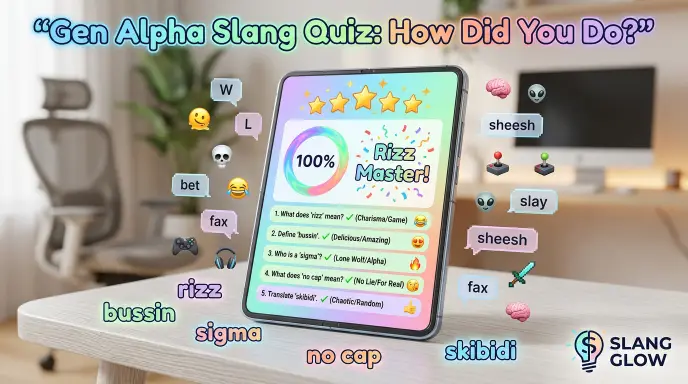
If you got 5 out of 5, you have a strong understanding of these popular expressions.
A score of 3 or 4 means you already recognize much of the vocabulary.
If you got 1 or 2, there is still plenty to discover. That is part of what makes internet slang interesting: the vocabulary keeps evolving.
Gen Alpha Slang Quiz: Round 2
The next set focuses on expressions that often appear in comments, memes, gaming conversations, and casual online posts. Read each question carefully because some choices may look similar.
6. What Does “Cooked” Mean in Internet Slang?
- Preparing food
- Being in trouble or having little chance of success
- Feeling relaxed
- Winning easily
7. What Does “W” Usually Mean Online?
A. A win or positive result
B. A warning
C. A question
D. A mistake
8. What Does “L” Usually Represent?
A. A loss or failure
B. A lucky moment
C. A lesson
D. A laugh
9. What Does “Brainrot” Mean?
A. A medical condition
B. Internet content or ideas that become excessively repetitive or occupy someone’s thoughts
C. A difficult puzzle
D. A computer problem
10. What Does “NPC” Mean When Used About Someone?
- A predictable or scripted person
- A video game creator
- A professional sports player
- An always online person
Gen Alpha Slang Quiz: Round 2 Answers
6. B — Someone is in trouble or has little chance of success
7. A — A win or positive result
8. A — A loss or failure
9. B — Internet content or ideas that become excessively repetitive or occupy someone’s thoughts
10. A — Someone who behaves in a predictable or scripted way
Context Challenge
Now try to understand the slang from the whole sentence, rather than from the word alone.
11. “That was a huge W for our team.”
What does W mean here?
A. A win
B. A warning
C. A weird moment
D. A work assignment
12. “Bro is cooked after that exam.”
What does cooked suggest?
- Preparing a meal
- Being in a difficult situation
- Finishing early
- Enjoying the exam
13. “Stop acting like an NPC.”
What is the speaker suggesting?
- Acting predictable or scripted
- Playing a game
- Leaving the internet
- Winning
14. “This meme is pure brainrot.”
What does the speaker likely mean?
- The meme is serious news
- A highly repetitive, absurd, or mentally occupying meme
- The meme is educational
- The meme is completely unknown
15. “Taking that L was painful.”
What does L mean?
A. A loss or disappointing outcome
B. A lesson at school
C. A location
D. A lucky result
Context Challenge Answers
11. A — A win
12. B — He may be in a difficult situation
13. A — The person is acting predictable or scripted
14. B — The meme is highly repetitive, absurd, or mentally occupying
15. A — A loss or disappointing outcome
What Makes These Terms Different?
These expressions do not all work in the same way.
W and L are often used as quick reactions to outcomes. Cooked describes someone’s situation, while NPC can describe behavior. Brainrot is more closely connected with the effect or style of repetitive online content.
Understanding this difference makes it easier to use slang naturally instead of treating every term as interchangeable.
A Quick Slang Reading Test
Read the sentence:
“We got the W, but the other team is saying it was an L.”
The first W represents a win, while L represents a loss. The sentence shows how internet slang can make a short comment sound much more compact.
Another example:
“After watching that same clip fifty times, I think I have brainrot.”
Here, brainrot is being used humorously to describe being heavily absorbed in repetitive online content.
These examples show why sentence context matters more than memorizing isolated definitions.
FAQs
How do Gen Alphas say “hi”?
Gen Alpha may use casual greetings like “hey,” “yo,” “heyy,” “hii,” or playful internet phrases. The choice often depends on the person and the platform.
Is a 13 year old Gen Z or Gen Alpha?
It depends on the birth year. In 2026, a 13 year old was born in 2012 or 2013, and those years are commonly placed in Gen Alpha. Generation ranges can vary by source.
What is the best Gen Alpha slang?
There is no single “best” term. Popular examples include rizz, aura, sigma, W, cooked, and brainrot. Their meanings can change with context and online trends.
How does Gen Alpha say “cringe”?
They may simply say “cringe,” “that’s cringe,” or use terms such as “corny” when something feels embarrassing, awkward, or uncool. The exact choice depends on context.
What does “41” mean in slang?
“41” has been used as an internet meme/slang expression, especially in short form social media content. Its meaning is often more about participating in the meme than communicating a precise definition.
What is a choppleganger?
“Choppleganger” is internet slang formed from “chop” + “doppelgänger.” It is generally used as a humorous way to describe someone who looks like another person but is portrayed jokingly as a less flattering or “chopped” version.
Gen Alpha Slang Quiz: Round 3
This round moves beyond the basic terms and tests if you can recognize slang from different online situations.
Questions 16–20
16. What does “delulu” usually mean?
A. Extremely tired
B. Playfully unrealistic or overly hopeful
C. Very angry
D. Extremely popular
17. If someone says “No cap,” what are they saying?
- Joking around
- Heading out
- Speaking truthfully
- Feeling confused
18. What does “mid” usually describe?
- An ordinary or disappointing thing
- Dangerous situations or things
- High priced items
- Something kept hidden
19. What does “touch grass” suggest?
A. Go outside and take a break from the internet
B. Start a new game
C. Study harder
D. Try something difficult
20. If someone says “Let him cook,” what do they usually mean?
A. Let him prepare food
B. Give him time to show what he can do
C. Stop talking to him
D. Ask him a question
Round 3 Answers
16. B — Playfully unrealistic or overly hopeful
“Delulu” is a humorous shortening of “delusional.” Online, it is often used in a playful way rather than as a serious description.
17. C — I am being truthful
“No cap” means someone is saying they are being honest or serious.
18. A — Something average or disappointing
When something is called “mid,” the speaker usually thinks it is ordinary, underwhelming, or not especially impressive.
19. A — Go outside and take a break from the internet
“Touch grass” is a joking way to tell someone to step away from online activity and spend some time in the real world.
20. B — Give him time to show what he can do
“Let him cook” means to allow someone to continue with an idea, plan, or activity because they may produce a good result.
Gen Alpha Slang: Match the Meaning
Try this matching challenge without looking at the answers.
| Slang | Meaning |
| 21. Based | A. Very good or impressive |
| 22. Sus | B. Suspicious or questionable |
| 23. Fire | C. Showing approval of an opinion or attitude |
| 24. GOAT | D. The greatest of all time |
| 25. Extra | E. Over the top or dramatic |
Answers
21. Based → C — Showing approval of an opinion or attitude
22. Sus → B — Suspicious or questionable
23. Fire → A — Very good or impressive
24. GOAT → D — The greatest of all time
25. Extra → E — Over the top or dramatic
Gen Alpha Slang Quiz: True or False
Now test your understanding with statements rather than definitions.
26. “Mid” is normally a strong compliment.
False. It usually suggests something is average or underwhelming.
27. “No cap” can be used to emphasize honesty.
True.
28. “Touch grass” is usually meant literally.
False. It is commonly an online joke about stepping away from internet culture.
29. “Let him cook” can show support for someone’s idea.
True.
30. “GOAT” is commonly used as praise.
True.
Can You Understand Slang Without Knowing Every Definition?
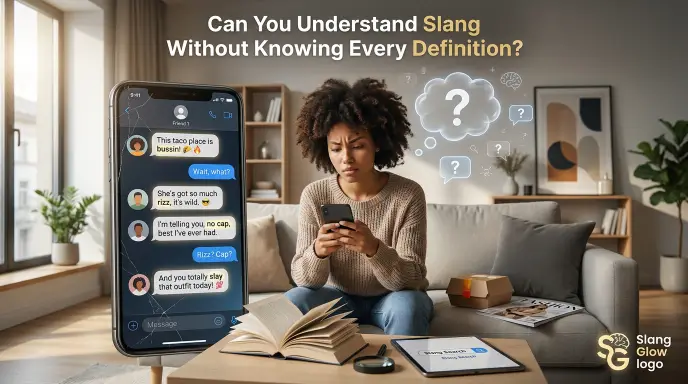
Yes. Context can reveal a lot about slang. Look at the words around the unfamiliar term and ask what emotion or reaction the speaker is showing.
For example, imagine someone writes:
“That new game is fire.”
Even without knowing the slang, the positive wording suggests that “fire” is being used as praise.
Another clue is punctuation and tone. A phrase such as “Bro, that is so sus 😭” gives a very different feeling from a serious statement about a suspicious situation.
This is why a good Gen Alpha slang quiz should test both vocabulary and context.
Gen Alpha Slang Quiz Score: Round 3
Give yourself one point for every correct answer from Questions 16–30.
- 13–15 points: You have a strong grasp of current internet slang.
- 10–12 points: You understand many common expressions.
- 7–9 points: You know the basics but have some new terms to learn.
- 0–6 points: Time for another slang challenge!
The score is only for fun. Internet slang changes quickly, so even people who spend a lot of time online can encounter unfamiliar terms.
Gen Alpha Slang Quiz: Expert Round
Ready for a harder challenge? This round uses less obvious slang and internet phrases. Instead of memorizing one word definitions, think about what the speaker is trying to communicate.
Questions 31–35
31. What does “fanum tax” refer to?
A. Paying a fee for using social media
B. Taking some of another person’s food, usually as a joke
C. Losing points in a game
D. Sharing an online account
32. What does “gyatt” commonly express online?
A. Surprise or admiration about someone’s appearance
B. Being tired after school
C. Winning a competition
D. Being confused by a meme
33. If someone calls an idea “based,” what are they usually showing?
A. Disapproval
B. Agreement or approval
C. Confusion
D. Fear
34. What does “lock in” mean in online slang?
A. Stop using a device
B. Focus seriously on a task or goal
C. Change your username
D. Leave a group chat
35. What does “aura points” usually describe?
A. School grades
B. Imaginary points for looking confident or doing something impressive
C. Money earned online
D. Gaming experience points
Expert Round Answers
31. B — Taking some of another person’s food, usually as a joke
“Fanum tax” became popular through creator and meme culture. It humorously describes taking a portion of someone else’s food.
32. A — Surprise or admiration about someone’s appearance
“Gyatt” is an internet expression that can signal surprise or admiration. Because it can comment on someone’s body or appearance, it is better used carefully and respectfully.
33. B — Agreement or approval
When someone says “based,” they may be expressing approval of an opinion or attitude they consider confident or authentic.
34. B — Focus seriously on a task or goal
To “lock in” means to become focused and committed, especially when something important needs to get done.
35. B — Imaginary points for looking confident or doing something impressive
“Aura points” are fictional points used online as a humorous way to describe someone’s perceived coolness, confidence, or impressive behavior.
Gen Alpha Slang Quiz: Fill in the Blank
Choose the slang term that best completes each sentence.
36. “I have a big test tomorrow. I need to ______ and study.”
A. lock in
B. fanum tax
C. aura points
D. based
37. “He walked into the room like he owned the place. Bro gained ______.”
A. mid
B. aura points
C. cap
D. sus
38. “You brought snacks? I’m taking the ______.”
A. fanum tax
B. GOAT
C. lock in
D. based
39. “That opinion is completely ______.”
A. cooked
B. based
C. NPC
D. extra
40. “The whole situation feels ______.”
A. sus
B. fire
C. W
D. GOAT
Fill in the Blank Answers
36. A — lock in
The sentence describes becoming focused on studying.
37. B — aura points
The phrase jokingly suggests that the person’s confident entrance made them seem cooler.
38. A — fanum tax
The speaker is joking about taking part of someone’s snacks.
39. B — based
Here, the speaker is expressing approval of the opinion.
40. A — sus
The sentence suggests that something seems suspicious or questionable.
Slang or Standard English?
Not every phrase used by younger internet users is technically Gen Alpha slang. Some expressions existed before Gen Alpha became associated with them and later became popular again through social media.
For example, “GOAT” is an acronym for “greatest of all time” and has been used in sports and popular culture for years. Meanwhile, other expressions can become popular through a particular meme, creator, game, or online community.
This makes slang difficult to classify. A term’s age, origin, popularity, and current usage can all be different.
Why Does Gen Alpha Slang Change So Fast?
Internet language can spread at incredible speed. A phrase may appear in a video, become part of a meme, and then show up in comments, gaming chats, and everyday conversations.
Several factors help slang spread:
- Short form videos make phrases easy to repeat.
- Memes give ordinary words new meanings.
- Gaming communities create their own vocabulary.
- Creators and influencers can introduce phrases to large audiences.
- Comment sections help expressions move from one community to another.
A term can also change meaning as more people start using it. That is why an old slang definition may not fully explain how people use the word today.
The Ultimate Slang Challenge
For this challenge, imagine you are reading a group chat. You do not need to know every word immediately. Use the surrounding clues to work out the speaker’s meaning.
41. “The new update is mid. I expected way more.”
What does “mid” communicate here?
42. “Don’t interrupt him yet. Let him cook.”
What does the speaker want others to do?
43. “I finally finished my project. Now I can relax.”
Which slang idea from this article could describe becoming seriously focused before finishing it?
44. “That was the most impressive entrance I’ve ever seen.”
Which playful slang concept could describe the person’s perceived coolness?
45. “You ate half my fries? That’s the fanum tax!”
What is the speaker joking about?
Challenge Answers
41. The speaker thinks the update is average or disappointing.
42. They want people to give the person time to continue with their idea or activity.
43. Lock in.
44. Aura points.
45. They are joking about someone taking part of their food.
Final Thoughts
A Gen Alpha slang quiz is a fun way to see how well you understand the fast changing language of online culture. The key is not to memorize every new word. Instead, pay attention to context, tone, and where the expression is being used.
Internet slang will keep changing as new memes, creators, games, and communities shape the way people communicate. A word that feels unfamiliar today may become common tomorrow or disappear just as quickly.
So, if you missed a few answers, don’t worry. Slang knowledge grows with exposure, and there is always another new phrase waiting to become part of the internet vocabulary.
Read the Full Guide!

Hey, I’m Emily. I’ve spent way too many hours scrolling TikTok and group chats trying to figure out what people actually mean by half the slang flying around — and somewhere along the way that turned into a whole thing I write about now. I cover internet slang, TikTok trends, and how words shift meaning practically overnight online.