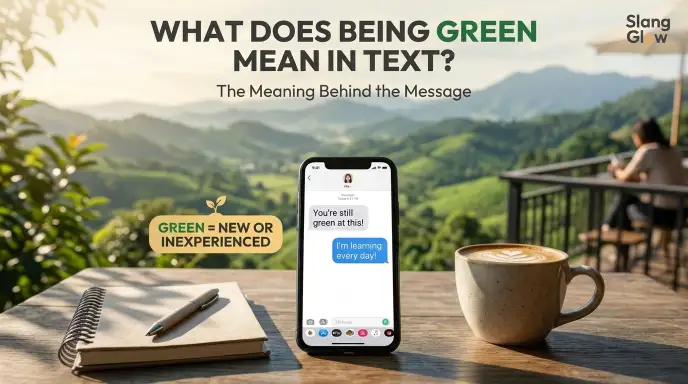
Being green in text usually means being inexperienced, new to something, or unfamiliar with a situation. Someone might call you green when you are learning a new skill or trying something for the first time. The meaning can change depending on the conversation.
You may see this expression in text messages, TikTok comments, Snapchat chats, Instagram posts, or online gaming conversations. People sometimes use it to describe a beginner or someone who has not gained much experience yet.
However, green does not always describe a person’s experience. It can also relate to environmental awareness, money, jealousy, or approval in certain expressions.
Understanding the words around it helps you figure out what the sender means and if they are being friendly, playful, or critical.
What Does Being Green Mean in Text Messages?
In casual texting, being green usually means being inexperienced or new to a particular activity or situation. It is an informal expression, not an acronym or abbreviation with a full form.
For example, if someone texts, “I’m still green at this job,” they mean they are new to the role and still learning how things work. The phrase does not automatically mean that the person is unintelligent. It simply suggests that they have not gained much experience yet.
Here are three important points to remember:
- New or inexperienced: A person may be learning a skill, starting a job, or trying an activity for the first time.
- Still learning: The person may need more practice before feeling confident.
- Context matters: The expression may sound friendly, teasing, or critical depending on how someone uses it.
For instance, a friend might say, “You’re still green at this game 😂.” They may simply be pointing out that you are a beginner.
However, if someone uses the word to put you down, it can sound dismissive. Read the complete message before deciding how the person intended it.
What Does It Mean to Be Green in a Chat?
The phrase “being green” describes a lack of experience in many everyday conversations. People may use it when talking about work, school, hobbies, relationships, or other situations that involve learning.
Here are three common ways to understand the expression:
- At work: A new employee may be green because they have not learned all the tasks yet.
- In hobbies: A beginner may be green at drawing, cooking, or playing an instrument.
- In online games: Someone who has only recently started playing may be called green by more experienced players.
Consider this example:
Alex: “I’ve never played this game before.”
Jordan: “No worries. You’re a little green, but you’ll learn.”
Meaning: Jordan is saying Alex is inexperienced and needs time to learn the game.
The phrase can also describe someone who is unfamiliar with a particular situation. It does not necessarily mean they lack ability. Even talented people can be inexperienced when they start something new.
Is Being Green Slang or an Abbreviation?
Being green is an informal expression that uses an ordinary English word in a figurative way. It is not a texting acronym like BRB or IDK.
The word green has several established meanings. When it describes a person, it can refer to inexperience. In other contexts, it may describe environmentally friendly choices or appear in expressions such as “green with envy.”
You usually do not need to memorize a special full form. Instead, look at the topic and the sentence in which the word appears.
What Does Green Mean on TikTok, Snapchat, and Instagram?
On social media, the meaning of green depends on the caption, comment, video, or private message. Calling someone green may describe inexperience, while other uses of the word can refer to different ideas.
Here is how to interpret it across common platforms:
- TikTok: A comment calling someone green may suggest they are new to a skill, trend, or activity. The exact meaning depends on the video and surrounding comments.
- Snapchat: In a personal conversation, someone may use green to describe a person who is unfamiliar with a situation or still learning.
- Instagram: The word may describe a beginner in a comment or refer to environmental awareness in a post about sustainable living.
- WhatsApp: Friends may use the expression in everyday messages when discussing work, school, games, or hobbies.
- SMS text messages: A sentence such as “I’m still green at driving” means the person has limited experience with driving.
For example, imagine someone posts a video of their first attempt at a dance routine. A friend comments, “You’re still green 😂.” The comment may mean that the person is still learning the moves.
The platform alone does not determine the meaning. Always consider what the people are discussing and if the word describes a beginner, the environment, or something else.
Real Chat Examples of Being Green
These sample conversations show how the expression can appear in ordinary messages. The meanings depend on the situation rather than the word alone.
Example 1: Starting a New Job
Mia: “It’s my first week at work, and I keep asking questions.”
Emma: “That’s normal. You’re still green!”
Meaning: Emma means Mia is new to the job and still learning the routine.
Example 2: Learning a New Game
Noah: “I lost three matches in a row.”
Liam: “You’re a bit green at this game. Keep practicing!”
Meaning: Liam is saying Noah has not gained much experience with the game yet.
Example 3: Trying a New Hobby
Ava: “I just started learning guitar, and my fingers keep missing the right strings.”
Sophie: “You’re green at it for now. You’ll improve with practice.”
Meaning: Sophie is explaining that Ava is a beginner.
Example 4: Joining a School Club
Ryan: “Everyone in the science club knows more than I do.”
Leo: “You’re new there, so of course you’re green.”
Meaning: Leo means Ryan has less experience with the club’s activities.
Example 5: Getting Used to New Technology
Olivia: “I can’t figure out all the settings on this app.”
Ella: “Don’t worry. We’re all green when we try something new.”
Meaning: Ella is saying that people need time to learn unfamiliar tools.
These examples show that being green usually refers to inexperience, not a permanent personal trait. Someone who is green today may become skilled and confident with time.
Example 6: Learning a New Skill
Ben: “I’ve only been learning photography for two days.”
Chris: “You’re still green, but you’ll get better.”
Meaning: Chris is saying Ben is a beginner and needs more practice.
Example 7: First Day at School
Lily: “I don’t know anyone in my new class yet.”
Mia: “You’ll get used to it. Everyone starts green somewhere.”
Meaning: Mia is encouraging Lily because she is new to the environment.
Example 8: Trying a New Sport
Jake: “I missed almost every shot during basketball practice.”
Noah: “You’re green at basketball. Give yourself some time.”
Meaning: Noah means Jake is still learning the sport.
Example 9: Learning to Cook
Emma: “I burned my first batch of cookies.”
Olivia: “Don’t worry! We were all green in the kitchen once.”
Meaning: Olivia is reminding Emma that everyone starts as a beginner.
Example 10: Starting an Online Course
Ryan: “The editing software is confusing me.”
Leo: “You’re green with it right now. You’ll learn the tools.”
Meaning: Leo means Ryan is unfamiliar with the software and needs more experience.
These examples show that the expression can describe different stages of learning. Being green does not mean someone cannot succeed. It simply suggests that they have not gained much experience in a particular area yet.
How to Reply When Someone Calls You Green
Your response depends on how the person uses the expression. They might be offering friendly advice, teasing you, or criticizing your lack of experience.
Here are some natural ways to respond:
- Casual reply: “Yeah, I’m still learning!”
- Friendly reply: “Everyone has to start somewhere.”
- Funny reply: “Give me time. I’ll level up soon!”
- Confident reply: “I’m new at this, but I’ll get better.”
- Neutral reply: “You’re right. I haven’t had much experience yet.”
For example:
Friend: “You’re pretty green at this game 😂.”
You: “True! Just wait until I’ve practiced a little more.”
This reply accepts that you are a beginner without making the conversation uncomfortable.
Funny Replies to Being Called Green
If someone uses the expression playfully, a lighthearted response can keep the conversation friendly.
Example 1
Friend: “You’re so green at this.”
You: “Fresh out of the beginner level!”
Example 2
Friend: “You clearly don’t know the rules yet.”
You: “I’m still downloading the experience 😂.”
Example 3
Friend: “You’re a rookie.”
You: “Every expert was a beginner once!”
These replies work best when both people understand that the conversation is playful. If the other person sounds insulting, you do not have to joke along with them.
Is Being Green Rude or Offensive?
Being called green is not automatically rude or offensive. It usually describes someone who is inexperienced, but the tone and situation can change how the expression feels.
A friend might call you green because you have just started playing a game. A coworker might use it to explain that you are still learning a job. In either case, the word can be a simple description rather than an insult.
However, someone may use it to make another person feel inexperienced or unprepared.
Consider these three situations:
- Friendly use: “You’re green at coding, but you’re learning quickly.” This sounds supportive.
- Neutral use: “She’s green in this role.” This describes someone who is new to the job.
- Negative use: “You don’t know anything because you’re green.” This sounds dismissive and disrespectful.
Is Being Green Safe to Use at School or Work?
The expression is generally acceptable in casual conversations, but it may not be the clearest choice in formal situations.
At school, saying “I’m new to this subject” is often more helpful than saying “I’m green.” At work, “I’m still learning this process” sounds professional and explains the situation directly.
Think about your audience before using the phrase. When someone is already feeling nervous about learning something, supportive language is usually more appropriate than labeling them inexperienced.
Who Uses the Expression Being Green?
People of different ages can use the expression because it is an established part of English rather than slang that belongs to only one generation.
You may hear it in conversations about work, education, sports, hobbies, and online games. It can describe anyone who is new to a task or situation.
Here are three common settings:
- Students and young people: They may use it when talking about a new game, school activity, or skill.
- Adults and professionals: Someone might describe a new employee as green while they learn workplace routines.
- Online communities: Gamers, hobby groups, and other communities may use the word to describe beginners.
Is Being Green a Gen Z Expression?
Being green is not exclusive to Gen Z. Younger people may use it in online conversations, but the meaning of inexperienced is much older than modern texting and social media.
The expression also appears in ordinary spoken English, so you do not need to use TikTok or Snapchat to encounter it.
Its meaning comes from the context, not the age of the person using it. Someone calling another person green is usually referring to their experience level, regardless of their generation.
Where Did the Expression Green Come From?
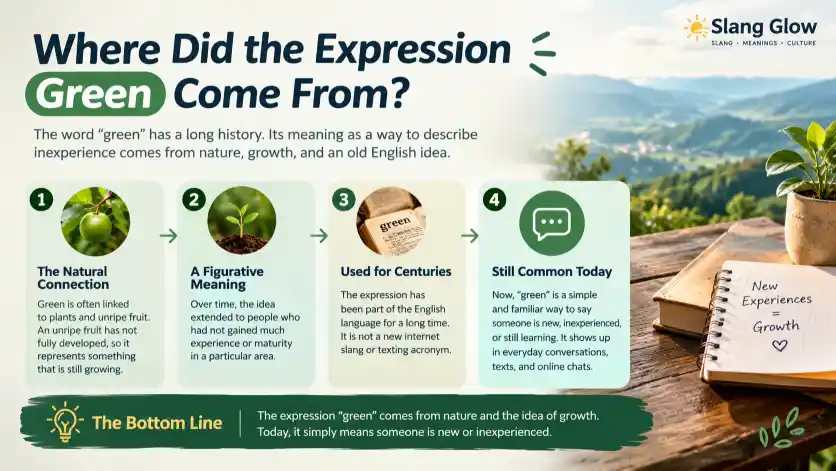
The use of green to describe an inexperienced person did not originate with text messages or social media. It developed from an older figurative use of the word.
Green is associated with plants and unripe fruit. An unripe fruit has not fully developed, and English speakers eventually used the same idea to describe people who lacked experience or maturity in a particular activity.
The meaning has been used in English for centuries. Today, it remains a familiar way to describe someone who is new to a task.
Three points help explain its history:
- Connection with unripe growth: Green can describe something that has not fully developed.
- Figurative meaning: The idea extended to people who had not gained much experience.
- Modern use: The expression continues in speech, writing, workplace conversations, and casual messages.
There is no reason to treat being green as a newly invented internet acronym. It is an ordinary English expression used figuratively.
Does Green Have Other Meanings in English?
Yes. The word has several meanings, and the intended one depends on the sentence.
For example:
- Green with envy: Feeling jealous of someone or something.
- Environmental meaning: Supporting nature friendly or environmentally responsible choices.
- Green light: Permission to begin or proceed with something.
These expressions are different from calling someone green because they lack experience.
Always read the complete sentence before choosing a meaning. The same word can communicate different ideas in different situations.
Being Green vs. Similar Texting Expressions
Several expressions describe people who are new to something or still learning. However, their meanings and uses are not exactly the same.
| Expression | Meaning | Typical use |
| Being green | Inexperienced or new | Describing someone who is still learning |
| Rookie | A beginner or newcomer | Sports, gaming, jobs, and other activities |
| Newbie | Someone who is new to an activity | Online communities, games, and hobbies |
| IDK | I don’t know | Expressing a lack of knowledge |
| IDC | I don’t care | Expressing a lack of concern |
| IMO | In my opinion | Introducing a personal view |
| BRB | Be right back | Saying someone will return shortly |
The main difference is that being green describes a person’s experience level, while IDK, IDC, IMO, and BRB are texting abbreviations used for different purposes.
For example, a person might be green at a new game but still know the meaning of common texting abbreviations. Someone can also use IDK to express uncertainty without being inexperienced in the subject.
These terms are not interchangeable. Choose the expression that matches what you want to communicate.
A Real Life Example of Being Green
Imagine that a student joins a school photography club for the first time. Other members already understand the cameras, lighting, and editing tools, but the new student has never used them before.
During a club meeting, the student struggles to adjust the camera settings. Another member says, “Don’t worry. You’re still green, and you’ll learn with practice.”
In this situation, the member is not necessarily insulting the student. They are explaining that the student is new to photography and has not developed the same experience as the others.
After attending several meetings, the student learns how to use the equipment and begins taking better pictures.
The example shows the central meaning of being green: lacking experience at the moment, not lacking the ability to improve.
The expression becomes easier to understand when you consider what the person is learning, how the word is used, and the speaker’s tone.
Frequently Asked Questions About Being Green
What does being green mean in text messages?
Being green usually means being inexperienced or new to something. The person may still be learning a skill, activity, or situation.
What does being green mean on TikTok?
It may describe someone who is new to a trend, game, or skill. However, the exact meaning depends on the video and surrounding comments.
Is being green slang?
It is an informal, figurative use of an ordinary English word. It is not an acronym or abbreviation.
Is being green rude or offensive?
Not necessarily. It can be neutral or friendly, but it may sound insulting when used to put someone down.
How should you reply when someone calls you green?
You can respond with “I’m still learning,” “Everyone starts somewhere,” or “I’ll get better with practice.” Choose a reply that matches the person’s tone.
Does being green mean being jealous?
Not usually. The expression “green with envy” means jealous, while calling someone green generally means inexperienced.
Is being green only used by young people?
No. People of different ages use the expression in everyday English, including at school, work, and during hobbies.
Final Takeaway
Being green in text usually means being inexperienced, new to something, or still learning. People may use it when discussing work, school, sports, hobbies, or online games.
The expression is not automatically rude, and it does not mean someone will always lack experience. The speaker’s tone and the surrounding conversation help determine if it is friendly, neutral, or critical.
When someone calls you green, you can ask what they mean or simply explain that you are still learning. The most important thing to remember is that being new at something is a stage of learning, not a permanent limitation.
GET THE MORE!

Hi, I’m James Parker, a writer passionate about modern slang, internet culture, and social media language. I enjoy researching trending words and explaining their meanings in simple, easy to understand English. My goal is to help readers confidently understand and use slang in everyday conversations, texting, and online platforms.