In text messages, “be” usually keeps its normal English meaning, while the shortened form “b” can stand for “be.” Its meaning can also change in phrases such as “be fr” or “be like.” Understanding the whole sentence helps you identify what the sender means.
You may see “be” in text messages, TikTok comments, Snapchat conversations, Instagram posts, or online chats. People use it in ordinary sentences, informal expressions, and phrases that communicate reactions or opinions.
Sometimes, readers mistake “be” for an acronym or a special slang term. However, “be” does not have one fixed secret meaning in texting. It is usually a regular English verb, although certain slang expressions and dialects give it specific uses.
This guide explains the different ways people use “be” in messages, with simple meanings, realistic chat examples, and tips for understanding unfamiliar phrases.
What Does Be Mean in Text Messages?
In everyday texting, “be” usually means the same thing it does in standard English. It can describe a state, condition, or action, as in “be careful,” “be ready,” and “be yourself.”
People also shorten the word to “b” in informal messages. For example, “I’ll b there soon” means “I’ll be there soon.” This is a typing shortcut rather than a new slang definition. <Cite refs={[“turn143273search0”]}/>
Here are three important points to remember:
- Normal English word: “Be” is a verb used to describe a state or condition.
- Informal shorthand: The letter “b” can replace “be” in casual messages.
- Context matters: Phrases such as “be fr” have a more specific meaning than the word “be” alone.
For example, imagine your friend texts, “Be ready at 6.” The sender is simply telling you to get ready by that time.
If they write, “I’ll b there in 10,” they are using an informal spelling to save a few characters.
The word itself is not usually slang. Its meaning depends on how someone uses it in a sentence or combines it with other words.
What Does Be Mean in Online Chat Slang?
Although “be” is an ordinary English verb, it appears in several popular informal expressions. In these phrases, the words around it help communicate a particular reaction, request, or idea.
Here are three examples you may encounter:
- Be fr: This means “be for real” and is used to ask someone to be serious or to express disbelief.
- Be like: This phrase often introduces a reaction, thought, or imitation of what someone said or did.
- Be yourself: This means to act naturally rather than pretending to be someone else.
For example, someone might text, “Be fr, did that really happen?” They are asking if the other person is serious.
In another conversation, someone might write, “I was like, be serious!” to describe their reaction to something surprising or unbelievable.
These phrases have their own meanings, but “be” does not become an acronym in them. It remains part of the expression.
Does Be Have a Special Meaning in Slang?
In some varieties of English, particularly African American English, “be” can express an action or situation that happens regularly or habitually. Linguists call this use habitual be.
For example, “She be working late” can mean that she regularly works late, rather than that she is working late at this exact moment. This is a meaningful grammatical feature of the dialect, not simply a mistake or random slang. <Cite refs={[“turn143273search1″,”turn143273search4”]}/>
Keep these distinctions in mind:
- Regular texting: “Be careful” uses the ordinary verb.
- Informal shorthand: “I’ll b there” shortens the spelling.
- Habitual be: In the relevant dialect, “be” can describe something that happens regularly.
Understanding this difference helps you avoid confusing a normal English word, a typing shortcut, and a specific dialect feature.
Where Do People Use Be in Text Messages?
The word “be” appears across nearly every messaging platform because it is part of everyday English. Its use does not depend on one social media app, although informal spelling and slang phrases may be more noticeable in casual online conversations.
Here are some common settings:
- TikTok: People may use phrases such as “be fr” in comments or captions to question a statement or express disbelief.
- Snapchat: Friends might write “b ready” or “I’ll b there” in quick messages.
- Instagram: Users may include “be like” in captions, comments, or conversations to describe reactions.
- WhatsApp: People may use normal sentences with “be” or shorten it to “b” when messaging friends.
- SMS text messages: The word appears in ordinary sentences such as “be careful” or “be home by eight.”
For example, a friend might text, “I’ll b there in 5 minutes.” The meaning is simply that they expect to arrive shortly.
Another person might comment, “Be fr right now,” when reacting to something they find hard to believe.
The app does not determine the meaning on its own. Read the complete phrase to understand if “be” is being used normally, shortened informally, or included in a slang expression.
Real Chat Examples of Be in Text
The following conversations show how “be” and its informal forms can appear in everyday messages. These examples illustrate ordinary English, shorthand, and common phrases.
Example 1: Asking Someone to Get Ready
Emma: “We have to leave at 7.”
Sophie: “Okay, I’ll be ready.”
Meaning: Sophie is saying that she will get ready for the planned departure.
Example 2: Using Be as a Typing Shortcut
Noah: “Where are you?”
Liam: “I’ll b there in 10.”
Meaning: Liam is using “b” as a shortened form of “be.” He expects to arrive in about ten minutes.
Example 3: Reacting With Be Fr
Mia: “He said he finished the entire project in one hour.”
Olivia: “Be fr, how is that possible?”
Meaning: Olivia is expressing disbelief and asking if the statement is serious.
Example 4: Describing a Reaction
Ryan: “What did you say when you heard the news?”
Leo: “I was like, be serious right now!”
Meaning: Leo is describing a reaction of surprise or disbelief.
Example 5: Offering Friendly Advice
Ava: “I’m nervous about meeting everyone tomorrow.”
Ella: “Just be yourself. You’ll be okay.”
Meaning: Ella is encouraging Ava to act naturally and feel comfortable being who she is.
These examples demonstrate that “be” does not have one special meaning in every message. Sometimes it is an ordinary verb, sometimes the letter “b” replaces it, and sometimes it forms part of an expression with a more specific meaning.
More Real Chat Examples of Be in Text Messages
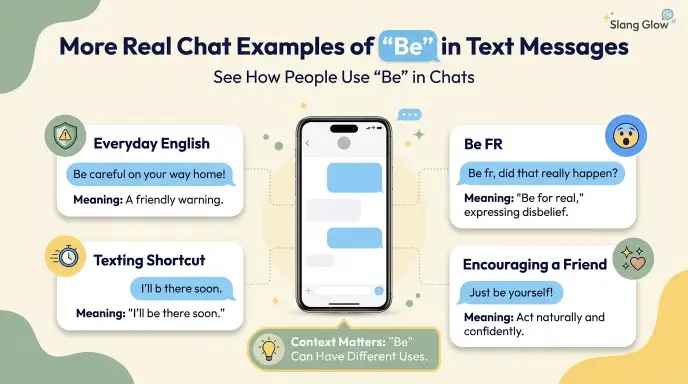
These additional conversations show how people use “be” in everyday messages and informal expressions. The exact meaning depends on the sentence and the way the sender uses the word.
Example 6: Encouraging a Friend
Mia: “I’m nervous about my first day at school.”
Emma: “Be confident! You’ve prepared for this.”
Meaning: Emma is encouraging Mia to feel confident.
Example 7: Making Plans With Friends
Noah: “What time should I arrive?”
Liam: “Be there around six.”
Meaning: Liam is telling Noah to arrive at approximately six o’clock.
Example 8: Reacting to Surprising News
Ava: “He says he finished the entire assignment in ten minutes.”
Sophie: “Be fr! How did he do that?”
Meaning: Sophie uses “be fr,” meaning “be for real,” to express disbelief or ask if the statement is serious.
Example 9: Sharing an Opinion
Ryan: “I think that was the funniest movie I’ve ever watched.”
Leo: “Be honest, did you really like the ending?”
Meaning: Leo is asking Ryan to give an honest opinion. Here, “be” is used in its ordinary English meaning.
Example 10: Describing a Regular Habit
Alex: “Why does your cousin visit the library so often?”
Jordan: “She be studying there after school.”
Meaning: In varieties of English that use habitual “be,” this sentence can mean that she regularly studies at the library after school. This is a specific grammatical feature, not simply a typing shortcut.
These examples show that “be” can be used in ordinary sentences, internet expressions, and particular varieties of English. Always consider the complete sentence before interpreting its meaning.
How Should You Reply When Someone Uses Be in Text?
Your response depends on the phrase containing “be.” If someone uses it in a normal sentence, reply to the message itself. If they use an expression such as “be fr,” understand the intended tone before responding.
Here are four natural ways to reply:
- Casual reply: “Okay, I’ll be there.”
- Friendly reply: “Thanks! I’ll do my best.”
- Playful reply: “I’m being serious 😂.”
- Clarifying reply: “What do you mean by that?”
Example 1: Responding to Be Fr
Friend: “Be fr, did you really finish that project already?”
You: “Yes! I finished it this morning.”
Meaning: Your friend is expressing surprise or asking you to be serious, and you answer directly.
Example 2: Responding to Advice
Friend: “Be yourself. You don’t need to impress everyone.”
You: “You’re right. Thanks for reminding me.”
Meaning: Your friend is encouraging you to act naturally.
Example 3: Clarifying an Unfamiliar Phrase
Friend: “Be like that sometimes.”
You: “What do you mean by that?”
Meaning: You ask for clarification because the phrase could have different meanings depending on the conversation.
You do not need to copy someone else’s slang to respond naturally. A clear, friendly sentence works well in most conversations.
Is Be Rude or Offensive in Text?
The word “be” is not generally rude or offensive by itself. It is an ordinary English verb. However, some expressions containing it can sound challenging, sarcastic, or disrespectful depending on the wording and tone.
For example, “Be careful” is usually a normal warning, while “Be fr!” can sound dismissive when someone uses it to challenge another person’s statement.
Here are three things to consider:
- Ordinary instructions: Phrases such as “be kind” and “be careful” are generally neutral or positive.
- Informal slang: “Be fr” can express playful disbelief, but it may sound rude in a serious conversation.
- Dialect and context: Habitual “be” has a specific grammatical function in some English varieties and should not automatically be interpreted as incorrect or disrespectful.
Is Be Appropriate at School or Work?
The word itself is appropriate in formal and informal settings. What matters is the complete sentence.
For example, “Please be ready for the meeting” is suitable for a professional message. However, an informal expression such as “be fr” may not fit a formal email or school assignment.
Use standard, clear wording when communicating with teachers, colleagues, or people who may not understand internet slang. It helps prevent misunderstandings.
Who Uses Be in Text Messages?
People of different ages use “be” because it is a basic part of English. Its informal uses appear in casual messaging, online discussions, and spoken conversation.
However, not every use belongs to internet slang. Ordinary English, abbreviated texting, and dialect specific grammar are different things.
- Everyday texters: People use “be” in regular messages, such as “be ready” or “I’ll be there.”
- Social media users: Some use phrases such as “be fr” when reacting to surprising or unbelievable statements.
- Speakers of different English varieties: Some grammatical varieties use habitual “be” to describe actions or situations that happen regularly.
Is Be a Gen Z Expression?
“Be” itself is not a Gen Z expression. It is a longstanding English word. Some phrases containing it, such as “be fr,” have become familiar in modern internet culture.
Habitual “be” also has a much longer linguistic history. It is a recognized feature of African American English and occurs in some other English varieties as well.
The meaning depends on how the word is being used, not simply on the speaker’s age.
Where Did the Word Be Come From?
“Be” is an old English verb with roots in the history of the English language. It did not originate as a texting abbreviation or a social media expression.
Its ordinary uses developed over centuries, while particular phrases and grammatical patterns gained their own meanings in different communities.
Three points help explain its use today:
- Traditional English: “Be” is a fundamental verb used to describe states, conditions, and situations.
- Informal texting: People sometimes shorten “be” to “b” to type messages more quickly.
- Modern expressions: Phrases such as “be fr” use the verb as part of an expression with a more specific meaning.
How Did Be Become Part of Internet Slang?
The word itself is not new internet slang. Instead, online culture has helped spread particular phrases containing “be,” including “be fr” and “be like.”
Habitual “be” is different from these modern expressions because it is a grammatical feature used by speakers of particular English varieties to convey recurring or habitual actions.
It is important not to confuse these uses. The ordinary verb, an informal spelling shortcut, a popular internet expression, and a dialect specific grammatical feature do not all mean the same thing.
Be vs. Other Common Texting Abbreviations
The word “be” differs from common texting abbreviations because it usually functions as a verb rather than replacing a longer phrase.
| Term | Meaning | Type | Typical use |
| BE | An English verb | Ordinary word | Describes a state or condition |
| IDK | I don’t know | Abbreviation | Expresses uncertainty |
| IDC | I don’t care | Abbreviation | Expresses a lack of concern |
| IMO | In my opinion | Abbreviation | Introduces a personal opinion |
| BRB | Be right back | Abbreviation | Says someone will return shortly |
These terms serve different purposes:
- BE usually forms part of a sentence, such as “Be careful.”
- IDK communicates that someone does not know something.
- IMO introduces an opinion, while BRB indicates a temporary absence.
For example, “I’ll be there soon” uses the ordinary verb, while “BRB” is shorthand for “be right back.”
Do not assume that every short word is slang or an acronym. Some words have their usual meanings even when they appear in casual text messages.
A Real World Example of Be in Text
Imagine that a student is getting ready for a school presentation. Their friend sends a message to encourage them before they leave home.
Emma: “I’m worried that I’ll forget what to say.”
Lily: “Be confident. You’ve practiced a lot.”
Emma: “Thanks! I’ll try my best.”
Lily: “Just be yourself and speak clearly.”
In this conversation, “be” is used in its ordinary English meaning. Lily encourages Emma to feel confident and act naturally.
Now consider a different message:
Noah: “Be fr, you finished the entire book today?”
Liam: “Yes, I couldn’t put it down.”
Here, “be fr” is an informal expression that communicates disbelief or asks someone to be serious.
These examples show why the surrounding words matter more than the individual word alone. Understanding the phrase helps you interpret the message correctly.
Frequently Asked Questions About Be in Text
What does be mean in text messages?
“Be” usually has its ordinary English meaning. In informal messages, “b” may be used as a shortened spelling, while phrases such as “be fr” have more specific meanings.
What does be mean on TikTok?
The word itself usually has its regular meaning. In a phrase such as “be fr,” it means “be for real” and can express disbelief or ask someone to be serious.
Is be slang?
Not by itself. “Be” is an ordinary English verb, although it appears in many informal expressions and some dialect specific grammatical patterns.
Is be rude or offensive?
No, the word itself is not generally rude. However, expressions such as “be fr” can sound challenging or dismissive depending on the situation.
How should you reply when someone uses be?
Reply according to the complete sentence. You can answer normally, respond to the request, or ask what an unfamiliar expression means.
Final Takeaway
“Be” usually has its normal English meaning in text messages, but its interpretation can change when it appears in shorthand, internet expressions, or particular English dialects.
You may see it in ordinary sentences, phrases such as “be fr,” or expressions that describe recurring actions. The surrounding words help you identify which use applies.
When a message seems confusing, read the full sentence instead of assuming that “be” has one hidden slang meaning. Understanding the context is the simplest way to read the message correctly.
FIND MORE!

Hi, I’m James Parker, a writer passionate about modern slang, internet culture, and social media language. I enjoy researching trending words and explaining their meanings in simple, easy to understand English. My goal is to help readers confidently understand and use slang in everyday conversations, texting, and online platforms.