BEC in text can have different meanings depending on the conversation. In some online communities, it refers to a person whose harmless actions annoy you, while “bec.” can also be used as a shortened form of “because.” The context helps you understand which meaning fits.
You may encounter BEC in private messages, online discussions, social media comments, or conversations about food. Because the same letters can represent different things, it is important to read the full message before deciding what someone means.
One notable internet slang meaning comes from a humorous expression about disliking someone so much that even their ordinary actions become annoying. This usage can sound insulting, so understanding the situation matters.
In this guide, you will learn the possible meanings of BEC, how people use it in conversations, and how to respond when someone sends it to you.
What Does BEC Mean in Text Messages?
BEC does not have one universal meaning in texting. Two interpretations you may encounter are an informal use connected to “because” and an internet slang expression used to describe someone who annoys you even when doing something harmless. These meanings are different, so context is essential.
Here are the main possibilities:
- Because: “Bec.” is sometimes used as a shortened form of “because,” although “bc” is a more familiar texting abbreviation.
- Internet slang: BEC can stand for “bitch eating crackers,” a vulgar expression for a person whose ordinary actions annoy you simply because you already dislike them.
- Other meanings: In a conversation about breakfast, BEC may stand for bacon, egg, and cheese. It can also represent a technical term or an organization’s name.
For example, if someone texts, “She’s my BEC,” they may be using the internet slang expression to say that even small things the person does irritate them.
However, if someone writes “bec.” in the middle of a sentence explaining a reason, they may simply mean “because.”
Do not assume BEC has the same meaning in every message. The topic, sentence, and relationship between the people involved help reveal the intended meaning.
What Does BEC Stand for in Online Slang?
In online slang, BEC often stands for “bitch eating crackers.” It is a humorous but vulgar expression that describes a person whose ordinary behavior annoys someone because that person already dislikes them. The phrase is associated with internet discussions and online snark communities.
Imagine that someone dislikes a particular influencer. The influencer posts a completely ordinary picture of themselves eating crackers, but the viewer still finds something to complain about. The viewer might describe that person as their BEC.
The joke is that even a harmless action becomes irritating when someone has a negative opinion of the person doing it.
Three details help explain this use:
- Personal irritation: The person finds ordinary behavior annoying.
- Existing dislike: The irritation often comes from how they already feel about someone, rather than from the action itself.
- Internet humor: People may use the expression when venting about celebrities, influencers, fictional characters, or people they discuss online.
For example, someone might write, “I know this is petty, but she’s my BEC, so everything she posts annoys me.”
This statement suggests that the speaker recognizes their own bias. It does not prove that the other person has done anything wrong.
Important: This slang expression contains a vulgar insult. It is better suited to understanding online discussions than to using directly against someone in a respectful conversation.
How Is BEC Used in Everyday Chats?
When people use BEC as internet slang, they are usually describing a person who gets on their nerves, even when that person is doing something ordinary. The expression often appears when someone wants to acknowledge that their irritation may be disproportionate.
Consider these possible examples:
- Discussing an influencer: Someone says a creator is their BEC because every post annoys them.
- Talking with friends: A person admits that a particular acquaintance irritates them for little reason.
- Discussing a public figure: Someone uses BEC to describe their strong dislike of a celebrity’s everyday behavior.
For example:
Emma: “Why does everything this influencer does bother me?”
Lily: “Sounds like she’s your BEC.”
Meaning: Lily is suggesting that Emma has become so annoyed with the influencer that even harmless actions bother her.
In contrast, “I missed the bus bec. I woke up late” uses a shortened form of “because,” not the internet slang meaning.
The abbreviation can therefore have very different interpretations. Reading the entire sentence is more reliable than guessing from the letters alone.
What Does BEC Mean on Social Media?
On social media, BEC is especially recognizable in conversations where people discuss influencers, celebrities, reality television, or online personalities they dislike. In these discussions, it usually refers to the “bitch eating crackers” expression rather than the word “because.”
You may encounter it in these situations:
- TikTok: Someone may use BEC in a discussion about a creator whose ordinary behavior irritates them.
- Instagram: The abbreviation may appear in private chats or discussions about public figures.
- Reddit: BEC is used in some snark communities to describe disproportionate annoyance with a person.
- Group chats: Friends may use it as shorthand when discussing someone who repeatedly gets on their nerves.
For example, someone might say, “I think that celebrity is my BEC because even their normal interviews annoy me.”
This means the speaker has a strong negative reaction to the celebrity, even when the celebrity is doing nothing especially irritating.
BEC does not have this meaning in every online post. In a conversation about breakfast, work, science, or another specialized topic, the letters may refer to something entirely different.
Check the surrounding discussion before interpreting the term, especially if you do not know the people or community using it.
How Should You Reply When Someone Uses BEC?
Your response depends on how the other person uses BEC. If they are describing someone who annoys them, you can respond to their opinion without automatically agreeing with their criticism. If they use the letters differently, the surrounding conversation will help you understand what they mean.
Here are some natural ways to respond:
- Casual reply: “I get what you mean.”
- Friendly reply: “Maybe you’re just noticing every little thing they do.”
- Neutral reply: “What happened that made you feel that way?”
- Clarifying reply: “Do you mean the internet slang version of BEC?”
Example 1: Talking About an Influencer
Emma: “She’s my BEC. Even her normal posts annoy me.”
Lily: “Maybe you’ve started noticing everything she does.”
Meaning: Lily recognizes that Emma’s dislike may influence how she views the influencer’s ordinary actions.
Example 2: Discussing Someone’s Behavior
Noah: “I can’t explain it, but everything he does gets on my nerves.”
Ryan: “Sounds like he might be your BEC.”
Meaning: Ryan uses the expression to describe Noah’s disproportionate irritation with someone.
Example 3: Understanding an Unfamiliar Message
Mia: “I keep seeing BEC in comments. What does it mean?”
Olivia: “It can mean ‘bitch eating crackers’ when people discuss someone who annoys them.”
Meaning: Olivia explains the internet slang meaning rather than assuming Mia already knows it.
You do not have to agree with someone’s negative opinion just because they use BEC. A neutral question can help you understand their point without encouraging unfair criticism.
Is BEC Rude or Offensive in Text?
BEC can be considered vulgar or offensive when it stands for “bitch eating crackers.” The expression contains an insulting word and is commonly used to describe someone who irritates the speaker even when doing something harmless.
People sometimes use it humorously among friends or in online discussions. However, its humorous purpose does not make the wording appropriate for every audience.
Here are three important things to consider:
- Private conversations: Friends who understand the expression may use it jokingly when discussing their frustrations.
- Public comments: Using it to target a person can sound insulting, especially when the person is being criticized for harmless behavior.
- School or workplace settings: It is better to avoid the vulgar expression in professional or formal communication.
Can You Use BEC at School or Work?
It is best to avoid using the vulgar version in school assignments, professional emails, workplace chats, or conversations with people you do not know well.
If you want to describe the same feeling more politely, you could say:
- “That person gets on my nerves.”
- “I find myself getting irritated by everything they do.”
- “I think my opinion of them is affecting how I see their actions.”
These alternatives explain the feeling without using an insulting expression.
Remember that BEC describes the speaker’s reaction, not proof that the other person has done something wrong. Recognizing that difference can help people discuss their feelings more fairly.
Who Uses the Expression BEC?
BEC is especially recognizable in online spaces where people discuss celebrities, influencers, reality television, public personalities, or everyday frustrations. It is also used in conversations between friends who understand the reference.
Some communities use the term to acknowledge that their dislike of someone may have become disproportionate.
You may encounter it in these situations:
- Online discussion groups: Members may describe a public figure as their BEC when even ordinary posts irritate them.
- Friendship conversations: Someone may use it while admitting that a particular person’s behavior bothers them more than it reasonably should.
- Entertainment discussions: Viewers may use the phrase when talking about contestants, characters, or personalities they find irritating.
Is BEC a Gen Z Expression?
BEC appears in modern internet conversations, but it is not exclusive to Gen Z. It became established in online culture during the 2010s and continues to appear in discussion forums and social media communities.
People from different age groups may recognize it, although familiarity varies. Someone outside the communities where it is used may not understand the abbreviation immediately.
BEC is an internet slang expression, not a term that belongs to only one generation. Its meaning depends on the community and the context in which it appears.
Where Did BEC Come From?
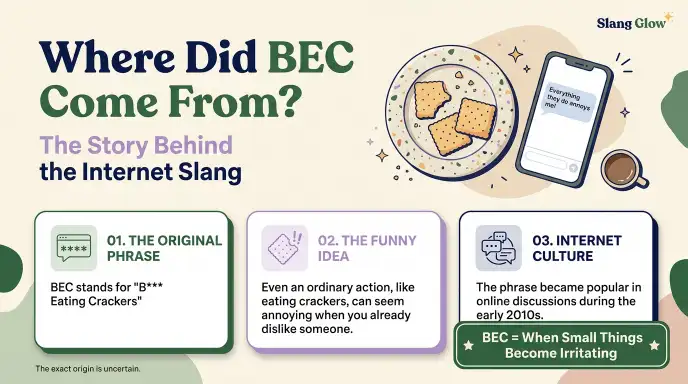
The expression “bitch eating crackers” became known through internet humor. It describes the idea that when you strongly dislike someone, even seeing them perform an ordinary action, such as eating crackers, can annoy you.
The phrase circulated online during the early 2010s. An entry on Know Your Meme traces an early known use to a Twitter post from 2011, although the exact origin may be difficult to establish with absolute certainty.
Three details explain the expression’s development:
- An ordinary action: Eating crackers represents something harmless that would not normally deserve criticism.
- A strong negative opinion: The speaker already dislikes the person, making even small actions irritating.
- Internet humor: The contrast between a trivial action and a strong reaction makes the expression recognizable as a joke about personal bias.
Why Does the Phrase Mention Crackers?
The crackers are the point of the joke. Eating a simple snack is an ordinary activity, but the speaker treats it as annoying because of their existing dislike of the person.
For example, someone might say, “I know she’s doing nothing wrong, but she’s my BEC today.”
That statement suggests the speaker understands that their irritation may not be reasonable.
The phrase became memorable because it turns a small, harmless action into an exaggerated example of dislike. It is a humorous description of a reaction, not evidence that the person being discussed deserves criticism.
BEC vs. Similar Internet Expressions
BEC is different from other common abbreviations and expressions used to communicate annoyance or disagreement. Knowing the difference helps you understand what someone intends to say.
| Term | Meaning | Main use |
| BEC | Bitch eating crackers | Describes disproportionate irritation with someone |
| IDK | I don’t know | Expresses uncertainty |
| IDC | I don’t care | Expresses a lack of concern |
| IMO | In my opinion | Introduces a personal opinion |
| BRB | Be right back | Says someone will return shortly |
| Annoying | Causing irritation | Describes something that bothers someone |
These terms are not interchangeable.
For example, IDK tells someone that you do not know something, while IDC expresses that you do not care about it. BEC, in its internet slang meaning, describes a person’s strong irritation with someone else.
It is also important to distinguish BEC from the shortened spelling “bec.” used by some people to mean “because.” That informal spelling does not carry the same meaning as the vulgar internet expression.
A Real World Example of BEC
Imagine that two friends are discussing a popular online creator. One friend has disliked the creator for a long time and now finds nearly every post irritating.
Emma: “She posted a picture of her breakfast, and somehow that annoyed me too.”
Lily: “Maybe she’s become your BEC.”
Emma: “Honestly, I think you’re right. Even normal things she posts bother me.”
In this situation, BEC describes Emma’s reaction to the creator. The breakfast post itself is ordinary, but Emma’s existing dislike affects how she responds to it.
The example does not establish that the creator did anything wrong. It simply shows how a person’s opinion can influence their interpretation of harmless behavior.
This is the central idea behind BEC: sometimes our feelings about a person affect how we judge even the smallest things they do.
Frequently Asked Questions About BEC
What does BEC mean in text messages?
In internet slang, BEC commonly stands for “bitch eating crackers.” It describes someone whose ordinary actions annoy the speaker because the speaker already dislikes them. Other meanings are possible in different contexts.
What does BEC mean on social media?
On social media, BEC often appears in discussions about influencers, celebrities, or people whose normal behavior irritates the speaker. It is particularly recognizable in online snark discussions.
Is BEC considered slang?
Yes. In the expression “bitch eating crackers,” BEC is an initialism used in internet slang. It is not a universally understood abbreviation, so context matters.
Is BEC rude or offensive?
The slang expression is vulgar because it includes an insulting word. Its meaning may be humorous, but it is not appropriate for every audience or situation.
How should you reply when someone uses BEC?
You can ask what made them feel that way, respond neutrally, or simply acknowledge their opinion. You do not need to agree with their criticism.
Does BEC always mean “bitch eating crackers”?
No. BEC can have other meanings in food, technical, business, and other specialized contexts. The internet slang meaning is most likely when someone discusses a person who annoys them.
Final Takeaway
BEC commonly stands for “bitch eating crackers” in internet slang. It describes a person whose ordinary actions become irritating to someone who already dislikes them.
You may see it in social media discussions, online forums, and casual conversations about influencers, celebrities, or everyday frustrations. Although people sometimes use the expression humorously, it contains vulgar language and can sound insulting.
The key is to understand both the meaning and the tone. If someone calls another person their BEC, they may be acknowledging that their dislike has influenced how they see that person’s behavior.
Use context to interpret the abbreviation, and choose respectful language when discussing other people.
EXPLORE MORE!

Hi, I’m James Parker, a writer passionate about modern slang, internet culture, and social media language. I enjoy researching trending words and explaining their meanings in simple, easy to understand English. My goal is to help readers confidently understand and use slang in everyday conversations, texting, and online platforms.