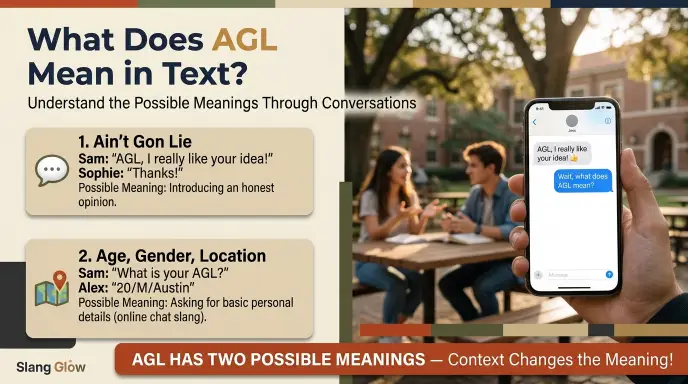
AGL in text can mean “Ain’t Gon Lie” or “Age, Gender, Location,” depending on the conversation. The first introduces an honest opinion, while the second asks someone for basic personal details. The surrounding words help identify the intended meaning.
You may encounter AGL in text messages, Snapchat conversations, Instagram comments, gaming chats, and online communities. Because these three letters have different interpretations, understanding the message can be confusing.
For example, someone might write “AGL, that movie was amazing” to introduce an honest opinion. In another conversation, someone might simply ask “AGL?” when requesting age, gender, and location.
AGL is an uncommon, context dependent abbreviation rather than a texting shortcut with one fixed meaning. This guide explains its different uses, real chat examples, and ways to understand it correctly.
What Does AGL Mean in Text Messages?
In casual online conversations, AGL can stand for “Ain’t Gon Lie,” meaning “I’m going to be honest.” It is used before an opinion, personal thought, or honest reaction. Another interpretation is “Age, Gender, Location,” which is used when asking someone for basic personal details. <Cite refs={[“turn752664search1″,”turn752664search2″,”turn752664search4”]}/>
Here are three important points to remember:
- Ain’t Gon Lie: Used to introduce an honest opinion or reaction.
- Age, Gender, Location: Used as a request for someone’s basic personal information.
- Context matters: The sentence and conversation help determine which meaning applies.
Consider these examples:
Example 1: Sharing an Honest Opinion
Emma: “Did you enjoy the movie?”
Sophie: “AGL, it was better than I expected.”
Meaning: Sophie is honestly sharing her opinion about the movie.
Example 2: Asking for Personal Details
Alex: “Someone asked me AGL in a chat.”
Jordan: “They may be asking for your age, gender, and location.”
Meaning: Jordan explains the possible meaning of the abbreviation.
Example 3: Expressing a Reaction
Mia: “What do you think of this song?”
Olivia: “AGL, I really like it!”
Meaning: Olivia is introducing her honest opinion.
The important difference is how AGL appears in the sentence. When it comes before an opinion, it may mean “Ain’t Gon Lie.” When someone asks “AGL?” by itself, they may be requesting personal details.
What Does AGL Stand for in Online Slang?
AGL has more than one interpretation in online communication. Its two relevant chat meanings are “Ain’t Gon Lie” and “Age, Gender, Location.”
Here is how they differ:
- Ain’t Gon Lie: A casual expression similar to “Honestly” or “To be honest.”
- Age, Gender, Location: A shortened request for someone’s age, gender, and general location.
- Technical meaning: Outside casual texting, AGL can also mean “Above Ground Level,” particularly in aviation and other technical fields. <Cite refs={[“turn752664search32″,”turn752664search13”]}/>
For example:
Noah: “AGL, your new artwork looks amazing.”
Liam: “Thank you! I worked hard on it.”
Meaning: Noah is introducing an honest compliment.
Now consider another example:
Ryan: “Someone messaged me asking for my AGL.”
Leo: “They might be asking about your age, gender, and location.”
Meaning: Ryan is discussing a request for personal details.
AGL does not have one universally accepted full form in texting. Reading the complete message is the best way to identify the intended meaning.
Where Do People Use AGL?
AGL may appear in different online environments, especially where people use short expressions to communicate quickly. Its meaning can change depending on If someone is sharing an opinion or asking for personal details.
Here are some situations where you might encounter it:
- Text messages: Someone may use AGL before sharing an honest thought.
- Snapchat: The abbreviation may appear in informal conversations or personal introductions.
- Instagram: Someone might use it when reacting to a picture, video, or opinion.
- WhatsApp: Friends may use AGL in group conversations or private messages.
- Gaming chats: It may appear in introductions or conversations where people ask about basic personal details.
For example:
Mia: “What did you think about the new design?”
Olivia: “AGL, it looks really good.”
Meaning: Olivia is expressing her honest opinion about the design.
Another example:
Emma: “Someone in the chat asked for my AGL.”
Sophie: “Check who is asking before sharing personal details.”
Meaning: Sophie recognizes that the abbreviation may be requesting personal information.
You do not have to share your personal details just because someone asks for AGL. You can ignore the request or ask why the person needs that information.
What Does AGL Mean on TikTok, Snapchat, and Instagram?
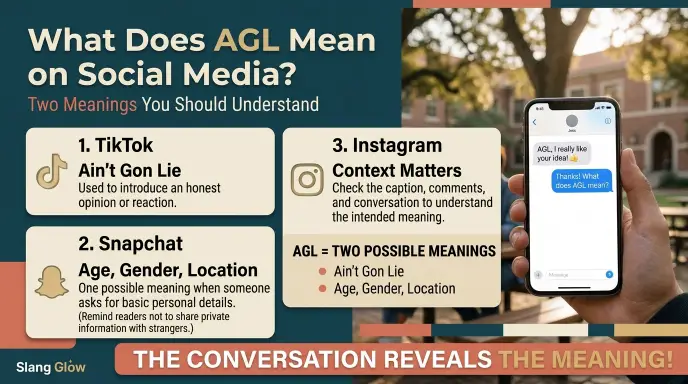
On social media, AGL can have different interpretations depending on the post or conversation. It may introduce an honest opinion or refer to a request for age, gender, and location.
Here are some possible situations:
- TikTok: AGL may appear before someone’s honest reaction to a video or trend.
- Snapchat: Someone might use it in a message or ask for personal details in a conversation.
- Instagram: It may appear in comments when someone shares a direct opinion.
- WhatsApp: People may use AGL when discussing something honestly or asking about an unfamiliar abbreviation.
- Online gaming: Users may encounter it in introductions or chat room conversations.
For example:
Noah: “AGL, that video was hilarious.”
Liam: “I couldn’t stop laughing either!”
Meaning: Noah is introducing an honest reaction to the video.
Another example:
Mia: “What does AGL mean?”
Olivia: “It can mean Ain’t Gon Lie or Age, Gender, Location.”
Meaning: Olivia explains the two possible interpretations.
Remember that AGL is not a universally recognized TikTok or Instagram code. Some people may understand it immediately, while others may need an explanation.
Real Chat Examples of AGL in Text Messages
The following conversations show how AGL may appear in different situations. Some examples use the meaning “Ain’t Gon Lie,” while others demonstrate “Age, Gender, Location.”
Example 1: Talking About a Movie
Emma: “Did you like the new movie?”
Sophie: “AGL, I loved the ending!”
Meaning: Sophie is honestly expressing her opinion.
Example 2: Complimenting a Friend
Noah: “What do you think of my new shoes?”
Liam: “AGL, they look great!”
Meaning: Liam is introducing a genuine compliment.
Example 3: Sharing an Opinion
Mia: “Do you like this song?”
Olivia: “AGL, it’s one of my favorites.”
Meaning: Olivia is sharing her honest opinion about the song.
Example 4: Asking About an Abbreviation
Ryan: “Someone just asked me AGL. What does that mean?”
Leo: “They may mean age, gender, and location.”
Meaning: Leo explains the personal information interpretation.
Example 5: Giving an Honest Reaction
Ava: “How was the school event?”
Ella: “AGL, it was really enjoyable.”
Meaning: Ella is giving her honest reaction to the event.
These examples show why context matters when interpreting AGL. The same letters can introduce an opinion or represent a request for personal details. If someone asks you for personal information, remember that you are not required to share it.
More Real Chat Examples of AGL in Text Messages
AGL can appear in different conversations depending on what someone wants to communicate. It may introduce an honest opinion or refer to a request for age, gender, and location.
Here are five additional examples:
Example 6: Giving an Honest Opinion
Emma: “Do you like my new haircut?”
Sophie: “AGL, it looks really good!”
Meaning: Sophie is honestly expressing her opinion and complimenting Emma’s haircut.
Example 7: Talking About a Movie
Noah: “Was the movie worth watching?”
Liam: “AGL, I enjoyed every minute!”
Meaning: Liam is introducing his honest opinion about the movie.
Example 8: Asking About an Abbreviation
Mia: “Someone messaged me AGL. What does it mean?”
Olivia: “They might mean age, gender, and location.”
Meaning: Olivia explains that someone may be requesting basic personal information.
Example 9: Sharing a Personal Reaction
Ryan: “What did you think of the new song?”
Leo: “AGL, it’s better than I expected.”
Meaning: Leo is sharing his honest reaction.
Example 10: Responding to a Personal Question
Ava: “Someone online asked me for my AGL.”
Ella: “You don’t have to share personal details with strangers.”
Meaning: Ella reminds Ava that she can protect her privacy and decline the request.
These examples show that the position of AGL matters. Before an opinion, it may mean “Ain’t Gon Lie.” As a standalone question, it may refer to “Age, Gender, Location.”
How Should You Reply When Someone Uses AGL?
Your response depends on which meaning the sender intends. If someone uses AGL before sharing an opinion, you can respond to what they say. If someone asks for your AGL, you can ask why they need that information or decline to share it.
Here are four natural ways to respond:
- Casual reply: “Okay, I see what you mean!”
- Friendly reply: “Thanks for being honest!”
- Funny reply: “Now that’s an honest opinion! 😂”
- Privacy focused reply: “I’d rather not share personal information.”
Example 1: Someone Shares an Honest Opinion
Emma: “AGL, your presentation was really good.”
Sophie: “Thank you! I worked hard on it.”
Meaning: Sophie appreciates Emma’s honest compliment.
Example 2: Someone Asks for AGL
Noah: “What’s your AGL?”
Liam: “What do you need that information for?”
Meaning: Liam asks why the person wants personal details before deciding If to continue the conversation.
Example 3: You Prefer Not to Share Details
Mia: “Someone asked me for my AGL.”
Olivia: “You can simply say that you’d rather keep that information private.”
Meaning: Olivia suggests a polite way to protect personal information.
You are never required to share your age or location with someone online. Be especially careful with strangers, and never provide your exact address or live location.
Is AGL Rude or Offensive in Text?
AGL is not generally considered a rude or offensive abbreviation. When it means “Ain’t Gon Lie,” it introduces an honest opinion. When it means “Age, Gender, Location,” it refers to a request for personal details.
However, the second use can feel intrusive when someone asks without explaining why.
Here are three important points:
- Honest expression: AGL can introduce a direct opinion without being offensive.
- Personal information request: Asking someone for age, gender, and location may make them uncomfortable.
- Context matters: The intention behind the message helps determine If it feels friendly, unnecessary, or intrusive.
Is AGL Appropriate at School or Work?
When AGL means “Ain’t Gon Lie,” it may appear in casual conversations with friends. However, the complete phrase or a more formal expression is clearer in professional communication.
For example:
Instead of writing:
“AGL, your work looks great.”
You can write:
“Honestly, your work looks great.”
When AGL refers to personal details, it is important to respect everyone’s privacy.
AGL itself is not a swear word, but asking someone for personal information without a good reason may be inappropriate.
Who Uses the Abbreviation AGL?
AGL appears in different online communities, but it is an uncommon abbreviation rather than a universal texting shortcut. Its use depends on the conversation and the community.
You may encounter it in these situations:
- Casual texters: People may use AGL before sharing an honest opinion.
- Online communities: Some users may recognize it as a request for age, gender, and location.
- Gaming conversations: It may appear in introductions or informal discussions.
- Social media users: People may encounter it in comments, captions, or private messages.
Is AGL a Gen Z Texting Term?
AGL is not exclusive to Gen Z. Both interpretations have appeared in online communication, although the abbreviation is less widely recognized than NGL, IDK, or BRB.
The age, gender, and location interpretation is associated with older online chat room shorthand. The “Ain’t Gon Lie” interpretation is used as an informal way to introduce an honest statement. <Cite refs={[“turn672472search0″,”turn672472search1”]}/>
It is better to understand AGL through context rather than assuming that everyone from one generation uses it the same way.
Where Did AGL Come From?
AGL does not have one clearly established origin because it has more than one possible meaning in online communication.
Older user submitted slang records list “Age, Gender, Location” as an interpretation dating back to October 2006. Another entry lists “Ain’t Gon Lie” from June 2011. These dates document submitted entries, not necessarily the first time either expression was used. <Cite refs={[“turn672472search0”]}/>
Three points help explain its background:
- Chat room shorthand: Age, Gender, Location developed as a compact way to request basic details during online introductions.
- Informal expressions: “Ain’t Gon Lie” uses shortened spoken English to introduce an honest opinion.
- Internet communication: Online communities helped different interpretations of the same letters circulate.
Did AGL Originate on TikTok?
There is no reliable evidence that AGL originated on TikTok or Instagram.
Both interpretations have connections to earlier online communication. Modern social media may help people encounter the abbreviation, but that does not establish where it originally began.
The exact creator and first use of AGL are not confirmed. It is more accurate to describe its different online uses separately rather than give it one invented origin story.
AGL vs. Other Common Texting Abbreviations
AGL is different from familiar texting shortcuts because it can represent two separate expressions depending on the situation.
| Term | Meaning | Type | Typical Usage |
| AGL | Ain’t Gon Lie / Age, Gender, Location | Context dependent initialism | Honesty or personal details |
| NGL | Not Gonna Lie | Initialism | Introducing an honest opinion |
| IDK | I Don’t Know | Initialism | Expressing uncertainty |
| IMO | In My Opinion | Initialism | Sharing a personal opinion |
| BRB | Be Right Back | Initialism | Saying someone will return |
These abbreviations serve different purposes:
- AGL can introduce an honest opinion or request personal information.
- NGL and IMO are commonly used when sharing thoughts or opinions.
- IDK and BRB communicate uncertainty or temporary absence.
For example:
“AGL, that movie was amazing.”
Here, AGL introduces an honest opinion.
In contrast:
“NGL, I didn’t enjoy that movie.”
NGL has a similar conversational purpose but a different full form.
AGL and NGL can sometimes be used in similar situations, but they are not the same abbreviation.
A Real World Example of AGL in a Conversation
Imagine two friends are discussing a new movie they watched recently.
Emma: “Did you enjoy the movie?”
Sophie: “AGL, I thought it would be boring.”
Emma: “Really? What did you think after watching it?”
Sophie: “It was actually one of the best movies I’ve seen!”
In this conversation, Sophie uses AGL to introduce an honest opinion. She is explaining what she genuinely thought about the movie.
Now consider another situation:
Noah: “Someone online asked me for my AGL.”
Liam: “Do you know why they need those details?”
Noah: “No, so I’m not sharing them.”
Here, AGL refers to age, gender, and location.
Both examples demonstrate why the surrounding conversation is important. One use introduces an honest opinion, while the other may request personal information.
Frequently Asked Questions About AGL
Q.1. What does AGL mean in text messages?
AGL can mean “Ain’t Gon Lie” or “Age, Gender, Location.” The intended meaning depends on the conversation.
Q.2. What does AGL mean on TikTok?
On TikTok, AGL may introduce an honest opinion or refer to a request for basic personal details, depending on the context.
Q.3. Is AGL considered slang?
Yes. AGL can be used as informal internet shorthand, although it is not as widely recognized as NGL or IDK.
Q.4. Is AGL rude or offensive?
No. AGL is not inherently offensive. However, asking strangers for personal information may feel intrusive.
Q.5. How should you reply when someone uses AGL?
You can respond naturally to an honest opinion. If someone asks for your personal details, you can say, “I’d rather keep that information private.”
Q.6. Does AGL mean the same as NGL?
No. AGL can mean “Ain’t Gon Lie,” while NGL means “Not Gonna Lie.” They have similar uses when introducing honest opinions, but their wording is different.
Final Takeaway
AGL has two possible meanings in online communication: “Ain’t Gon Lie” and “Age, Gender, Location.” The first introduces an honest thought, while the second refers to a request for personal details.
You may encounter the abbreviation in text messages, gaming conversations, social media comments, and online introductions.
Always check the surrounding sentence before deciding what AGL means. If someone asks for your personal information, remember that you can decline and keep your details private.
FIND MORE!

Hi, I’m James Parker, a writer passionate about modern slang, internet culture, and social media language. I enjoy researching trending words and explaining their meanings in simple, easy to understand English. My goal is to help readers confidently understand and use slang in everyday conversations, texting, and online platforms.