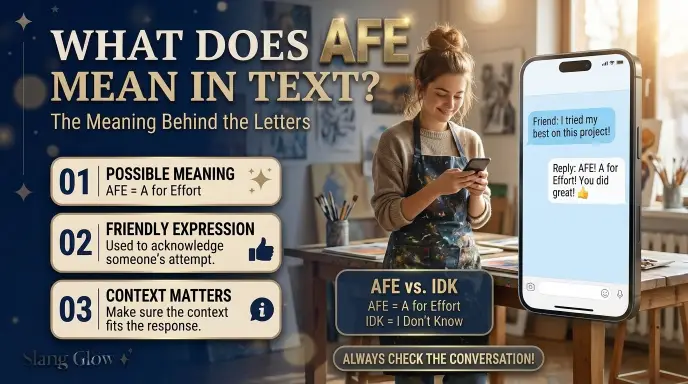
What does AFE mean in text? AFE does not have one widely recognized meaning in everyday texting. Some online abbreviation references list it as “A for Effort,” a phrase used to recognize someone’s attempt, even when the result is not perfect. Its intended meaning depends on the conversation and how the sender uses it.
You may encounter AFE in text messages, Instagram comments, Snapchat conversations, group chats, or online discussions. Because it is less familiar than abbreviations such as LOL and BRB, its meaning can be confusing.
The phrase “A for Effort” is generally used as encouragement or lighthearted praise. However, AFE itself is not a universally established texting shortcut, so you should not assume everyone understands it the same way.
This guide explains the possible meaning of AFE, where it may appear, and how to interpret it through simple conversation examples.
What Does AFE Mean in Text Messages?
AFE may stand for “A for Effort” in some informal abbreviation references, but it does not have one confirmed, widely accepted texting meaning. The phrase recognizes that someone tried hard, even if the outcome was not successful. <Cite refs={[“turn728857search0″,”turn728857search2”]}/>
For example, someone might use the phrase “A for effort” when a friend attempts something difficult but does not get the expected result.
Here are three important points to remember:
- Recognizing effort: “A for Effort” can be used to appreciate someone’s attempt.
- Informal expression: It may sound encouraging, playful, or slightly sarcastic depending on the situation.
- Context matters: AFE is uncommon as a texting abbreviation, so its intended meaning should be checked.
Consider this conversation:
Emma: “I tried making a birthday cake, but it didn’t turn out well.”
Sophie: “A for effort! At least you tried.”
Meaning: Sophie is recognizing Emma’s attempt rather than judging the final result.
Remember that this example uses the complete phrase. Not everyone would shorten it to AFE in an ordinary text message.
The safest interpretation is to treat AFE as an uncommon abbreviation that needs context, rather than assuming it always means “A for Effort.”
What Does AFE Stand for in Online Slang?
AFE consists of three letters, but it does not have one universally recognized full form in internet slang. Some abbreviation directories list “A for Effort” as a possible expansion, while other references include different meanings. <Cite refs={[“turn728857search0″,”turn728857search6”]}/>
The intended meaning can depend on the subject and the community using it.
Here are three possibilities to understand:
- A for Effort: A phrase that recognizes someone’s attempt or hard work.
- Personal shorthand: A person or friend group may use AFE for a phrase that they understand.
- Specialized abbreviation: In professional, educational, or technical discussions, AFE may represent an unrelated term.
For example:
Alex: “I spent the whole afternoon trying to fix the project.”
Jordan: “A for effort! You really worked hard on it.”
Meaning: Jordan is appreciating Alex’s effort, even if the project still needs improvement.
Another important point is that “A for Effort” can sometimes be used sarcastically. The tone depends on the relationship between the people and the situation.
Do not assume AFE is a popular social media code with one fixed definition. If someone sends only those three letters, asking what they mean is a better option than guessing.
Where Do People Use AFE?
AFE is not among the most widely recognized texting abbreviations. However, you may encounter the letters in casual messages, group conversations, or discussions involving effort and achievement.
Here are some possible situations:
- Text messages: Someone may use the initials as personal shorthand when discussing an attempt or achievement.
- Group chats: Friends may create their own abbreviation for a phrase they use regularly.
- Social media comments: Someone may use the complete phrase “A for Effort” when reacting to another person’s attempt.
- Educational discussions: The phrase may appear when someone recognizes another person’s work or participation.
- Online communities: AFE may appear with different meanings depending on the subject being discussed.
For example:
Mia: “I tried drawing that picture, but it looks completely different.”
Olivia: “A for effort! You gave it a try.”
Meaning: Olivia is encouraging Mia and appreciating her attempt.
It is important to distinguish between the phrase itself and the abbreviation. “A for Effort” is understandable English, but writing only AFE may confuse readers who have never seen that shortened form.
Use the complete phrase when clarity matters. This makes your message easier to understand, especially when talking to people unfamiliar with the abbreviation.
What Does AFE Mean on TikTok, Snapchat, and Instagram?
AFE does not have one established meaning across TikTok, Snapchat, and Instagram. Its interpretation depends on the post, caption, comment, and conversation surrounding it.
Here are some situations where you might encounter it:
- TikTok: Someone may use “A for Effort” when reacting to a person’s attempt in a video.
- Snapchat: A friend may use the complete phrase to encourage someone after an unsuccessful attempt.
- Instagram: The expression may appear in comments when someone wants to recognize another person’s effort.
- WhatsApp: Friends may use the phrase while discussing schoolwork, creative projects, or everyday activities.
- SMS messages: Someone may use it as a playful response when a friend tries something challenging.
For example:
Noah: “I tried learning a new dance, but I got every move wrong.”
Liam: “A for effort!”
Meaning: Liam is appreciating Noah’s attempt rather than focusing on the mistakes.
You may also see AFE in a professional or specialized post where it has an unrelated meaning.
Do not automatically assume that AFE is a popular TikTok or Gen Z abbreviation. The full conversation is the best way to understand what the sender intends.
Real Chat Examples of AFE in Text Messages
The following examples illustrate how someone might use the phrase “A for Effort” in everyday conversations. They are examples of the complete phrase, not proof that AFE is a commonly recognized abbreviation.
Example 1: Trying Something New
Emma: “I tried painting for the first time.”
Sophie: “A for effort! Keep practicing.”
Meaning: Sophie appreciates Emma’s willingness to try something new.
Example 2: Talking About a School Project
Noah: “My project didn’t look exactly how I planned.”
Liam: “A for effort. You clearly worked hard.”
Meaning: Liam recognizes Noah’s hard work despite the imperfect result.
Example 3: Making a Creative Attempt
Mia: “I tried making a handmade birthday card.”
Olivia: “A for effort! That’s a thoughtful idea.”
Meaning: Olivia appreciates Mia’s attempt and creativity.
Example 4: Encouraging a Friend
Ryan: “I attempted to fix my computer, but it still isn’t working.”
Leo: “A for effort! At least you gave it a try.”
Meaning: Leo acknowledges Ryan’s attempt, even though the problem remains.
Example 5: Using the Phrase Playfully
Ava: “I tried telling a joke, but nobody laughed.”
Ella: “A for effort! 😂”
Meaning: Ella responds humorously while acknowledging Ava’s attempt.
These examples demonstrate how “A for Effort” can be used as encouragement or lighthearted praise. If someone sends only AFE, remember that the abbreviation itself is less established and may need clarification.
More Real Chat Examples of AFE in Text Messages
The phrase “A for Effort” can appear in conversations when someone wants to recognize another person’s attempt, even if the result is not perfect. Here are five more examples showing how it can be used naturally.
Example 6: Trying a New Recipe
Emma: “I tried baking cookies, but they came out too hard.”
Sophie: “A for effort! At least you tried.”
Meaning: Sophie appreciates Emma’s attempt at baking.
Example 7: Learning a New Skill
Noah: “I tried playing the guitar today.”
Liam: “A for effort! Keep practicing.”
Meaning: Liam encourages Noah for trying something new.
Example 8: Completing an Assignment
Mia: “I couldn’t finish every question, but I tried my best.”
Olivia: “A for effort. You can finish the rest next time.”
Meaning: Olivia recognizes Mia’s hard work.
Example 9: Making Someone Laugh
Ryan: “I prepared a joke, but nobody laughed.”
Leo: “A for effort! Maybe next time.”
Meaning: Leo responds playfully while appreciating Ryan’s attempt.
Example 10: Trying Something Creative
Ava: “I made a handmade gift for my friend.”
Ella: “A for effort! That’s really thoughtful.”
Meaning: Ella appreciates Ava’s creativity and effort.
These examples show that “A for Effort” is generally used to recognize someone’s attempt. However, the abbreviation AFE itself may not be understood by everyone.
How Should You Reply When Someone Uses AFE?
Your response depends on the conversation and what the sender means by AFE. If someone is using it to recognize your effort, you can respond with a simple thank you or a friendly comment.
Here are four natural ways to reply:
- Casual reply: “Thanks! I really tried.”
- Friendly reply: “I appreciate that!”
- Funny reply: “At least I get points for trying! 😂”
- Neutral reply: “Thank you for noticing my effort.”
Example 1: Someone Appreciates Your Attempt
Emma: “A for effort! You worked hard on that project.”
Sophie: “Thank you! I’ll improve it next time.”
Meaning: Sophie appreciates the encouragement and plans to keep improving.
Example 2: Receiving a Friendly Comment
Noah: “I tried learning a new skill today.”
Liam: “A for effort!”
Noah: “Thanks! Practice makes progress.”
Meaning: Noah responds positively to Liam’s encouragement.
Example 3: Clarifying an Unknown Abbreviation
Mia: “Someone sent me AFE. What does it mean?”
Olivia: “Did they mean A for Effort?”
Meaning: Olivia suggests a possible interpretation rather than assuming it is correct.
You do not need to use AFE in your reply. Simple expressions such as “Thanks,” “I appreciate it,” and “I’ll keep trying” work naturally.
Is AFE Rude or Offensive in Text?
AFE is not inherently rude or offensive. When someone uses it to mean “A for Effort,” it usually communicates encouragement or recognition.
However, the tone depends on how the phrase is used. Sometimes, “A for Effort” can sound sarcastic if someone uses it to make fun of an unsuccessful attempt.
Here are three important points:
- Positive use: It can recognize someone’s effort and encourage them to continue.
- Sarcastic use: It may sound slightly mocking when the speaker does not genuinely appreciate the attempt.
- Context matters: The relationship between the people and the surrounding words help explain the intended tone.
Is AFE Appropriate at School or Work?
Yes. The complete phrase “A for Effort” can be appropriate in educational and workplace conversations when used sincerely.
For example, a teacher might recognize a student’s hard work even when an assignment needs improvement. A colleague might use the phrase to appreciate someone’s attempt at solving a problem.
However, the abbreviation AFE may confuse people who do not recognize it.
Using the complete phrase is usually clearer in professional emails, school assignments, and formal communication.
Who Uses the Expression AFE?
The phrase “A for Effort” can be used by people in different age groups and social settings. It is not limited to one generation or social media platform.
You may encounter it in these situations:
- Students: They may use it when discussing schoolwork, projects, or attempts at learning something new.
- Friends: People may use it to encourage each other after an unsuccessful attempt.
- Social media users: The complete phrase may appear in comments reacting to creative work or personal achievements.
- Workplace conversations: Colleagues may use it informally to recognize someone’s effort.
Is AFE a Gen Z Texting Term?
AFE is not an established Gen Z expression with one widely recognized meaning. The phrase “A for Effort” is familiar English, but its shortened form may not be understood by everyone.
Younger users may encounter it in online conversations, while other people may use the full phrase in everyday communication.
It is better to describe AFE as an uncommon abbreviation or possible shorthand rather than a popular texting expression used by everyone.
Where Did AFE Come From?
The phrase “A for Effort” comes from the familiar practice of recognizing someone’s attempt or hard work, even when the final result is not perfect.
The letter A is commonly associated with a high grade in educational grading systems. The expression uses this idea humorously to recognize effort rather than the actual result.
Three points help explain its use:
- Educational connection: The letter A is commonly associated with strong academic performance.
- Encouragement: The phrase recognizes someone’s attempt, even when the outcome could be better.
- Informal communication: People may use it in everyday conversations, comments, and friendly messages.
Did AFE Originate on Social Media?
There is no reliably established evidence that AFE originated on TikTok, Instagram, or another particular social media platform.
The complete phrase “A for Effort” is understandable English that can be used without internet slang.
The exact origin of AFE as a shortened texting abbreviation is unclear. It is more accurate to distinguish the familiar phrase from its less established abbreviation.
AFE vs. Other Common Texting Abbreviations
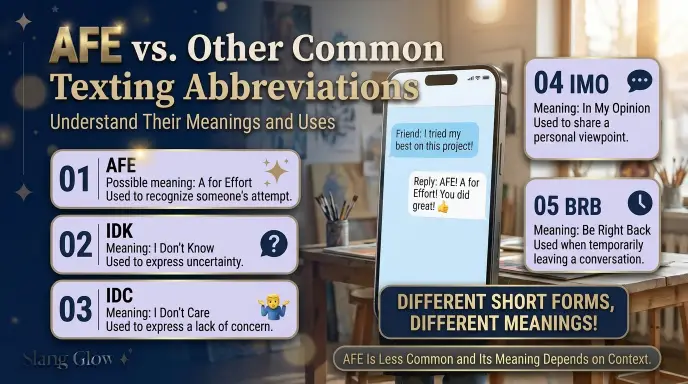
AFE differs from common texting abbreviations because it is a possible shortened form of a phrase rather than a widely recognized everyday initialism.
| Term | Meaning | Type | Typical Usage |
| AFE | Sometimes used for A for Effort | Uncommon abbreviation | Recognizing someone’s attempt |
| IDK | I Don’t Know | Initialism | Expressing uncertainty |
| IDC | I Don’t Care | Initialism | Expressing a lack of concern |
| IMO | In My Opinion | Initialism | Sharing an opinion |
| BRB | Be Right Back | Initialism | Saying someone will return |
These terms serve different purposes:
- AFE may communicate encouragement when intended as A for Effort.
- IDK and IDC express a person’s response or attitude.
- IMO and BRB communicate an opinion or a temporary absence.
For example, someone might write “A for Effort” to recognize a friend’s attempt, while another person writes “IDK” to express uncertainty.
Do not assume AFE is as widely recognized as IDK or BRB. Its intended meaning may need clarification.
A Real World Example of AFE in a Conversation
Imagine two classmates are preparing presentations for a school activity. One student has worked hard on a project but is not completely satisfied with the result.
Emma: “I spent the entire evening working on my presentation.”
Sophie: “It looks good! You clearly put in a lot of effort.”
Emma: “I still think some parts need improvement.”
Sophie: “A for Effort! You can make it even better next time.”
In this conversation, Sophie uses the phrase to recognize Emma’s hard work rather than judge the final result.
The expression focuses on the effort someone makes, not just the outcome. This is why it can be used as encouragement in friendly and educational situations.
Frequently Asked Questions About AFE
Q.1. What does AFE mean in text messages?
AFE may stand for “A for Effort,” a phrase used to recognize someone’s attempt. However, this abbreviation does not have one universally accepted texting meaning.
Q.2. What does AFE mean on TikTok?
AFE does not have one widely recognized TikTok meaning. It may refer to “A for Effort” when the conversation involves encouragement or someone’s attempt.
Q.3. Is AFE considered slang?
AFE can be used as informal shorthand, but it is not a widely established texting abbreviation like LOL or BRB.
Q.4. Is AFE rude or offensive?
No, not when it means “A for Effort.” Its tone may sound sarcastic or playful depending on the situation.
Q.5. How should you reply when someone uses AFE?
You can reply with “Thanks, I really tried!” or “I appreciate the encouragement,” depending on the conversation.
Q.6. Does AFE always mean A for Effort?
No. AFE can have different meanings in specialized subjects, and its intended meaning depends on the surrounding conversation.
Final Takeaway
AFE may mean “A for Effort” in informal conversations, where it is used to recognize someone’s attempt or hard work. The expression can be encouraging, friendly, or occasionally sarcastic depending on the situation.
However, AFE is not a universally recognized texting abbreviation. You may encounter different meanings in educational, professional, or online discussions.
Always check the surrounding message before deciding what AFE means. If someone sends only these three letters, asking for clarification is the easiest way to avoid misunderstanding.
SEE MORE!

Hi, I’m James Parker, a writer passionate about modern slang, internet culture, and social media language. I enjoy researching trending words and explaining their meanings in simple, easy to understand English. My goal is to help readers confidently understand and use slang in everyday conversations, texting, and online platforms.