What does AIR mean in text? AIR can mean to ignore someone or deliberately give them no attention, especially in casual conversations and texting. When someone says, “You aired me,” they usually mean that their message was ignored. You may see this expression in Snapchat messages, TikTok comments, Instagram DMs, and everyday chats.
For example, if someone texts, “Why are you airing me?” they are asking why the other person is ignoring them or not responding.
The expression is particularly associated with British youth slang and informal online communication. <Cite refs={[“turn485442search0″,”turn485442search2”]}/>
AIR is not normally an acronym with a separate full form in this slang use. It is a verb that describes ignoring or dismissing someone. Its meaning can change in other sentences, so understanding the context is important.
What Does AIR Mean in Text Messages?
In casual texting, to air someone means to ignore them or leave their message without a response. It can describe someone who does not reply to messages, avoids a conversation, or gives another person no attention.
For example, when someone says, “He aired me yesterday,” they mean that he ignored them.
Here are three important points to remember:
- Ignoring someone: AIR can describe deliberately avoiding another person’s messages or attempts to communicate.
- No response: It may describe a situation where someone receives no reply.
- Social rejection: Depending on the situation, airing someone can suggest that the person is being dismissed or avoided.
Consider this conversation:
Emma: “Did you talk to Jake yesterday?”
Sophie: “No, I messaged him, but he aired me.”
Meaning: Sophie is saying that Jake ignored her message and did not respond.
You may also see AIR in these common expressions:
- He aired me: He ignored me.
- Don’t air me: Don’t ignore me.
- Stop airing my messages: Stop ignoring my messages.
- I got aired: Someone ignored me.
AIR usually works as a verb in this slang expression. The word “aired” describes an action that already happened, while “airing” describes the action happening now.
What Does AIR Stand for in Online Slang?
In texting slang, AIR does not usually stand for three separate words. Instead, it is an ordinary English word used as an informal verb meaning to ignore or dismiss someone.
The expression is associated with British slang and is particularly recognizable in some youth communication communities. <Cite refs={[“turn485442search0″,”turn485442search4”]}/>
Here are three ways to understand its use:
- Air someone: Ignore someone or avoid responding to them.
- Get aired: Experience being ignored by another person.
- Airing someone: Repeatedly ignoring someone or their attempts to communicate.
For example:
Alex: “Why did you air my message?”
Jordan: “Sorry, I didn’t mean to ignore you.”
Meaning: Alex is asking why Jordan did not respond to the message.
It is also helpful to understand that AIR has other meanings outside texting slang:
- Air: The mixture of gases that people breathe.
- Air a program: Broadcast a television or radio show.
- Air your opinion: Express your thoughts publicly.
The slang meaning of AIR is connected to ignoring someone, not to the air we breathe. The sentence helps you identify which meaning applies.
Where Do People Use AIR in Text Messages?
People may use AIR in informal conversations when talking about someone who ignores messages or avoids communication. It is especially recognizable in British slang and some online youth communities.
Here are some places where you might encounter it:
- Text messages: Friends may use AIR when discussing someone who has not replied.
- Snapchat: Someone might say, “You aired my snap,” when complaining about being ignored.
- Instagram: It may appear in direct messages or comments about unanswered messages.
- TikTok: Users may encounter the expression in videos and discussions about relationships or friendships.
- WhatsApp: Friends may use it when talking about someone who has stopped responding.
For example:
Mia: “I sent her two messages yesterday.”
Olivia: “Did she reply?”
Mia: “No, she completely aired me.”
Meaning: Mia is explaining that the other person ignored her messages.
Remember that an unanswered message does not always mean someone is deliberately ignoring you. A person might be busy, away from their phone, or unable to respond.
AIR is an informal expression, so it is more suitable for casual conversations than formal communication.
What Does AIR Mean on TikTok, Snapchat, and Instagram?
On social media, AIR can describe ignoring someone or not responding to their messages. Its basic slang meaning generally stays the same across different platforms.
Here are some possible situations:
- TikTok: Someone may use AIR in a comment about being ignored by a friend.
- Snapchat: A person might say, “You aired my snap,” after receiving no response.
- Instagram: It may appear in DMs when someone complains about being ignored.
- WhatsApp: Friends may use it when discussing unanswered messages.
- SMS messages: Someone may use AIR to describe being ignored during a conversation.
For example:
Noah: “I replied to her story, but she aired me.”
Liam: “Maybe she hasn’t checked her messages.”
Meaning: Noah thinks the person ignored his response, although Liam suggests there may be another explanation.
You may also encounter phrases such as “getting air” or “stop airing me.” These expressions communicate a similar idea of being ignored.
AIR is not a special TikTok or Snapchat acronym. It is an informal slang expression that people may use across different communication platforms.
Real Chat Examples of AIR in Text Messages
The following conversations show how people might use AIR in everyday messages. Each example includes a simple explanation to make its meaning easier to understand.
Example 1: Someone Ignores Your Message
Emma: “Did you hear from Daniel?”
Sophie: “No, he aired me yesterday.”
Meaning: Daniel ignored Sophie’s message and did not respond.
Example 2: Asking Why Someone Is Ignoring You
Noah: “Why are you airing me?”
Liam: “Sorry, I was busy with schoolwork.”
Meaning: Noah is asking why Liam has not been responding.
Example 3: Talking About an Unanswered Message
Mia: “I sent her a message this morning.”
Olivia: “Did she answer?”
Mia: “No, she left me with air.”
Meaning: Mia is saying that she received no response.
Example 4: Complaining About Being Ignored
Ryan: “I called him twice.”
Leo: “Did he call you back?”
Ryan: “No, he completely aired me.”
Meaning: Ryan believes the other person is deliberately avoiding communication.
Example 5: Asking Someone Not to Ignore You
Ava: “Don’t air me when I ask you something!”
Ella: “Okay, I’ll reply when I get a chance.”
Meaning: Ava is asking Ella not to ignore her messages.
These examples show that AIR is mainly used to describe ignoring someone or avoiding communication. The words around it help you understand what happened and how the sender feels.
More Real Chat Examples of AIR in Text Messages
AIR can appear in different conversations when someone feels ignored or receives no response. The expression “get aired” usually describes being ignored or blanked by another person.
Here are five additional examples showing how people might use it.
Example 6: Being Ignored on Snapchat
Emma: “I sent her three snaps yesterday.”
Sophie: “Did she reply?”
Emma: “No, she aired me again.”
Meaning: Emma is saying that the other person did not respond to her snaps.
Example 7: Waiting for a Reply
Noah: “I asked him about the weekend plans.”
Liam: “What did he say?”
Noah: “Nothing. I’ve been aired.”
Meaning: Noah has not received a response.
Example 8: Talking About a Friend
Mia: “Why isn’t Olivia talking to me?”
Emma: “Maybe she is busy, or she might be airing you.”
Meaning: Emma suggests that Olivia may be ignoring Mia.
Example 9: Being Ignored in Person
Ryan: “I said hello when I saw him.”
Leo: “What happened?”
Ryan: “He completely aired me.”
Meaning: Ryan feels that the other person ignored him without acknowledging his greeting.
Example 10: Complaining About Someone
Ava: “I keep trying to talk to her.”
Ella: “Don’t worry too much about it.”
Ava: “She keeps airing my messages.”
Meaning: Ava is frustrated because the other person is not responding.
These examples show that AIR can describe being ignored in both online conversations and face to face situations. However, someone not replying does not always mean they are deliberately ignoring you.
How Should You Reply When Someone Uses AIR?
Your response depends on what happened and how the other person feels. If someone says they got aired, you can acknowledge their experience or ask what happened.
Here are four natural ways to respond:
- Casual reply: “Maybe they’re just busy.”
- Friendly reply: “That must be frustrating.”
- Funny reply: “You’ve been left on delivered again? 😂”
- Neutral reply: “Did they see your message?”
Example 1: A Friend Says They Got Aired
Emma: “He aired me yesterday.”
Sophie: “Maybe he hasn’t checked his phone.”
Meaning: Sophie suggests another possible reason for the lack of response.
Example 2: Someone Complains About Being Ignored
Noah: “I sent her a message, but she ignored me.”
Liam: “That’s frustrating. Maybe give her some space.”
Meaning: Liam responds sympathetically to Noah’s situation.
Example 3: Asking for Clarification
Mia: “Why did you air me?”
Olivia: “Sorry, I didn’t see your message.”
Meaning: Olivia explains why she did not respond.
You do not need to use AIR in your reply. Simple expressions such as “I understand,” “That’s frustrating,” and “Maybe they’re busy” sound natural.
Is AIR Rude or Offensive in Text?
AIR is not generally a swear word or offensive expression. It is an informal slang verb used to describe ignoring someone or not acknowledging them.
However, the tone can change depending on the situation.
Here are three important points:
- Neutral description: Someone may use AIR simply to explain that they received no response.
- Frustration: It can express disappointment when someone feels ignored.
- Accusation: Saying “Why are you airing me?” may sound confrontational because it suggests that someone is deliberately ignoring you.
Is AIR Appropriate at School or Work?
AIR is mainly used in casual conversations with friends and people who understand informal slang.
It is better to use standard expressions such as “ignore,” “not respond,” or “leave unanswered” in formal communication.
For example:
Instead of writing:
“Why are you airing my message?”
You could write:
“Why haven’t you responded to my message?”
The second sentence sounds clearer and more appropriate in professional communication.
AIR itself is not an insult, but accusing someone of airing you can sound annoyed or impatient.
Who Uses the Slang Term AIR?
AIR is particularly associated with informal British English and some youth online communities. It may appear when people discuss unanswered messages, social interactions, or being ignored. <Cite refs={[“turn476239search4″,”turn476239search14”]}/>
You may encounter it in these situations:
- Friends: People may use it when discussing someone who has not replied.
- Teenagers and young adults: Some may use it in casual conversations and social media discussions.
- Social media users: It may appear in comments, direct messages, and videos about friendships.
- Online communities: Users may use it when describing someone being ignored or left out.
Is AIR a Gen Z Texting Term?
AIR is not exclusive to Gen Z. It is associated with broader British slang and has appeared in online communication beyond one generation.
Younger users may encounter it in social media discussions, while other people may recognize it from everyday British English.
AIR is better understood as informal slang than as a new abbreviation created by Gen Z.
Where Did AIR Come From?
The slang use of AIR is associated with British youth language, particularly Multicultural London English (MLE). In this usage, to air someone means to ignore or blank them. <Cite refs={[“turn476239search2″,”turn476239search3″,”turn476239search4”]}/>
Three points help explain its background:
- British slang: The expression is associated with informal British English.
- Social interactions: It describes ignoring someone or failing to acknowledge them.
- Digital communication: Text messages and social media made the expression useful for describing unanswered messages.
Did AIR Originate on Social Media?
There is no reliably established record identifying one person or social media platform as the creator of this slang use.
The expression is associated with British slang beyond modern social media. Online messaging has helped make phrases such as “I got aired” recognizable to more people.
The exact first use is unclear, so it is better not to assign AIR a specific creator or date.
AIR vs. Other Common Texting Abbreviations
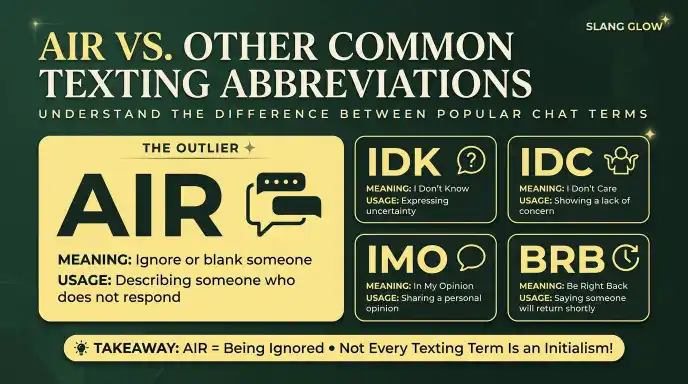
AIR differs from common texting abbreviations because it is generally used as a verb rather than an initialism.
| Term | Meaning | Type | Typical Usage |
| AIR | Ignore or blank someone | Slang verb | Describing being ignored |
| IDK | I Don’t Know | Initialism | Expressing uncertainty |
| IDC | I Don’t Care | Initialism | Expressing a lack of concern |
| IMO | In My Opinion | Initialism | Sharing an opinion |
| BRB | Be Right Back | Initialism | Saying someone will return |
These expressions serve different purposes:
- AIR describes an action: Someone ignores another person.
- IDK and IDC communicate attitudes: They express uncertainty or a lack of concern.
- IMO and BRB communicate different messages: One introduces an opinion, while the other indicates a temporary absence.
For example:
“He aired me yesterday.”
This means he ignored the person.
In contrast:
“IDK why he hasn’t replied.”
This means the sender does not know why the other person has not responded.
AIR is a slang verb, while the other examples are initialisms made from longer phrases.
A Real World Example of AIR in a Conversation
Imagine that two friends are discussing an unanswered message.
Emma: “I sent Jake a message yesterday.”
Sophie: “Did he reply?”
Emma: “No, he completely aired me.”
Sophie: “Maybe he hasn’t checked his phone yet.”
Emma: “I’ll wait and see.”
In this conversation, Emma uses AIR to explain that Jake did not respond to her message.
The expression communicates her frustration, although it does not prove that Jake deliberately ignored her.
This example shows how AIR is used in everyday conversations to describe being ignored. It can refer to unanswered messages as well as situations where someone is ignored in person.
Frequently Asked Questions About AIR
Q.1. What does AIR mean in text messages?
AIR can mean to ignore someone or leave their message unanswered. It is an informal slang verb, particularly associated with British English.
Q.2. What does AIR mean on Snapchat?
On Snapchat, AIR may mean ignoring someone’s snaps or messages rather than responding to them.
Q.3. Is AIR considered slang?
Yes. AIR is an informal slang verb used to describe ignoring or blanking someone.
Q.4. Is AIR rude or offensive?
No. AIR is not generally offensive by itself, but accusing someone of airing you can sound annoyed or confrontational.
Q.5. How should you reply when someone says AIR?
You can respond with “Maybe they’re busy,” “Did they see your message?” or “That sounds frustrating,” depending on the situation.
Q.6. What does getting aired mean?
Getting aired means being ignored or receiving no acknowledgment after trying to communicate with someone.
Final Takeaway
AIR in texting slang means ignoring someone or leaving their message unanswered. It is an informal verb associated with British slang and online conversations.
You may encounter it in text messages, Snapchat chats, Instagram DMs, TikTok discussions, and everyday conversations.
Remember that getting aired does not always prove someone is deliberately ignoring you. They might be busy or unable to respond. Understanding the complete situation helps you interpret the expression correctly.
DISCOVER MORE!

Hi, I’m James Parker, a writer passionate about modern slang, internet culture, and social media language. I enjoy researching trending words and explaining their meanings in simple, easy to understand English. My goal is to help readers confidently understand and use slang in everyday conversations, texting, and online platforms.