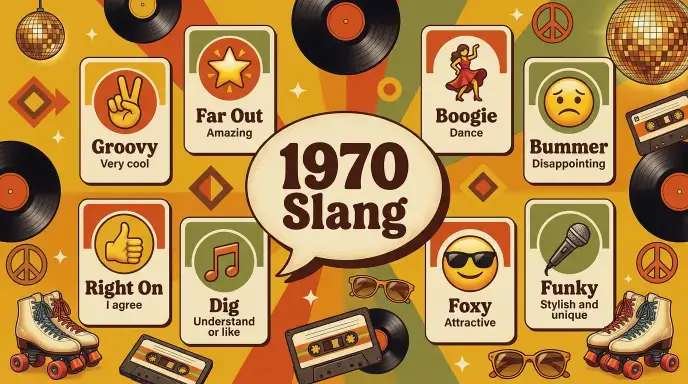
Answer: Popular 1970s slang words include groovy, far out, boogie, bummer, right on, dig, and funky.
Example: That disco party was groovy! 🎶
The 1970 slang gave the English language many memorable slang expressions. Young people used these words in daily conversations, at school, during concerts, and while spending time with friends. Music, television, fashion, and movies all helped spread these popular phrases.
Some 1970 slang words disappeared over time, while others are still heard today. Expressions like groovy, far out, bummer, and boogie remain part of pop culture because of classic films, songs, and TV shows.
In this guide, you’ll learn what 1970 slang means, discover the most popular words from the decade, see real life examples, understand where the expressions came from, and find out which ones are still used today.
H2: What Is 1970 Slang?
1970 slang refers to the informal words and expressions that became popular during the 1970s. These phrases helped people communicate in a fun, relaxed, and creative way. Most were used by teenagers and young adults, but many spread into everyday American English.
The decade was heavily influenced by rock music, disco, hippie culture, skateboarding, television, and Hollywood movies. Because of these influences, many slang terms reflected freedom, excitement, and self expression.
Today, some 1970 slang words are still recognized, while others are mainly used when talking about history, vintage culture, or classic entertainment.
H2: Popular 1970 Slang Words and Their Meanings
| Slang Word | Meaning | Example |
| Groovy | Very cool or excellent | “That jacket looks groovy.” |
| Far Out | Amazing or unbelievable | “Far out! That concert was incredible.” |
| Bummer | Something disappointing | “Missing the game was a real bummer.” |
| Boogie | To dance | “Let’s boogie on the dance floor.” |
| Right On | I agree or that’s great | “Right on! That’s a fantastic idea.” |
| Dig | To understand or like something | “I dig your new hairstyle.” |
| Foxy | Attractive or stylish | “She looks really foxy tonight.” |
| Can You Dig It? | Do you understand? | “Can you dig it?” |
| Funky | Stylish, unusual, or music with a strong rhythm | “That’s a funky song.” |
| Outta Sight | Extremely impressive | “Your new bike is outta sight!” |
H2: Why Was 1970 Slang So Popular?
The 1970s were full of cultural changes that encouraged people to create new ways of speaking. Slang became a symbol of youth culture and personal expression.
H3: Music Shaped Everyday Language
Rock bands, disco artists, and radio stations introduced new words that quickly became popular among young people.
H3: Movies and Television Spread Slang
Popular TV shows and blockbuster films helped millions of people hear and copy the same expressions.
H3: Youth Culture Loved Creative Expressions
Teenagers enjoyed using slang because it sounded modern, fun, and different from formal language.
H3: Friends Shared New Words Quickly
School, parties, concerts, and neighborhood gatherings helped slang spread from one group to another.
H2: How to Use 1970 Slang in Conversations
Many 1970 slang words are easy to understand and can still be used in casual conversations. They work best with friends, family, or when talking about retro culture.
H3: Expressing Excitement
Friend: I got tickets to the classic rock concert.
You: Far out! That’s going to be amazing.
H3: Giving a Compliment
Friend: What do you think of my new outfit?
You: It looks groovy!
H3: Talking About Something Disappointing
Friend: The concert was canceled.
You: That’s such a bummer.
H3: Inviting Someone to Dance
Friend: The music is great tonight.
You: Let’s boogie!
H3: Showing Agreement
Friend: We should watch that old movie.
You: Right on!
H2: Where Is 1970 Slang Commonly Used Today?
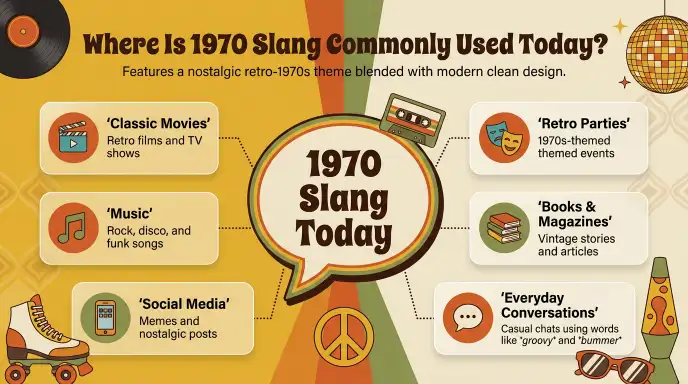
Although these expressions came from the 1970s, many people still recognize them because they appear in modern entertainment and everyday conversations.
H3: Movies and TV Shows
Classic films and retro television programs often use 1970 slang to match the time period.
H3: Music
Old rock, disco, and funk songs continue to introduce these expressions to new listeners.
H3: Social Media
People sometimes use vintage slang in nostalgic posts, memes, and retro themed videos.
H3: Costume Parties
Words like groovy and far out are popular during 1970s themed events and celebrations.
H3: Everyday Conversations
Some expressions, especially groovy, bummer, and dig, are still used casually today.
H2: Is 1970 Slang Still Used Today?
Yes, some 1970 slang words remain popular, while others are mostly used for fun or nostalgia.
| Slang | Still Used? | Notes |
| Groovy | ✅ Yes | Still means cool or stylish. |
| Bummer | ✅ Yes | Common way to express disappointment. |
| Dig | ✅ Sometimes | Used to mean understand or enjoy. |
| Far Out | ⚠️ Rarely | Mostly heard in retro settings. |
| Right On | ⚠️ Sometimes | Used to show agreement. |
| Boogie | ✅ Yes | Still used when talking about dancing. |
| Outta Sight | ❌ Rarely | Mostly found in older movies. |
| Foxy | ⚠️ Sometimes | Less common than in the 1970s. |
H2: 1970 Slang vs Modern Gen Z Slang
Language changes over time. Many popular words from the 1970s have been replaced by newer slang used by Gen Z.
| 1970 Slang | Modern Slang | Meaning |
| Groovy | Fire | Very cool |
| Far Out | obsessed | Amazing |
| Right On | Facts | I agree |
| Bummer | That Sucks | Disappointing |
| Dig | Vibe With | Like or enjoy |
| Foxy | Fine | Attractive |
| Boogie | Hit the Dance Floor | Dance |
H3: Which Style Should You Use?
Use 1970 slang when discussing retro culture, classic music, or vintage movies. Use modern slang when chatting with younger audiences online.
FAQS
Q1. What are some 1970s slang words?
Popular 1970s slang words include groovy, far out, bummer, boogie, right on, dig, foxy, funky, outta sight, and can you dig it?
Q2. What gen is 1970 slang for?
1970s slang is mainly associated with Baby Boomers and the older members of Generation X.
Q3. How do you say “cool” in the 70s?
People in the 1970s often said groovy, far out, outta sight, or right on instead of “cool.”
Q4. What was the most popular slang word in 1971?
Groovy was one of the most popular slang words in 1971 and meant something cool or excellent.
Q5. What was the top slang word in 1980?
Awesome became one of the most popular slang words around 1980 for describing something impressive.
Q6. What was slang in 2007?
Popular 2007 slang included LOL, OMG, BRB, BFF, epic, and fail, especially in texting and online conversations.
H2: Common Mistakes to Avoid When Using 1970 Slang
Although 1970 slang is fun to use, using it incorrectly can make conversations sound unnatural. Here are some common mistakes to avoid.
H3: Using Slang in Formal Situations
Avoid 1970 slang in business emails, school assignments, job interviews, or professional presentations.
H3: Mixing Different Generations of Slang
Don’t combine 1970s expressions with modern Gen Z slang in the same sentence unless you’re doing it for humor.
H3: Using Rare Words Too Often
Some expressions like “Outta Sight” or “Can You Dig It?” are uncommon today, so use them only in the right context.
H3: Misunderstanding the Meaning
Always learn what a slang word means before using it to avoid confusion.
H3: Forgetting Your Audience
Older people may recognize these expressions immediately, while younger audiences may need an explanation.
H2: Quick Reference Table
| Topic | Answer |
| Meaning | Informal words and phrases popular in the 1970s |
| Popular Words | Groovy, Far Out, Bummer, Dig, Boogie |
| Common Users | Teenagers, young adults, music fans |
| Used In | Casual conversations, music, TV shows, movies |
| Tone | Friendly, fun, and informal |
| Still Used Today? | Some words are still common |
| Formal or Informal? | Informal |
| Best Known Word | Groovy |
H2: Exercise – Test Your Knowledge
H3: Multiple Choice
1. What does “Groovy” mean?
A. Angry
B. Cool or Excellent
C. Tired
D. Quiet
Answer: B. Cool or Excellent
2. Which slang word means “to dance”?
A. Dig
B. Boogie
C. Foxy
D. Right On
Answer: B. Boogie
3. Which phrase shows agreement?
A. Right On
B. Bummer
C. Funky
D. Outta Sight
Answer: A. Right On
H3: Fill in the Blanks
1. That disco song is ________.
Answer: Groovy
2. Let’s ________ all night.
Answer: Boogie
3. Missing the concert was a real ________.
Answer: Bummer
H3: True or False
1. Groovy means something cool or excellent.
Answer: True
2. 1970 slang is mainly used in formal business writing.
Answer: False
3. Many 1970 slang words are still recognized today.
Answer: True
4. Boogie means to dance.
Answer: True
H2: Related Slang Terms You Should Know
If you’re interested in 1970 slang, you’ll probably enjoy learning other classic and modern slang terms that are still popular today.
| Slang | Meaning | Popular Era |
| Groovy | Cool or excellent | 1970s |
| Far Out | Amazing or unbelievable | 1970s |
| Right On | I agree | 1970s |
| Bummer | Something disappointing | 1970s |
| Dig | To understand or like | 1970s |
| Funky | Stylish or unique | 1970s |
| Awesome | Very impressive | 1980s |
| Cool | Fashionable or impressive | Every decade |
| Epic | Extremely amazing | 2000s |
| Fire | Excellent or exciting | Modern slang |
H2: Why 1970 Slang Still Matters Today
Even though the 1970s ended decades ago, many slang words from that era continue to appear in movies, TV shows, songs, books, and online discussions.
H3: Connects You with Pop Culture
Classic films and television series often use 1970 slang to create an authentic feel.
H3: Makes Vintage Conversations Easier to Understand
Knowing these expressions helps you understand older books, interviews, and songs.
H3: Keeps Language History Alive
Slang shows how people communicated during different time periods and reflects cultural changes.
H3: Adds Fun to Casual Conversations
Using classic expressions occasionally can make conversations more interesting and nostalgic.
H2: Fun Facts About 1970 Slang
H3: “Groovy” Became a Cultural Icon
Few slang words represent the 1970s as strongly as groovy.
H3: Disco Helped Spread New Words
Dance clubs and disco music introduced expressions like boogie to millions of people.
H3: Television Increased Slang Popularity
Popular TV shows helped slang travel across the United States and beyond.
H3: Some Words Never Disappeared
Terms like bummer and awesome are still heard in everyday conversations.
1970 Slang Cheat Sheet
| Topic | Quick Answer |
| Meaning | Informal expressions popular during the 1970s |
| Most Famous Word | Groovy |
| Used By | Teenagers and young adults |
| Common Places | Schools, concerts, parties, movies |
| Tone | Casual and friendly |
| Still Popular? | Some words are still widely used |
| Formal? | No |
| Best Example | “That concert was groovy!” |
Key Takeaways
- 1970 slang reflects the culture and lifestyle of the decade.
- Music, movies, and television helped popularize many expressions.
- Groovy, Far Out, and Bummer remain the best known terms.
- Most 1970 slang is used in casual conversations.
- Learning classic slang makes it easier to understand vintage entertainment.
- Some 1970 expressions are still part of modern English today.
Timeline of Popular 1970 Slang
The language of the 1970s changed as music, fashion, and entertainment evolved throughout the decade.
| Year | Popular Slang | Meaning |
| 1970 | Groovy | Cool or excellent |
| 1971 | Far Out | Amazing or unbelievable |
| 1972 | Right On | I agree |
| 1973 | Dig | To understand or like |
| 1974 | Bummer | Something disappointing |
| 1975 | Boogie | To dance |
| 1976 | Funky | Stylish or unique |
| 1977 | Outta Sight | Extremely impressive |
| 1978 | Foxy | Attractive or fashionable |
| 1979 | Can You Dig It? | Do you understand? |
H2: Did 1970 Slang Influence Modern English?
Many expressions from the 1970s continue to influence modern English. Some words have kept their original meaning, while others have evolved over time.
H3: Everyday Vocabulary
Words like bummer and awesome are still commonly used in casual conversations.
H3: Entertainment and Media
Retro movies, TV shows, and music continue to introduce younger generations to classic 1970 slang.
H3: Internet Culture
Social media users often bring back vintage slang in memes, nostalgic posts, and retro themed videos.
H3: Fashion and Lifestyle
The return of 1970s fashion has also renewed interest in the slang from that era.
H2: Famous 1970 Slang Quotes and Expressions
These classic expressions were commonly heard during the 1970s.
- “Groovy!”
- “Far Out!”
- “Right On!”
- “Can You Dig It?”
- “Let’s Boogie!”
- “That’s a Bummer.”
- “Outta Sight!”
- “Stay Funky!”
H2: One Minute Summary
If you’re short on time, here’s a quick overview of 1970 slang.
- It includes informal words popular during the 1970s.
- Music, movies, and youth culture helped spread these expressions.
- Groovy was one of the decade’s most famous slang words.
- Many terms are still recognized in modern English.
- These expressions are best used in casual conversations and retro discussions.
H2: Conclusion
1970 slang captures the fun, creativity, and culture of one of the most memorable decades in modern history. From groovy and far out to boogie and right on, these expressions reflected the music, fashion, and lifestyle of the time. While some words are now mainly heard in classic films or nostalgic conversations, others continue to be part of everyday English. Learning 1970 slang is a great way to understand vintage pop culture and appreciate how language changes over time.
H2: Exercise Test Your Knowledge of 1970 Slang
Practice these exercises to see how well you understand 1970 slang. Check your answers after each section.
H3: Exercise 1 – Multiple Choice
1. What does “Groovy” mean?
A. Angry
B. Cool or excellent
C. Sleepy
D. Expensive
Answer: B. Cool or excellent
2. Which 1970 slang word means “to dance”?
A. Dig
B. Boogie
C. Foxy
D. Bummer
Answer: B. Boogie
3. Which expression shows agreement?
A. Right On
B. Far Out
C. Funky
D. Outta Sight
Answer: A. Right On
4. What does “Bummer” mean?
A. A happy event
B. A disappointing situation
C. A dance move
D. A music style
Answer: B. A disappointing situation
5. Which slang word means “to understand”?
A. Dig
B. Boogie
C. Groovy
D. Foxy
Answer: A. Dig
H3: Exercise 2 – Fill in the Blanks
1. That vintage car looks ________.
Answer: Groovy
2. Let’s ________ at the disco tonight.
Answer: Boogie
3. Missing the concert was a real ________.
Answer: Bummer
4. I really ________ your new music playlist.
Answer: Dig
5. ________! That’s an excellent idea.
Answer: Right On
H3: Exercise 3 – True or False
1. Groovy means something cool or excellent.
Answer: True
2. 1970 slang was mainly used in formal business meetings.
Answer: False
3. Boogie means to dance.
Answer: True
4. Many 1970 slang words are still recognized today.
Answer: True
5. Right On is used to show disagreement.
Answer: False
H3: Exercise 4 – Match the Slang
| Slang | Correct Meaning |
| Groovy | Cool or excellent |
| Bummer | Something disappointing |
| Dig | To understand or like |
| Boogie | To dance |
| Right On | I agree |
H3: Exercise 5 – Write Your Own Sentence
Use each slang word in a sentence.
- Groovy: _______________________
- Far Out: _______________________
- Boogie: _______________________
- Bummer: _______________________
- Dig: _______________________
Sample Answers
- That jacket looks groovy.
- Far out! That concert was amazing.
- Let’s boogie after dinner.
- Missing the game was a bummer.
- I really dig this song.
Read the Complete Guide!

Hey, I’m Emily. I’ve spent way too many hours scrolling TikTok and group chats trying to figure out what people actually mean by half the slang flying around — and somewhere along the way that turned into a whole thing I write about now. I cover internet slang, TikTok trends, and how words shift meaning practically overnight online.