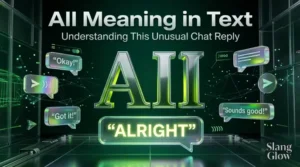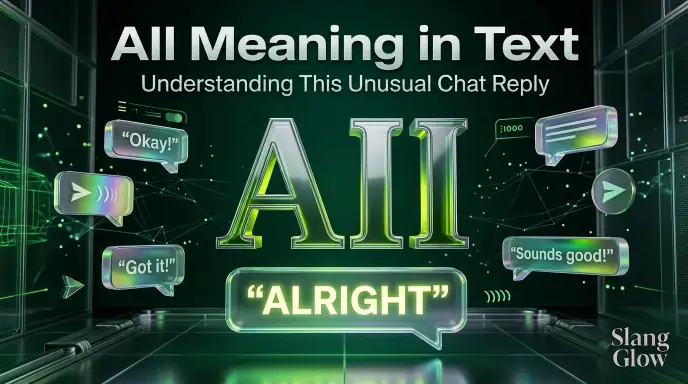
Have you received a message containing AII and wondered what does AII mean in text? In casual texting, AII usually means “Alright” or “Okay.” People may use it as a short, informal way to agree with someone, acknowledge a message, or show that they understand something.
For example, if a friend says, “I’ll call you later,” you might reply, “Aii,” to show that you understand. It works similarly to saying “Okay” or “Sounds good.”
However, AII is an uncommon spelling, and not everyone uses it in the same way. The surrounding conversation can help you understand the sender’s intended meaning.
What Does AII Mean in Text Messages?
In text messages, AII is an informal spelling of “Alright.” It can communicate agreement, acceptance, or acknowledgment in a casual conversation.
People may use it when they want to respond quickly without typing a complete sentence. Depending on the situation, it can have the same meaning as:
- Alright: Showing that something is acceptable.
- Okay: Confirming that you understand.
- Sounds good: Agreeing with a suggestion or plan.
- Got it: Acknowledging information.
Examples:
- “Aii, I’ll see you tomorrow.” The sender agrees with the plan.
- “Aii, no problem.” The person accepts the situation.
- “Aii, I understand.” The sender confirms that the message is clear.
The exact tone depends on the conversation. A short reply does not automatically mean someone is annoyed or uninterested.
What Does AII Stand For?
AII is generally used as a casual spelling of “Alright” rather than a traditional acronym in which every letter represents a separate word.
It is closely related to other informal spellings, such as Aight and Aiight, which also represent “Alright.”
Here is a simple comparison:
| Texting form | Meaning |
| AII | Alright |
| Aight | Alright |
| Aiight | Alright |
| ALR | Alright |
| OK | Okay |
These spellings can serve a similar purpose, but their style and familiarity may differ. AII is less widely recognized than standard forms such as “Okay” and “Alright.”
Is AII Slang or an Abbreviation?
AII is better understood as an informal texting spelling or slang variation rather than a standard abbreviation.
Traditional abbreviations often shorten longer expressions, while AII is used as a casual written form of “Alright.” It may appear in private messages, comments, or relaxed online conversations.
For example:
- Formal: “Alright, I will complete the task tomorrow.”
- Informal: “Aii, I’ll do it tomorrow.”
Both communicate agreement, but the second version has a more casual texting style.
How Is AII Used in Everyday Conversations?
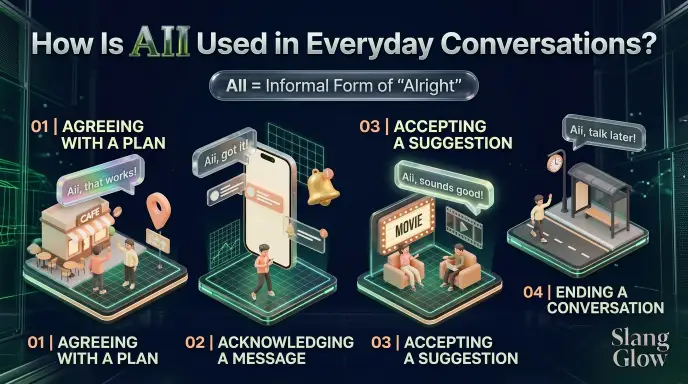
AII can fit different types of casual conversations. People may use it to agree with plans, acknowledge information, or respond when someone shares something with them.
1. Agreeing With a Plan
Someone might send AII when they are happy with a suggested time or arrangement.
Example:
- Friend: “Let’s meet at 5 PM.”
- You: “Aii, that works.”
- Meaning: You agree with the suggested time.
2. Acknowledging a Message
AII can also show that you have understood what another person has said.
Example:
- Friend: “Don’t forget to bring your notebook.”
- You: “Aii, got it.”
- Meaning: You understand the reminder.
3. Accepting a Suggestion
When a friend offers an idea, AII may be used as a quick response to show acceptance.
Example:
- Friend: “We can watch a movie tonight.”
- You: “Aii, sounds good!”
- Meaning: You like the suggestion and agree with it.
4. Ending a Casual Conversation
Sometimes, AII appears near the end of a chat when both people have finished discussing something.
Example:
- Friend: “Okay, talk to you later.”
- You: “Aii, bye!”
- Meaning: You acknowledge the goodbye and end the conversation.
Does AII Have Different Meanings Depending on Context?
Yes. Although AII is commonly listed as an informal form of “Alright,” its exact tone can change according to the situation.
For example, a person may use it to show agreement, confirm information, or respond casually to a suggestion.
Consider these situations:
- Friendly conversation: “Aii, let’s go!” shows excitement or agreement.
- Making plans: “Aii, see you at 6” confirms an arrangement.
- Receiving information: “Aii, thanks” acknowledges what someone shared.
- Serious discussion: “Aii, I understand” confirms that the sender has understood the message.
If the meaning still seems unclear, looking at the complete conversation is more helpful than interpreting the three letters alone.
Meaning note: Texting references list AII as a rare informal form of “Alright.” It is better described as a spelling variation than a formal acronym.
How Is AII Used on Social Media?
AII may appear in casual social media conversations when someone wants to agree, acknowledge a message, or respond quickly. Its intended meaning is usually close to “Alright” or “Okay” when used as an informal spelling.
Here are some examples of how it might appear on different platforms.
1. AII on Instagram
Someone might use AII in a direct message when agreeing with a friend’s suggestion or confirming plans.
Example:
“ Aii, I’ll see you later!”
Meaning: The sender agrees and confirms that they will meet later.
2. AII on Snapchat
In a Snapchat conversation, AII can be a quick response when someone wants to acknowledge a message.
Example:
“ Aii, got you!”
Meaning: The person understands what the other user has said.
3. AII on TikTok
AII may also appear in casual comments or messages as a short expression of agreement.
Example:
“Aii, that’s actually funny!”
Meaning: The person is agreeing or reacting positively to the content.
4. AII in Group Chats
Friends may use AII when confirming plans or responding to a group message.
Example:
“Everyone ready for tonight?”
“Aii, let’s go!”
Meaning: The person is agreeing and showing readiness.
Real Text Message Examples Using AII
These sample conversations show how AII can be used in different situations. Each example demonstrates its possible meaning as an informal form of “Alright.”
1.Example: Agreeing to Meet
- Friend: “Let’s meet outside the library at 4.”
- You: “Aii, see you there.”
- Meaning: You agree with the suggested meeting place and time.
2.Example: Acknowledging Information
- Friend: “Don’t forget to bring your notes.”
- You: “Aii, I won’t.”
- Meaning: You have understood the reminder.
3.Example: Accepting an Invitation
- Friend: “Would you like to come with us?”
- You: “Aii, sounds good!”
- Meaning: You accept the invitation.
4.Example: Responding to a Suggestion
- Friend: “We can finish the assignment tomorrow.”
- You: “Aii, that works for me.”
- Meaning: You are comfortable with the suggested plan.
5.Example: Ending a Conversation
- Friend: “I’ll message you when I get home.”
- You: “Aii, talk later.”
- Meaning: You acknowledge the message and expect to talk again.
What Does AII Mean From a Girl or a Boy?
AII generally carries the same basic meaning regardless of who sends it. A girl or a boy may use it as a casual way to say “Alright” or “Okay.”
The abbreviation itself does not automatically show romantic interest, anger, or excitement. The rest of the conversation provides more information about the sender’s tone.
For example:
- From a girl: “Aii, see you tomorrow!” usually confirms a plan.
- From a boy: “Aii, I understand” acknowledges what you said.
An emoji, additional words, and the overall conversation can make the message sound warmer, more playful, or more serious.
How Should You Reply When Someone Uses AII?
Your response should match the message you received. Since AII often communicates agreement or acknowledgment, a simple reply is usually enough.
| Their message | Your reply |
| “Aii, see you tomorrow.” | “See you then!” |
| “Aii, got it.” | “Thanks for understanding.” |
| “Aii, let’s meet at 5.” | “Perfect, see you there.” |
| “Aii, no problem.” | “I appreciate it!” |
| “Aii, talk later.” | “Sure, take care.” |
Helpful tip: If you are unsure what the sender means, you can ask, “Do you mean alright?” This avoids confusion, especially when the spelling is unfamiliar.
AII vs. Aight, Aiight, and Other Texting Terms
AII may look similar to several informal expressions used in online conversations. These terms can communicate agreement, but their spellings and meanings are not exactly identical.
| Term | Meaning | Usage |
| AII | Alright | Uncommon informal spelling |
| Aight | Alright | Casual slang spelling |
| Aiight | Alright | Alternative informal spelling |
| ALR | Alright | Short texting form |
| OK | Okay | General acknowledgment |
| Bet | Okay, agreed | Casual agreement |
AII and Aight can communicate a similar idea, but Aight and Aiight are more recognizable spellings in informal English. OK is a clearer choice when you want everyone to understand your response.
Is AII Formal or Informal?
AII is an informal texting expression. It may be suitable for relaxed conversations with friends, classmates, or people who understand casual online language.
However, standard spelling is more appropriate in professional and academic communication.
Compare these examples:
- Informal: “Aii, I’ll send it tonight.”
- Formal: “Alright, I will send it tonight.”
The second version is clearer and more appropriate for formal messages, emails, or school related communication.
Common Mistakes People Make About AII
Because AII is an uncommon spelling, readers may misunderstand it. Keep these points in mind:
- Calling it a formal acronym: AII is better understood as an informal spelling variation, not a traditional acronym.
- Confusing it with Aight: Both can represent “Alright,” but they are different spellings.
- Assuming it always shows excitement: AII can simply acknowledge a message without expressing strong emotion.
- Treating it as a romantic signal: The abbreviation itself does not indicate that someone likes you.
- Mixing it up with ALL: In some fonts, capital I and lowercase L look similar. AII may therefore be mistaken for ALL, so read the complete sentence carefully.
- Using it in formal writing: Standard words such as “Alright” and “Okay” are clearer in professional communication.
Frequently Asked Questions
Q.1 What Does AII Mean in Text?
AII can mean “Alright” in informal texting. People may use it to agree, acknowledge a message, or confirm that they understand something.
Q.2 Is AII the Same as Alright?
Yes, in this informal texting usage, AII represents “Alright.” It is an uncommon spelling variation rather than the standard spelling.
Q.3 Does AII Mean Okay?
AII can communicate the same idea as “Okay” in a casual conversation. Its exact tone depends on the message.
Q.4 Is AII a Common Texting Abbreviation?
AII is a rare texting expression, and not everyone recognizes it. More familiar alternatives include “Okay,” “Alright,” and “Aight.”
Q.5 What Does AII Mean From a Girl?
A girl may use AII to acknowledge a message or agree with a suggestion. It does not automatically have a romantic meaning.
Q.6 What Does AII Mean From a Boy?
A boy may use AII as a casual way to say “Alright” or “Okay.” The surrounding conversation helps explain his intention.
Q.7 Is AII Rude When Someone Sends It?
Not necessarily. AII is generally a casual acknowledgment, although a short response may sound blunt depending on the conversation and punctuation.
Q.8 Can I Use AII in Professional Messages?
It is better to avoid AII in professional messages because it is an uncommon informal spelling. Use “Okay,” “Alright,” or “Understood” instead.
Final Thoughts
AII can mean “Alright” in informal text messages. People may use this uncommon spelling to agree with a plan, acknowledge information, or respond quickly during a casual conversation.
It is not a formal acronym, and its meaning should not be assumed in every situation. When you receive AII, check the surrounding words to understand the sender’s intention. For clearer communication, standard spellings such as “Alright” and “Okay” are always good alternatives.
Accuracy note: Texting references identify AII as a rare form of “All Right,” while similar spellings such as “Aight” and “Aiight” are informal alternatives.
UNDERSTAND MORE!

Hi, I’m James Parker, a writer passionate about modern slang, internet culture, and social media language. I enjoy researching trending words and explaining their meanings in simple, easy to understand English. My goal is to help readers confidently understand and use slang in everyday conversations, texting, and online platforms.