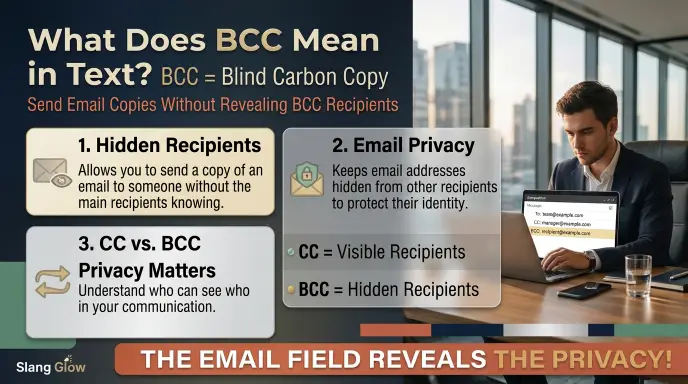
BCC in text usually stands for “Blind Carbon Copy.” It is an email abbreviation used when someone sends a copy of a message to another recipient without showing that person’s email address to the other recipients. You may see BCC in emails, workplace messages, and online conversations.
People often search for BCC after seeing it in an email or receiving a message that mentions being copied privately. Unlike common texting shortcuts such as LOL and BRB, BCC is mainly an email related abbreviation.
For example, someone might write, “Please BCC me on that email.” This means they want to receive a copy without their address being visible to the other recipients.
BCC is not a typical texting slang expression. It is a standard email abbreviation that people may also mention in text messages when discussing email communication.
What Does BCC Mean in Text Messages?
In digital communication, BCC stands for “Blind Carbon Copy.” It is an email feature that allows the sender to include additional recipients without displaying their email addresses to the other recipients.
For example, if someone writes, “I’ll BCC you on the email,” they mean they will send you a hidden copy of that email.
Here are three important points to remember:
- Private recipients: BCC hides the addresses of BCC recipients from other recipients.
- Email communication: It is mainly used when sending emails rather than ordinary SMS messages.
- Privacy: It can help protect email addresses when sending a message to multiple people.
Consider this conversation:
Emma: “Did you receive the project email?”
Sophie: “Yes, I was BCC’d on it.”
Meaning: Sophie received a hidden copy of the email without her address being shown to the other recipients.
You may also see BCC used in messages such as:
- BCC me: Send me a hidden copy of the email.
- I’ll BCC you: I’ll include your email address privately.
- You were BCC’d: You received a copy without being listed publicly among the recipients.
The main purpose of BCC is to send copies of emails while keeping certain recipient addresses private.
What Does BCC Stand for in Online Communication?
BCC is an initialism formed from the words “Blind Carbon Copy.” It comes from the older practice of making document copies using carbon paper.
In modern email communication, the BCC field lets the sender include recipients whose email addresses are not displayed to the other recipients.
Here are three important things to understand:
- Blind: Other recipients cannot see the addresses entered in the BCC field.
- Carbon Copy: A copy of the original email is sent to an additional recipient.
- Privacy: The feature helps protect recipients’ email addresses, especially in group emails.
What Is the Difference Between To, CC, and BCC?
These three email fields have different purposes:
| Email Field | Full Form | Purpose |
| To | Main recipient | The person the email is addressed to |
| CC | Carbon Copy | Sends a visible copy to additional recipients |
| BCC | Blind Carbon Copy | Sends a copy without showing the BCC addresses to other recipients |
For example, imagine that someone sends an announcement to a group of people.
The main recipient appears in the To field, additional visible recipients appear in CC, and private recipients are added through BCC.
The important difference is that BCC keeps its recipients’ email addresses hidden from the other recipients. The sender can still see the BCC addresses.
Where Do People Use BCC?
People use BCC mainly in email communication when they need to send copies of a message while keeping certain email addresses private.
Here are some situations where you might encounter it:
- Workplace emails: Employees may use BCC when including someone privately in an email conversation.
- Group announcements: Senders may use it to avoid displaying everyone’s email addresses.
- School communication: A teacher or organizer may use BCC when sending an announcement to multiple recipients.
- Business communication: Companies may use it when sending updates to a large group.
- Personal emails: Someone may use BCC when including another person without displaying their address to everyone else.
For example:
Emma: “Why did you receive that announcement?”
Sophie: “The sender included me in BCC.”
Meaning: Sophie received a hidden copy of the email.
BCC is not usually necessary for ordinary text messages. Its main purpose is connected to email services and the way email recipients are organized.
When you see BCC in a text conversation, it usually means the people are discussing an email or a hidden email recipient.
What Does BCC Mean on TikTok, Snapchat, and Instagram?
BCC is not a widely established slang expression on TikTok, Snapchat, or Instagram. Its standard meaning remains “Blind Carbon Copy,” even when someone mentions it on social media.
Here are some possible situations where you might encounter it:
- TikTok: Someone may explain BCC in an educational video about email terms.
- Snapchat: A friend might ask what BCC means after seeing it in an email.
- Instagram: It may appear in comments or messages discussing email privacy.
- WhatsApp: Someone may mention being BCC’d on an email.
- SMS messages: A person may ask you to BCC them when sending an email.
For example:
Noah: “What does BCC mean in that email?”
Liam: “It means Blind Carbon Copy.”
Meaning: Liam is explaining the email feature that keeps certain recipient addresses hidden.
Remember that BCC does not have a separate, universally recognized meaning on each social media platform.
Do not confuse an email feature with ordinary internet slang. Its meaning is generally connected to sending emails and protecting recipient privacy.
Real Chat Examples of BCC in Text Messages
The following conversations show how people might mention BCC while discussing emails and digital communication.
Example 1: Asking to Be Included
Emma: “Can you BCC me on the email?”
Sophie: “Sure, I’ll include you.”
Meaning: Emma wants to receive a copy without her email address being visible to other recipients.
Example 2: Receiving a Hidden Email Copy
Noah: “Did you get the announcement?”
Liam: “Yes, I was BCC’d.”
Meaning: Liam received the email as a hidden recipient.
Example 3: Discussing Email Privacy
Mia: “Why did you use BCC instead of CC?”
Olivia: “I wanted to keep the other email addresses private.”
Meaning: Olivia explains why she used the BCC field.
Example 4: Sending a Group Email
Ryan: “Are you sending the update to everyone?”
Leo: “Yes, I’ll use BCC for the group.”
Meaning: Leo plans to hide the recipients’ addresses from one another.
Example 5: Asking About an Email Field
Ava: “What is the difference between CC and BCC?”
Ella: “CC shows the copied recipients, but BCC hides their addresses from other recipients.”
Meaning: Ella explains the difference between the two email options.
These examples show that BCC is mainly used when discussing email copies and recipient privacy. It is not an ordinary abbreviation for expressing feelings or reactions.
More Real Chat Examples of BCC in Text Messages
BCC may appear in conversations when people discuss email recipients, private copies, or workplace communication. Here are five additional examples showing how it works.
Example 6: Sending an Email to a Group
Emma: “Are you sending the announcement to everyone?”
Sophie: “Yes, I’ll BCC the group.”
Meaning: Sophie plans to send the email without displaying the recipients’ email addresses to one another.
Example 7: Asking About a Hidden Recipient
Noah: “Why wasn’t my email address visible?”
Liam: “You were probably added through BCC.”
Meaning: Liam explains that Noah may have received a hidden copy.
Example 8: Discussing a Workplace Email
Mia: “Did the manager receive the update?”
Olivia: “Yes, I included the manager in BCC.”
Meaning: Olivia included the manager as a hidden email recipient.
Example 9: Understanding Email Privacy
Ryan: “Can other people see who I added in BCC?”
Leo: “Other recipients generally cannot see the BCC addresses.”
Meaning: Leo explains how the BCC field protects recipient address visibility.
Example 10: Comparing Email Options
Ava: “Should I use CC or BCC?”
Ella: “Use BCC when you don’t want other recipients to see those addresses.”
Meaning: Ella explains when the hidden copy option is useful.
These examples show that BCC is mainly connected to email privacy and recipient management. It helps people understand why an email address may not appear in the visible recipient list.
How Should You Reply When Someone Uses BCC?
Your response depends on what the person is discussing. If someone mentions BCC, they are usually talking about sending an email, including a hidden recipient, or protecting email addresses.
Here are four natural ways to respond:
- Casual reply: “Okay, I understand!”
- Friendly reply: “Thanks for explaining.”
- Neutral reply: “Got it. I’ll check my email.”
- Clarifying reply: “Do you mean Blind Carbon Copy?”
Example 1: Someone Says They Will BCC You
Emma: “I’ll BCC you on the email.”
Sophie: “Okay, thanks!”
Meaning: Sophie understands that Emma will send her a hidden copy of the email.
Example 2: Asking About an Email
Noah: “I added you to BCC.”
Liam: “Got it. I’ll look for the email.”
Meaning: Liam acknowledges that he has been included as a hidden recipient.
Example 3: Clarifying the Purpose
Mia: “Should I put everyone in BCC?”
Olivia: “Yes, especially if you want to keep their email addresses private.”
Meaning: Olivia recommends using BCC to protect the recipients’ email addresses.
You do not need to use BCC in your reply. Simple expressions such as “Okay,” “Thanks,” and “Understood” are perfectly natural.
Is BCC Rude or Offensive in Text?
BCC is not inherently rude or offensive. It is a standard email feature designed to send copies of messages without revealing certain recipients’ email addresses to others.
However, the way someone uses BCC can affect how a situation is understood.
Here are three important points:
- Privacy: BCC can help protect email addresses when sending messages to multiple people.
- Professional communication: It is commonly used for group announcements and certain workplace emails.
- Transparency: Using BCC to secretly involve someone in a sensitive conversation may create trust concerns.
Is BCC Appropriate at School or Work?
Yes. BCC is useful in educational and professional communication when recipient privacy matters.
For example, a school organizer may send an announcement to many parents and use BCC so their email addresses are not displayed to everyone.
However, BCC should be used thoughtfully and according to the expectations of the communication. Hiding addresses for privacy is different from secretly copying someone into a sensitive conversation.
The abbreviation itself is neutral. Its appropriateness depends on how the email feature is used.
Who Uses the BCC Feature?
BCC is used by people who send emails and need to manage recipient privacy. It is not limited to one age group, profession, or online community.
You may encounter it in these situations:
- Office employees: They may use BCC when sending announcements to groups.
- Students and teachers: They may encounter it in school related emails.
- Businesses: Organizations may use BCC when contacting multiple people.
- Event organizers: They may use it to protect the email addresses of participants.
- Everyday email users: Individuals may use it when sending private copies.
Is BCC a Gen Z Texting Term?
BCC is not specifically a Gen Z slang expression. It is an established email abbreviation used across different age groups.
Younger people may encounter it while studying, communicating with teachers, or sending emails. Other users may recognize it through workplace and business communication.
BCC belongs to email terminology rather than modern youth texting slang.
Where Did BCC Come From?
BCC comes from the older expression “Blind Carbon Copy.” The term is connected to the use of carbon paper, which was historically placed between sheets of paper to create duplicate copies when writing or typing.
The word “carbon copy” later became familiar in business communication. When email systems adopted similar terminology, CC and BCC became labels for sending copies of electronic messages.
Three points help explain its background:
- Carbon paper: It was used to create duplicate documents.
- Carbon copy: CC became a familiar term for sending an additional copy.
- Email technology: BCC developed as an email feature that hides certain recipient addresses from other recipients.
Why Is It Called a Blind Carbon Copy?
The word “blind” refers to the fact that other recipients cannot see the email addresses entered in the BCC field.
For example, when you send an email to one person and add another person through BCC, the primary recipient will not see the BCC recipient’s address.
The term comes from traditional document copying language, but its modern use is connected to email privacy.
BCC vs. Other Common Email and Texting Abbreviations
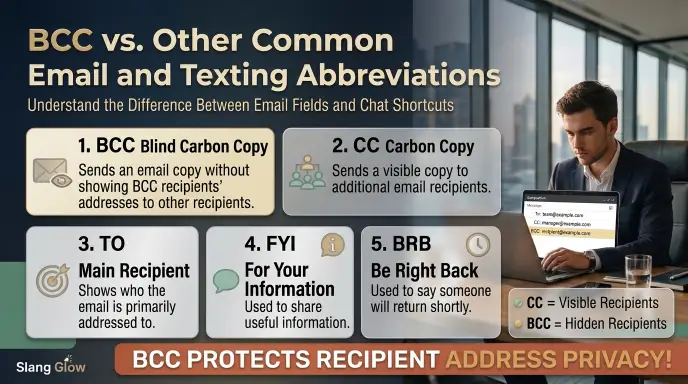
BCC is different from ordinary texting abbreviations because it describes an email function rather than a reaction, feeling, or everyday response.
| Term | Meaning | Type | Typical Usage |
| BCC | Blind Carbon Copy | Email abbreviation | Sending hidden copies |
| CC | Carbon Copy | Email abbreviation | Sending visible copies |
| TO | Main recipient | Email field | Addressing the main recipient |
| FYI | For Your Information | Initialism | Sharing information |
| BRB | Be Right Back | Initialism | Saying someone will return |
These terms serve different purposes:
- BCC hides recipient addresses from other recipients.
- CC displays additional recipients in the email.
- TO identifies the main recipient of the message.
- FYI and BRB are everyday communication shortcuts with different meanings.
For example, someone might write “I’ll BCC you” when sending a private email copy, while “I’ll CC you” means the recipient will be visible in the email’s recipient list.
Do not confuse CC with BCC. Both send copies of an email, but they handle recipient visibility differently.
A Real World Example of BCC in a Conversation
Imagine that a school organizer needs to send an announcement to several parents about an upcoming school event.
Emma: “I need to send the announcement to all the parents.”
Sophie: “Are you going to use CC?”
Emma: “I think BCC would be better.”
Sophie: “Why?”
Emma: “I don’t want everyone’s email addresses to be visible to the entire group.”
In this conversation, Emma chooses BCC to protect the recipients’ email addresses.
The feature allows her to send the same announcement to multiple people without displaying all their addresses to one another.
This is a practical example of how BCC helps protect privacy during group email communication.
Frequently Asked Questions About BCC
Q.1. What does BCC mean in text messages?
BCC stands for “Blind Carbon Copy.” It is an email feature that hides BCC recipients’ email addresses from other recipients.
Q.2. What does BCC mean on TikTok?
BCC does not have one widely recognized TikTok slang meaning. It generally refers to Blind Carbon Copy when someone discusses email communication.
Q.3. Is BCC considered slang?
No. BCC is primarily an email abbreviation or initialism, not a traditional internet slang expression.
Q.4. Is BCC rude or offensive?
No. BCC is generally neutral. It is an email privacy feature, although the way someone uses it may affect trust and transparency.
Q.5. How should you reply when someone uses BCC?
You can reply with “Okay, thanks for letting me know” or ask, “Do you mean Blind Carbon Copy?” if you are unsure.
Q.6. What is the difference between CC and BCC?
CC makes additional recipients visible, while BCC hides their email addresses from other recipients. Both options send copies of an email.
Final Takeaway
BCC means “Blind Carbon Copy” and is an email feature used to send copies without displaying certain recipients’ email addresses to others. It is commonly used in workplace communication, group announcements, school emails, and business messages.
You may encounter BCC in text conversations when someone is discussing email recipients or privacy settings.
Remember that BCC is different from CC because it keeps the BCC recipient list hidden from other recipients. Understanding this difference can help you use email more confidently and protect people’s contact information.
READ MORE!

Hi, I’m James Parker, a writer passionate about modern slang, internet culture, and social media language. I enjoy researching trending words and explaining their meanings in simple, easy to understand English. My goal is to help readers confidently understand and use slang in everyday conversations, texting, and online platforms.