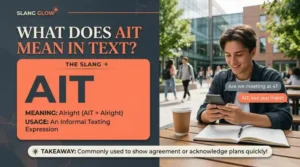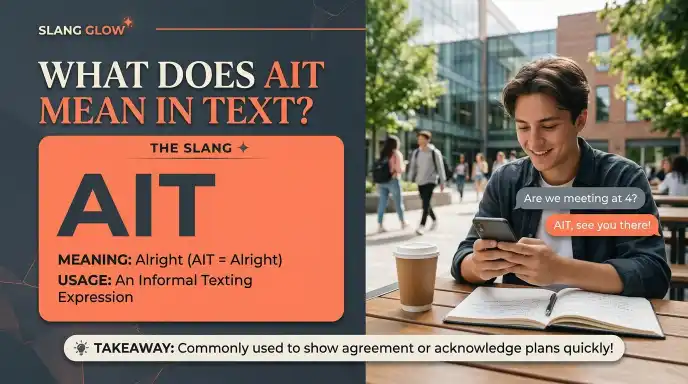
What does AIT mean in text? AIT usually means “Alright.” It is an informal texting expression people use to show agreement, understanding, or acceptance. You may see it in text messages, Snapchat chats, Instagram DMs, TikTok comments, and everyday online conversations.
For example, someone might reply, “AIT, I’ll see you tomorrow!” instead of writing, “Alright, I’ll see you tomorrow!” The meaning stays the same, but the shorter spelling makes the message more casual.
Although AIT looks like an abbreviation, it is better understood as an informal shortened spelling of “alright” rather than an acronym with three separate words.
People sometimes confuse AIT with other expressions such as Aight, Ight, and OK. Understanding the context helps you recognize what someone means.
What Does AIT Mean in Text Messages?
In casual texting, AIT usually stands for “Alright.” People use it as a short response when agreeing with someone, acknowledging information, or confirming a plan. <Cite refs={[“turn348796search0″,”turn348796search2″,”turn348796search11”]}/>
For example, if a friend writes, “Meet me at 5,” you might reply, “AIT!” to show that you understand and agree.
Here are three important points to remember:
- Agreement: AIT can show that someone accepts a suggestion or plan.
- Acknowledgment: It may indicate that someone understands what another person has said.
- Casual communication: It is an informal alternative to writing the complete word “alright.”
Consider this conversation:
Emma: “I’ll meet you outside the library at 4.”
Sophie: “AIT, see you there!”
Meaning: Sophie agrees with the plan and confirms that she will meet Emma.
You may also see AIT in these common expressions:
- AIT, sounds good: Agreeing with a suggestion.
- AIT, no problem: Accepting a request.
- AIT, see you later: Confirming a plan.
- AIT then: Showing acceptance or agreement.
The easiest way to understand AIT is to replace it with “alright” or “okay.” If the sentence still makes sense, the sender is probably using its common texting meaning.
What Does AIT Stand for in Online Slang?
AIT is an informal shortened spelling of “alright.” It does not normally represent three separate words. Instead, people use these letters as a casual way to acknowledge something or show agreement.
It is similar to other informal spellings used in digital conversations.
Here are three ways people may use it:
- Showing agreement: Someone may write AIT when accepting an idea or suggestion.
- Confirming information: It can show that a person understands what another person said.
- Ending a conversation: Someone may use AIT before saying goodbye or moving on to another topic.
For example:
Alex: “Can we finish this assignment tomorrow?”
Jordan: “AIT, that works for me.”
Meaning: Jordan agrees to finish the assignment tomorrow.
You may also encounter similar expressions:
- AIT: Alright.
- Aight: An informal spelling of alright.
- Ight: A shortened version of aight.
- OK: Okay.
These expressions have similar uses, but their spelling and popularity can vary between people and online communities.
AIT is less widely recognized than standard forms such as OK and alright. Some people may understand it immediately, while others may need clarification.
Where Do People Use AIT in Text Messages?
People may use AIT in informal digital conversations when they want to acknowledge a message or agree with someone. Its basic meaning generally stays connected to the word “alright.”
Here are some places where you might encounter it:
- Text messages: Friends may write AIT when confirming plans or accepting suggestions.
- Snapchat: Someone might use it in a quick reply to a friend’s message.
- Instagram: It may appear in direct messages or casual comments.
- TikTok: Users may use it in comments or conversations as a short acknowledgment.
- WhatsApp: Friends may write AIT when discussing plans or responding to requests.
For example:
Mia: “We’re going to the park after school.”
Olivia: “AIT, I’ll be there!”
Meaning: Olivia agrees with the plan and confirms that she will join.
The abbreviation is useful in casual conversations because it communicates agreement without requiring a longer response.
However, AIT is not a special code belonging to one particular social media platform. Its meaning usually depends on the message rather than the app.
What Does AIT Mean on TikTok, Snapchat, and Instagram?
On social media, AIT usually means “alright” when someone uses it as an informal response. It may appear in comments, captions, direct messages, and everyday conversations.
Here are some examples of how it may appear:
- TikTok: Someone might comment “AIT, I understand now” after watching an explanation.
- Snapchat: A friend may reply “AIT, see you later” when confirming a plan.
- Instagram: Users may write AIT in direct messages to acknowledge information.
- WhatsApp: Friends may use it when agreeing about a meeting or activity.
- SMS messages: Someone might write AIT instead of typing the complete word alright.
For example:
Noah: “I’ll send you the pictures tonight.”
Liam: “AIT, thanks!”
Meaning: Liam understands the plan and acknowledges Noah’s message.
You may also see AIT written as “ait” or “AIT.” Capitalization does not usually change its intended meaning in casual texting.
Remember that AIT is not a widely established platform specific slang term. Some users may prefer writing “OK,” “alright,” or “aight” instead.
Real Chat Examples of AIT in Text Messages
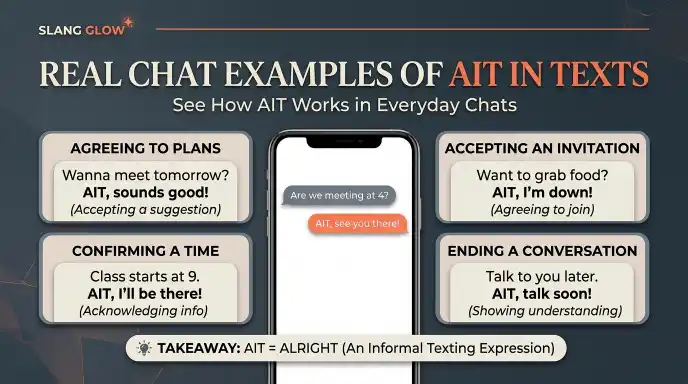
The following conversations show how AIT might appear in everyday digital communication. Each example includes a simple explanation to make its meaning easier to understand.
Example 1: Agreeing With a Plan
Emma: “Let’s meet at the coffee shop tomorrow.”
Sophie: “AIT, sounds good!”
Meaning: Sophie agrees with Emma’s suggestion.
Example 2: Confirming a Time
Noah: “The class starts at 9 tomorrow.”
Liam: “AIT, I’ll be there.”
Meaning: Liam acknowledges the information and confirms that he understands.
Example 3: Accepting an Invitation
Mia: “Do you want to join us for the movie?”
Olivia: “AIT, I’d love to!”
Meaning: Olivia accepts the invitation.
Example 4: Responding to a Request
Ryan: “Can you send me the notes tonight?”
Leo: “AIT, I’ll send them.”
Meaning: Leo agrees to send the notes later.
Example 5: Ending a Conversation
Ava: “I’ll message you when I get home.”
Ella: “AIT, talk to you later!”
Meaning: Ella understands and agrees with Ava’s plan.
These examples show that AIT usually communicates agreement, acceptance, or acknowledgment. The complete sentence helps you understand exactly what the sender intends.
More Real Chat Examples of AIT in Text Messages
AIT can appear in casual conversations when someone wants to agree, acknowledge information, or accept a suggestion. It is generally used as an informal way of saying “alright.”
Here are five additional examples:
Example 6: Accepting an Invitation
Emma: “We’re going shopping this weekend. Want to come?”
Sophie: “AIT, I’d love to!”
Meaning: Sophie accepts the invitation and agrees to join.
Example 7: Confirming a Meeting
Noah: “I’ll meet you outside the library at 3.”
Liam: “AIT, see you there!”
Meaning: Liam understands and agrees with the meeting arrangements.
Example 8: Responding to Good News
Mia: “I finished my assignment early!”
Olivia: “AIT, that’s great!”
Meaning: Olivia acknowledges Mia’s update and responds positively.
Example 9: Agreeing to Help
Ryan: “Can you help me with this project tomorrow?”
Leo: “AIT, I’ll help you.”
Meaning: Leo agrees to help Ryan.
Example 10: Ending a Discussion
Ava: “I’ll call you when I reach home.”
Ella: “AIT, talk to you later!”
Meaning: Ella acknowledges the plan and ends the conversation.
These examples show how AIT can communicate agreement or acknowledgment. The surrounding words help make the intended meaning clear.
How Should You Reply When Someone Uses AIT?
Your response depends on what the other person is discussing. If someone uses AIT to agree with a plan, you can continue the conversation or confirm the details.
Here are four natural ways to respond:
- Casual reply: “Okay, sounds good!”
- Friendly reply: “Great, see you soon!”
- Funny reply: “Perfect, don’t be late! 😂”
- Neutral reply: “Thanks for confirming.”
Example 1: Someone Agrees With Your Plan
Emma: “Let’s meet after school.”
Sophie: “AIT, see you there!”
Emma: “Perfect!”
Meaning: Both people agree with the meeting plan.
Example 2: Someone Accepts Your Request
Noah: “Can you send me the notes?”
Liam: “AIT, I’ll send them tonight.”
Noah: “Thanks!”
Meaning: Liam agrees to send the notes.
Example 3: Someone Acknowledges Your Message
Mia: “The event starts at 6 PM.”
Olivia: “AIT, I’ll be there.”
Mia: “See you!”
Meaning: Olivia understands the information and confirms her attendance.
You do not need to use AIT in your reply. Simple words such as “Okay,” “Sure,” and “Sounds good” are perfectly natural.
Is AIT Rude or Offensive in Text?
AIT is generally not rude or offensive when used to mean “alright.” It is an informal expression that can communicate agreement, acceptance, or acknowledgment.
However, the complete message can affect how it sounds.
Here are three important points:
- Neutral meaning: AIT usually shows that someone understands or accepts something.
- Casual tone: It is more suitable for relaxed conversations than formal communication.
- Context matters: A short response may sound less enthusiastic than a longer reply, depending on the situation.
Is AIT Appropriate at School or Work?
AIT may be understandable in casual conversations with friends, classmates, or colleagues. However, writing “alright” or “okay” is clearer in formal communication.
For example:
Instead of writing:
“AIT, I’ll finish the report.”
You can write:
“Alright, I’ll finish the report.”
The complete spelling looks more appropriate in professional emails, assignments, and official messages.
AIT is not a swear word or an insult. It is simply an informal spelling that some people use in digital conversations.
Who Uses the Abbreviation AIT?
AIT may appear in informal digital conversations among people who prefer short and casual messages. It is not limited to one age group, country, or social media platform.
You may encounter it in these situations:
- Friends: People may use AIT when agreeing with plans or suggestions.
- Students: Classmates may use it when confirming school related arrangements.
- Social media users: It may appear in direct messages and casual comments.
- Online communities: Some users may use it as a quick acknowledgment.
Is AIT a Gen Z Texting Term?
AIT is not exclusively a Gen Z expression. It is better understood as an informal spelling of “alright” rather than a slang term belonging to one particular generation.
Different people may prefer spellings such as AIT, aight, or alright. However, AIT is less widely recognized than common responses such as OK and BRB.
Its use depends on personal texting habits and familiarity with informal online language.
Where Did AIT Come From?
AIT is generally understood as an informal shortened spelling of “alright.” It follows a common pattern in digital communication where people use shorter spellings to make messages quicker.
The exact origin and first use of AIT as a texting spelling are not firmly established.
Three points help explain its use:
- Original word: AIT is associated with the everyday English word “alright.”
- Shortened spelling: It uses fewer letters than the complete word.
- Digital communication: Casual texting encourages shorter spellings and quick responses.
Did AIT Originate on Social Media?
There is no reliable evidence identifying TikTok, Instagram, Snapchat, or another platform as the creator of AIT.
The spelling may appear in informal online conversations, but it is not a well documented social media trend with one confirmed origin.
It is more accurate to describe AIT as an informal spelling variation rather than claim that a particular generation or platform invented it.
AIT vs. Other Common Texting Abbreviations
AIT is different from many common texting shortcuts because it is generally used as a shortened spelling of “alright” rather than an initialism.
| Term | Meaning | Type | Typical Usage |
| AIT | Alright (informal spelling) | Shortened spelling | Showing agreement |
| IDK | I Don’t Know | Initialism | Expressing uncertainty |
| IDC | I Don’t Care | Initialism | Showing a lack of concern |
| IMO | In My Opinion | Initialism | Sharing an opinion |
| BRB | Be Right Back | Initialism | Saying someone will return |
These expressions serve different purposes:
- AIT communicates agreement or acknowledgment.
- IDK and IDC express a person’s response or attitude.
- IMO and BRB introduce an opinion or explain a temporary absence.
For example:
“AIT, I’ll meet you there!”
This means someone agrees with a plan.
In contrast:
“IDK if I can come.”
This means someone is unsure if they can attend.
AIT is a shortened spelling, while IDK, IDC, IMO, and BRB are initialisms formed from longer phrases.
A Real World Example of AIT in a Conversation
Imagine that two classmates are arranging a time to work on a school project.
Emma: “Can we meet at the library tomorrow?”
Sophie: “Sure, what time?”
Emma: “Let’s meet at 4 PM.”
Sophie: “AIT, I’ll be there.”
Emma: “Great! Don’t forget your notes.”
In this conversation, Sophie uses AIT to confirm that she agrees with the suggested time and place.
The shortened spelling makes her response casual and direct.
This example shows how AIT may be used to accept a suggestion or confirm an arrangement.
Frequently Asked Questions About AIT
Q.1. What does AIT mean in text messages?
AIT usually means “alright.” It is an informal spelling that people may use to show agreement or acknowledge a message.
Q.2. What does AIT mean on TikTok?
On TikTok, AIT may be used as a casual way of saying “alright” in comments and conversations. It does not have one special platform specific meaning.
Q.3. Is AIT considered slang?
AIT is better described as an informal texting spelling of “alright” rather than a traditional acronym.
Q.4. Is AIT rude or offensive?
No. AIT is generally neutral and non offensive when used to express agreement or acknowledgment.
Q.5. How should you reply when someone uses AIT?
You can respond with “Okay,” “Sounds good,” “Sure,” or another natural expression depending on the conversation.
Q.6. Does AIT mean the same as Aight?
Both may be used informally to communicate “alright,” but they are different spellings. Aight is a more recognizable slang spelling, while AIT is less widely understood.
Final Takeaway
AIT usually means “alright” in informal text messages. People may use it to show agreement, acknowledge information, or accept a suggestion.
You may encounter it in text messages, Snapchat conversations, Instagram DMs, TikTok comments, and other online discussions.
However, AIT is less widely recognized than common texting expressions such as OK and BRB. Always consider the complete sentence before deciding what someone means. When clarity matters, writing the full word “alright” is a better choice.
FIND MORE!

Hi, I’m James Parker, a writer passionate about modern slang, internet culture, and social media language. I enjoy researching trending words and explaining their meanings in simple, easy to understand English. My goal is to help readers confidently understand and use slang in everyday conversations, texting, and online platforms.