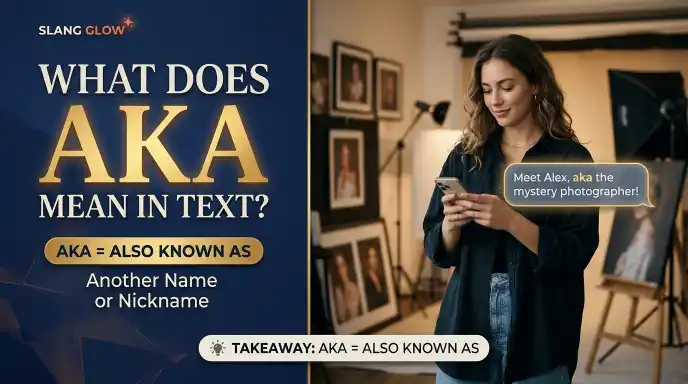
What does AKA mean in text? AKA stands for “Also Known As.” People use it when someone or something has another name, nickname, title, or identity. You may see it in text messages, TikTok comments, Snapchat conversations, Instagram posts, and everyday online chats.
For example, someone might write, “My brother, aka the family comedian, is always making jokes.” Here, AKA introduces a funny nickname that describes the person.
Unlike expressions such as LOL and BRB, AKA is used to introduce another name rather than express an emotion or reaction. It helps people explain who or what they are talking about.
This guide explains its meaning, common uses, social media examples, and how to understand AKA in different conversations.
What Does AKA Mean in Text Messages?
In everyday texting, AKA means “Also Known As.” It is an abbreviation people use when referring to someone or something by another name, nickname, or familiar title. <Cite refs={[“turn294796search0″,”turn294796search3″,”turn294796search8”]}/>
For example, if someone writes, “My best friend, aka my personal comedian, makes me laugh every day,” they are using AKA to introduce a playful nickname.
Here are three important points to remember:
- Alternative name: AKA introduces another name used for a person or thing.
- Nickname: It can introduce a funny, friendly, or familiar nickname.
- Identity: It can explain how someone or something is also recognized.
Consider this conversation:
Emma: “Who is Alex in your contact list?”
Sophie: “My brother, aka my biggest headache!”
Meaning: Sophie is giving her brother a funny nickname to explain who Alex is.
You may also see AKA in these common expressions:
- My bestie, aka my favorite person: Introducing a friendly nickname.
- My dog, aka the little troublemaker: Giving a pet a playful name.
- London, aka the Big Smoke: Introducing another name for a place.
- My favorite singer, aka the music legend: Describing someone using a familiar title.
AKA does not change the identity of a person or thing. It simply introduces another name or description associated with it.
What Does AKA Stand for in Online Slang?
AKA stands for “Also Known As.” It is an abbreviation, often classified as an initialism because people usually pronounce its individual letters.
It is commonly used in informal writing, online conversations, and everyday communication. <Cite refs={[“turn294796search1″,”turn294796search5”]}/>
Here are three common ways people use it:
- Introducing nicknames: Someone may use AKA to explain another name for a friend.
- Describing a personality: It can introduce a humorous description of someone.
- Explaining an alternative identity: It may connect a person’s real name with a stage name or online username.
For example:
Alex: “Why do you call him Captain?”
Jordan: “His nickname is Captain, aka the boss of our group.”
Meaning: Jordan explains another name people use for that person.
You may also encounter similar expressions:
- AKA: Also Known As.
- A.K.A.: The same abbreviation written with periods.
- Alias: Another name used by a person.
- Nickname: An informal name given to someone.
AKA and alias are related, but they are not exactly the same thing. AKA introduces another name, while an alias is the alternative name itself.
Where Do People Use AKA in Text Messages?
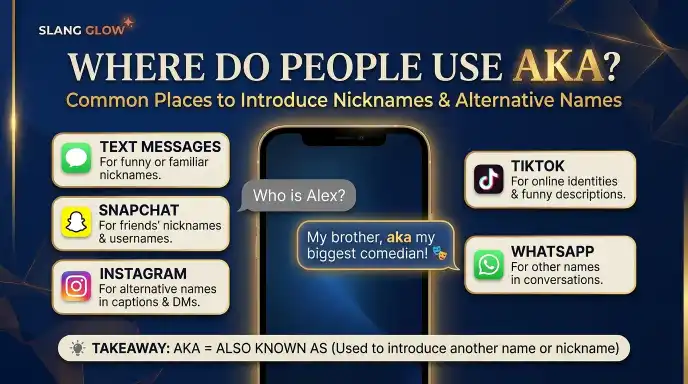
People use AKA in different forms of digital communication when they want to introduce an alternative name or explain a nickname. Its basic meaning stays the same across messaging platforms.
Here are some places where you might encounter it:
- Text messages: Friends may use AKA when explaining someone’s nickname.
- Snapchat: Someone might use it when discussing a friend’s username or familiar name.
- Instagram: It may appear in captions, comments, and direct messages.
- TikTok: Users may include AKA when introducing a funny nickname or online identity.
- WhatsApp: Friends may use it when describing someone or something in a conversation.
For example:
Mia: “Who is Sunshine?”
Olivia: “That’s my sister, aka the happiest person in our family!”
Meaning: Olivia explains that Sunshine is her sister’s nickname.
AKA is useful when someone wants to explain another name without writing a long description.
It is not a special code belonging to one social media platform. People can use it in many types of written communication.
What Does AKA Mean on TikTok, Snapchat, and Instagram?
On social media, AKA generally means “Also Known As.” People use it in captions, comments, videos, and private messages to introduce nicknames, usernames, and alternative descriptions.
Here are some examples of how it may appear:
- TikTok: Someone might introduce a funny nickname for a friend or describe their online personality.
- Snapchat: A user may explain another name or nickname used by a friend.
- Instagram: AKA may appear in biographies, captions, and comments to introduce another identity.
- WhatsApp: Friends may use it when explaining who someone is.
- Online communities: Members may use it to connect a username with a familiar nickname.
For example:
Noah: “Who is the person in your new Instagram picture?”
Liam: “My cousin, aka my adventure partner!”
Meaning: Liam is introducing another description for his cousin.
You may also see AKA written as “aka,” “AKA,” or “a.k.a.” The capitalization and punctuation do not change its basic meaning.
Remember that AKA does not have a completely different definition on TikTok, Snapchat, or Instagram. Its purpose remains introducing another name or description.
Real Chat Examples of AKA in Text Messages
The following conversations show how people might use AKA in everyday digital communication. Each example includes a simple explanation to make the meaning easier to understand.
Example 1: Talking About a Friend
Emma: “Who is the funniest person in your group?”
Sophie: “Jack, aka the class comedian!”
Meaning: Sophie uses AKA to introduce Jack’s funny nickname.
Example 2: Introducing a Nickname
Noah: “Why does everyone call you Ace?”
Liam: “That’s my nickname, aka the name my friends gave me.”
Meaning: Liam explains that Ace is another name his friends use for him.
Example 3: Talking About a Pet
Mia: “What did you name your new puppy?”
Olivia: “Max, aka the little troublemaker!”
Meaning: Olivia introduces a playful nickname for her puppy.
Example 4: Describing a Family Member
Ryan: “Who keeps making everyone laugh?”
Leo: “My sister, aka the family comedian!”
Meaning: Leo uses AKA to describe his sister with a funny title.
Example 5: Talking About a Favorite Place
Ava: “Have you visited New York City?”
Ella: “Yes! NYC, aka the Big Apple, is amazing.”
Meaning: Ella uses AKA to introduce another familiar name for New York City.
These examples show that AKA connects a name with another nickname, title, or familiar description. The surrounding sentence helps you understand why someone is using it.
More Real Chat Examples of AKA in Text Messages
AKA appears in different conversations when someone wants to introduce another name, nickname, or familiar description. It helps explain who or what someone is talking about without adding a long explanation.
Here are five additional examples:
Example 6: Talking About a Best Friend
Emma: “Who is your favorite person to hang out with?”
Sophie: “My best friend, aka my partner in crime!”
Meaning: Sophie uses AKA to introduce a playful nickname for her best friend.
Example 7: Discussing an Online Username
Noah: “Who is GamingKing?”
Liam: “That’s my cousin, aka the best player in our group.”
Meaning: Liam explains the person’s online username and another description.
Example 8: Talking About a Favorite Singer
Mia: “Who is your favorite music artist?”
Olivia: “Taylor Swift, aka my favorite songwriter!”
Meaning: Olivia introduces another description for the artist she likes.
Example 9: Describing a Teacher
Ryan: “Who is Mr. Johnson?”
Leo: “Our math teacher, aka the homework expert!”
Meaning: Leo uses AKA to introduce a funny description of his teacher.
Example 10: Talking About Yourself
Ava: “Why do your friends call you Sunshine?”
Ella: “Because I’m the positive one, aka the group motivator!”
Meaning: Ella explains another name her friends use for her.
These examples show that AKA connects a person’s name with a nickname, title, username, or alternative description.
How Should You Reply When Someone Uses AKA?
Your response depends on what the person is explaining. If someone introduces a nickname, you can acknowledge it, ask about the name, or continue the conversation naturally.
Here are four simple ways to respond:
- Casual reply: “Oh, now I get it!”
- Friendly reply: “That’s a funny nickname!”
- Funny reply: “Haha, that name suits them! 😂”
- Clarifying reply: “Is that their real name or nickname?”
Example 1: Someone Introduces a Nickname
Emma: “My brother, aka the family comedian, is hilarious.”
Sophie: “Haha, that nickname suits him!”
Meaning: Sophie understands the nickname and responds playfully.
Example 2: Someone Explains an Online Name
Noah: “My username is NightWolf, aka my gaming name.”
Liam: “Oh, that’s a cool username!”
Meaning: Liam acknowledges the alternative name.
Example 3: Someone Uses AKA for a Place
Mia: “We’re visiting NYC, aka New York City, tomorrow.”
Olivia: “That’s exciting! Have fun!”
Meaning: Olivia understands that NYC is another name for New York City.
You do not need to use AKA in your reply. Simple responses such as “Got it,” “That’s funny,” and “I understand” are perfectly natural.
Is AKA Rude or Offensive in Text?
AKA is generally not rude or offensive. It is a neutral abbreviation used to introduce another name, nickname, title, or identity.
However, the words that come after AKA can affect how a message sounds.
Here are three important points:
- Neutral use: AKA simply introduces another name or description.
- Friendly use: It may introduce a funny nickname or playful title.
- Context matters: A nickname can sound disrespectful if it is insulting or unwanted.
Is AKA Appropriate at School or Work?
Yes. AKA is commonly used in everyday writing and can be appropriate in school assignments, workplace communication, and informal conversations.
For example:
“William Shakespeare, aka the Bard of Avon, wrote many famous plays.”
This sentence introduces another familiar name for the writer.
AKA is suitable for many types of communication, but make sure that alternative names and nicknames are accurate and respectful.
Who Uses the Abbreviation AKA?
AKA is used by people who want to introduce another name or explain how someone or something is recognized. It is not limited to one age group, country, or social media platform.
You may encounter it in these situations:
- Friends: People use AKA to introduce funny or familiar nicknames.
- Students: Students may use it when discussing writers, historical figures, or famous personalities.
- Social media users: People may include it in usernames, captions, and online profiles.
- Writers and professionals: It may appear when explaining aliases, stage names, or alternative identities.
Is AKA a Gen Z Texting Term?
AKA is not exclusive to Gen Z. It has been used in English writing long before modern social media became popular.
Younger users may use it in TikTok comments, Instagram captions, and casual messages. Other age groups use it in books, articles, professional writing, and everyday communication.
AKA is a general English abbreviation rather than a newly created Gen Z slang expression.
Where Did AKA Come From?
AKA comes from the phrase “Also Known As.” It developed as a shortened form used to introduce another name, nickname, or identity.
The abbreviation has been used in English language writing for a long time, particularly when people need to identify someone who is known by more than one name.
Three points help explain its background:
- Original phrase: AKA comes from “Also Known As.”
- Written abbreviation: It provides a shorter way to introduce alternative names.
- Modern communication: Texting and social media continue to use it for nicknames, usernames, and familiar titles.
Did AKA Originate on Social Media?
No, AKA did not originate on TikTok, Snapchat, or Instagram. It existed in written English before modern social media platforms became popular.
Today, people use it across digital conversations, entertainment discussions, online profiles, and everyday writing.
The exact first person to use AKA is not clearly established, so it is better not to assign the abbreviation a specific creator or social media origin.
AKA vs. Other Common Texting Abbreviations
AKA is different from common texting shortcuts because it introduces another name rather than expressing an emotion or describing a temporary action.
| Term | Meaning | Type | Typical Usage |
| AKA | Also Known As | Initialism | Introducing another name |
| IDK | I Don’t Know | Initialism | Expressing uncertainty |
| IDC | I Don’t Care | Initialism | Showing a lack of concern |
| IMO | In My Opinion | Initialism | Sharing a personal opinion |
| BRB | Be Right Back | Initialism | Saying someone will return |
These abbreviations serve different purposes:
- AKA introduces another name or identity.
- IDK and IDC communicate a person’s response or attitude.
- IMO and BRB introduce an opinion or explain a temporary absence.
For example:
“My best friend, aka my study partner, helps me every day.”
This introduces another description of the same person.
In contrast:
“IDK who that person is.”
This means the sender does not know the person’s identity.
AKA is mainly used for names and identities, while the other abbreviations communicate different ideas.
A Real World Example of AKA in a Conversation
Imagine that two classmates are discussing a famous author during a school assignment.
Emma: “Who wrote Romeo and Juliet?”
Sophie: “William Shakespeare, aka the Bard of Avon.”
Emma: “Oh, I’ve heard that nickname before!”
Sophie: “Yes, it’s another name associated with him.”
In this conversation, Sophie uses AKA to introduce an alternative title associated with William Shakespeare.
Now consider another situation:
Noah: “Why does everyone call your brother Champ?”
Liam: “That’s his nickname, aka the name his friends use for him.”
Here, AKA connects a person’s familiar nickname with their identity.
These situations show how AKA makes it easier to explain another name without repeating a long description.
Frequently Asked Questions About AKA
Q.1. What does AKA mean in text messages?
AKA means “Also Known As.” It is used when introducing another name, nickname, title, or identity.
Q.2. What does AKA mean on TikTok?
On TikTok, AKA usually means “Also Known As.” People may use it to introduce nicknames, usernames, or alternative descriptions.
Q.3. Is AKA considered slang?
AKA is an informal abbreviation or initialism, but it is also widely used in standard English writing.
Q.4. Is AKA rude or offensive?
No. AKA is generally neutral and non offensive. However, the nickname or description following it may be disrespectful depending on the context.
Q.5. How should you reply when someone uses AKA?
You can respond with “Oh, I get it,” “That’s a funny nickname,” or ask if the name is a nickname or an alternative identity.
Q.6. Does AKA mean the same as an alias?
They are related but different. AKA means “Also Known As,” while an alias is another name used by a person.
Final Takeaway
AKA means “Also Known As” and is used to introduce another name, nickname, title, or identity. It is a common abbreviation found in text messages, social media posts, articles, and everyday conversations.
You may encounter it when someone explains a friend’s nickname, a celebrity’s stage name, or another familiar name for a place or person.
Remember that AKA simply connects two names or descriptions of the same person or thing. It is generally appropriate in both casual and formal writing when used accurately and respectfully.
FIND MORE!

Hi, I’m James Parker, a writer passionate about modern slang, internet culture, and social media language. I enjoy researching trending words and explaining their meanings in simple, easy to understand English. My goal is to help readers confidently understand and use slang in everyday conversations, texting, and online platforms.