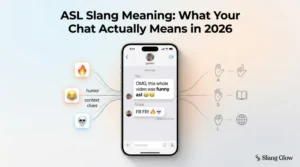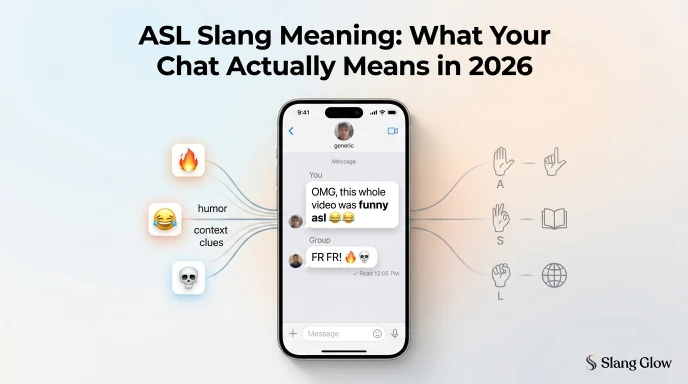
Seeing ASL slang text in a comment, caption, or message can be confusing because the same three letters can have different meanings. You may see “funny asl” in a casual post, while ASL in another conversation may refer to American Sign Language.
There is also an older internet meaning connected to early chat culture. Because of these different uses, the right meaning depends on the words around the abbreviation and the topic being discussed.
This guide explains the main meanings of ASL slang text, how the abbreviation works in casual messages, and the clues that can help you understand what someone means.
What Does ASL Mean in Text?
In modern casual texting, asl often means “as hell.” It is used to make an adjective stronger.
For example:
“That movie was funny asl.”
This means the movie was very funny.
You may also see:
- tired asl — very tired
- busy asl — very busy
- cold asl — very cold
- confused asl — very confused
- funny asl — very funny
This use is mainly associated with informal online communication, including casual messages, comments, group chats, and gaming conversations.
What Does ASL Stand For?
ASL has several meanings, so the correct definition depends on the situation.
The three main meanings to know are:
As Hell
In internet slang, asl can mean “as hell.” It commonly appears after an adjective to add emphasis.
Example:
“This game is hard asl.”
The speaker means the game is very hard.
American Sign Language
ASL can also stand for American Sign Language, a complete natural language used by many Deaf and hard of hearing people.
Example:
“My friend is learning ASL.”
Here, the topic is language learning, so American Sign Language is the likely meaning.
Age, Sex, Location
In older internet chat culture, ASL was used as a short way to ask for age, sex, and location.
Someone might simply type:
“ASL?”
This meaning is associated with earlier online chat environments and is less likely when ASL appears after an adjective.
How Can You Tell Which ASL Meaning Is Correct?
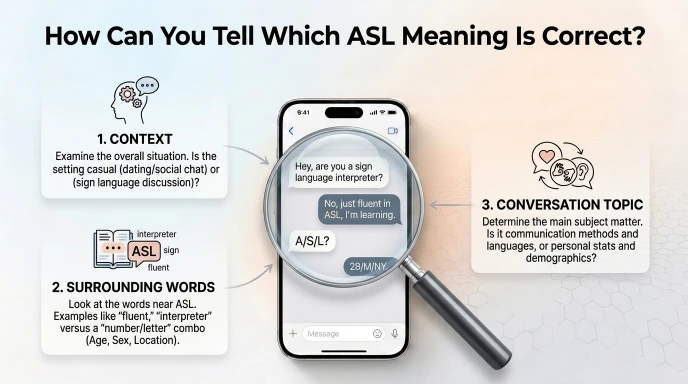
The easiest way is to examine the sentence and surrounding conversation.
If ASL comes after an adjective, it often has the slang meaning “as hell.”
“That song is good asl.”
Here, asl strengthens the word “good.”
If the conversation involves signing, interpreters, Deaf communities, accessibility, or learning a language, ASL probably means American Sign Language.
“She wants to learn ASL.”
If someone simply writes “ASL?” in an older style chat context, it may refer to age, sex, and location.
The surrounding words usually provide a better clue than capitalization alone.
ASL Meaning as “As Hell”
The slang meaning of asl works as an intensifier rather than as the main subject of the sentence.
A common pattern is:
adjective + asl
For example:
“I’m hungry asl.”
The person means they are very hungry.
Another example:
“That was awkward asl.”
The speaker is emphasizing how awkward the situation felt.
This pattern can be used with many descriptive words. It is short and informal, which makes it useful in quick online conversations.
Why Do People Use “asl” in Online Chats?
People often use abbreviations because they make messages shorter and more expressive.
Instead of writing:
“That video was extremely funny.”
someone may write:
“That video was funny asl.”
The shorter version fits the fast and casual style of many online conversations.
Slang can also make a message feel more conversational. Users may combine abbreviations with emojis, punctuation, and other informal expressions to communicate their reaction quickly.
ASL Slang Text Examples
Here are some examples of the slang meaning:
“That test was difficult asl.”
Meaning: The test was very difficult.
“I’m bored asl today.”
Meaning: The person is very bored.
“That ending was confusing asl.”
Meaning: The ending was extremely confusing.
“This weather is cold asl.”
Meaning: The weather is very cold.
“That joke was funny asl.”
Meaning: The joke was very funny.
These examples show how asl adds emphasis to different adjectives.
When ASL Means American Sign Language
Not every appearance of ASL is slang.
When people discuss communication, signing, interpreters, Deaf communities, or language learning, ASL usually means American Sign Language.
For example:
“Do you know ASL?”
The question is likely about if someone knows American Sign Language.
Another example:
“I watched a video about ASL.”
The topic of the sentence makes the meaning clear.
This is why automatically reading every ASL mention as “as hell” can lead to a misunderstanding.
When ASL Means Age, Sex, Location
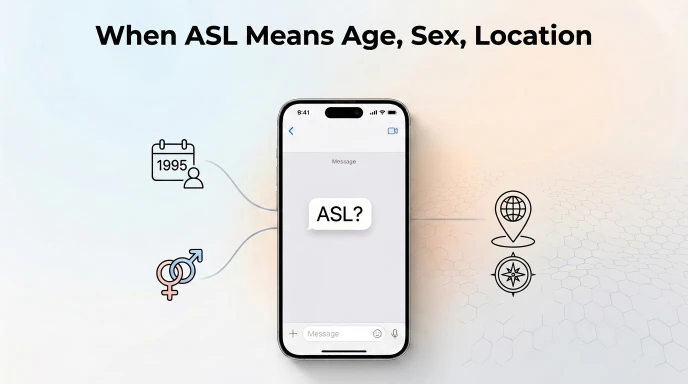
The “age, sex, location” meaning comes from older internet chat culture.
In early online chat environments, people sometimes used short abbreviations to ask basic information quickly.
Someone could simply write:
“ASL?”
Today, this meaning is much less likely in many everyday online conversations.
If you see:
“That picture is cute asl.”
the position of asl after “cute” strongly suggests the modern slang meaning “as hell.”
Does Capitalization Change the Meaning of ASL?
Capitalization can provide a clue, but it is not a guaranteed rule.
For example:
“I am studying ASL.”
This commonly points toward American Sign Language.
Meanwhile:
“That was funny asl.”
looks like the informal slang use.
However, people often ignore capitalization rules when typing online. Someone can write ASL or asl without intending to change the meaning.
For that reason, the context of the complete message is more reliable than capitalization by itself.
Is ASL Slang Used in 2026?
Yes, the slang form asl continues to appear in casual online communication.
It is especially easy to recognize when it follows an adjective:
“busy asl”
“funny asl”
“tired asl”
Its use can vary between platforms, communities, and age groups. Not everyone uses the abbreviation in the same way.
That is why understanding the current sentence and conversation is more useful than assuming that ASL has only one fixed meaning.
Come On Slang Meaning on TikTok and Social Media
On social media, ASL slang text can appear in short comments, captions, replies, and private messages. People often use slang because it makes online conversations feel quick and natural.
The surrounding content is important because social platforms contain many different communities. A comment on a comedy video may use slang differently from a post about language or accessibility.
How ASL Slang Works in Different Online Spaces
The platform itself does not always determine the meaning, but the type of conversation can provide useful clues.
On TikTok, slang may appear in quick reactions to videos or trends.
On Instagram, it can show up in comments, captions, and casual DMs.
On Discord, the meaning can depend heavily on the community or server.
In gaming chats, short expressions are common because conversations can move quickly.
The important point is that the subject of the conversation matters more than the platform name.
What Does “Wild ASL” Mean?
“Wild asl” can mean very wild, extreme, or surprising, depending on what the person is describing.
For example:
“That plot twist was wild asl.”
Here, the writer is strongly emphasizing how unexpected the plot twist was.
The phrase is informal and works best in casual digital conversations.
What Does “Busy ASL” Mean?
“Busy asl” means very busy.
For example:
“I’ve been busy asl this week.”
The abbreviation adds extra emphasis to the person’s description of their schedule or workload.
It is a casual expression rather than standard formal English.
What Does “Cold ASL” Mean?
“Cold asl” means very cold when used as internet slang.
For example:
“It’s cold asl outside.”
Here, asl strengthens the adjective “cold.”
The same structure can be used when talking about weather, a room, a drink, or another cold situation.
Why Does Context Matter More Than Capitalization?
Online users do not always follow standard capitalization rules. Someone may type ASL, asl, or another variation without intending to signal a different meaning.
For example:
“I’m learning ASL.”
The subject points toward American Sign Language.
But:
“This place is crowded asl.”
The placement after “crowded” points toward the slang use.
This shows why readers should consider the complete sentence instead of treating uppercase and lowercase as strict rules.
How Emojis Can Change the Feeling of ASL Slang
Emojis can add emotional information to a short slang message.
For example:
“That was strange asl 😭”
The emoji can make the reaction feel dramatic or humorous.
Another example:
“That video was funny asl 😂”
The emoji supports the playful reaction.
The emoji does not create the slang meaning by itself. Instead, it helps communicate the attitude behind the message.
Can ASL Sound Different Depending on the Tone?
Yes. The same slang structure can feel different depending on the way a person writes it.
A plain statement may sound neutral:
“That game was hard asl.”
Adding an emoji can make the reaction more emotional:
“That game was hard asl 😭”
Extra punctuation can also affect the way a short message is read.
This is common in digital communication because text does not include a person’s voice or facial expression.
ASL Slang vs. Standard English
The slang form and standard English can communicate the same basic idea while creating different impressions.
For example:
Informal:
“That movie was boring asl.”
Standard:
“That movie was extremely boring.”
The first sounds more like casual internet language. The second is more appropriate when writing for a formal audience.
Choosing between them depends on the reader and situation.
Why English Learners May Find ASL Confusing
English learners may recognize ASL as an abbreviation but still struggle to understand its slang use.
The difficulty comes from the fact that one abbreviation can represent unrelated ideas.
A learner might understand:
“ASL class”
as something connected to American Sign Language.
Then they may encounter:
“That was funny asl.”
and wonder why the same letters appear there.
Learning the abbreviation through complete sentences makes the difference easier to recognize.
Can ASL Change Meaning During a Conversation?
Yes. The meaning can change if the subject of the conversation changes.
Imagine a chat that begins with a discussion about a funny video:
“That clip was funny asl.”
Later, the conversation moves to language learning:
“I’m thinking about taking an ASL course.”
The first use is casual slang, while the second refers to American Sign Language.
The topic shift changes the most likely interpretation.
When Is “asl” Too Casual?
Although slang can work naturally between friends or online communities, it may not fit every audience.
It is better to choose standard wording when communicating with someone who may not understand internet slang or when the message needs a polished tone.
For example, an important announcement is usually clearer when it avoids ambiguous abbreviations.
This is not because asl is always inappropriate. It is simply a question of matching the language to the situation.
How to Avoid Misunderstanding ASL
If you are unsure what someone means, do not immediately assume the definition.
Instead, look at:
- The words before and after ASL
- The topic of the conversation
- The type of online community
- The person’s overall writing style
- Any emojis or punctuation surrounding the phrase
If those clues are still not enough, asking what the person means is the clearest option.
A Quick Context Example
Consider these three messages:
“That challenge is hard asl.”
“She is learning ASL.”
“ASL?”
Although they contain the same letters, the sentence structure and topic make the likely meanings different.
This is the main reason context is essential when reading internet abbreviations.
Frequently Asked Questions About ASL Slang Text
Can “ASL” mean something different from “asl”?
Yes. ASL and asl can appear in different contexts, but capitalization alone does not decide the meaning. The surrounding words and topic provide a better clue.
Why do people put “asl” at the end of a word?
People often place asl after an adjective to add strong emphasis. It creates a short, informal expression that is common in casual online communication.
What does “wild asl” mean?
“Wild asl” means something is very wild, extreme, or surprising, depending on the situation. The word “asl” adds extra emphasis to “wild.”
What does “busy asl” mean?
“Busy asl” means very busy. It is an informal way to emphasize how busy someone feels or how much they have to do.
What does “hard asl” mean?
“Hard asl” usually means very hard or difficult. The exact meaning depends on what the speaker is describing, such as a game, test, task, or situation.
What does “cold asl” mean?
“Cold asl” means very cold in casual internet slang. It can describe weather, a room, a drink, or another situation involving coldness.
Can ASL be used by itself?
Yes, but the meaning changes depending on the context. A standalone “ASL?” can have the older chat meaning, while ASL in a conversation about signing may refer to American Sign Language.
Does “asl” always come after an adjective?
Not necessarily, but the adjective + asl pattern is one of the clearest signs that it is being used as internet slang. Looking at the complete sentence is still important.
Why might someone misunderstand ASL in a message?
The abbreviation has multiple meanings, and different generations or online communities may be familiar with different ones. Without context, the same three letters can be interpreted in more than one way.
Is “asl” common in casual internet language?
Yes, asl can be found in informal online conversations, especially where users prefer short and expressive wording. Its use can vary between communities and platforms.
What is a simple alternative to “asl” in formal English?
Depending on the sentence, you can use words such as very, really, extremely, or highly instead. These options are clearer when writing for a formal audience.
ASL Slang in Everyday Digital Communication
The way people write online can change how an abbreviation feels. Short messages, punctuation, emojis, and the surrounding words can all add extra meaning to ASL slang text.
A simple abbreviation may look neutral on its own, but the complete message can reveal if the person is being serious, humorous, surprised, or simply descriptive.
How Tone Affects ASL in a Message
Tone is especially important in short online messages because there is no voice or facial expression to provide extra clues.
Compare these styles:
“That is funny asl.”
A simple statement describing something as very funny.
“That is funny asl 😂”
The emoji makes the message feel more openly humorous.
“That is funny asl…”
The punctuation may make the reaction feel more hesitant or unusual.
The basic slang meaning remains similar, but the presentation changes the mood.
ASL in Short Form Internet Language
Online conversations often favor short expressions because users may be replying quickly.
Instead of writing a long description, someone can use an adjective followed by asl to make the reaction brief and expressive.
For example:
“That update is confusing asl.”
The writer communicates the intensity of the reaction without adding a longer explanation.
This fits the broader style of internet communication, where abbreviations, emojis, and shortened words are often combined.
Why Context Beats the Abbreviation Alone
A three letter abbreviation does not contain enough information to explain itself.
Consider these two messages:
“I started taking ASL classes.”
and:
“This is confusing asl.”
The surrounding words create two completely different interpretations.
The first sentence points toward a language, while the second uses the abbreviation as part of casual slang.
This is why reading only the abbreviation can lead to an incorrect interpretation.
ASL in Comments and Replies
Comments and replies often have very little space for explanation, so users may rely on familiar slang.
A person reacting to a surprising clip might write:
“That was unexpected asl.”
Someone responding to a difficult challenge might say:
“This looks complicated asl.”
These messages are short, but the adjective gives the reader a clear idea of what is being emphasized.
ASL and Audience Awareness
Not every reader understands internet slang in the same way.
A phrase that seems obvious to one group may confuse someone who knows ASL mainly as American Sign Language.
For this reason, writers should consider their audience before using ambiguous abbreviations.
If the audience is broad, spelling out the intended phrase can prevent misunderstanding.
What Makes ASL Slang Different From Standard English?
The main difference is informality.
Standard English might use:
“The movie was extremely funny.”
Casual internet language may use:
“The movie was funny asl.”
Both communicate strong emphasis, but the second version has a more informal online style.
This distinction matters when choosing language for different situations.
ASL and Changing Internet Language
Internet slang is not fixed. Words and abbreviations can become popular, lose popularity, or develop new uses as online communities change.
That means an abbreviation should not always be interpreted using an old definition.
For ASL slang text, this is especially important because the abbreviation already has several established meanings.
Understanding the current sentence and conversation is therefore more useful than relying only on what the abbreviation meant years ago.
Quick Takeaway
When you encounter ASL slang text, do not focus on the letters alone.
Check:
- The words surrounding ASL
- The topic being discussed
- The platform or community
- The punctuation and emojis
- if the conversation is formal or casual
These clues can help you understand the intended message without jumping to the wrong definition.
Real World Examples of ASL Slang Text
Seeing ASL slang text in different situations makes it easier to understand how people naturally use the abbreviation online. The exact adjective or sentence can change the strength and mood of the message.
Reactions to Videos
A viewer may comment:
“That ending was confused asl.”
Here, the writer is strongly describing the ending as surprising or extreme.
Talking About a Busy Day
Someone might text:
“I’ve been busy asl all morning.”
The abbreviation adds emphasis to how busy the person has been.
Reacting to a Difficult Task
A gamer or student might write:
“This challenge is difficult asl.”
The message emphasizes that the challenge feels very difficult.
Describing Something Unexpected
A social media reply might say:
“That plot twist was wild asl.”
The writer is emphasizing how unexpected the plot twist was.
How ASL Can Make a Message More Expressive
Short slang can make an online message feel more conversational.
Compare:
“That was very unexpected.”
with:
“That was unexpected asl.”
The second version has a more casual internet tone. It can feel like a quick reaction rather than a carefully written statement.
This is one reason abbreviations remain useful in informal digital conversations.
When a Full Word Is Better Than ASL
Sometimes clarity is more important than speed.
If you are writing to someone who may not understand internet slang, replacing asl with a standard word can make the message easier to understand.
For example:
“The instructions were extremely confusing.”
is clearer for a general audience than:
“The instructions were confusing asl.”
The best choice depends on who will read the message and where it is being used.
ASL as a Context Test
You can use the surrounding sentence as a quick test.
If removing asl still leaves a normal adjective based statement, the abbreviation may be functioning as an intensifier.
For example:
“That movie was boring asl.”
Without the abbreviation:
“That movie was boring.”
The basic statement remains clear, while asl adds stronger emphasis.
This simple test can help readers recognize the slang pattern.
Why Online Slang Can Be Hard for English Learners
Internet slang is often difficult for English learners because it does not always follow textbook English.
A learner may know the word “hell” but still not realize that asl can function as an informal intensifier after an adjective.
The difficulty increases when the same abbreviation has unrelated meanings.
Learning the phrase through complete examples is therefore more useful than memorizing the abbreviation by itself.
ASL in Casual vs. Formal Tone
The same idea can be expressed differently depending on the setting.
Casual:
“That was confusing asl.”
More standard:
“That was extremely confusing.”
The first version sounds like informal internet language, while the second is more suitable for formal communication.
Neither changes the basic idea; the difference is mainly the style and audience.
Key Points to Remember
ASL slang text is easiest to understand when you look beyond the abbreviation.
Remember these points:
- asl can work as an informal intensifier.
- The word before it often gives an important clue.
- Online communities may use abbreviations differently.
- Emojis and punctuation can influence the tone.
- Capitalization is not a guaranteed meaning test.
- Formal writing usually benefits from clearer standard wording.
- The complete conversation provides the strongest context.
Understanding these patterns makes it easier to read slang naturally without assuming that every ASL has the same meaning.
How to Reply When Someone Uses “asl”
Your reply can depend on what the person appears to mean.
If asl is being used as an intensifier, you can respond normally to the main statement.
For example:
“That was stressful asl.”
A natural reply could focus on the situation rather than the abbreviation.
If the message is simply:
“ASL?”
and you are unsure what the person means, asking for clarification can prevent confusion.
This is especially useful when the conversation does not provide enough context.
How Writers Can Avoid Confusing ASL With Other Meanings
If you are writing for a large audience, abbreviations with multiple definitions can create confusion.
A simple way to make your meaning clearer is to use the full phrase when necessary.
For example, writing American Sign Language (ASL) the first time can help readers understand the subject immediately.
For casual slang, the surrounding sentence usually provides enough information.
Clear wording is especially helpful when a post may be read by people from different backgrounds or age groups.
ASL and the Difference Between Meaning and Tone
The meaning of ASL can remain the same while the overall tone changes.
Consider a sentence such as:
“That was strange asl.”
The basic idea is that the situation was very strange.
Adding punctuation or an emoji can change how the reaction feels:
“That was strange asl 😭”
The second version may sound more dramatic or humorous.
This shows that digital communication uses more than words to communicate emotion.
Can ASL Be Misread Without Context?
Yes. A short message may not provide enough information to identify the intended meaning immediately.
For example:
“Do you know ASL?”
could refer to American Sign Language, but the reader needs the surrounding conversation to be completely certain.
Likewise, a message containing asl after an adjective usually provides a much stronger clue that it is slang.
When the meaning is unclear, looking at previous messages can help.
Why ASL Is a Good Example of Internet Language
ASL shows how one abbreviation can exist across different communication styles.
It connects:
- Older internet chat language
- Modern slang
- Social media communication
- Language related conversations
- Informal digital writing
These uses developed in different settings, so the same abbreviation cannot be understood correctly without considering its context.
That is also why internet slang can be interesting for English learners: familiar looking letters may have meanings that change with the situation.
ASL Slang: Quick Reference
| Phrase or Situation | Likely Meaning |
| funny asl | Very funny |
| busy asl | Very busy |
| wild asl | Very wild or extreme |
| ASL class | American Sign Language |
| learning ASL | American Sign Language |
| ASL? in older chat | Age, sex, location |
This table is only a quick guide. The full conversation should always be considered before choosing a meaning.
Final Thoughts on ASL Slang Text
ASL slang text is a good example of how online language can carry more than one meaning. In casual slang, asl can strengthen an adjective, while ASL can also refer to American Sign Language or an older internet chat abbreviation.
The safest way to understand it is to consider the sentence, topic, audience, and online setting together. Instead of assuming one definition, look for the clues around the abbreviation.
Once you understand these patterns, phrases containing asl become much easier to read and interpret in everyday digital conversations.
VIEW MORE ARTICLES!

Hi, I’m James Parker, a writer passionate about modern slang, internet culture, and social media language. I enjoy researching trending words and explaining their meanings in simple, easy to understand English. My goal is to help readers confidently understand and use slang in everyday conversations, texting, and online platforms.