Russian can sound very formal in textbooks, but everyday conversations can be much more relaxed. Russian slang words add humor, emotion, friendliness, and personality to the language.
If you are watching Russian videos, chatting online, playing games, or talking with Russian speakers, you may come across words that do not appear in a normal Russian dictionary.
Some slang is friendly and harmless. Other expressions can sound rude or very informal. That is why learning the meaning and context is important.
This guide explores modern Russian slang words, their simple English meanings, pronunciation, and examples. It also looks at slang used by younger speakers, online communities, and friends.
What Is Russian Slang?
Russian slang is informal language used in casual conversations and online communities. It can include shortened words, playful expressions, borrowed English terms, and words with meanings that differ from their traditional definitions.
Slang can change quickly. A word that was popular years ago may sound old fashioned today, while internet culture can introduce new expressions.
For learners, the biggest challenge is not just knowing the translation. You also need to know when the word sounds natural and when it may sound inappropriate.
Russian Slang Words for Everyday Conversations
Here are some common informal expressions you may hear in casual Russian.
| Russian slang | Pronunciation | Simple meaning |
| Привет | pri VYET | Hi |
| Пока | pa KA | Bye |
| Чувак | chu VAK | Dude / guy |
| Братан | bra TAN | Bro |
| Круто | KROO ta | Cool |
| Классно | KLAS na | Great / cool |
| Прикольно | pri KOL na | Cool / fun |
| Движ | DVEEZH | A happening / activity |
| Тусовка | tu SOV ka | Hangout / party |
| Бабки | BAB ki | Money |
Some of these words are not extremely new, but they are useful for understanding informal Russian.
Чувак — Dude
Чувак (chuvak) is an informal word for “dude,” “guy,” or “man.”
Example:
Этот чувак смешной.
Meaning:
“This dude is funny.”
It is casual, so it is better suited to conversations with friends than formal situations.
Братан — Bro
Братан (bratan) is a friendly informal word similar to “bro.”
It can be used between friends or people speaking in a relaxed way.
Example:
Привет, братан!
Meaning:
“Hey, bro!”
Круто — Cool
Круто (kruto) is one of the most useful informal Russian expressions. It can mean “cool,” “awesome,” or “great.”
Example:
Круто!
Meaning:
“Cool!”
You may hear it when someone reacts positively to an idea, object, achievement, or experience.
Russian Slang for Friends and Social Life
Russian speakers also have informal words for hanging out, having fun, and spending time with friends.
Тусовка — Hangout or Party
Тусовка (tusovka) refers to a social gathering, hangout, or party.
Example:
Сегодня будет тусовка.
Meaning:
“There will be a party/hangout today.”
The exact translation depends on the situation.
Движ — Something Going On
Движ (dvizh) is an informal word related to activity, social events, or “something going on.”
Example:
Там будет движ.
Meaning:
“There will be something going on there.”
This type of slang is especially useful when understanding casual conversations about social activities.
Прикольно — Cool or Fun
Прикольно (prikolno) can describe something amusing, interesting, fun, or cool.
Example:
Прикольная идея!
Meaning:
“Cool idea!”
Its meaning can shift slightly depending on tone and context.
Russian Internet Slang
Modern Russian slang is strongly influenced by internet culture. Russian speaking users may mix traditional slang with English words, abbreviations, gaming terms, and social media expressions.
You may encounter words such as:
- Лайк — like
- Репост — repost
- Пост — post
- Чат — chat
- Бан — ban
- Тролль — troll
- Фейк — fake
- Хейтер — hater
- Фолловер — follower
- Кринж — cringe
Many of these terms come from English but have been adapted to Russian pronunciation and grammar.
Russian Slang Borrowed From English
One interesting feature of modern Russian slang is the way English internet vocabulary becomes part of everyday online speech.
For example:
Лайк comes from “like.”
Чат comes from “chat.”
Фейк comes from “fake.”
Кринж comes from “cringe.”
Хейтер comes from “hater.”
These words may look familiar to English speakers, but their pronunciation and grammatical use can be different in Russian.
Modern Russian Slang: Кринж
Кринж (krinzh) is a modern internet slang word based on the English word “cringe.”
It describes something embarrassing, awkward, or uncomfortable to watch.
Example:
Это такой кринж.
Meaning:
“This is so cringe.”
It is especially useful for understanding Russian internet culture and younger online conversations.
Modern Russian Slang: Фейк
Фейк (feyk) comes from the English word “fake.”
It can describe something false, misleading, or not genuine.
Example:
Это фейк.
Meaning:
“This is fake.”
You may see this word in online discussions about posts, accounts, news, images, or information.
Modern Russian Slang: Хейтер
Хейтер (kheyter) comes from the English word “hater.”
It usually describes someone who constantly criticizes or attacks a person, creator, group, or idea online.
Example:
Не обращай внимания на хейтеров.
Meaning:
“Don’t pay attention to the haters.”
This is a good example of how English internet vocabulary has entered modern Russian online language.
Russian Slang Cheat Sheet
Quick learner’s list:
Чувак → Dude
Братан → Bro
Круто → Cool
Прикольно → Cool / Fun
Тусовка → Hangout / Party
Движ → Something going on
Кринж → Cringe
Фейк → Fake
Хейтер → Hater
Лайк → Like
This cheat sheet gives you a quick way to recognize common Russian slang words before moving into more specific internet, gaming, and youth expressions.
Why Context Matters With Russian Slang
A direct English translation does not always explain how a Russian slang word feels.
For example, круто can simply mean “cool,” but the tone can depend on the speaker and situation.
Likewise, братан can sound friendly between friends but may feel unnatural in a formal conversation.
So when learning Russian slang words, remember three things:
Meaning + Context + Tone
Knowing all three will help you use slang more naturally and avoid using an informal word in the wrong situation.
Russian Slang on Social Media
Modern Russian slang is easy to find on social media. Russian speaking users may mix traditional slang with internet terms, English loanwords, abbreviations, and memes.
You may see slang in:
- TikTok comments
- Telegram chats
- YouTube comments
- Gaming communities
- Social media posts
- Private messages
- Online forums
For example, кринж can describe something embarrassing, while лайк refers to a social media like.
This mix of Russian and English makes online Russian especially interesting for language learners.
Russian Slang Used by Younger Speakers
Younger Russian speakers often use short, playful, or internet based expressions when talking with friends.
Some examples include:
| Slang | Simple English meaning |
| Кринж | Cringe |
| Рофл | Joke / trolling |
| Хайп | Hype |
| Чилл | Chill / relax |
| Токсик | Toxic person |
| Имба | Extremely good / overpowered |
| Мем | Meme |
| Флексить | To show off |
| Зашквар | Embarrassing / uncool |
| Топ | Top / excellent |
These words are especially useful when reading Russian online conversations.
Рофл — Joke or Trolling
Рофл (rofl) comes from the English internet abbreviation ROFL.
In modern Russian online slang, рофл can refer to a joke, something said for laughs, or playful trolling.
Example:
Я просто рофлил.
Meaning:
“I was just joking.”
The word is strongly connected with internet culture.
Хайп — Hype
Хайп (khype) comes from the English word “hype.”
It describes a lot of attention or excitement around a person, topic, product, event, or trend.
Example:
Вокруг этого фильма большой хайп.
Meaning:
“There is a lot of hype around this movie.”
You may see this word in social media discussions and entertainment content.
Чилл — Chill
Чилл (chill) comes from English and is used in informal Russian online speech.
It can describe relaxing or taking things easy.
Example:
Сегодня просто чилл.
Meaning:
“Today is just chill.”
It is casual and should not be treated as a formal Russian expression.
Токсик — Toxic Person
Токсик (toksik) comes from the English word “toxic.”
Online, it can describe someone whose behavior is unpleasant, aggressive, or harmful to a group conversation.
Example:
Он настоящий токсик.
Meaning:
“He is really toxic.”
The word is common in online communities, gaming, and social discussions.
Имба — Extremely Good or Overpowered
Имба (imba) is especially common in gaming and internet culture.
It is related to the English gaming term “imba,” short for “imbalanced.”
Players can use it for something that seems extremely powerful or difficult to compete against.
Example:
Этот персонаж — имба.
Meaning:
“This character is overpowered.”
Outside gaming, people may also use it more generally to describe something extremely good.
Флексить — To Show Off
Флексить (fleksit’) comes from the English word “flex.”
In slang, it can mean showing off something, such as money, clothes, achievements, or possessions.
Example:
Он любит флексить.
Meaning:
“He likes to show off.”
It is mostly informal and is strongly associated with modern internet culture.
Зашквар — Embarrassing or Uncool
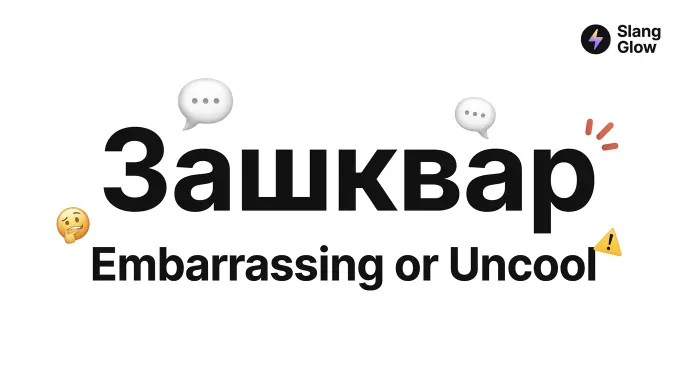
Зашквар (zashkvar) is informal Russian slang for something considered embarrassing, shameful, or uncool.
Example:
Это полный зашквар.
Meaning:
“That is totally embarrassing.”
This word can sound judgmental, so context and tone matter.
Топ — Excellent or One of the Best
Топ (top) comes from English and is widely understood in informal Russian.
It can mean something is excellent, popular, or among the best.
Example:
Этот фильм — топ!
Meaning:
“This movie is great!”
The word is short, casual, and easy to recognize online.
Russian Gaming Slang
Gaming has created its own vocabulary in Russian speaking communities.
You may encounter terms such as:
- Имба — overpowered
- Нуб — newbie / inexperienced player
- Лаг — lag
- Бан — ban
- Кикнуть — kick someone
- Лут — loot
- Скилл — skill
- Респаун — respawn
- Катка — gaming match/session
- Пати — party/team
Many of these terms come from English gaming vocabulary but are written and pronounced in a Russian way.
Катка — Gaming Session or Match

Катка (katka) is informal gaming slang for a game or gaming session.
Example:
Пойдём в катку?
Meaning:
“Want to play a match?”
The word is mainly associated with casual gaming conversations.
Нуб — New or Inexperienced Player
Нуб (noob) comes from the English gaming term “noob.”
It usually refers to an inexperienced player.
Example:
Он ещё нуб.
Meaning:
“He is still a noob.”
Depending on the tone, it can be playful or insulting.
Russian Slang vs. Formal Russian
One of the most important things for learners is knowing when slang is appropriate.
| Casual slang | More neutral/formal idea |
| Братан | Friend / brother |
| Круто | Very good |
| Тусовка | Social gathering |
| Фейк | False / not genuine |
| Хайп | Public excitement |
| Токсик | Difficult or harmful person |
| Чилл | Relaxation |
| Кринж | Embarrassing / awkward |
A slang word may sound completely normal among friends but strange in a formal interview or official document.
A Short Russian Slang Conversation
Here is a simple example showing how several informal terms can appear together:
А: Привет, братан! Что делаешь?
Б: Да ничего, просто чилл. Пойдём в катку?
А: Давай. Этот персонаж — имба!
Б: Рофл 😂
Simple English meaning:
A: “Hey, bro! What are you doing?”
B: “Nothing, just chilling. Want to play a match?”
A: “Sure. This character is overpowered!”
B: “Just joking 😂”
This kind of conversation shows why translating individual words is not always enough. The context and tone give the slang its real meaning.
When Russian Slang Can Sound Rude
Not every slang word is friendly.
Some expressions can sound insulting, mocking, or disrespectful depending on how they are used. Even a word that seems harmless in one conversation can sound aggressive in another.
Before using unfamiliar Russian slang, check:
- Who you are talking to
- if the setting is formal
- How the speaker uses the word
- if the word is joking or insulting
- if native speakers consider it rude
When in doubt, choose neutral Russian instead.
A Simple Rule for Russian Slang
If you are learning Russian slang words, remember this simple rule:
Friends → slang can sound natural
Online chats → slang is common
Gaming → slang is very common
School or work → use more neutral language
Formal situations → avoid slang
This helps you understand Russian internet culture without accidentally using a word in the wrong setting.
Cool Russian Words You Should Know
If you are looking for cool Russian words, several informal expressions are fun to recognize in everyday speech and online conversations.
Here are a few:
| Russian word | Pronunciation | Meaning |
| Круто | KROO ta | Cool / awesome |
| Классно | KLAS na | Great / cool |
| Прикольно | pri KOL na | Cool / fun |
| Топ | TOP | Excellent / top |
| Имба | EEM ba | Extremely good / overpowered |
| Чилл | CHILL | Chill / relaxing |
| Рофл | ROFL | Joke / joking |
Some are traditional informal expressions, while others come from modern internet and gaming culture.
How Do Russians Say “Wow”?
A common Russian equivalent of “Wow!” is:
Вау!
It is pronounced approximately “vau” and is a direct adaptation of the English “wow.”
Depending on the situation, Russians can also use expressions such as:
Ничего себе!
Meaning: “Wow!” / “No way!” / “That’s something!”
This expression is useful when reacting to something surprising or impressive.
How Do Russians Say “I Love You”?
In Russian, “I love you” is:
Я тебя люблю.
Pronunciation:
Ya tebya lyublyu.
It literally means “I love you.”
This is not specifically slang. It is a standard Russian phrase and can be used in romantic or affectionate contexts.
A shorter version such as люблю can also mean “I love [it/you]” when the context is clear.
How Do Russians Say “Cool”?
The most common informal Russian word for “cool” is:
Круто!
Pronunciation:
KROO ta
It can mean:
- Cool
- Awesome
- Great
- Nice
Example:
Круто! Мне нравится.
Meaning:
“Cool! I like it.”
Another useful word is классно, which can also mean “great” or “cool.”
How Do Russians Say “Sorry”?
A common way to say “sorry” in Russian is:
Извини.
Pronunciation:
iz vi NEE
It is an informal way to apologize to one person.
For a more formal or polite situation, Russian speakers can use:
Извините.
This is appropriate when speaking respectfully or addressing more than one person.
Another common expression is:
Прости.
It can mean “forgive me” or “sorry” and is often used with someone you know well.
How Do You Flirt in Russian?
Flirting in Russian is usually more about tone, compliments, and friendly conversation than memorizing special slang.
Some simple, non explicit phrases include:
Ты классно выглядишь.
“You look great.”
Мне нравится с тобой разговаривать.
“I like talking with you.”
Ты очень интересный человек.
“You are a very interesting person.”
These phrases are more natural and respectful than trying to use aggressive or overly informal slang.
For language learners, it is also important to remember that a phrase can sound different depending on the relationship and situation.
Russian Slang You Can Recognize Quickly
Here is a quick review of some useful expressions from this guide:
Круто → Cool / awesome
Классно → Great / cool
Прикольно → Fun / cool
Братан → Bro
Чувак → Dude
Тусовка → Hangout / party
Кринж → Cringe
Рофл → Joke / joking
Хайп → Hype
Имба → Overpowered / extremely good
Флексить → Show off
Топ → Excellent
Old Russian Slang vs. Modern Internet Slang
Russian slang is not one fixed group of words. It changes with culture, age, technology, and social trends.
Older informal expressions may still be understood today, while newer internet slang can spread quickly through social media and gaming.
For example:
Traditional informal expression:
Чувак → Dude
Modern internet expression:
Кринж → Cringe
Gaming/internet expression:
Имба → Overpowered
This is why a good understanding of Russian slang words requires more than memorizing a dictionary list.
Russian Slang Borrowed From English
English has had a noticeable influence on modern Russian internet vocabulary.
Examples include:
Лайк → Like
Чат → Chat
Фейк → Fake
Хейтер → Hater
Кринж → Cringe
Хайп → Hype
Флексить → Flex / show off
These words are adapted to Russian spelling and pronunciation, so they may look familiar while still behaving like Russian words in a sentence.
Quick Russian Slang Cheat Sheet
| Russian | English | Type |
| Круто | Cool | Everyday |
| Братан | Bro | Friendly |
| Чувак | Dude | Casual |
| Тусовка | Hangout | Social |
| Кринж | Cringe | Internet |
| Рофл | Joke | Internet |
| Хайп | Hype | Internet |
| Имба | Overpowered | Gaming |
| Нуб | Noob | Gaming |
| Фейк | Fake | Internet |
| Хейтер | Hater | Social media |
| Топ | Excellent | Internet |
Frequently Asked Questions About Russian Slang
1. What are some cool Russian words?
Some popular informal Russian words include круто for “cool,” классно for “great,” прикольно for “fun,” and топ for “excellent.”
2. How do Russians say “WoW”?
Russians commonly use вау for “wow.” Another expressive phrase is ничего себе, which can also communicate surprise.
3. How do Russians say “I love you”?
Я тебя люблю means “I love you” in Russian. It is a standard phrase rather than slang.
4. How do Russians say “cool”?
Круто is a common informal way to say “cool” or “awesome.”
5. How do Russians say “sorry”?
Извини is a common informal way to say “sorry” to one person. Извините is more polite or formal.
6. How do you flirt in Russian?
Simple compliments such as “Ты классно выглядишь” (“You look great”) or “Мне нравится с тобой разговаривать” (“I like talking with you”) can sound friendly and natural.
Final Takeaway
Russian slang words can make everyday Russian sound more natural, expressive, and connected to modern culture.
The most useful approach is not to memorize every slang term. Instead, learn the meaning, pronunciation, tone, and situation where each word is used.
Words such as круто, братан, чувак, тусовка, кринж, рофл, хайп, and имба can help you understand casual conversations, social media, and gaming communities.
Just remember that slang is informal. If you are speaking with someone in a professional or formal setting, neutral Russian is usually the safer choice.
Russian slang is constantly changing, so context is the key to understanding what a word really means.
Where Did Russian Slang Come From?
Russian slang has developed through many different parts of society. Everyday speech, music, literature, cities, workplaces, gaming, and the internet have all influenced the way informal Russian is spoken.
Some expressions stay popular for decades, while others disappear quickly.
Modern online slang is especially fast moving. A phrase can become popular through a meme or online community and then spread into everyday conversations.
This is why Russian slang words are better understood as a changing part of the language rather than one permanent list.
Old Russian Slang vs. Modern Slang
Russian informal language has changed a lot over time.
Older slang may be connected to Soviet era culture, professions, street language, or older youth groups. Modern slang is more likely to be influenced by social media, gaming, English, and global internet culture.
A simple comparison looks like this:
| Older influence | Modern influence |
| Street speech | Social media |
| Local communities | Gaming |
| Music | Memes |
| Workplaces | Online creators |
| Youth groups | English internet terms |
This does not mean older slang has disappeared. Some older expressions remain familiar while newer meanings develop around them.
Russian Slang and Regional Differences
Russian is spoken across a very large geographic area, so informal language can vary by region.
A word that sounds normal in one place may be less common somewhere else. Pronunciation, local expressions, and cultural references can also influence casual speech.
For language learners, this means that hearing an unfamiliar expression does not always mean the word is completely new. It may simply be regional or community specific slang.
Russian Slang in Music and Pop Culture
Music and entertainment have played an important role in spreading informal language.
Artists can introduce unusual expressions, shortened words, or creative phrases to large audiences. Fans may then repeat those expressions online.
The same can happen with:
- Movies
- TV shows
- Comedy
- YouTube
- Streaming
- Memes
- Online creators
A slang expression can therefore move from a small community into mainstream internet culture.
Russian Slang and Sarcasm
One tricky part of Russian slang is sarcasm.
Sometimes the words themselves sound positive, but the speaker’s tone means the opposite.
For example, someone could use a positive expression sarcastically after something goes badly.
That means a direct translation may not tell you what the speaker really means.
When you see unfamiliar Russian slang, consider:
What happened?
Who is speaking?
Is the person joking?
What is the tone?
These clues can completely change the interpretation.
Russian “False Friends” for English Speakers
Some Russian words borrowed from English can look familiar but behave differently in context.
This can confuse English speakers because recognizing the English source does not always mean you understand the Russian usage.
For example, Russian internet vocabulary may take an English word and change its spelling, pronunciation, or grammatical form.
A learner should therefore avoid assuming:
“It looks English, so it must work exactly like English.”
Instead, learn the Russian word as its own vocabulary item.
How Russian Slang Changes Form
Russian is a highly inflected language, so borrowed slang can change its form when used in sentences.
A foreign word may receive Russian endings or be changed into a verb.
For example, an English based word can become a Russian style verb ending in ить.
This is one reason online Russian can look confusing even when you recognize the original English word.
The important lesson is simple:
Russian speakers often adapt borrowed slang instead of using the English word exactly as it appears in English.
Why Russian Slang Can Be Hard to Translate
A single slang word may have several possible English translations.
For example, an informal expression could be translated differently depending on if the speaker is:
- Complimenting someone
- Joking
- Complaining
- Showing surprise
- Being sarcastic
- Criticizing something
This is why a good slang explanation should include a real sentence, not just one English word.
For learners, context is often more useful than a literal translation.
Guess the Russian Slang Meaning
Test yourself before looking at the answers.
1. What does “кринж” describe?
A. Something embarrassing
B. A formal meeting
C. A traditional meal
2. What does “имба” commonly describe in gaming?
A. A weak character
B. An overpowered character
C. A game update
3. What does “тусовка” usually refer to?
A. A social gathering
B. A school subject
C. A computer error
Answers
1. A — Something embarrassing
2. B — An overpowered character
3. A — A social gathering
How to Tell If Russian Slang Is Safe to Use
Not every informal expression is appropriate for every conversation.
Before using an unfamiliar word, ask:
1.Is it friendly?
2.Is it insulting?
3.Is it very informal?
4.Is it associated with a specific community?
Would a native speaker use it in this situation?
This matters especially when speaking to strangers.
A word used jokingly between close friends may sound disrespectful when said to someone you have just met.
Russian Slang for Language Learners
If your goal is to understand Russian rather than sound like a native speaker immediately, focus on recognition first.
You do not need to use every slang expression you encounter.
A good learning order is:
Recognize → Understand → Notice the tone → Learn the context → Use carefully
This approach helps prevent awkward translations and inappropriate slang use.
A Different Way to Study Russian Slang
Instead of memorizing a huge list, create four columns in your notes:
| Word | Meaning | Tone | Example |
| Russian slang | English meaning | Friendly / casual / rude | Real sentence |
This makes it easier to remember how a word actually works.
For example:
Word: Круто
Meaning: Cool
Tone: Casual
Example: Круто!
This method is more useful than memorizing translations alone.
Russian Slang: What Learners Should Remember
Russian slang is not one fixed vocabulary group. It changes according to age, location, online communities, culture, and trends.
Some words become popular through social media. Others come from gaming, music, or older forms of informal speech.
The safest way to understand a new expression is to look at the speaker, situation, tone, and surrounding words.
That will usually tell you much more than a dictionary translation alone.
Russian Slang Culture Graphic
Graphic concept: Show Russian slang evolving from older informal speech → music and pop culture → gaming → social media → modern internet language.
Use a clean timeline design with Russian words, short English meanings, chat bubbles, gaming elements, music symbols, and social media visuals. Keep the graphic educational, uncluttered, and easy to understand on mobile.
Final Thought
Learning Russian slang words is really about learning how people communicate in informal settings.
A dictionary can tell you what a word means, but context tells you how the word feels.
That is why pronunciation, tone, culture, regional use, and online context are all important when learning Russian slang.
If you understand those elements, unfamiliar expressions become much easier to decode even when they are not found in a traditional Russian textbook.
LEARN MORE!

Hey, I’m Emily. I’ve spent way too many hours scrolling TikTok and group chats trying to figure out what people actually mean by half the slang flying around — and somewhere along the way that turned into a whole thing I write about now. I cover internet slang, TikTok trends, and how words shift meaning practically overnight online.