The lear definition slang depends on where and how the word appears. In some internet memes, “lear” is a deliberate misspelling of “learn” that people use jokingly or sarcastically. It can suggest that someone failed to learn a lesson or keeps repeating a mistake. However, “lear” is not a universally recognized slang term, so the full sentence matters.
You may encounter the word in social media comments, memes, online discussions, or casual messages. In other contexts, “Lear” can be a name, while the lowercase word “lear” also has an older regional English meaning related to learning or a lesson.
What Does Lear Mean in Slang?
In some online slang and meme contexts, “lear” means “learn,” written incorrectly on purpose for humorous or sarcastic effect.
People may use it when joking about someone who does not learn from past experiences or continues making the same mistake.
For example:
“Bro will never lear.”
The intended meaning is:
“Bro will never learn.”
The altered spelling gives the sentence a deliberately incorrect, meme like tone. It is not standard English spelling, and not everyone who writes “lear” intends to use slang. Sometimes it is simply a typo.
What Is the Lear Definition in Internet Slang?
The internet slang meaning of lear comes from using a misspelled form of “learn” as a joke or online reference.
One documented use connects the spelling to the phrase “Quality Learing Center,” a misspelling that became a subject of internet memes around late 2025 and early 2026. The word subsequently appeared in online posts using “lear” instead of “learn.”
In this context, the spelling can be used to mock incorrect wording, poor understanding, or a failure to learn from something.
For example:
“Did you even lear anything?”
This is a deliberately misspelled version of “Did you even learn anything?”
The exact tone depends on the post. It might be playful teasing, sarcasm, or criticism.
Is Lear a Real Slang Word?
Lear does appear in internet slang, but it is not a widely standardized slang term with one meaning understood by everyone.
Unlike familiar expressions such as “no cap” or “bet,” its interpretation often depends on a specific meme or online conversation.
There are three possibilities to consider:
- Internet meme: “Lear” may be a deliberate misspelling of “learn.”
- Typing mistake: Someone may have accidentally misspelled another word.
- Name or regional word: “Lear” may be a proper name, while lowercase “lear” has an older regional meaning related to learning or a lesson.
Checking the context is the best way to tell which interpretation makes sense.
What Does Lear Mean in Texting?
In texting, lear may be a typo for “learn” or a deliberate spelling used for a joke.
For example:
“I need to lear from this.”
The person may have intended to write “I need to learn from this.” If the spelling appears in a meme or a conversation about an internet trend, it may be intentional.
Another example is:
“Some people never lear.”
This can be a sarcastic way to say that some people never learn from their mistakes.
Because texting is informal, the spelling alone does not prove that the sender is using a specific slang term.
What Does Lear Mean on TikTok?
On TikTok, lear may appear as a meme reference or a deliberately misspelled version of “learn.”
A creator might use it in a caption or comment to make a sentence look intentionally incorrect or to joke about someone repeating a mistake.
For example:
“When you never lear from your mistakes.”
The joke relies on the misspelling of “learn.”
However, “lear” does not have one universal TikTok meaning. A video may use it as an inside joke, a reference to an existing meme, or simply a spelling error. The caption and surrounding comments can help explain the intended meaning.
What Does Lear Mean on Social Media?
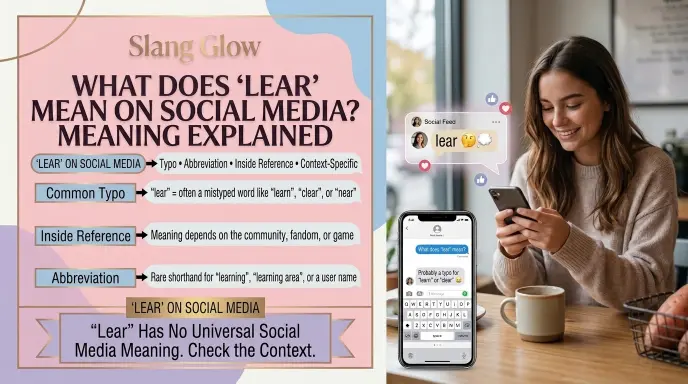
On social media, lear can function as humorous or sarcastic internet spelling rather than a completely separate word.
Someone might use it to criticize a repeated mistake or to imitate an intentionally misspelled phrase from a meme.
For example:
“Another day, another lesson they didn’t lear.”
The sentence uses a misspelling for comic effect.
Some readers may recognize the meme reference immediately, while others may assume that the person made a spelling mistake. That difference is why context matters when interpreting the word.
Does Lear Mean the Same Thing as Learn?
Not exactly. “Learn” is the standard English word, while “lear” may be a deliberate misspelling in modern internet slang.
Compare these examples:
Standard English:
“I want to learn something new.”
Meme style spelling:
“I want to lear something new.”
The second sentence is not standard spelling. It may be intended as a joke or meme reference, but it could also be an accidental typo.
When writing for school, work, or formal communication, use “learn.”
Can Lear Be a Typo Instead of Slang?
Yes. Lear can simply be a typing mistake, especially when the surrounding sentence clearly needs the word “learn.”
For example:
“I want to lear how this works.”
The writer probably intended to type “learn.”
Before interpreting the spelling as internet slang, consider if the sentence contains other clues, such as a meme reference, sarcastic tone, or comments about someone repeating mistakes.
One unusual spelling does not automatically create a slang meaning.
What Is the Difference Between Lear and Leer?
Lear and leer are different spellings with different uses.
“Lear” may refer to a name, an older regional word related to learning, or the internet slang spelling of “learn.”
“Leer” is a separate English word that can mean to look at someone in an unpleasant or suggestive way.
For example:
- “He needs to learn from the experience.” : Standard use of learn.
- “He will never lear.” : Possible meme style misspelling.
- “He gave an unpleasant leer.” :Standard use of leer.
The difference matters because replacing one spelling with another can completely change the meaning of a sentence.
Can Lear Have an Older Dictionary Meaning?
Yes. The word “lear” has an older regional English meaning connected with learning, instruction, or a lesson.
These traditional meanings are different from the recent internet slang use.
Therefore, not every occurrence of “lear” should be interpreted as a meme or deliberate misspelling. The source, sentence, and context determine the likely meaning.
What Does Lear Mean in Different Contexts?
The word “lear” does not have one widely recognized modern slang meaning. Depending on where you see it, it may be an intentional misspelling of “learn,” a typo, a proper name, or an older regional word.
For example:
“Bro will never lear.”
In a meme or joking conversation, the writer may mean “Bro will never learn.”
However, if someone writes “leer at someone,” they are using a different English word. “Leer” means to look at someone in an unpleasant or suggestive way.
Checking the spelling and the full sentence helps you understand the intended meaning.
What Does It Mean to Leer at Someone?
To leer at someone means to look at them in an unpleasant, mocking, or sometimes suggestive way. The word often describes a stare that makes the person being watched feel uncomfortable.
For example:
“He gave her an uncomfortable leer.”
This means he looked at her in a way that seemed inappropriate or unpleasant.
Leer is not the same as lear. If a sentence describes someone staring at another person, “leer” is probably the intended word.
What Does “Leer” Mean in Slang?
Leer is a standard English word, not just an internet slang term. It describes a particular kind of unpleasant or suggestive look.
For example:
“Stop leering at people.”
The sentence means to stop looking at people in an uncomfortable or inappropriate way.
On social media, people may use “leer” when describing someone’s facial expression, behavior, or reaction in a photo or video.
Remember that “lear” and “leer” have different spellings, so using the correct one is important.
Is Lear the Same as Learn?
No. “Learn” is the standard spelling for gaining knowledge or understanding something.
“Lear” may appear as an intentional misspelling in a meme, but it is not the normal spelling of the verb.
For example:
Correct: “I want to learn something new.”
Meme style spelling: “I want to lear something new.”
The second version may be a joke or a typo. In schoolwork, formal writing, and professional communication, use “learn.”
Is Lear or Leer the Correct Spelling?
Both lear and leer exist, but they have different uses.
Learn: To gain knowledge or a skill.
Leer: To look at someone in an unpleasant or suggestive way.
Lear: A proper name in some contexts, and a rare older regional word. It may also appear as an intentional misspelling of “learn” online.
For example:
“You should learn from your mistake.”
and
“He continued to leer at the stranger.”
Both sentences use the correct spelling for their meanings.
What Are Some Examples of Lear and Leer?
These examples show the difference between the words.
“Bro will never lear.”
Possible meaning: A humorous misspelling of “Bro will never learn.”
“I need to learn from this.”
Meaning: I need to gain knowledge from this experience.
“He gave an unpleasant leer.”
Meaning: He gave someone an uncomfortable or suggestive look.
“King Lear is a famous literary character.”
Here, Lear is a proper name.
Looking at the sentence makes the intended meaning easier to identify.
Can Lear Be Used in a Meme?
Yes. Someone may use “lear” as a deliberately incorrect spelling for humorous effect in a meme, caption, or comment.
For example:
“The lesson was right there, but bro refused to lear.”
The joke depends on replacing “learn” with “lear.”
However, this does not mean everyone who types the word intends a joke. The spelling could also be accidental, so the surrounding context matters.
What Is a Synonym for Leer?
The best synonym for “leer” depends on the exact expression.
Possible alternatives include:
- Ogle: To look at someone in an overly interested or inappropriate way.
- Stare: To look at someone or something for a long time.
- Glare: To look angrily at someone.
- Gawk: To stare openly, often with surprise or poor manners.
These words are related to looking, but they are not exact substitutes in every sentence. A “leer” usually has an unpleasant or suggestive quality that a simple stare may not have.
How Can You Understand Lear in Online Conversations?
Start by checking if the word is spelled lear, learn, or leer.
- If the sentence is about gaining knowledge, the writer probably means “learn.” If it describes someone looking at another person in an unpleasant way, “leer” is likely correct.
- If the word appears in a meme or joke, “lear” may be an intentional misspelling. A capitalized “Lear” could also be a name.
This small spelling check can prevent confusion and help you understand what the writer intended.
Frequently Asked Questions About Lear and Leer
1. What does Lear mean?
“Lear” can be a proper name, a rare older regional word, or an intentional misspelling of “learn” in an online joke. It does not have one universally recognized modern slang meaning.
2. What does it mean to Lear at someone?
The usual phrase is “leer at someone,” not “lear at someone.” It means looking at someone in an unpleasant, mocking, or sometimes suggestive way.
3. What does “leer” mean in slang?
“Leer” means to look at someone in an unpleasant or suggestive way. It is a standard English word that can also appear in casual online conversations.
4. Is it leer or Lear?
Both spellings exist, but the meaning differs. “Leer” means to look at someone in an unpleasant or suggestive way. “Lear” may be a name, a rare regional word, or a joke spelling of “learn.”
5. What is Lear slang for?
“Lear” is not a widely established slang term with one fixed meaning. In memes, it may be used as a misspelling of “learn,” but context is needed to confirm that interpretation.
6. What is a synonym for “lear”?
If you mean “leer,” possible synonyms include ogle, stare, glare, and gawk, depending on the context. If you mean “lear” as a misspelling of “learn,” related words include study, understand, and gain knowledge.
Final Thoughts on Lear Definition Slang
The meaning of “lear” depends on its spelling and context. Online, it may be a joking misspelling of “learn,” but it can also be a typo or a proper name.
The word “leer” has a separate meaning: looking at someone in an unpleasant or suggestive way. Recognizing the difference between these spellings will help you interpret messages, comments, and memes more accurately.
FIND THE NEW ARTICLES!

Hi, I’m James Parker, a writer passionate about modern slang, internet culture, and social media language. I enjoy researching trending words and explaining their meanings in simple, easy to understand English. My goal is to help readers confidently understand and use slang in everyday conversations, texting, and online platforms.