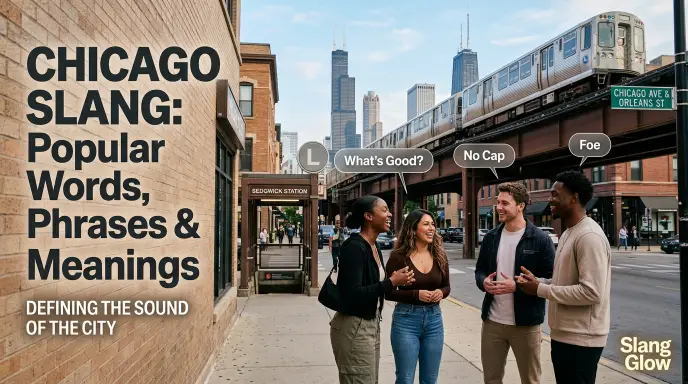
Chicago slang includes informal words, phrases, nicknames, and expressions associated with everyday speech in Chicago and the surrounding area. Some terms are strongly connected with local neighborhoods and communities, while others have spread through music, sports, social media, food culture, and popular entertainment.
Learning Chicago slang can make it easier to understand conversations, social media posts, songs, local references, and discussions about life in the city.
What Is Chicago Slang?
Chicago slang refers to informal words and expressions commonly associated with Chicago speech and culture. The vocabulary can vary depending on the neighborhood, age group, community, and situation.
Some Chicago expressions are used across the city, while others may be more common within particular communities. Local pronunciation and vocabulary can also give Chicago speech its distinctive character.
Chicago slang is not one fixed dictionary. It continues to change as people introduce new expressions and older terms become less common.
Why Does Chicago Have Its Own Slang?
Chicago has developed distinctive slang partly because of its diverse communities, neighborhoods, migration patterns, music scenes, sports culture, and local traditions.
Different communities have contributed words and expressions to the city’s everyday language. African American English, Latino communities, immigrant communities, neighborhood traditions, and youth culture have all influenced how informal language develops in Chicago.
Social media has also helped local expressions reach people outside the city.
What Words Are Chicago Known For?
Several words are strongly associated with Chicago or frequently appear in discussions about Chicago speech.
Common examples include:
| Chicago expression | Common meaning |
| Chi Town | Nickname for Chicago |
| The L | Chicago’s elevated and rapid transit system |
| Pop | Soda or soft drink |
| Frunchroom | Front room |
| Gym shoes | Sneakers |
| Jewels | Jewel Osco grocery store |
| The Loop | Central Chicago area |
| Da | A playful representation of Chicago pronunciation |
| Dib | A claim or reservation of something |
Not every Chicago resident uses all of these expressions. Their popularity can differ across generations and communities.
What Does Chi Town Mean?
Chi Town is a nickname for Chicago. The name is often used casually in conversation, music, sports discussions, tourism, and social media.
You might see someone write:
“I’m heading back to Chi Town.”
The expression gives Chicago a shorter, informal identity. It is one of the city’s most recognizable nicknames.
What Does “The L” Mean in Chicago?
In Chicago, “the L” refers to the city’s elevated and rapid transit system.
The system is commonly called the “L,” even though not every part of the network runs above street level. Chicago residents and visitors may use the term when discussing transportation around the city.
For example:
“I took the L downtown.”
This means the person used Chicago’s rapid transit system.
What Does Pop Mean in Chicago Slang?
In Chicago and parts of the Midwest, pop is commonly used to mean a carbonated soft drink, while other regions of the United States often use “soda” or another regional term.
For example:
“Do you want a pop with your meal?”
The word itself is not exclusive to Chicago, but its use is strongly associated with Midwestern speech.
What Does Frunchroom Mean?
Frunchroom is a Chicago associated pronunciation and spelling of “front room.”
The term reflects a recognizable feature of Chicago area speech in which certain words and phrases may be pronounced differently from standard written forms.
You may encounter “frunchroom” in discussions about Chicago accents, local speech, and the city’s linguistic traditions.
What Does Gym Shoes Mean in Chicago?
Gym shoes means sneakers or athletic shoes.
The phrase is associated with Chicago and parts of the Midwest. Someone might say:
“Grab your gym shoes before we leave.”
The person is talking about athletic footwear rather than a specific type of shoe designed only for a gym.
What Does Jewels Mean in Chicago?
Jewels can be an informal reference to Jewel Osco, a grocery store chain that has a strong presence in the Chicago area.
Someone might say:
“I’m stopping at Jewels.”
The plural form may sound unusual to people from other parts of the country, but it is recognizable as a local Chicago area usage.
What Is the Loop in Chicago?
The Loop is Chicago’s central business and downtown area. The name is also closely connected with the elevated train tracks that form a loop around part of the downtown area.
People commonly use “the Loop” when talking about downtown Chicago.
For example:
“I work in the Loop.”
This means the person works in the central downtown area.
What Does “Da” Mean in Chicago Slang?
“Da” is often used as a playful written representation of a Chicago style pronunciation of “the.”
You may see it in humorous references to Chicago accents, local jokes, memes, and cultural content.
For example:
“Da Bears”
is a well known humorous representation of how some Chicago speakers may pronounce “the Bears.”
The spelling is generally a stylized representation rather than standard Chicago writing.
What Does Dib Mean in Chicago?
Dib can be used informally to claim something or reserve it for yourself.
For example:
“Dib on the front seat!”
This means the speaker is claiming the front seat.
The expression can appear in playful conversations, especially when people are deciding who gets something first.
What Is Chicago Lingo?
Chicago lingo includes local vocabulary, pronunciation patterns, nicknames, food terms, neighborhood references, and informal expressions.
Some terms are obvious examples of local speech, while others are shared with nearby Midwestern regions. Chicago’s large and diverse population means that local language can vary considerably.
A phrase that sounds completely normal in one neighborhood may be less familiar somewhere else.
Does Chicago Slang Come From the Chicago Accent?
Some Chicago slang and local expressions are connected to Chicago pronunciation and accent features, but slang and accent are not the same thing.
An accent describes how words are pronounced. Slang refers more broadly to informal vocabulary and expressions.
Chicago speech is sometimes recognized by particular pronunciation patterns, while local slang can include words that do not depend on pronunciation at all.
What Are Some Funny Chicago Slang Words?
Chicago has several expressions that may sound unusual or funny to people unfamiliar with local speech.
Examples include:
- Frunchroom
- Jewels
- Gym shoes
- Pop
- Da
- Chi Town
- The L
The humor often comes from the difference between Chicago usage and expressions people hear in other parts of the United States.
Chicago Slang for Everyday Conversations
Chicago slang can appear in ordinary conversations about transportation, food, sports, neighborhoods, shopping, and plans.
For example:
“I’m taking the L to the Loop.”
“Grab your gym shoes.”
“I’m stopping at Jewels.”
“Want a pop?”
These examples show how local vocabulary can appear naturally without making an entire conversation sound unusual.
Is Chicago Slang Different From New York Slang?
Yes, Chicago slang and New York slang have different regional histories and expressions, although some informal words may overlap.
Chicago language is influenced by Midwestern speech, local communities, and the city’s own cultural history. New York has its own vocabulary, pronunciation patterns, neighborhood expressions, and linguistic traditions.
Regional slang is not completely separate from other varieties of English, so some words can appear in multiple cities.
Is Chicago Slang Different From Midwest Slang?
Chicago slang overlaps with Midwestern slang, but the two terms are not identical.
Chicago is part of the Midwest, so some expressions associated with Chicago are also heard elsewhere in the region. At the same time, Chicago has developed local terms and cultural references that are especially recognizable within the city.
This makes Chicago slang a mixture of broader regional language and city specific expressions.
How Does Chicago Slang Appear Online?
Social media has helped Chicago slang spread beyond the city.
Local expressions can appear in TikTok videos, Instagram captions, memes, sports discussions, music, YouTube videos, and online conversations. People outside Chicago may adopt certain words because they encounter them through popular culture.
Online usage can also change the meaning or popularity of a local expression over time.
Why Should You Learn Chicago Slang?
Learning Chicago slang can help you understand local conversations and cultural references.
It can also make it easier to recognize Chicago references in movies, television, music, sports content, social media, and travel discussions.
The goal is not to memorize every expression. Understanding the most common local terms and knowing when they are appropriate is more useful.
Chicago Slang Examples in Conversation
Here are a few simple examples:
Example 1:
“I’m taking the L downtown.”
Meaning: The speaker is using Chicago’s rapid transit system.
Example 2:
“Want a pop?”
Meaning: The speaker is asking if someone wants a soft drink.
Example 3:
“Grab your gym shoes.”
Meaning: The speaker means sneakers or athletic shoes.
Example 4:
“I’m heading to the Loop.”
Meaning: The speaker is going toward central downtown Chicago.
Example 5:
“I’m stopping at Jewels.”
Meaning: The speaker is referring to Jewel Osco.
These examples show how Chicago vocabulary can appear naturally in everyday speech.
How Do You Recognize Chicago Slang?
The easiest way to recognize Chicago slang is to look at the context, pronunciation, and local references surrounding a word.
A term like “the L” becomes obvious when the conversation is about transportation. Similarly, “gym shoes” makes sense when someone is discussing footwear.
Some expressions are also recognizable because they refer directly to Chicago places, institutions, or local culture.
What Are Some Popular Chicago Slang Phrases?
Chicago has many informal expressions that connect everyday language with local culture. Some phrases are related to neighborhoods, transportation, food, sports, or the city’s recognizable way of speaking.
Common examples include “What’s good?”, “You good?”, and local references such as “the L” and “the Loop.” Not every phrase is exclusive to Chicago, so context matters when identifying if an expression is truly local.
What Does “You Good?” Mean in Chicago?
“You good?” usually means “Are you okay?” or “Do you need anything?”
The phrase can be used casually when someone wants to check on another person. Its meaning depends on the situation and tone.
For example:
“You good? You’ve been quiet.”
Here, the speaker is simply asking if everything is okay.
What Does “What’s Good?” Mean in Chicago Slang?
“What’s good?” is a casual way to ask how someone is doing or what is happening.
The phrase is not exclusive to Chicago, but it can appear in Chicago conversations and other varieties of informal American English.
For example:
“What’s good? Haven’t seen you in a while.”
The speaker is using the phrase as a casual greeting.
What Does “No Cap” Mean in Chicago?
“No cap” means “I’m telling the truth” or “I’m not exaggerating.”
This expression is widely used in American internet and youth slang, so it should not be treated as uniquely Chicagoan. It may still appear in conversations involving Chicago speakers, music, and online culture.
For example:
“That was the best pizza I’ve had, no cap.”
The speaker is emphasizing that they genuinely mean what they said.
What Does “Finna” Mean in Chicago Slang?
“Finna” is an informal expression meaning “about to” or “going to.”
It appears in African American English and has spread into broader internet and youth slang. Because Chicago has a large and influential African American community, the expression can be heard in Chicago conversations, music, and online content.
For example:
“I’m finna head home.”
This means the person is about to go home.
What Does “Foe” Mean in Chicago Slang?
“Foe” can have different meanings depending on the Chicago community and context.
In some Chicago related online and music contexts, “foe” appears as a shortened or stylized form associated with local speech and group references. Its exact meaning should not be assumed from the spelling alone.
When you encounter “foe” in Chicago slang, the surrounding sentence and the speaker’s community are important for understanding what they mean.
What Does “Shorty” Mean in Chicago Slang?
“Shorty” is an informal word that can refer to a young person or someone being addressed casually.
The word is not exclusive to Chicago and has been used in several varieties of American slang for many years.
Its meaning can change according to context. In one conversation it may simply be a casual nickname, while in another it can refer to a younger person.
What Does “Folks” Mean in Chicago Conversations?
“Folks” is an informal word for people or family members.
Although the term is not specifically Chicago slang, it can appear naturally in Chicago conversations just as it does in other parts of the United States.
For example:
“I’m going to see my folks this weekend.”
Here, “folks” usually means the speaker’s parents or family.
What Chicago Slang Is Used for Friends?
Chicago speakers may use several casual words for friends, depending on their age, community, and social group.
Words such as “bro,” “fam,” “folks,” and “homie” can appear in informal conversations. These terms are not uniquely Chicagoan, but they can be part of casual speech in the city.
Local slang often overlaps with wider American slang rather than existing as a completely separate vocabulary.
What Chicago Slang Is Used for Food?
Chicago is famous for its food culture, so many local expressions are connected with food and restaurants.
You may hear people casually discuss:
- Deep dish
- Italian beef
- Chicago dog
- Jibaritos
- Tavern style pizza
Some of these are food names rather than slang words. Still, they are important local vocabulary when learning about Chicago culture.
What Does “Chicago Dog” Mean?
A Chicago dog is a style of hot dog strongly associated with Chicago food culture.
The phrase does not simply mean any hot dog sold in Chicago. It usually refers to a particular preparation associated with the city.
Because the term is culturally recognizable, someone might mention a “Chicago dog” while discussing local food, restaurants, sports events, or travel.
What Does “Italian Beef” Mean in Chicago?
Italian beef refers to a Chicago associated sandwich made with thinly sliced seasoned beef served on Italian style bread.
The term is especially recognizable in Chicago food culture. People may discuss variations in how the sandwich is prepared or served.
Although “Italian beef” is not slang in the traditional sense, it is useful local vocabulary when learning about Chicago expressions and culture.
What Is Chicago Slang for a Friend?
There is no single word that every Chicago resident uses for “friend.”
Depending on the speaker and social group, terms such as “bro,” “homie,” “fam,” or other casual expressions may appear. Many of these words are shared across American slang.
This is why it is better to think of Chicago slang as a combination of local expressions and broader informal language.
What Are Some Chicago Slang Words From Music?
Chicago’s music scenes have helped introduce local expressions to audiences outside the city.
Chicago hip hop and drill music have especially influenced how people outside Chicago encounter local vocabulary, neighborhood references, and expressions.
However, a word appearing in Chicago music does not automatically mean it is exclusive to Chicago. Many expressions come from broader African American English or internet slang and are used in multiple regions.
How Has Chicago Drill Influenced Slang?
Chicago drill has helped spread some Chicago associated words, phrases, and neighborhood references to wider audiences.
Music can expose listeners to local vocabulary that they may not encounter in ordinary conversations. Social media then spreads those terms even further.
At the same time, Chicago slang existed long before drill music. The city’s informal language has developed through many communities, generations, and cultural influences.
What Are Some Old Chicago Slang Words?
Older Chicago speech includes expressions that may sound unfamiliar to younger speakers today.
Terms such as “frunchroom” and the use of “pop” are often discussed when people describe traditional Chicago or Midwestern speech. Some older expressions remain recognizable, while others become less common as language changes.
Chicago slang is therefore not limited to current internet vocabulary.
Does Chicago Slang Change by Neighborhood?
Yes, Chicago speech can vary between neighborhoods and communities.
The city has a large and diverse population, and different areas have developed their own cultural histories and speech patterns. Age, family background, social groups, and local experiences can all influence vocabulary.
For that reason, there is no single list that represents every Chicago resident.
Is Chicago Slang the Same as Chicago Accent?
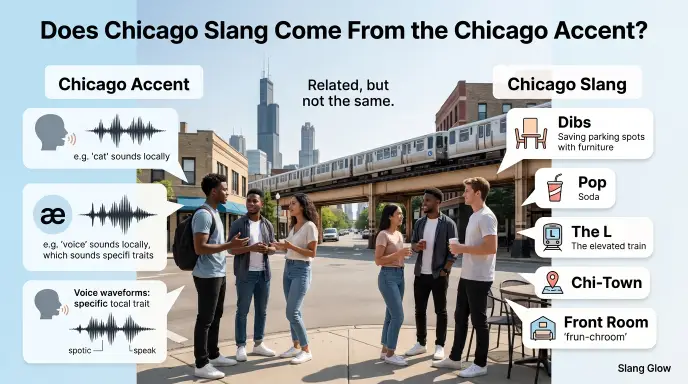
No. Chicago slang and the Chicago accent are related but different things.
Slang focuses mainly on informal words and expressions. An accent describes pronunciation and speech patterns.
Someone can use Chicago slang without having a strong Chicago accent, and someone with a Chicago accent does not necessarily use every local slang expression.
Is Chicago Slang Still Used Today?
Yes, Chicago slang continues to change and appear in modern conversations, music, sports culture, and social media.
Some older expressions remain recognizable, while newer terms spread through online communities and popular culture.
The meaning and popularity of individual words can change quickly, so not every expression labeled “Chicago slang” online is equally common among current Chicago residents.
Chicago Slang vs. New York Slang
- Chicago and New York both have recognizable regional expressions, but their slang developed within different cultural and linguistic environments.
- Chicago vocabulary often includes Midwestern influences and local references such as the L, the Loop, pop, and frunchroom. New York has its own expressions connected with the city’s neighborhoods, history, and communities.
Some slang overlaps because American internet culture allows words to spread rapidly between cities.
Chicago Slang vs. Atlanta Slang
- Chicago slang and Atlanta slang also have different regional histories.
- Chicago expressions are shaped by Midwestern speech and the city’s diverse communities. Atlanta has its own Southern influences, music culture, and regional vocabulary.
Music and social media have caused slang from both cities to reach national audiences, which can make regional boundaries less obvious.
How Can You Use Chicago Slang Naturally?
The easiest way to use Chicago slang naturally is to understand the context before using the expression.
Start with terms that have clear meanings, such as the L, the Loop, pop, or gym shoes. These are easier to understand than highly localized expressions whose meanings may depend on a particular community.
Using too many local expressions at once can also sound unnatural if you are not familiar with how Chicago speakers actually use them.
Chicago Slang Examples for Beginners
Here are a few beginner friendly examples:
| Expression | Example |
| Chi Town | “I’m visiting Chi Town this summer.” |
| The L | “I took the L downtown.” |
| The Loop | “My office is in the Loop.” |
| Pop | “Can I get a pop?” |
| Gym shoes | “Don’t forget your gym shoes.” |
| Frunchroom | “We’re sitting in the frunchroom.” |
| Jewels | “I’m going to Jewels after work.” |
These examples are useful for understanding the vocabulary without trying to imitate a specific accent.
Frequently Asked Questions About Chicago Slang
What are the top 10 slang words?
There is no single official top 10 list for Chicago slang, because usage varies by neighborhood, age, and community. Some commonly recognized Chicago associated terms include Chi Town, the L, the Loop, pop, gym shoes, frunchroom, Jewels, dibs, da, and Chicago dog.
Some of these are local vocabulary or cultural references rather than slang in the strict linguistic sense.
How do you say “hi” in Chicago?
There is no special Chicago only word that universally replaces “hi.” Chicagoans can use ordinary greetings such as “hi,” “hey,” “hello,” or casual expressions like “what’s good?” depending on the situation.
The greeting someone uses usually depends more on their age, community, and personal style than on Chicago alone.
What is the slang name for Chicago?
Chi Town is one of the best known informal nicknames for Chicago.
You may see it in casual conversation, music, sports discussions, social media, and other informal contexts.
What’s “to you” in Chicago slang?
There is no single Chicago slang word that directly means “to you.” The phrase normally remains “to you” in everyday Chicago English.
If you encountered a specific expression that was described as meaning “to you,” the surrounding sentence would be important because local slang can change meaning by context.
What is Gen Z’s favorite slang?
There is no single slang word that can accurately be called Gen Z’s favorite. Gen Z uses a wide range of internet and conversational expressions, including terms such as “no cap,” “bet,” “lowkey,” “highkey,” and “rizz.”
These expressions are not uniquely Chicago slang, although Chicago speakers may use some of them in casual conversations.
What is 100 in slang?
In slang, “100” or “keep it 100” commonly means being honest, genuine, or real.
For example:
“Keep it 100 with me.”
This means the speaker is asking someone to be honest or straightforward. The expression is broader American slang rather than a term unique to Chicago.
What Are the Most Recognizable Chicago Expressions?
Some of the easiest Chicago expressions to recognize are connected with places, transportation, food, and local speech.
The L refers to the city’s rapid transit system. The Loop refers to a central part of downtown. Pop is a common Midwestern term for a soft drink, while frunchroom reflects a local pronunciation.
Chi Town is an informal nickname, and gym shoes is a regional term for sneakers.
These expressions provide a useful starting point for anyone learning Chicago vocabulary.
How Does Chicago Slang Show Local Identity?
Chicago slang can reflect where people live, the communities they belong to, and the cultural influences around them.
Words connected with transportation, food, neighborhoods, and pronunciation can quickly identify a conversation as Chicago related. Music and sports can also reinforce these local references.
At the same time, Chicago language is constantly influenced by national trends, so local identity and broader American slang often overlap.
Why Is Chicago Slang Popular Online?
Chicago slang is popular online partly because music, sports, memes, short form videos, and local culture reach audiences far beyond the city.
A word that starts as a local expression can become familiar to people in other states after appearing repeatedly in popular content.
Social media also makes it easier for younger speakers to introduce new expressions and adapt older ones.
Final Thoughts on Chicago Slang
Chicago slang reflects the city’s neighborhoods, communities, history, food culture, transportation system, music, and changing speech patterns. Some expressions are strongly local, while others are part of broader Midwestern or American slang.
Words such as Chi Town, the L, the Loop, pop, gym shoes, frunchroom, and Jewels can help you recognize common Chicago references. Other expressions may be associated with particular communities rather than the entire city.
Chicago slang also continues to evolve. Music, social media, younger speakers, and popular culture introduce new vocabulary while older local expressions remain part of the city’s linguistic history.
Understanding the context is the most important part of learning Chicago slang because not every expression is used by every Chicago resident.
Explore the Meaning!
Hey, I’m Emily. I’ve spent way too many hours scrolling TikTok and group chats trying to figure out what people actually mean by half the slang flying around — and somewhere along the way that turned into a whole thing I write about now. I cover internet slang, TikTok trends, and how words shift meaning practically overnight online.