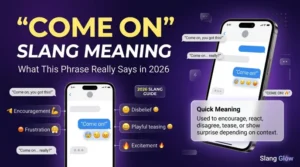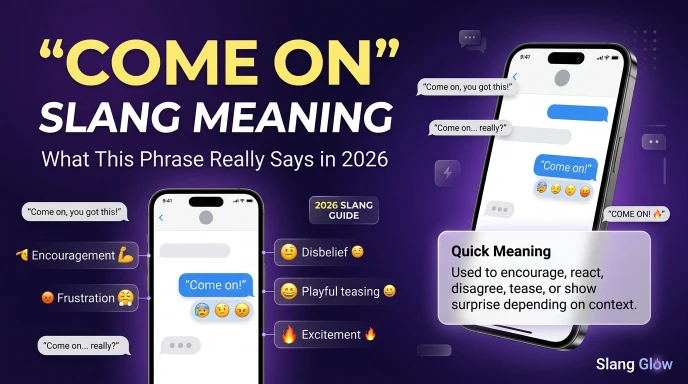
“Come on” in slang is used to encourage someone, show disbelief, or urge them to hurry, depending on the context.
“Come on” is a common phrase in everyday English, but its meaning can change when people use it as slang. You may see it in texts, TikTok comments, Instagram posts, gaming chats, or casual conversations.
The phrase come on slang can show different feelings. Someone might use it to show surprise, annoyance, encouragement, disbelief, or excitement. The same two words can sound friendly in one message and frustrated in another.
For example, if a friend says, “Come on, you can do it!” the phrase is encouraging. But if someone says, “Come on! Seriously?” it may show that they are annoyed or surprised.
This guide explains how people use “come on” in modern online conversations and how to understand its meaning from context.
What Does “Come On” Mean in Slang?
In casual slang, “come on” is often used as an emotional reaction. It can mean “really?”, “let’s go,” “stop,” or “you can do it,” depending on the situation.
Unlike some internet abbreviations, “come on” is not limited to one slang definition.
Its meaning usually comes from the tone and context.
Common meanings include:
- Encouragement: “Come on, you got this!”
- Disbelief: “Come on, you can’t be serious.”
- Annoyance: “Oh, come on!”
- Excitement: “Come on! Let’s go!”
- Persuasion: “Come on, give it a try.”
Why “Come On” Sounds Different in Every Chat
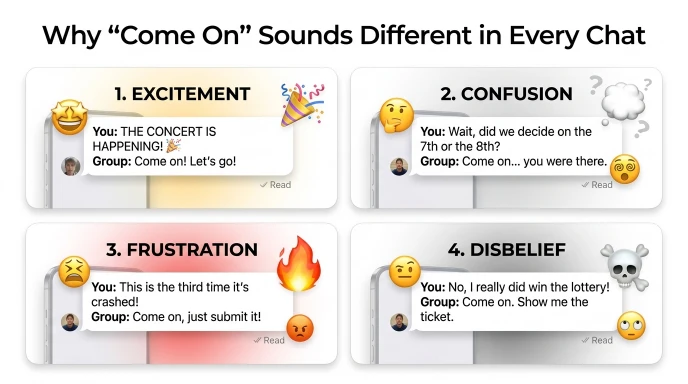
The interesting thing about come on slang is that punctuation and surrounding words can change the feeling.
Compare these:
“Come on!”
This can sound excited or encouraging.
“Come on…”
This may sound disappointed or tired.
“Oh, come on!”
This often shows annoyance or disbelief.
“Come on, you can do it!”
This clearly gives encouragement.
So, you should not look only at the phrase. Look at the complete message.
Come On Slang in Texting
In texting, people often use “come on” as a quick emotional response.
For example:
“Come on 😭 you really forgot again?”
Here, the phrase can show playful frustration.
Another example:
“Come onnn, let’s go!”
The extra letters make the message feel more energetic and informal.
Texting also allows people to use emojis, repeated letters, and punctuation to show tone.
“Come On” as Encouragement
One of the most positive uses of “come on” is to encourage someone.
For example:
“Come on! You can finish this!”
Here, come on means something like “keep going” or “you can do it.”
You may see this use in:
- Sports
- Gaming
- School chats
- Friend groups
- Motivational posts
- Live streams
It can make a message sound energetic and supportive.
“Come On” to Show Disbelief
People also say “come on” when they do not believe something.
For example:
“You said you studied all night and got one question right? Come on!”
Here, the speaker is expressing disbelief.
It can be serious, but it is often playful between friends.
Another common style is:
“Come on, bro 😭”
The phrase may suggest that the person thinks something is obvious, silly, or hard to believe.
“Come On” to Show Annoyance
“Come on” can also express frustration.
For example:
“Come on! We’ve been waiting for an hour.”
Here, the speaker is clearly annoyed about the delay.
The phrase does not necessarily mean something rude. The tone depends on the situation and relationship between the speakers.
Come On in Gen Z Style Chats
You may see “come on” used with emojis, stretched spelling, and internet style reactions.
Examples include:
“Come onnn 😭”
“Oh come on 💀”
“COME ONNN 🔥”
These versions add emotion to the basic phrase.
The meaning may stay the same, but the style becomes more expressive and informal.
Come On on TikTok and Social Media
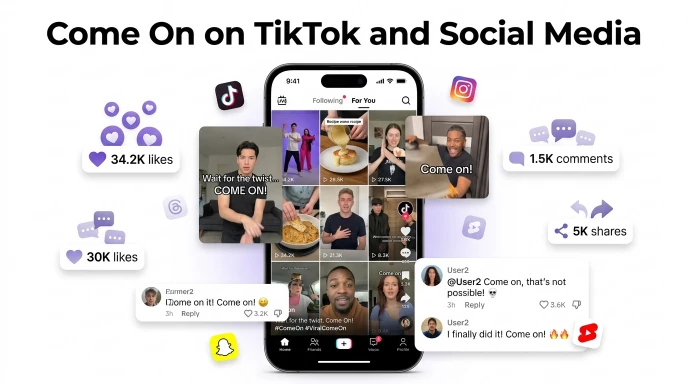
On TikTok, Instagram, and other social platforms, “come on” can appear in captions, comments, reactions, and replies.
A person might comment:
“Come onnn 😭”
after watching something surprising or funny.
Another person might write:
“Come on, that’s actually impressive.”
Here, the phrase can show excitement or approval.
Social media context often makes the phrase more dramatic or playful.
Come On in Gaming Chats
Gaming communities use “come on” in many emotional situations.
A player might type:
“COME ON! ONE MORE HIT!”
This shows excitement and encouragement.
Another player might say:
“Oh, come on! That was unfair.”
Here, it shows frustration.
Gaming makes the emotional use of “come on” especially clear because players often react quickly to what is happening.
Is “Come On” Actually Slang?
“Come on” is not always slang. It is a standard English phrase that has been used for a long time.
It becomes more slang like when people use it in informal, expressive, or internet style conversations.
For example:
“Come on, let’s leave.”
This is normal everyday English.
But:
“Oh come onnn 😭💀”
is much more informal and internet style.
So, come on slang is better understood as the casual and expressive use of the phrase rather than a completely separate slang word.
Part 2: How “Come On” Changes With Tone
The meaning of come on slang often depends more on tone than the words themselves. Online, people use punctuation, emojis, capitalization, and repeated letters to show what they feel.
“Come On” for Encouragement
When someone says “come on!” in an encouraging way, they usually want another person to keep trying.
Example:
“Come on, you’re almost there!”
Here, it means “keep going” or “don’t give up.”
This use is common in sports, gaming, school, and friendly conversations.
“Come On” for Surprise
People can also use “come on” when something surprises them.
Example:
“Come on, you actually won?”
In this case, the phrase can show surprise or disbelief.
The speaker may not be angry. They may simply be shocked by what happened.
“Come On” for Playful Frustration
Among friends, “come on” can express mild frustration without being seriously rude.
Example:
“Come on 😭 you forgot again?”
The emoji can make the message feel playful rather than harsh.
This is one reason the phrase appears so often in casual online chats.
“Come On” as a Reaction to Something Funny
Sometimes people use “come on” when reacting to a funny or unexpected moment.
Example:
“Bro, come on 💀”
Here, the phrase may mean something like “you have to be kidding me” or “that was too much.”
The exact feeling depends on what happened before the message.
“Come On” With Extra Letters
Online users sometimes write:
“Come onnn!”
The extra “n” does not create a new dictionary meaning. It simply adds emotion.
Compare:
“Come on.”
with:
“Come onnn 😭”
The second version sounds more dramatic, playful, or emotional.
This style is common in informal texting and social media.
“Come On” With Emojis
Emojis can change how the phrase feels.
In an excited moment, “Come on!” can express enthusiasm or urgency.
A questioning “Come on?” may show confusion or surprise.
When someone says “Come on…”, it can suggest disappointment or hesitation.
“Oh, come on 🙄” can suggest annoyance.
The words stay almost the same, but the emoji helps communicate the intended tone.
“Come On” vs. “C’mon”
“C’mon” is an informal shortened form of “come on.”
Both can have the same basic meaning.
For example:
“Come on, let’s go.”
and
“C’mon, let’s go.”
The second version feels more conversational and relaxed.
In texting, people may also write “cmon” without the apostrophe.
“Come On” vs. “Let’s Go”
These phrases can sometimes sound similar, but they are not always interchangeable.
“Let’s go!” usually expresses excitement or tells people to start moving.
“Come on!” can encourage someone, express frustration, show disbelief, or tell someone to move.
For example:
“Let’s go! The game is starting.”
This is excitement.
“Come on, you can do it!”
This is encouragement.
“Come On” vs. “Really?”
In some conversations, “come on” can work like “really?”
For example:
“Come on, you believed that?”
The speaker is expressing disbelief.
However, “come on” has more emotional range than “really?” It can also be used for encouragement or persuasion.
Is “Come On” Rude?
Usually, “come on” is not automatically rude.
Its tone depends on how it is used.
Friendly:
“Come on, let’s get some food.”
Encouraging:
“Come on, you can do it!”
Frustrated:
“Oh, come on! Not again.”
The last example can sound sharper, especially when directed at someone during an argument.
When Should You Use “Come On”?
“Come on” works well in casual conversations with friends, classmates, gaming teammates, and people you know online.
It is useful when you want to:
- Encourage someone
- Show surprise
- Express mild frustration
- Ask someone to hurry
- Persuade someone
- React to something funny
For formal writing, it is usually better to use clearer and more direct wording.
What Does “Come On Bro” Mean?
“Come on bro” is a very casual version often used between friends or online users.
Depending on the context, it can mean:
- “Seriously?”
- “You can do better.”
- “Let’s go.”
- “I can’t believe you did that.”
- “Don’t do that.”
For example:
“Come on bro, you missed an easy shot.”
This could be playful teasing rather than serious criticism.
What Does “Oh, Come On” Mean?
“Oh, come on” is often used when someone feels annoyed, surprised, or unconvinced.
For example:
“Oh, come on! That’s not fair.”
Here, the speaker is showing frustration.
In another situation:
“Oh, come on 😂 That’s hilarious.”
The same phrase can sound playful instead.
Context and tone decide the meaning.
Come On Slang in Modern Internet Culture
The phrase remains useful online because it is short, emotional, and easy to adapt.
People can change its style with:
- Capital letters
- Extra letters
- Emojis
- Punctuation
- Shortened spelling
That makes come on slang flexible enough for many types of online reactions.
The key idea is simple: “come on” does not have one slang meaning. Its meaning changes with the emotion behind the message.
Frequently Asked Questions About Come On Slang
Q. 1: What Is Slang for Come On?
Common casual forms include “c’mon,” “cmon,” and “come on.” The meaning can show encouragement, surprise, frustration, or disbelief depending on the context.
Q. 2: Is It CMon or Come On?
“Come on” is the standard spelling. “C’mon” is an informal shortened form, while “cmon” is a common texting version.
Q. 3: Is Cmon a Slang?
Cmon is an informal version of “come on.” People often use it in texting, social media, gaming chats, and other casual online conversations.
Q. 4: What Is Meant by “Come On”?
“Come on” can mean different things, such as “let’s go,” “keep trying,” “really?”, or “I don’t believe it.” The exact meaning depends on the situation and tone.
Q. 5: What’s Going On in Gen Z Slang?
In Gen Z style online language, phrases like “what’s going on?” may be shortened or replaced with casual expressions such as “what’s happening?” or “what’s the vibe?” The exact wording changes across online communities.
Q. 6: What Does 0F Mean?
“0F” is not a standard slang form of “come on.” Its meaning depends on where you saw it. It may be a typo, abbreviation, code, or part of another phrase, so the surrounding text is needed to identify it correctly.
Part 4: Come On Slang in Different Online Situations
The phrase come on slang becomes easier to understand when you look at how people use it in real conversations. Its meaning can shift from encouragement to frustration without changing the basic words.
Come On in Friendly Conversations
Friends often use “come on” in a relaxed and playful way.
For example:
“Come on, you know I was joking!”
Here, the phrase can make the message sound friendly and informal.
It can also be used when asking a friend to agree with you:
“Come on, you have to admit that was funny.”
In this case, come on works as a casual way to persuade someone.
Come On When Someone Is Taking Too Long
“Come on” can also mean “hurry up” in an informal conversation.
For example:
“Come on, we’re going to be late!”
The speaker wants the other person to move faster.
A similar use appears in gaming:
“Come on, queue up!”
Here, the phrase encourages someone to start the next action.
Come On When Something Goes Wrong
People often say “come on!” after something goes wrong.
For example:
“Come on! My internet just stopped.”
This use usually shows frustration or disappointment.
Online, people may add an emoji:
“Come on 😭”
The emoji makes the emotional reaction clearer.
Come On in Memes and Comments
Internet users often use “come on” in memes and comments as a quick reaction.
For example:
“Come on 💀”
Depending on the post, this might mean:
- “That is ridiculous.”
- “You have to be joking.”
- “That was too much.”
- “Seriously?”
The phrase often works because the reader already understands what happened in the post.
Come On in Sports
In sports conversations, “come on!” is often a form of encouragement.
A fan might say:
“Come on! You can do this!”
It can also be shouted when supporting a team or player.
The meaning here is usually positive and energetic rather than annoyed.
Come On in School Chats
Students may use “come on” casually when talking with friends.
For example:
“Come on, help me with this question.”
Here, it is a friendly request.
Another example:
“Come on, the test wasn’t that hard.”
This can express mild disagreement or disbelief.
The phrase is informal, so it fits better in casual student conversations than in formal school writing.
Come On in Gaming Slang
Gaming chats are full of short emotional reactions, and “come on!” is one of them.
A player might type:
“COME ON! ONE MORE!”
This shows excitement and encouragement.
After losing, someone might write:
“Oh, come on 😭”
This shows frustration.
The capitalization often makes the reaction feel stronger.
Come On vs. Come Onnn
Both expressions mean the same basic thing, but “come onnn” adds extra emotion.
Come on → normal casual reaction.
Come onnn 😭 → stronger, more dramatic, or playful reaction.
Adding letters is common in informal texting because it helps show how the person would say the phrase out loud.
Come On vs. C’mon vs. Cmon
These forms are closely related:
| Form | Style | Meaning |
| Come on | Standard | Original phrase |
| C’mon | Informal | Shortened form |
| Cmon | Texting | Casual shortened form |
| Come onnn | Internet style | More emotional version |
“Come on” is the safest form when you want clear writing.
What Does “Come On, Man” Mean?
“Come on, man” is another casual variation.
It can express frustration, disbelief, or encouragement.
For example:
“Come on, man, that was an easy question.”
The speaker may be disappointed but not necessarily angry.
Among friends, it can also be playful teasing.
What Does “Come On Bro” Mean?
“Come on bro” has a similar casual tone.
For example:
“Come on bro, you can’t be serious 💀”
Here, the speaker is likely showing disbelief or playful frustration.
The word “bro” makes the phrase sound more informal and conversational.
Is Come On Still Popular in 2026?
Yes, “come on” remains a common phrase in casual communication, including texting, social media, gaming, and everyday speech.
What changes is the way people style it.
You may see:
- “Come on!”
- “C’mon!”
- “Cmon 😭”
- “Come onnn”
- “Oh, come on 💀”
- “COME ON 🔥”
These versions add different levels of emotion while keeping the basic phrase recognizable.
How to Understand Come On Slang Correctly
When you see come on slang online, check the situation before deciding what it means.
If someone is cheering, it probably means encouragement.
During a complaint, it may show frustration.
Reacting to an unbelievable post can express disbelief.
For a friend who is taking too long, it may mean hurry up.
The same phrase can communicate several emotions, which is why tone and context matter more than the words alone.
Part 5: More Ways People Use “Come On” Slang
The phrase come on slang can fit many casual situations. Online, people often change the spelling, punctuation, or surrounding words to make the reaction stronger.
“Come On” as a Challenge
Sometimes “come on” is used to challenge someone in a playful way.
For example:
“Come on, beat my score!”
Here, the phrase means encouragement or motivation.
It can also sound competitive:
“Come on, I know you can do better.”
The meaning is usually motivating rather than negative.
“Come On” When Asking for Another Chance
People may use “come on” when they want someone to reconsider something.
For example:
“Come on, give me one more chance.”
Here, the phrase adds a feeling of persuasion and makes the request sound more emotional and informal.
“Come On” as a Funny Reaction
Online, “come on” can be used when something is funny, surprising, or ridiculous.
For example:
“Come on 😂 what was that?”
The person may not actually be angry. They could simply be reacting to something unexpected or amusing.
“Come On” When Someone Makes a Mistake
If a friend makes an obvious mistake, you might see:
“Come on bro 😭”
This can be a playful reaction.
Depending on the context, it may mean “you should have known better” rather than serious criticism.
“Come On” in Arguments
During an argument, “come on” can express disagreement or disbelief.
For example:
“Come on, that’s not what happened.”
Here, the speaker is challenging the other person’s statement.
The phrase can sound stronger when used with an angry tone, so context matters.
“Come On” in Memes
Meme culture often uses short phrases as reactions, and “come on” works well because it can communicate emotion with only two words.
For example:
“Oh, come on 💀”
Depending on the meme, this can suggest disbelief, humor, or frustration.
Why Do People Write “Cmon”?
“Cmon” is a casual shortened spelling of “come on.”
People may use it because:
- It is quicker to type.
- It feels more conversational.
- It matches casual texting.
- It is common in informal online chats.
It is not a completely different slang term.
Why Do People Write “C’mon”?
“C’mon” is another informal shortened form of “come on.”
For example:
“C’mon, let’s go!”
It has the same basic meaning as “Come on, let’s go,” but it sounds more casual.
Is “Come On” an Offensive Slang Term?
No, “come on” is not inherently offensive.
It is a normal English phrase that can sound supportive, playful, surprised, or annoyed depending on the situation.
For example:
“Come on, you can do it!”
is encouraging.
But:
“Oh, come on! Stop doing that.”
can sound frustrated.
What Does “Come On 😭” Mean?
When someone writes “come on 😭,” the emoji often adds dramatic emotion.
It may express:
- Disbelief
- Frustration
- Playful disappointment
- A dramatic reaction
- “Seriously?”
The exact meaning depends on the conversation.
What Does “Come On 💀” Mean?
“Come on 💀” is often used as a humorous or exaggerated reaction.
The skull emoji can suggest that something is very funny, ridiculous, or unbelievable.
For example:
“He really said that? Come on 💀”
Here, the message is likely playful rather than seriously angry.
What Does “Come Onnn” Mean in Texting?
“Come onnn” is an exaggerated version of “come on.”
The repeated “n” adds extra emotion.
It can show:
- Excitement
- Frustration
- Persuasion
- Playful teasing
- Encouragement
For example:
“Come onnn, tell me what happened!”
This sounds more expressive than simply saying “come on.”
Quick Guide to Come On Slang
| Expression | Common Feeling |
| Come on, you got this! | Encouragement |
| Come on, seriously? | Disbelief |
| Come on, hurry! | Urgency |
| Oh, come on! | Frustration |
| Come on 😂 | Playful reaction |
| Come onnn 😭 | Strong emotion |
| C’mon! | Casual reaction |
| Cmon 💀 | Humorous disbelief |
The key point is that “come on” does not have just one slang meaning. Its meaning changes with the situation, tone, punctuation, and emojis.
Part 6: Final Guide to Come On Slang
The phrase come on slang is simple but flexible. Its meaning can change based on the situation, tone, punctuation, and even the emoji used with it.
What Makes “Come On” So Flexible?
“Come on” can express several different emotions without changing the basic phrase.
It can show:
- Encouragement — “Come on, you can do it!”
- Disbelief — “Come on, you really believe that?”
- Frustration — “Oh, come on!”
- Persuasion — “Come on, give it a try.”
- Excitement — “Come on! Let’s go!”
This flexibility is why the phrase works so well in everyday speech and online chats.
How Punctuation Changes the Meaning
Punctuation can give “come on” a different tone.
With a crying emoji, “Come on 😭” can suggest disappointment or amused frustration.
Adding 😂 to “Come on” can make the message feel playful.
Written as “COME ON 🔥”, it can express excitement or strong support.
“Oh, come on!” often shows frustration or disbelief.
So, when reading come on slang, punctuation can provide an important clue.
How Emojis Change “Come On”
Emojis can also add emotion to the phrase.
“Come on 😭” often gives a sense of dramatic frustration or disappointment.
With “Come on 😂”, the phrase can feel more playful or funny.
Using “Come on 💀” may signal disbelief or extreme humor.
In “COME ON 🔥”, the phrase usually shows excitement or strong support.
The emoji does not create a fixed definition. Instead, it helps show the speaker’s intended tone.
Is “Come On” Different From “C’mon”?
The basic meaning is the same.
“Come on” is the standard form.
“C’mon” is an informal shortened form.
“Cmon” is a casual texting version.
“Come onnn” adds extra emotion.
These forms are mainly different in style and tone, not their core meaning.
Can “Come On” Be Used in Formal English?
Yes, “come on” is a normal English phrase, but some uses are more casual than others.
For example:
“Come on, let’s begin.”
This is simple everyday English.
However, forms such as “cmon 😭” or “come onnn 💀” are clearly informal and are better suited to texting and social media.
When Should You Use Come On Slang?
Use casual versions of “come on” when talking with people who understand informal language.
It works naturally in:
- Text messages
- Group chats
- Social media
- Gaming chats
- Comments
- Casual conversations
For formal emails, reports, or academic writing, choose wording that clearly matches the situation.
What Is the Main Meaning of Come On Slang?
There is no single slang definition of “come on.”
The most common casual meanings include “hurry up,” “really?”, “let’s go,” “keep trying,” and “I don’t believe that.”
The exact meaning comes from the sentence and the speaker’s tone.
Final Thoughts
Come on slang is a flexible way to express emotion in casual communication. It can encourage someone, show disbelief, express frustration, or add excitement to a conversation.
Forms such as “c’mon,” “cmon,” and “come onnn” are simply informal variations that people may use online.
The best way to understand the phrase is to look at the full message, punctuation, emojis, and situation.
So, if you see “come on” in a text or social media comment, don’t assume it always means the same thing. Context tells you what the person really means.
Dive Deeper!

Hey, I’m Emily. I’ve spent way too many hours scrolling TikTok and group chats trying to figure out what people actually mean by half the slang flying around — and somewhere along the way that turned into a whole thing I write about now. I cover internet slang, TikTok trends, and how words shift meaning practically overnight online.