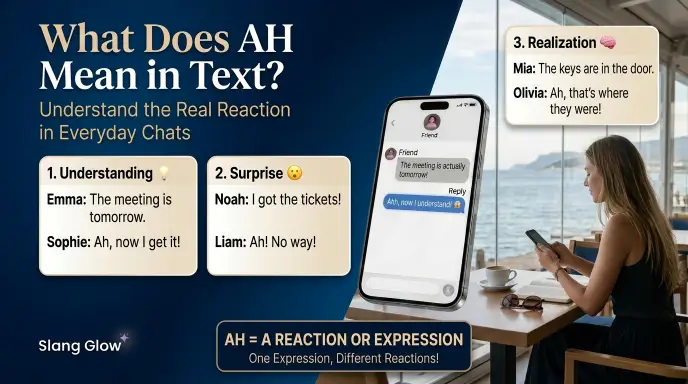
What does AH mean in text? AH usually represents “Ah,” an expression used to show understanding, surprise, realization, or a reaction. People use it in text messages, Snapchat conversations, Instagram DMs, and everyday online chats to express how they feel about something.
For example, someone might reply, “Ah, now I understand!” after receiving an explanation. In this situation, AH shows that the person has finally understood something.
Unlike abbreviations such as LOL and BRB, AH is usually an interjection rather than a traditional texting acronym. In some texting references, uppercase AH can also mean “At Home,” depending on the conversation.
This guide explains its different uses, real chat examples, and how to understand the meaning when someone sends AH.
What Does AH Mean in Text Messages?
In everyday texting, “Ah” is commonly used to express understanding, surprise, pleasure, or realization. It is a short expression that helps communicate someone’s immediate reaction to a message or situation. <Cite refs={[“turn820092search0″,”turn820092search5”]}/>
For example, if someone explains something and you reply, “Ah, I get it now,” you are showing that you understand the information.
Here are three important points to remember:
- Understanding: AH can show that someone has understood an explanation.
- Surprise or realization: It may express a sudden reaction when someone discovers something.
- Emotional expression: Depending on the conversation, it can communicate happiness, disappointment, or relief.
Consider this conversation:
Emma: “The meeting starts at 10, not 11.”
Sophie: “Ah, okay! Thanks for telling me.”
Meaning: Sophie understands the correction and acknowledges the information.
You may also see AH used in these common expressions:
- Ah, okay: Showing understanding or acceptance.
- Ah, I see: Showing that something has become clear.
- Ah, really?: Expressing surprise or curiosity.
- Ah, now I understand: Showing realization.
The easiest way to understand AH is to read the complete sentence and notice the feeling behind it. The same expression can communicate different reactions depending on the situation.
What Does AH Stand for in Online Slang?
AH does not usually stand for a specific phrase in ordinary English texting. It is commonly used as an interjection rather than an initialism. However, some texting references list another possible meaning: “At Home.” <Cite refs={[“turn820092search3″,”turn820092search8”]}/>
Here are three interpretations to understand:
- Ah (understanding): Used when someone understands something or makes a connection.
- Ah (surprise): Used when someone reacts to unexpected information.
- AH (At Home): An informal abbreviation that may appear when someone is talking about their location.
For example:
Alex: “I finally figured out how the app works.”
Jordan: “Ah, that’s great!”
Meaning: Jordan is reacting positively and acknowledging Alex’s discovery.
Now consider another example:
Mia: “Where are you right now?”
Olivia: “AH.”
Possible meaning: Olivia may be using AH to mean “At Home,” although the abbreviation is less universally recognized.
Do not assume AH always has one fixed full form. Its meaning depends on if someone is expressing a reaction or using a location related abbreviation.
Where Do People Use AH in Text Messages?
People use AH in informal digital conversations when they want to express a quick reaction or acknowledge something. It is useful because a single short expression can communicate understanding, surprise, or another feeling.
Here are some places where you might encounter it:
- Text messages: Friends may write AH when reacting to something they have just learned.
- Snapchat: Someone might reply with AH after understanding a message.
- Instagram: Users may include it in direct messages or comments.
- WhatsApp: People may use it when acknowledging information or reacting to news.
- Online group chats: Someone may write AH when something suddenly makes sense.
For example:
Mia: “The shop closes earlier on Sundays.”
Olivia: “Ah, that explains why it was closed!”
Meaning: Olivia understands the reason after receiving the information.
You may also encounter AH in uppercase when someone is using it as a shortened form of “At Home.”
The context of the conversation is more important than the capitalization. Read the words around AH to understand if it expresses a reaction or represents an abbreviation.
What Does AH Mean on TikTok, Snapchat, and Instagram?
On social media, AH commonly appears as a short expression of understanding, surprise, or reaction. Its basic function is similar to the way people use it in ordinary text messages.
Here are some situations where you might see it:
- TikTok: Someone may comment “Ah, now I get it!” after understanding a video.
- Snapchat: A friend might reply “Ah okay” after receiving an explanation.
- Instagram: Someone may use AH in a direct message when reacting to a picture or story.
- WhatsApp: Friends may write “Ah, I see” when acknowledging information.
- SMS messages: People may use it as a quick response to unexpected news.
For example:
Noah: “I finally finished the project.”
Liam: “Ah, that’s awesome!”
Meaning: Liam is reacting positively to Noah’s achievement.
AH may also appear as “Ahh” or “Aah” when someone wants to make the expression stronger or show a more noticeable reaction.
For example:
“Ahhh, now everything makes sense!”
Adding extra letters can change the feeling or emphasis without necessarily changing the basic expression.
Remember that AH is not a special TikTok or Instagram code with one fixed meaning. The complete message and situation help explain the intended reaction.
Real Chat Examples of AH in Text Messages
These conversations show how people use AH in everyday digital communication. Each example includes a simple explanation to help you recognize its meaning.
Example 1: Understanding an Explanation
Emma: “You need to click the blue button first.”
Sophie: “Ah, I understand now!”
Meaning: Sophie has understood the instructions.
Example 2: Showing Surprise
Noah: “I won the school competition yesterday.”
Liam: “Ah, really? That’s amazing!”
Meaning: Liam is expressing surprise and excitement.
Example 3: Realizing Something
Mia: “The event is actually happening tomorrow.”
Olivia: “Ah, that’s why everyone was making plans!”
Meaning: Olivia suddenly understands why people were discussing the event.
Example 4: Acknowledging Information
Ryan: “I’ll send you the details tonight.”
Leo: “Ah, okay. Thanks!”
Meaning: Leo acknowledges the information and shows understanding.
Example 5: Expressing Relief
Ava: “Your notebook was in the classroom.”
Ella: “Ah, good! I thought I had lost it.”
Meaning: Ella feels relieved after discovering where her notebook was.
These examples show that AH can express different feelings depending on the conversation. It may communicate understanding, surprise, realization, or relief without needing a longer reply.
More Real Chat Examples of AH in Text Messages
AH can appear in different conversations when someone wants to express understanding, surprise, or a sudden realization. Here are five additional examples showing how people use it naturally.
Example 6: Understanding a Situation
Emma: “The store is closed because today is a holiday.”
Sophie: “Ah, now I understand!”
Meaning: Sophie understands why the store is closed.
Example 7: Reacting to Good News
Noah: “I passed my driving test!”
Liam: “Ah, congratulations!”
Meaning: Liam is reacting positively to Noah’s achievement.
Example 8: Showing Disappointment
Mia: “The concert tickets are already sold out.”
Olivia: “Ah, that’s disappointing.”
Meaning: Olivia expresses disappointment after hearing the news.
Example 9: Remembering Something
Ryan: “We met at the school library last year.”
Leo: “Ah, yes! I remember now.”
Meaning: Leo suddenly remembers their previous meeting.
Example 10: Expressing Relief
Ava: “Your phone was on the table all along.”
Ella: “Ahh, I thought I had lost it!”
Meaning: Ella expresses relief after finding out where her phone was.
These examples show that AH can communicate several emotions. The words around it help explain if someone feels surprised, relieved, disappointed, or simply understands something.
How Should You Reply When Someone Uses AH?
Your response depends on the situation and the feeling behind the message. If someone uses AH to show understanding, you can continue explaining. If they use it to express surprise, you can respond to their reaction.
Here are four natural ways to reply:
- Casual reply: “Yep, exactly!”
- Friendly reply: “Glad you understand!”
- Funny reply: “Now it makes sense, right? 😂”
- Neutral reply: “That’s right.”
Example 1: Someone Understands Your Explanation
Emma: “Ah, now I get it!”
Sophie: “Exactly! That’s what I meant.”
Meaning: Sophie confirms that Emma has understood the explanation.
Example 2: Someone Is Surprised
Noah: “Ah, really? I didn’t know that!”
Liam: “Yes, it’s true!”
Meaning: Liam responds to Noah’s surprise.
Example 3: Someone Expresses Relief
Mia: “Ahh, that’s a relief!”
Olivia: “I’m glad everything worked out.”
Meaning: Olivia responds positively to Mia’s relief.
You do not need to use AH in your reply. Simple expressions such as “I see,” “Exactly,” and “That’s right” are natural alternatives.
Is AH Rude or Offensive in Text?
AH is generally not rude or offensive when used as an ordinary expression or reaction. It is a common way to communicate feelings such as understanding, surprise, or disappointment.
However, the complete sentence and tone can change how the message sounds.
Here are three important points:
- Neutral expression: AH can simply show that someone understands something.
- Emotional reaction: It may communicate surprise, disappointment, or frustration.
- Context matters: A short “Ah” may sound different depending on the surrounding conversation and punctuation.
Is AH Appropriate at School or Work?
Yes. Using AH as an ordinary expression is generally acceptable in casual conversations at school and work.
However, using complete sentences is clearer in formal emails, assignments, and professional documents.
For example:
Instead of writing:
“Ah, okay!”
You could write:
“I understand. Thank you for explaining.”
AH itself is not a swear word or an insult. Its meaning and tone depend on how someone uses it.
Who Uses the Expression AH?
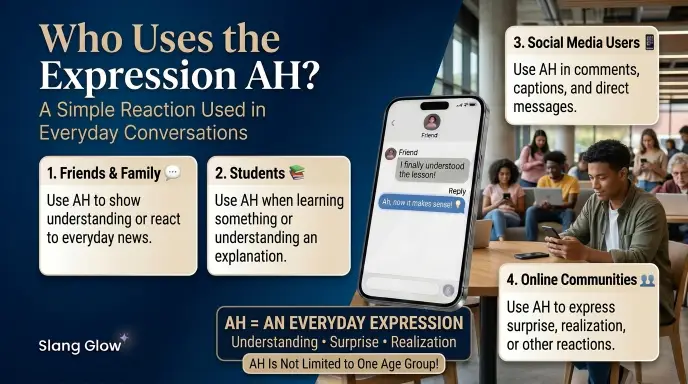
AH is a familiar expression used in everyday communication. It is not limited to one particular age group, country, or social media platform.
You may encounter it in these situations:
- Friends: People use AH when reacting to news or understanding a message.
- Students: Classmates may use it when learning something or discussing assignments.
- Social media users: People may include it in comments, captions, and direct messages.
- Online communities: Users may write AH when expressing surprise or responding to information.
Is AH a Gen Z Texting Term?
AH is not exclusively a Gen Z expression. It is a common interjection that people have used in spoken and written communication for a long time.
Younger users may write it in short messages, while other people use it in everyday conversations.
Unlike newer internet slang, AH does not belong to one particular generation.
It is better understood as a general conversational expression rather than a special Gen Z abbreviation.
Where Did AH Come From?
The expression AH comes from the English interjection “Ah,” which has long been used in spoken and written language to communicate reactions and feelings.
It was not invented specifically for texting or social media. People already used it in everyday speech before digital conversations became common.
Three points help explain its background:
- Everyday language: AH represents a familiar spoken expression.
- Written communication: People have used it in writing to communicate reactions and emotions.
- Digital messaging: Text messages and social media made short expressions such as AH convenient for quick replies.
Did AH Originate on Social Media?
No, AH did not originate specifically on TikTok, Instagram, or Snapchat. It is an established English interjection that people also use in modern digital communication.
Its exact historical first use is not necessary to understand its everyday texting meaning.
AH vs. Other Common Texting Abbreviations
AH is different from many familiar texting shortcuts because it is generally an expression of reaction rather than an abbreviation made from the first letters of several words.
| Term | Meaning | Type | Typical Usage |
| AH | Ah (reaction or realization) | Interjection | Expressing understanding or surprise |
| OH | Oh | Interjection | Showing a reaction or realization |
| OMG | Oh My God | Initialism | Expressing strong surprise |
| IDK | I Don’t Know | Initialism | Expressing uncertainty |
| BRB | Be Right Back | Initialism | Saying someone will return |
These expressions serve different purposes:
- AH expresses understanding, realization, or an emotional reaction.
- OH and OMG communicate different kinds of surprise or reactions.
- IDK and BRB communicate uncertainty or temporary absence.
For example:
“Ah, now I understand!”
This shows that someone has understood something.
In contrast:
“IDK what happened.”
This expresses that someone does not know what happened.
AH is generally an interjection, while IDK, OMG, and BRB are initialisms. Understanding this difference helps you recognize how people use them in messages.
A Real World Example of AH in a Conversation
Imagine two classmates are discussing a school assignment. One student explains a difficult question to the other.
Emma: “You need to read the question carefully before choosing the answer.”
Sophie: “Ah, I see what you mean now!”
Emma: “Exactly. That makes it easier to understand.”
Sophie: “Thanks for explaining it!”
In this conversation, Sophie uses AH to show that she has understood the explanation.
Now consider another situation:
Noah: “Our class trip has been moved to Friday.”
Liam: “Ah, really? I thought it was Thursday.”
Here, AH expresses surprise after receiving unexpected information.
Both examples show how AH communicates a reaction without needing a long explanation. The surrounding message reveals the exact feeling.
Frequently Asked Questions About AH
Q.1. What does AH mean in text messages?
AH commonly represents “Ah,” an expression used to show understanding, surprise, realization, or another reaction.
Q.2. What does AH mean on TikTok?
On TikTok, AH usually works as a reaction or expression in comments, captions, and conversations. Its meaning depends on the context.
Q.3. Is AH considered slang?
AH is better described as an informal interjection rather than a traditional texting acronym.
Q.4. Is AH rude or offensive?
No. AH is generally neutral and non offensive when used as an ordinary expression. Its tone depends on the complete sentence.
Q.5. How should you reply when someone uses AH?
You can respond with “Exactly,” “I know,” “Glad you understand,” or another reply that fits the conversation.
Q.6. Can AH mean At Home in text messages?
Yes, some people may use uppercase AH as an abbreviation for “At Home.” However, this meaning is less universally recognized than the ordinary expression “Ah,” so context is important.
Final Takeaway
AH in text usually represents the expression “Ah,” which people use to show understanding, surprise, realization, or an emotional reaction. It is a simple expression that makes everyday digital conversations feel natural.
You may encounter it in text messages, Snapchat conversations, Instagram DMs, TikTok comments, and WhatsApp chats.
Remember that AH does not have one fixed emotional meaning. The surrounding words, punctuation, and conversation help you understand what someone is trying to express.
YOU MAY KNOW!

Hey, I’m Emily. I’ve spent way too many hours scrolling TikTok and group chats trying to figure out what people actually mean by half the slang flying around — and somewhere along the way that turned into a whole thing I write about now. I cover internet slang, TikTok trends, and how words shift meaning practically overnight online.