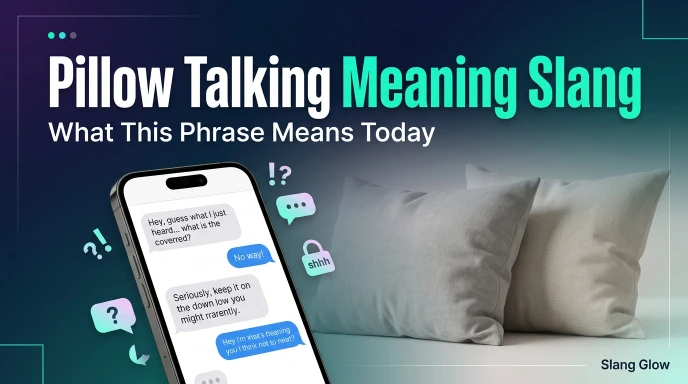
Pillow talking meaning slang means sharing private or personal information with someone during close, private conversations, often revealing secrets or details that should stay private.
If you have seen the phrase “pillow talking” in a text, comment, or social media post, you may wonder what the person really means. The phrase is informal and can have more than one shade of meaning.
In slang, pillow talking usually refers to sharing private or personal information during a close conversation. It can also describe someone who tells another person details that were expected to stay private. Because of this, the expression is sometimes connected with trust, secrets, relationships, and oversharing.
The phrase can sound harmless in one conversation and negative in another. A person may use it simply to describe a private talk, while someone else may use it as criticism.
Understanding the pillow talking meaning slang users intend requires looking at the complete sentence and situation. This guide explains the phrase in simple English and shows how it appears in texting, social media, and everyday communication.
What Does Pillow Talking Mean in Slang?
Pillow talking means having a private or personal conversation with someone you are close to. In some slang contexts, it specifically suggests revealing private information to that person, especially information about another person or a relationship.
The expression is based on the idea of people having personal conversations in a relaxed private setting. Over time, it became associated with the things people may reveal when they feel comfortable with someone.
For example:
“He needs to stop pillow talking.”
This usually means the speaker thinks he is sharing information that should have remained private.
Another sentence can have a softer meaning:
“They stayed up late pillow talking.”
Here, the phrase can simply mean talking privately and personally.
Simple meaning of pillow talking
In very simple English:
Pillow talking = private personal conversation, especially when personal information is being shared.
The exact meaning depends on the context.
What Does Pillow Talking Mean in Texting?
Texting is one of the places where this phrase can appear naturally. People may use it when discussing private conversations, secrets, or relationship information.
A message such as:
“Why were you pillow talking?”
can sound like an accusation. The person asking may believe that someone shared information with another person.
On the other hand:
“We were just pillow talking.”
may describe a private conversation without suggesting that anyone did something wrong.
Why the context changes the meaning
Slang is often flexible. The same expression can sound friendly, serious, or negative depending on the words around it.
Look for clues such as:
- Who is speaking?
- Who are they talking about?
- Was private information involved?
- Is the speaker joking?
- Does the message sound angry or supportive?
These clues help identify the intended pillow talking slang meaning.
What Does Pillow Talking Reveal About a Conversation?

Pillow talking can reveal that a conversation is private, personal, or based on trust. In slang, the phrase may also suggest that someone has shared information that was expected to remain confidential.
The meaning depends on the situation. If someone says, “They were pillow talking,” they may simply mean the two people were having a personal conversation. When the phrase is used negatively, it can point to secrets, gossip, or the sharing of private details.
This is why the phrase often connects with ideas such as trust, privacy, closeness, and confidentiality.
Is Pillow Talking a Bad Thing?
Pillow talking is not always negative.
Private conversations are a normal part of close friendships and relationships. People may talk about their feelings, plans, worries, experiences, or personal matters.
The phrase becomes negative when it refers to breaking someone’s confidence or revealing information without permission.
For instance, imagine someone tells a friend something privately and later discovers that the information was shared with others. They might describe that behavior as pillow talking.
When it has a negative meaning
The phrase can suggest:
- Revealing secrets
- Sharing private details
- Breaking someone’s trust
- Talking about relationship matters
- Giving personal information to others
- Oversharing
Not every private conversation fits these negative meanings. The surrounding situation is what matters.
What Does “No Pillow Talking” Mean?
“No pillow talking” usually means “keep this private” or “do not share what was discussed.”
This phrase is commonly used as a warning or reminder.
For example:
“You know the rules. No pillow talking.”
The speaker is asking the other person not to repeat private information.
A similar phrase is:
“Keep this between us.”
Both expressions communicate the idea of confidentiality.
“Stop pillow talking” meaning
“Stop pillow talking” is stronger. It usually means that someone believes private information has already been shared and wants that behavior to end.
For example:
“Stop pillow talking about our business.”
The word “business” here means personal matters, not a company or workplace.
What Is a Pillow Talker?
A “pillow talker” is a person who is believed to share private information during personal conversations.
The phrase often has a negative tone when someone uses it as a label.
For example:
“Don’t tell him your secrets. He’s a pillow talker.”
The speaker is suggesting that the person may not keep private information confidential.
The expression can also be used jokingly among friends. Therefore, tone and context remain important.
Where Is Pillow Talking meaning slang Used?
You may encounter “pillow talking” in several informal spaces.
It can appear in:
- Text messages
- Social media comments
- TikTok posts
- Instagram captions
- Snapchat conversations
- Memes
- Online relationship discussions
- Casual conversations
The expression is generally informal, so it is not a good choice for most formal writing.
Pillow talking in online conversations
On social media, users often shorten their thoughts into phrases that are easy to understand. “No pillow talking” is one example because it quickly communicates the idea of not sharing private information.
A meme may use the phrase humorously, while a serious post may use it to discuss trust.
Pillow Talking in Relationships
In relationship related conversations, pillow talking can refer to personal discussions between two people who are emotionally close.
Those conversations may include feelings, plans, experiences, or other personal matters. The phrase can be neutral when it simply describes private communication.
However, it may have a negative meaning when one person shares private relationship information with someone else.
For example, someone might complain:
“I trusted her, but she started pillow talking.”
The speaker is likely saying that private information was passed on to another person.
Trust and pillow talking
Trust is an important part of this expression when it is used negatively.
If someone expects a conversation to remain private, sharing it with others can create a conflict. That is why “pillow talking” sometimes appears in discussions about boundaries and confidentiality.
Pillow Talking on Social Media
Social media has helped informal phrases spread between different communities.
A person might write:
“No pillow talking on this app.”
The message may simply mean do not reveal private information.
Another user could write:
“Bro was pillow talking again.”
This sounds more playful or critical. The writer may be joking about someone who revealed information.
The meaning cannot always be understood from the phrase alone. The post, comments, and conversation around it provide important clues.
Pillow Talking Examples and Related Meanings
Examples make the pillow talking meaning slang users see online much easier to understand. The phrase can describe a private conversation, a warning about confidentiality, or behavior involving oversharing.
Example 1: Sharing private information
“Why are you pillow talking about our conversation?”
Here, pillow talking means revealing details from a private conversation.
Example 2: A warning
“No pillow talking, okay?”
The speaker is asking the other person to keep the information private.
Example 3: Calling someone a pillow talker
“Don’t tell him anything personal. He’s a pillow talker.”
In this sentence, pillow talker describes someone who may reveal private information.
Example 4: A neutral conversation
“They spent hours pillow talking.”
This use can simply describe a long, personal conversation between close people.
Example 5: Social media slang
“She really started pillow talking after the party.”
The writer may be suggesting that private information was shared after the event.
These examples show that the phrase does not have to be negative every time. Context determines the tone.
Pillow Talking vs. Gossiping
Pillow talking and gossiping can overlap, but they are not identical.
Gossip generally involves talking about another person’s personal matters, often when that person is not present. Pillow talking is more closely linked to private conversations and information being shared in a close or personal setting.
| Term | General Meaning |
| Pillow talking | Sharing or discussing private information |
| Gossiping | Talking about other people’s personal matters |
| Oversharing | Giving more personal information than needed |
| Confiding | Sharing something personal with a trusted person |
| Spilling secrets | Revealing information meant to stay private |
| Keeping it private | Choosing not to share personal information |
These expressions may overlap in some conversations, but they should not be treated as exact synonyms.
Pillow Talking vs. Oversharing
Oversharing means giving people more personal information than is necessary or expected.
Pillow talking can involve oversharing when someone reveals private relationship details to another person. Yet the two phrases can describe different situations.
For example, posting too many personal details online is often called oversharing. It would not automatically be called pillow talking.
The setting is the main difference.
Why Do People Say “Pillow Talking”?
The phrase uses a familiar image of private conversation between people who feel comfortable with each other.
Instead of saying “sharing private information,” someone may use “pillow talking” because it sounds more casual and expressive.
The expression can also work as a short warning. Saying “no pillow talking” immediately gives the idea that certain information should not be repeated.
Common reasons people use it
People may use the phrase to:
- Warn someone about privacy
- Describe a personal conversation
- Joke about someone revealing information
- Discuss trust
- Talk about relationship boundaries
- Criticize oversharing
- Describe conversations between close people
The intended meaning depends on the situation.
Is Pillow Talking Rude?
The phrase itself is not automatically rude.
Its tone changes with the situation. “No pillow talking” may be a simple request for privacy. Calling someone a “pillow talker” can sound more negative because it suggests that the person cannot keep personal information confidential.
A joking conversation may make the phrase sound harmless. A serious argument can give it a much stronger meaning.
When it can sound insulting
Calling someone a pillow talker may imply that they:
- Cannot keep secrets
- Share information too easily
- Break people’s trust
- Talk about private matters
- Reveal relationship details
If the statement is actually offensive depends on the relationship and tone.
Can Pillow Talking Be Used as a Joke?
Yes. Online slang is often used humorously, especially in memes and casual comments.
Someone may write “pillow talking” simply to tease a friend who has revealed too much information.
For example:
“Bro told the whole story. Pillow talking is confused.”
The wording suggests a joke or criticism rather than a formal accusation.
Still, context matters. If the discussion involves genuinely private information, the phrase may be intended seriously.
When Should You Avoid Using Pillow Talking?
Because “pillow talking” is informal, it may not be suitable for every situation.
For school assignments, professional emails, official notices, or serious explanations, clearer wording is usually better.
Instead of saying:
“He was pillow talking.”
You could say:
“He shared private information.”
That version is easier for everyone to understand.
Clear alternatives
Depending on your meaning, you can use:
- Sharing private information
- Revealing personal details
- Breaking confidentiality
- Oversharing
- Spilling a secret
- Talking about someone’s private matters
Use the slang form when the setting is casual and the audience understands it.
What Is the Opposite of Pillow Talking?
There is no single official opposite slang word for pillow talking.
However, expressions such as “keeping it private,” “keeping a secret,” and “keeping something confidential” communicate the opposite idea.
The basic contrast is straightforward:
Pillow talking → sharing private information
Keeping it private → not sharing private information
The correct opposite depends on the specific situation.
Pillow Talking Synonyms and Related Expressions
There are several expressions that can be connected with the different meanings of pillow talking.
| Related Expression | Meaning |
| Private conversation | A conversation intended for a limited group |
| Confiding | Telling personal information to someone trusted |
| Oversharing | Giving unnecessary personal details |
| Gossiping | Discussing another person’s private matters |
| Spilling secrets | Revealing information that should stay private |
| Talking in confidence | Sharing information with an expectation of privacy |
| Revealing personal details | Making private information known |
These are related terms rather than perfect synonyms. “Pillow talking” has its own informal tone and context.
Is Pillow Talking Formal English?
No. “Pillow talking” is informal slang or casual expression.
You are more likely to see it in texts, social media, memes, conversations, and relationship discussions than in formal documents.
If you are writing for a professional or academic audience, use direct wording instead. Clear phrases such as “sharing confidential information” communicate the idea without relying on slang.
How to Understand Pillow Talking in a Text
When you see this phrase in a message, start by reading the entire sentence.
Next, consider the relationship between the people involved. If the conversation is about secrets, trust, or personal details, the phrase probably has the privacy related meaning.
A relaxed conversation may use it more neutrally.
Quick context check
Ask yourself:
- Is the conversation private?
- Is someone revealing information?
- Are relationships or secrets being discussed?
- Does the message sound serious or playful?
- Is the phrase part of a meme or social media trend?
These clues can help you identify the intended meaning without assuming that every use is the same.
Key Takeaway About Pillow Talking
The most important point is that pillow talking has two closely connected uses.
First, it can describe private and personal conversation between close people. Second, it can refer to sharing private information that should have stayed confidential.
When the phrase appears in texting or social media, the second meaning is often important if the message sounds like a warning or criticism.
Always check the context before interpreting it. The surrounding words, tone, relationship, and platform can all affect the meaning.
Frequently Asked Questions About Pillow Talking Meaning Slang
What Is the Bad Meaning of Pillow Talking?
“Pillow talking” can have a negative meaning when it refers to sharing private information, secrets, or personal details with someone else. In this context, it suggests that a person has broken someone’s trust.
What Does “Pillows” Mean in Slang?
“Pillows” can have different meanings depending on the context. On its own, “pillows” does not have one universal slang definition. The surrounding sentence is important for understanding what the speaker means.
Is Pillow Talk Romantic?
Pillow talk can be romantic, but it does not always have to be. The phrase can also describe a private and personal conversation between people who are close.
What Does “Pillow Talk” Mean in Rap Slang?
In rap slang, “pillow talk” can refer to sharing private information during personal conversations. The exact meaning can change depending on the lyrics, artist, and context.
What Is Pillow Talking in Slang?
Pillow talking usually means discussing private or personal matters with someone close. It can also suggest revealing information that was expected to remain confidential.
What Is Pillow Talking to Girls?
“Pillow talking to girls” generally means having a private or personal conversation with a girl. In a negative context, it may suggest sharing secrets or personal information with her.
Final Thoughts on Pillow Talking Meaning Slang
Pillow talking is an informal expression with a meaning that depends heavily on context. It can describe a private conversation between close people, but it can also refer to sharing secrets or personal information with someone else.
The phrase may sound casual in a text or social media post, yet its meaning can become more serious when trust and confidentiality are involved. That is why reading the complete conversation is important.
If you see “pillow talking,” “no pillow talking,” or “pillow talker” online, look at the surrounding words before deciding what the speaker means. This will help you understand If the phrase is being used as a simple description, a joke, or a warning about privacy.
See Real-Life Examples!

Hi, I’m James Parker, a writer passionate about modern slang, internet culture, and social media language. I enjoy researching trending words and explaining their meanings in simple, easy to understand English. My goal is to help readers confidently understand and use slang in everyday conversations, texting, and online platforms.