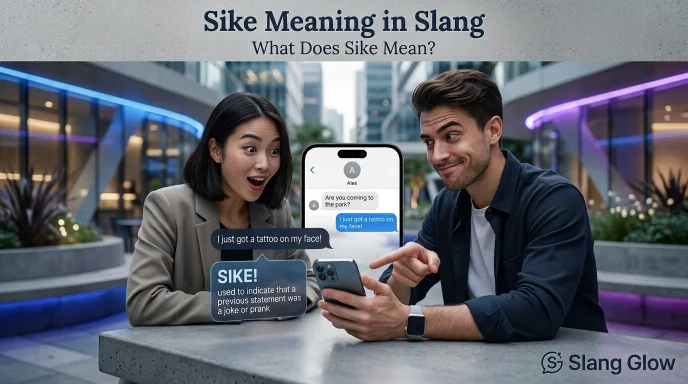
Sike is a slang expression people use to show that they were joking, teasing, or saying something that should not be taken seriously. It often appears after a statement that sounds believable, surprising, or serious, followed by “sike meaning in slang” to reveal that the speaker was only messing around.
For example, someone might say, “I’m giving you my last slice of pizza… sike!” The word changes the meaning of the previous statement and tells the other person that the speaker was joking.
What Does Sike Mean in Slang?
In slang, sike means “just kidding” or “I’m joking.” People commonly use it after making a statement that they do not actually mean.
The expression is usually meant to create a quick surprise. A person may first make another person believe something is true and then add “sike” to show that the statement was only a joke.
The tone can be playful, teasing, or humorous depending on the conversation.
Example:
“I’ll do your homework for you. Sike!”
Here, the speaker is not actually offering to do the homework. The word “sike” signals that they were joking.
What Does Sike Mean in a Text?
In a text message, sike usually means that the person is taking back what they just said because it was meant as a joke.
Texting makes this slang especially easy to use because there is no facial expression or voice tone to show that someone is joking. Adding “sike” immediately clarifies the playful intention.
For example:
“You can have my new headphones. Sike 😂”
The message first sounds generous, but “sike” changes the meaning and makes it clear that the person is teasing.
People may also write “SIKE,” “sike,” or “SYKE” depending on their personal style.
What Does Sike Mean on Social Media?
On social media, sike is often used as a short reaction or punchline after a surprising statement.
You may see it in captions, comments, memes, short videos, and casual conversations. The expression works well in humorous posts because it creates a quick change between expectation and reality.
For example:
“Me thinking I was finally going to have a productive day. Sike.”
In this type of post, “sike” adds a humorous twist to the statement.
Social media users can also use the word when joking about plans, relationships, school, games, food, or everyday situations.
Why Do People Say Sike?
People say sike because it is a quick way to reveal that they were joking or teasing.
The expression can make a conversation more playful by creating a short moment of surprise. Someone may intentionally make a statement sound serious before using “sike” to change the meaning.
Common reasons people use it include:
- To make a joke
- To tease a friend
- To create a surprise
- To change the meaning of a previous statement
- To make a message more playful
- To add humor to a social media post
The exact tone depends on the relationship between the people involved.
Is Sike the Same as Just Kidding?
Sike and “just kidding” can have a similar meaning, but they are not always used in exactly the same way.
“Just kidding” directly tells someone that a statement was a joke. “Sike” often creates a stronger twist because it is commonly placed after a statement that initially sounds genuine.
For example:
Just kidding:
“I’m joking. I’m not going to eat your fries.”
Sike:
“I’m not going to eat your fries… sike!”
Both expressions communicate that the speaker was not being serious, but “sike” is often used for a more sudden or playful reversal.
What Is the Difference Between Sike and Syke?
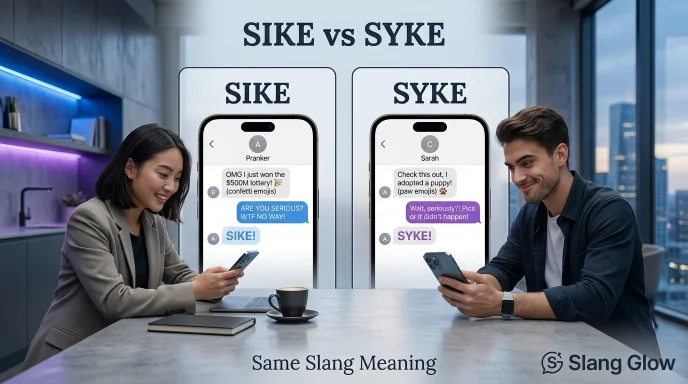
Sike and syke are commonly used as alternative spellings of the same slang expression.
You may see either version in informal online conversations. The spelling “sike” is widely recognized in modern slang, while “syke” may appear because people spell the word according to how they hear it.
The intended meaning is usually understood from context.
For example:
“You thought I forgot your birthday? Sike!”
and
“You thought I forgot your birthday? Syke!”
Both examples communicate the same basic idea: the speaker was joking or teasing.
Is Sike Still Used in Modern Slang?
Yes, sike can still appear in informal conversations, memes, comments, and social media, although slang usage changes over time.
Some expressions become strongly associated with particular internet communities or generations, while others remain recognizable for many years. Sike is one of those expressions that people may understand even when they do not use it regularly.
Its meaning is usually easy to identify when it appears after a surprising statement.
How Is Sike Used in a Sentence?
Sike can be placed at the end of a sentence or statement to reveal that the speaker was joking.
Here are some simple examples:
Example 1:
“I’m going to clean my whole room today. Sike!”
Example 2:
“You can have the last cookie. Sike!”
Example 3:
“I already finished all my work. Sike, I haven’t even started.”
Example 4:
“I’m deleting this account forever. Sike.”
In each example, the word changes how the previous statement should be understood.
Sike Meaning in Chat Conversations
In chat conversations, sike can act like a quick punchline.
A person may send one message that makes another person believe something, then send “sike” in a separate message. This creates a playful reversal.
For example:
- Person A: “I have a surprise for you.”
- Person B: “Really?”
- Person A: “Never mind. Sike!”
The word does not have to be used in a serious conversation. It is mainly associated with casual communication where joking and teasing are expected.
Can Sike Be Used to Tease Someone?
Yes, sike can be used for light teasing, especially between friends who understand each other’s humor.
A person might pretend to agree, offer something, reveal information, or announce a plan before adding “sike” to show that they were playing around.
For example:
“Sure, I’ll let you pick the movie. Sike, we’re watching my choice.”
if this feels funny or annoying depends on the situation. If someone is already upset or discussing something serious, using “sike” may not be appropriate.
What Does Sike Mean in TikTok Slang?
On TikTok and similar social platforms, sike can be used to create a sudden joke or unexpected change in a statement.
A creator might build up an expectation and then use “sike” as the punchline. The word can also appear in captions, comments, text overlays, and memes.
For example:
“Me: I’m going to sleep early tonight.
Sike.”
The humor comes from the contrast between the expected plan and what the speaker actually intends to do.
Is Sike a Gen Z Word?
Sike is commonly recognized by Gen Z and other internet users, but it did not originate with Gen Z.
The expression has been used in informal American English for decades and became widely recognizable through youth culture, entertainment, and later online communication.
Because slang evolves quickly, younger users may combine “sike” with newer internet expressions, memes, and texting styles.
What Is the Origin of Sike Slang?
The slang expression sike is generally associated with the informal phrase “psych!”, which has been used to indicate that someone was joking or fooling another person.
The spelling changed in casual usage, and forms such as “sike” became recognizable as slang. Because informal slang often develops through speech and youth culture, the exact path of a slang spelling can be difficult to reduce to one single moment.
Today, “sike” is primarily understood as a playful way to signal that a previous statement was not meant literally.
Sike vs. Psych: Are They the Same?
Sike and psych can communicate a similar idea, especially when they are used to reveal that someone was joking.
“Psych!” is an older form associated with the idea of fooling or tricking someone for a moment. “Sike” is a spelling that became common in informal slang and online communication.
The context still matters because slang can develop different meanings within different communities.
What Is an Example of Sike in a Conversation?
A simple conversation can show how the slang works:
Alex: “I bought you your favorite snack.”
Sam: “Seriously?”
Alex: “Nope. Sike!”
Here, Alex first creates an expectation and then uses “sike” to reveal that the statement was a joke.
Another example is:
Alex: “I’m going to give you the last piece.”
Sam: “Thanks!”
Alex: “Sike, it’s mine.”
This use is playful and depends on both people understanding that the statement is not serious.
When Should You Use Sike?
Sike works best in casual conversations where joking and teasing are appropriate.
You can use it with friends, in informal texts, or in humorous social media content. It is generally not suitable for formal writing, professional communication, or situations where your message needs to be taken literally.
Understanding the audience is important because a joke that works between close friends may sound confusing or rude in another setting.
Common Sike Slang Examples
Here are several natural examples showing how sike can work in everyday slang:
| Situation | Example |
| Teasing a friend | “I’ll share my snacks. Sike!” |
| Changing a plan | “I’m going to bed early. Sike.” |
| Playing a joke | “Guess what? You got the answer right. Sike!” |
| Social media humor | “Me saying I’ll only watch one episode. Sike.” |
| Casual texting | “I forgot about your birthday… sike!” |
These examples show that the main function of the word is to create a playful reversal.
Is Sike Rude?
Sike is not automatically rude, but the way it is used can affect how it sounds.
A harmless joke between friends may be completely normal, while using “sike” to embarrass someone or make them believe something serious can come across differently.
The relationship, topic, and tone all matter. If the conversation involves an important or sensitive subject, a joke using “sike” may cause confusion rather than humor.
Can You Say Sike in Real Life?
Yes. Sike can be spoken aloud as well as written in texts.
Someone might say “sike!” immediately after making a playful statement. In spoken conversation, facial expressions and tone often make the joke easier to understand.
For example:
“I’m totally giving you my seat. Sike!”
The expression works as a quick verbal punchline and does not require a long explanation.
Sike Meaning in Simple Words
In simple terms, sike means “I was joking” or “I fooled you for a moment.”
It is normally used after a statement to show that the speaker did not mean the statement literally. The expression is informal and works best in casual conversations, jokes, texts, memes, and social media.
The exact feeling can range from harmless teasing to a playful surprise, depending on the context and relationship between the speakers.
How Do People Use Sike in Everyday Conversations?
People use sike when they want to make a statement sound believable for a moment and then reveal that they were joking. The word usually appears right after the statement or at the end of a short exchange.
For example, a friend might say, “I’m paying for everyone today. Sike!” The first part creates an expectation, while the final word changes the meaning.
The expression works best when everyone involved understands that the conversation is playful.
Can Sike Change the Meaning of a Sentence?
Yes, sike can completely change how the previous sentence is understood.
Without “sike,” a statement may sound genuine. Adding the slang word tells the reader or listener that the speaker was not being serious.
For example:
“I’m giving you my new game. Sike!”
The first part sounds like a real offer, but “sike” reveals that the person was only teasing.
This quick change is one reason the expression works well in jokes and casual messages.
Does Sike Always Mean Someone Is Lying?
No. Sike does not normally mean that someone is simply lying.
The word usually signals a joke, playful trick, or sudden reversal rather than a serious attempt to deceive someone. The speaker generally expects the other person to realize that the original statement was not meant literally.
For instance, saying “I hate pizza. Sike!” is a playful reversal. It does not necessarily mean the person was deliberately trying to deceive someone.
Context remains important because the same expression can feel different depending on the conversation.
What Does Sike Mean When Someone Replies With It?
When someone replies with “sike,” they may be rejecting or reversing something they just said or implied.
Imagine a conversation like this:
- Person A: “Are you really leaving?”
- Person B: “Yep.”
- Person B: “Sike!”
The second message changes the meaning of the first one and shows that the person was joking.
In text conversations, the expression can function almost like a punchline because it creates an unexpected change.
Is Sike Used in Memes?
Yes, sike is often suitable for memes and humorous posts because it creates an easy setup and reversal format.
A meme might first show an expected situation and then use “sike” to introduce the opposite result. The word can also appear in captions about school, work, friendships, entertainment, food, plans, and everyday situations.
Its short length makes it convenient for captions and text based jokes.
What Does Sike Mean in a Funny Text?
In a funny text, sike usually tells the reader that the previous message was a joke.
For example:
“I finished all my assignments already. Sike, I just opened the first one.”
The humor comes from the contrast between the first claim and the actual situation.
People may also add emojis, capitalization, or multiple messages to make the joke easier to understand.
Can Sike Be Used in a Serious Conversation?
It can technically appear anywhere, but sike is generally better suited to informal and playful conversations.
Using it during an important discussion can make the other person misunderstand your intention. If someone is asking a serious question, joking with “sike” may make the situation more confusing.
Formal emails, school assignments, professional messages, and official documents usually do not need this slang expression.
Is Sike Appropriate for Texting Friends?
Yes, sike can be appropriate when texting friends, especially when the conversation already has a joking tone.
Friends may use it to tease each other or create an unexpected punchline. The expression is informal, so it fits casual texting much better than formal communication.
For example:
“I saved you the last cookie. Sike 😂”
The emoji can further show that the message is meant playfully.
What Are Some Words Similar to Sike?
Several informal expressions can communicate a similar idea, although their exact tone may differ.
| Expression | Common meaning |
| Just kidding | I was joking |
| Just joking | I did not mean it seriously |
| Gotcha | I fooled or surprised you |
| Kidding | I was not serious |
| Not really | The previous statement was not true |
| Psych | A playful reveal that someone was being fooled |
| Sike | A joking reversal of a previous statement |
Among these expressions, sike has a particularly playful and sudden feel.
Sike vs. Just Kidding: What Is the Difference?
“Just kidding” directly explains that a statement was a joke, while “sike” often creates a surprise reversal.
Compare these examples:
“I’m not coming to the party. Just kidding.”
The speaker directly explains the joke.
Now compare:
“I’m not coming to the party. Sike!”
The second version feels shorter and more like a punchline.
Both expressions can communicate that the speaker was not being serious, but their style is slightly different.
Sike vs. Gotcha: What Is the Difference?
Sike usually reveals that a previous statement was a joke, while gotcha can indicate that someone successfully fooled, caught, or surprised another person.
For example:
“I’m giving you my seat. Sike!”
Here, “sike” reverses the statement.
A person might instead say:
“You really believed me? Gotcha!”
That focuses more on the fact that someone was successfully fooled.
What Does Sike Mean for Younger Internet Users?
Younger internet users may recognize sike as an informal way to signal joking, teasing, or a sudden change in meaning.
The expression can appear alongside newer slang, memes, abbreviations, and reaction style language. However, understanding the word does not necessarily mean every younger speaker uses it regularly.
Slang changes quickly, so expressions can remain recognizable even when they become less common in everyday speech.
Can Sike Be Written in Different Ways?
Yes. You may encounter variations such as “sike” and “syke.”
The spelling can vary because informal slang often spreads through speech, texting, social media, and online communities. People may choose a spelling based on how they hear the word or what they have seen others use.
Despite the spelling difference, the intended meaning is often similar when the word appears as a joke or reversal.
Why Is Sike Popular in Informal Language?
The main reason sike works well in informal language is that it is short and immediately changes the direction of a statement.
Instead of explaining that someone was joking in a full sentence, the speaker can simply add one word. That makes it useful for texting, memes, casual conversations, and humorous posts.
Its effectiveness comes from the contrast between what someone expects to hear and what the speaker reveals afterward.
How Can You Tell If Someone Is Using Sike as a Joke?
Look at the context surrounding the word.
If “sike” appears after an exaggerated, surprising, or playful statement, it is usually signaling that the speaker was joking. Emojis, laughing reactions, punctuation, and the relationship between the people can also provide clues.
For example:
“I’m never eating chocolate again. Sike 😂”
The statement is followed by an obvious playful reversal, so the meaning is easy to understand.
Common Mistakes When Using Sike
One common mistake is using sike in a situation where the other person expects a serious answer.
Another mistake is assuming that everyone will automatically understand the joke. Slang can vary between age groups, communities, and online spaces.
It is also better not to rely on “sike” when the message concerns an important fact or serious situation. Clear language works better when there is a real chance of misunderstanding.
How Do You Respond When Someone Says Sike?
A response depends on the tone of the conversation.
If the person is clearly joking, you can respond with another playful comment, a laughing reaction, or a casual reply such as “You got me.”
For example:
Person A: “I ate your last cookie. Sike!”
Person B: “I knew you were joking.”
The important part is understanding if the conversation is genuinely playful before responding in the same style.
Is Sike Still Slang or Just an Informal Word?
Sike is best understood as an informal slang expression.
It is not normally used in formal writing, and its meaning depends heavily on conversational context. People generally encounter it in casual speech, texting, memes, comments, and other informal communication.
Because slang can move into wider everyday language over time, some people may recognize “sike” even if they do not personally use it.
Sike Meaning in Different Contexts
The basic idea stays similar, but the way sike feels can change depending on where it appears.
| Context | How sike is usually understood |
| Texting | A quick way to show a joke |
| Social media | A humorous reversal |
| Memes | A surprise or punchline |
| Friend conversations | Playful teasing |
| TikTok style content | An unexpected change |
| Formal writing | Usually inappropriate |
| Serious discussions | Can cause confusion |
This is why looking at the surrounding words is useful when interpreting the slang.
Frequently Asked Questions About Sike Slang
What is the meaning of sike?
Sike means “I was joking” or “I was only kidding.” People use it after a statement to show that they were teasing or did not mean the previous statement literally.
Is syke a slang?
Yes, “syke” can be used as an informal slang spelling of “sike.” It is commonly understood in casual conversations as a way to show that someone was joking or teasing.
What is another word for sike?
Common alternatives include “just kidding,” “kidding,” “just joking,” and “psych.” The exact choice depends on the tone and context of the conversation.
Why is it called sike?
Sike is commonly associated with the older slang expression “psych!”, which was used to indicate that someone had fooled or teased another person. The spelling “sike” became a recognizable form in informal language.
How do you say sike?
Sike is pronounced like “syke,” rhyming with words such as “bike” and “like.” The pronunciation is generally the same when someone writes “syke.”
What does “Syke” mean?
“Syke” generally means the same thing as “sike” when used as slang. It can tell someone that a previous statement was a joke, tease, or playful trick.
Final Thoughts on Sike Meaning in Slang
Sike is an informal slang expression used to show that a previous statement was a joke, tease, or playful reversal. It is especially common in casual conversations, texts, memes, and social media.
The word works by creating a quick change in expectation. Someone may first say something that sounds believable and then add “sike” to reveal that they were not being serious.
Although sike, syke, and psych can appear in similar contexts, the exact spelling and tone can vary between speakers. When you see the expression online, checking the surrounding conversation usually makes its meaning clear.
For formal communication, straightforward phrases such as “just kidding” or “I was joking” are usually clearer. In casual settings, however, “sike” remains a recognizable way to add a playful twist to a statement.
LEARN MORE!

Hi, I’m James Parker, a writer passionate about modern slang, internet culture, and social media language. I enjoy researching trending words and explaining their meanings in simple, easy to understand English. My goal is to help readers confidently understand and use slang in everyday conversations, texting, and online platforms.