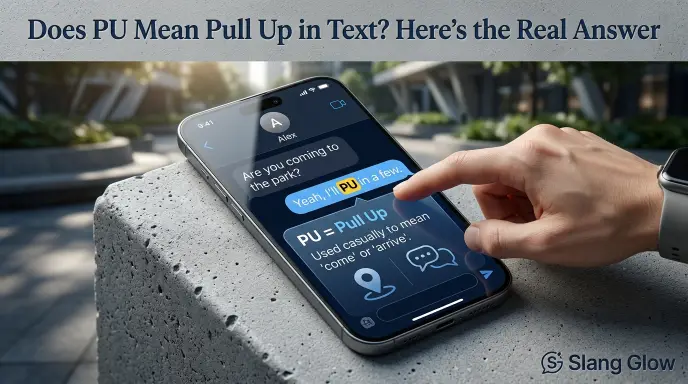
Yes, Does PU Mean Pull Up in Text “pull up” in text, especially when someone is asking another person to come to a place, arrive somewhere, or join them. The exact meaning depends on the context of the conversation.
You may see PU in text messages, Snapchat chats, Instagram DMs, WhatsApp, TikTok comments, and other casual online conversations. Because it is short, people often wonder what PU means when they see it for the first time.
When someone writes “PU at my place,” they may mean “pull up at my place,” which is a casual way of saying “come over.” Similarly, “PU later” can suggest that someone should come by later.
What Does PU Mean in Text?
In casual texting, PU can mean “pull up.” The expression is used when someone wants another person to come to a particular location or show up somewhere.
In simple terms, pull up can mean:
- Come over
- Come here
- Show up
- Arrive
- Join someone
- Come to a specific place
For example:
“We’re at the mall, PU.”
This can mean:
“We’re at the mall, pull up.”
The sender is telling the other person to come to the mall.
PU is mainly an informal abbreviation, so it fits better in casual conversations than in formal writing. Friends may use it because it is quick and easy to type.
Is PU Slang or an Abbreviation?
When PU means “pull up,” it is best understood as a texting abbreviation for a casual slang expression.
The full expression is pull up, while PU is the shortened form used in messages and online conversations.
For example:
“PU when you get here.”
This can mean:
“Pull up when you get here.”
The abbreviation can make a message feel shorter and more casual.
However, PU does not always have one fixed meaning. In some conversations, it can mean something different, such as “pick up.” The words around it usually make the intended meaning clearer.
Does PU Mean “Pull Up” in Text?
Yes, PU can mean “pull up” in text when the conversation is about meeting, visiting, arriving, or going somewhere.
Consider these examples:
“PU tonight.”
This may mean, “Pull up tonight.”
“We’re at Sarah’s, PU.”
This may mean, “We’re at Sarah’s, come over.”
“PU to the game.”
This may mean, “Come to the game.”
“You close? PU.”
This may mean, “Are you nearby? Come over.”
“Everyone’s here. PU!”
This may mean, “Everyone is here, come join us.”
The meaning becomes easier to understand when there is a clear location or plan in the conversation.
For example:
A: “Where are you guys?”
B: “At the coffee shop.”
A: “PU?”
Here, PU most naturally means “pull up?” or “should I come over?”
How Does PU Mean “Pull Up” in a Conversation?
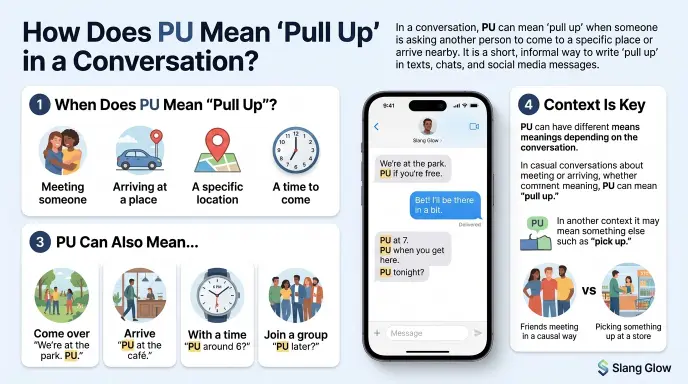
Context is the most important clue.
If someone mentions a house, party, school event, mall, restaurant, game, or another location, PU may be telling someone to come there.
For example:
A: “We’re having a small hangout at my house.”
B: “What time?”
A: “Around 7. PU.”
In this conversation, PU means that B should come over around 7.
Another example is:
A: “We’re outside.”
B: “Where?”
A: “By the gym. PU.”
Here, PU means “pull up” or “come here.”
The expression is usually friendly and casual. It does not automatically carry a serious or rude tone.
Why Do People Use PU Instead of “Pull Up”?
People often shorten words and phrases in texting because it makes communication faster.
Writing PU takes less space than writing pull up, especially in quick messages.
It can also make a conversation sound more relaxed:
“Are you coming over?”
is more complete, while:
“PU?”
is much shorter and more casual.
The meaning is usually understood when both people are familiar with texting slang.
That said, PU may be confusing if there is no context. If someone simply sends “PU”, the recipient may need to ask what they mean.
Can PU Mean Something Other Than Pull Up?
Yes. PU can have different meanings depending on the conversation.
One common possibility is “pick up.” For example:
“PU the package.”
In this sentence, the meaning is more likely to be “pick up the package” rather than “pull up the package.”
The surrounding words are important.
Compare these:
“PU at 8.”
Likely meaning: Pull up at 8.
“PU my order.”
Likely meaning: Pick up my order.
This is why you should not assume that every use of PU means “pull up.” Look at the full message before deciding what the sender means.
Where Do People Use PU?
People can use PU in several casual online spaces when they mean “pull up.” The abbreviation is especially useful in quick conversations where the people involved already understand the context.
PU on TikTok
On TikTok, PU may appear in comments, captions, or private messages when someone is talking about meeting up or coming somewhere.
For example:
“We’re at the spot, PU.”
This can mean:
“We’re at the spot, pull up.”
The meaning can change when the surrounding conversation changes, so it is always better to read the complete comment or message.
PU on Snapchat
Snapchat conversations often use short abbreviations because messages are usually casual and quick.
Someone might send:
“PU after school?”
Here, PU can mean:
“Pull up after school?”
In other words, the person is asking if you can come over or meet them afterward.
PU on Instagram
On Instagram, PU may appear in DMs between friends.
For example:
“We’re getting food later. PU if you want.”
This can mean:
“Come over or join us if you want.”
The abbreviation keeps the message short without changing the basic idea.
PU on WhatsApp
WhatsApp chats can also contain PU when friends are making informal plans.
For example:
“PU at 6?”
Depending on the conversation, this may mean:
“Pull up at 6?”
The sender is asking the other person to come or arrive around that time.
PU in SMS and Text Messages
Traditional text messages can use PU in the same casual way.
For example:
“I’m at the park. PU.”
This can mean:
“I’m at the park. Pull up.”
The phrase usually works best when the person receiving the message already knows where the sender is.
Real Chat Examples of PU Meaning Pull Up
Here are some realistic examples showing how PU can work in everyday texting.
Example 1
A: “Where are you?”
B: “At Mike’s.”
A: “PU?”
Here, PU means “pull up?” or “should I come over?”
Example 2
A: “We’re hanging out tonight.”
B: “Where?”
A: “My place. PU around 8.”
Here, the sender is inviting B to come over around 8.
Example 3
A: “We’re outside the restaurant.”
B: “Bet, PU.”
Here, B is saying they will come over or arrive at the restaurant.
Example 4
A: “You still coming to the game?”
B: “Yeah, PU in a bit.”
Here, PU suggests arriving or coming over soon.
Example 5
A: “Everyone’s at the park.”
B: “I’m close.”
A: “Then PU!”
Here, PU means “come here” or “pull up.”
Example 6
A: “What are you doing later?”
B: “Nothing much.”
A: “PU tonight.”
The sender is casually inviting B to come over.
Example 7
A: “We’re at the mall.”
B: “Which entrance?”
A: “Main one. PU.”
The message is telling B to come to the mall.
Example 8
A: “You around?”
B: “Yeah.”
A: “PU if you’re free.”
Here, the sender is inviting B to come over or meet them.
Example 9
A: “Party starts at 9.”
B: “Should I come?”
A: “Yeah, PU.”
Here, PU means “pull up” or “come to the party.”
Example 10
A: “We’re chilling at my cousin’s.”
B: “Sounds fun.”
A: “PU!”
This is a short and casual invitation to join them.
How to Tell If PU Means Pull Up or Pick Up
Because PU can have more than one meaning, context is important.
Look at the words surrounding PU and ask what the conversation is about.
If someone is talking about meeting, visiting, hanging out, or arriving, PU may mean “pull up.”
If someone is talking about an order, package, food, transportation, or collecting something, PU may mean “pick up.”
Compare these examples:
| Text | Likely Meaning |
| “PU at my house.” | Pull up |
| “PU tonight.” | Pull up |
| “PU to the party.” | Pull up |
| “PU my order.” | Pick up |
| “Can you PU the food?” | Pick up |
| “I’ll PU the package.” | Pick up |
The same two letters can therefore have different meanings.
Why Context Matters
Imagine someone texts:
“Can you PU at 7?”
That could be unclear by itself.
But if the previous messages were:
A: “Are you coming to the party?”
B: “Yeah, probably.”
A: “PU at 7.”
Then pull up makes sense.
On the other hand:
A: “The store closes at 8.”
B: “I need my order.”
A: “PU at 7.”
Here, pick up may make more sense.
How to Reply When Someone Says PU
Your reply depends on if you understand PU as an invitation to come over or arrive somewhere.
Casual Replies
You could reply:
- “Bet, I’ll be there.”
- “Sure, what time?”
- “I’m on my way.”
- “Yeah, give me a few.”
- “I’ll pull up later.”
Friendly Replies
If you want to sound friendly, you could say:
- “Sure, I’d love to come.”
- “Sounds good!”
- “Yeah, I’ll join you.”
- “I’ll be there soon.”
Funny Replies
Among close friends, you might respond playfully:
- “Say less 😂”
- “Already on the way.”
- “You know I’m coming.”
- “Give me five.”
The right reply depends on the relationship and the situation. PU itself is usually very casual, so a formal response may sound out of place in a friendly chat.
Is PU Rude or Offensive?
When PU means “pull up,” it is generally not rude or offensive.
It is a casual way to invite someone to come somewhere or tell them to arrive.
For example:
“PU when you’re free.”
This normally sounds like a casual invitation.
However, tone can change depending on the situation. A short message such as “PU now” could sound demanding if the relationship or context makes it feel that way.
PU is also not normally suitable for formal communication. In school, work, or professional messages, it is clearer to write “come over,” “arrive,” “meet us,” or “please come by” instead.
Who Uses PU?
PU can appear in informal conversations among people who regularly use texting abbreviations and internet slang.
You may encounter it in:
- Friend group chats
- Private messages
- Casual text conversations
- Social media conversations
- Gaming chats
- Online communities
You should not assume that every person knows the abbreviation. Slang varies between groups, platforms, and regions.
Younger internet users may encounter abbreviations like PU alongside many other short forms, but the meaning still depends on context rather than age alone.
Where Did PU Come From?
The abbreviation PU comes from shortening the phrase “pull up.”
The phrase “pull up” has been used in English in several contexts, including describing someone arriving at a location. Informal internet communication later encouraged people to shorten common expressions into quick abbreviations.
The exact point when PU became widely used as a texting abbreviation is not always clear. Online slang changes quickly, and different communities may use the same abbreviation differently.
For that reason, it is safer to focus on the current context and usage rather than claiming one definite origin for PU.
PU vs. Other Common Text Abbreviations
PU is only one of many short forms people may use in casual messaging.
| Term | Meaning | Type | Typical Usage |
| PU | Pull up | Abbreviation | Asking someone to come or arrive |
| IDK | I don’t know | Initialism | Showing uncertainty |
| IDC | I don’t care | Initialism | Showing lack of concern |
| IMO | In my opinion | Initialism | Giving an opinion |
| BRB | Be right back | Initialism | Temporarily leaving a chat |
These abbreviations serve different purposes.
For example, IDK communicates uncertainty, while IMO introduces an opinion. BRB tells someone that the sender will return soon. PU, when used as “pull up,” is more connected to coming or arriving somewhere.
A Real World Example of PU
Imagine a group of friends is meeting at a local park.
One person arrives first and sends a message:
“I’m at the park. PU when you get here.”
A friend who understands the abbreviation will probably read this as:
“I’m at the park. Pull up when you get here.”
The message is simply encouraging the other person to come over and join them.
However, if someone receives “PU” without any previous conversation, they may reasonably ask what the sender means.
That is one reason context matters so much with short slang abbreviations.
Frequently Asked Questions About PU
What Does “PU” Mean in Texting?
In texting, PU can mean “pull up” when someone is asking another person to come over, arrive somewhere, or join them. The exact meaning depends on the context of the conversation.
What Does “PU” Mean in Slang?
In slang, PU can be a short form of “pull up.” People may use it when talking casually about coming to a place, meeting someone, or showing up.
What Does “PU” Mean in Gen Z Slang?
In casual Gen Z style texting, PU can mean “pull up” when someone is inviting another person to come somewhere or join them. However, not everyone uses PU this way, so the surrounding message is important.
Is PU Slang for Pull Up?
Yes, PU can be slang for “pull up” in casual texting. For example, “PU tonight?” can mean “Are you going to pull up tonight?” or “Are you coming over tonight?”
What Does PU Stand For?
When it is used in the context of meeting or arriving, PU stands for “pull up.” It is a shortened form that makes casual messages quicker to type.
PU can also have other meanings in different situations. For example, if someone is talking about collecting an order, PU may mean “pick up.”
What Is PU on Snap?
On Snapchat, PU can mean “pull up” when someone is asking you to come over, meet them, or join a group. For example, “PU after school?” can mean “Pull up after school?”
The exact meaning still depends on the conversation. If the message is about an order or collecting something, PU could have a different meaning.
What Does PU Mean When Someone Says “PU”?
When someone simply sends “PU,” they may be telling you to pull up, meaning come over or arrive at a particular place.
For example:
“We’re at the park. PU.”
This likely means:
“We’re at the park. Pull up.”
If there is no context, however, it is reasonable to ask the person what they mean because PU can have multiple interpretations.
Does PU Always Mean Pull Up?
No, PU does not always mean “pull up.”
The abbreviation can have different meanings depending on the situation.
For example:
“PU at my house.”
Here, pull up makes sense because the message refers to a location.
But:
“PU the package.”
Here, pick up may be the intended meaning because the message is about collecting something.
This shows why reading the entire conversation is important before interpreting a short abbreviation.
Is PU Common in Casual Texting?
PU can appear in casual texting when people are making plans or asking someone to come somewhere.
It is more natural in informal conversations than in formal communication.
Friends might write:
“PU later?”
A more formal version could be:
“Are you coming over later?”
Both messages can communicate a similar idea, but PU makes the conversation shorter and more casual.
Can PU Mean “Come Over”?
Yes. When PU is being used as “pull up,” it can effectively mean “come over” or “come here.”
For example:
“I’m home. PU if you’re free.”
The sender is casually inviting the other person to come over.
The phrase does not necessarily mean that the person must arrive immediately. The timing depends on the rest of the conversation.
Can PU Be Used in a Question?
Yes. PU can be used as a question when someone wants to know if another person will come.
For example:
“PU tonight?”
This can mean:
“Are you going to pull up tonight?”
Another example:
“PU after class?”
This can mean:
“Are you coming over after class?”
The question mark makes the intended meaning easier to recognize.
Can PU Be Used With a Time?
Yes. People can use PU with a time when making informal plans.
For example:
“PU at 7.”
This can mean:
“Pull up at 7.”
Another example:
“PU around 9?”
This can mean:
“Can you come around 9?”
Using a time alongside PU gives the recipient more information about when they are expected to arrive.
Can PU Be Used With a Place?
Yes. A location can make the meaning of PU much clearer.
For example:
“PU at my house.”
This suggests:
“Pull up at my house.”
Another example:
“PU to the game.”
This can mean:
“Come to the game.”
When a location appears next to PU, pull up is often easier to understand from context.
What Is the Difference Between PU and Pull Up?
The main difference is that PU is the shortened form, while pull up is the complete phrase.
For example:
“Pull up later.”
and
“PU later.”
can communicate essentially the same idea in a casual conversation.
The first version is clearer to people who may not know the abbreviation. The second is shorter and more informal.
Final Thoughts on PU Meaning in Text
PU can mean “pull up” in text, especially when someone is asking another person to come over, arrive somewhere, or join a group.
It is an informal abbreviation that works best in casual conversations, text messages, social media chats, and messages between friends.
The most important thing to remember is that PU can have more than one meaning. When the conversation involves meeting or arriving somewhere, “pull up” may fit. When the conversation involves collecting something, “pick up” may make more sense.
Looking at the surrounding words will usually help you understand what the sender intended.
Frequently Asked Questions
What does PU mean in text messages?
In text messages, PU can mean “pull up” when someone is asking another person to come over, arrive somewhere, or join them. The exact meaning depends on the conversation and the words around the abbreviation.
What does PU mean on TikTok?
On TikTok, PU can mean “pull up” when people are talking about meeting, arriving, or asking someone to come somewhere. The surrounding comment or conversation can help clarify the intended meaning.
Is PU slang?
Yes, PU can be an informal slang abbreviation for “pull up” in casual texting and online conversations. It is generally used in relaxed conversations rather than formal communication.
Is PU rude or offensive?
No, PU is not generally rude or offensive when it means “pull up.” It is a casual expression. However, the tone can depend on how it is used. A message such as “PU now” may sound more direct or demanding than “PU when you’re free.”
How should you reply to PU?
If someone uses PU to mean “pull up,” your reply can depend on if you want to come or need more information.
You could say:
- “Bet, I’ll be there.”
- “Sure, what time?”
- “I’m on my way.”
- “I’ll pull up later.”
- “Where are you?”
What Does PU Mean When Someone Says “PU”?
When someone simply sends “PU,” they may be telling you to pull up, meaning to come over, arrive somewhere, or join them.
For example:
“We’re at the park. PU.”
This can mean:
“We’re at the park. Pull up.”
If the message appears without any context, its meaning may be unclear because PU can have different meanings.
Does PU Always Mean Pull Up?
No, PU does not always mean “pull up.”
The abbreviation can have different meanings depending on the conversation.
For example:
“PU at my house.”
Here, pull up makes sense because the message refers to a location.
But:
“PU the package.”
Here, pick up may be the intended meaning because the message is about collecting something.
Looking at the surrounding words is therefore important when interpreting PU.
Is PU Common in Casual Texting?
PU can appear in casual texting when people are making plans or asking someone to come somewhere.
For example:
“PU later?”
This can mean:
“Are you coming over later?”
The abbreviation makes the message shorter and gives it a casual tone.
It is generally more suitable for conversations with friends or people who are familiar with informal texting language.
Can PU Mean “Come Over”?
Yes. When PU means “pull up,” it can effectively mean “come over” or “come here.”
For example:
“I’m home. PU if you’re free.”
The sender is casually inviting the other person to come over.
Another example is:
“We’re at my cousin’s. PU.”
This can mean:
“We’re at my cousin’s. Pull up.”
Can PU Be Used in a Question?
Yes. PU can appear as a question when someone wants to know if another person will come.
For example:
“PU tonight?”
This can mean:
“Are you going to pull up tonight?”
Another example is:
“PU after class?”
This can mean:
“Are you coming over after class?”
The question mark helps show that the sender is asking rather than simply telling someone to come.
Can PU Be Used With a Time?
Yes. PU can be used with a specific time when people are making informal plans.
For example:
“PU at 7.”
This can mean:
“Pull up at 7.”
Another example:
“PU around 9?”
This can mean:
“Can you come around 9?”
Adding a time makes the intended plan easier to understand.
Can PU Be Used With a Place?
Yes. A location can make the meaning of PU clearer.
For example:
“PU at my house.”
This suggests:
“Pull up at my house.”
Another example:
“PU to the game.”
This can mean:
“Come to the game.”
When a location appears with PU, the “pull up” meaning is easier to identify.
What Is the Difference Between PU and Pull Up?
The main difference is that PU is an abbreviation, while pull up is the complete phrase.
For example:
“Pull up later.”
and
“PU later.”
can communicate a similar message in a casual conversation.
The full phrase is easier for everyone to understand, while PU is shorter and more informal.
When Should You Avoid Using PU?
It is usually better to avoid PU in formal situations where clear communication is important.
For example, a school assignment, professional email, official notice, or formal message would normally use complete words instead.
Instead of:
“PU at 5.”
a clearer message would be:
“Please come by at 5.”
Using the complete phrase can prevent confusion, especially when the reader may not know the abbreviation.
Final Thoughts on PU Meaning in Text
PU can mean “pull up” in text, especially when someone is asking another person to come over, arrive somewhere, or join them.
It is an informal abbreviation commonly suited to casual conversations and online messaging. You may see it in texts, social media conversations, and messages between friends.
Remember that PU can have more than one meaning. When the conversation is about meeting or arriving, “pull up” may be the intended meaning. When it involves collecting an order, package, or another item, “pick up” may make more sense.
The surrounding conversation is the best clue for understanding what the sender means.
READ MORE!

Hi, I’m James Parker, a writer passionate about modern slang, internet culture, and social media language. I enjoy researching trending words and explaining their meanings in simple, easy to understand English. My goal is to help readers confidently understand and use slang in everyday conversations, texting, and online platforms.