
Right now in Spanish slang is commonly expressed as “ahorita,” “ahora mismo,” or “ya,” depending on the country and context.
Right now in Spanish slang is a popular search because many people hear Spanish speakers use different words and phrases that all seem to mean “right now.” If you watch TikTok videos, chat with Spanish speaking friends, play online games, or travel to Spanish speaking countries, you may notice that people rarely use the exact same expression everywhere.
The meaning often changes depending on the country, the situation, and how casual the conversation is. Some expressions sound friendly and natural, while others are more regional slang that locals use every day. Understanding these differences helps you communicate more naturally and avoid confusion.
In this guide, you’ll learn what right now in Spanish slang means, where it is commonly used, when to use different expressions, and real life examples that sound natural.
Quick Answer
“Right now” in Spanish slang does not have one universal slang word. Native speakers commonly use expressions like “ahorita,” “ahora mismo,” and “ya” depending on the country and the situation. The exact meaning can range from immediately to very soon, depending on local usage.
What Does Right Now in Spanish Slang Mean in Text?
When people search for right now in Spanish slang, they usually want to know how Spanish speakers naturally say “right now” in text messages or casual conversations.
Unlike English, Spanish has several expressions that can mean “right now.” The most common include:
- Ahorita
- Ahora mismo
- Ya
- En este momento
The meaning depends on where the speaker is from.
For example:
- In Mexico, ahorita may mean right now, in a few minutes, or even later, depending on the context and tone.
- In Spain, people often say ahora mismo when they mean immediately.
- In many Latin American countries, ya can mean right now, already, or go ahead, depending on the conversation.
Because of these regional differences, listening to the context is just as important as knowing the words themselves.
Right Now in Spanish Slang Full Form / Definition
There is no full form for right now in Spanish slang because it is not an abbreviation or acronym.
Instead, it refers to several informal Spanish expressions that people use in everyday conversations.
Here are the most common ones:
| Spanish Expression | English Meaning | Common Usage |
| Ahorita | Right now / Soon | Mexico, Central America |
| Ahora mismo | Right now | Spain and Latin America |
| Ya | Right now / Already | Many Spanish speaking countries |
| En este momento | At this moment | More formal conversations |
These expressions all relate to the present time, but the exact meaning depends on the speaker, region, and context.
Is Right Now in Spanish Slang Rude, Offensive, or Neutral?
In most situations, expressions used for right now in Spanish slang are completely neutral.
They are commonly used between:
- Friends
- Family members
- Coworkers
- Classmates
- Online communities
- Text messages
None of the common expressions are offensive on their own.
However, tone matters.
For example:
- Saying “¡Ya!” politely can simply mean “Right now.”
- Saying “¡Ya!” loudly during an argument may sound impatient or frustrated.
Similarly, ahorita is usually friendly and relaxed, but misunderstandings can happen because its timing varies by region.
If you are speaking with native Spanish speakers, paying attention to context and tone is more important than the word itself.
Where Is Right Now in Spanish Slang Commonly Used?
These expressions appear in many everyday situations.
Text Messages
Friends often use them when replying quickly.
Example:
“Te respondo ahorita.”
“I’ll reply right now.”
WhatsApp and Messenger
Spanish speakers frequently use these phrases while chatting online.
Example:
“Voy ahora mismo.”
“I’m coming right now.
TikTok and Instagram
Content creators often use casual expressions to sound natural and conversational.
Example captions include:
- “Subo el video ahorita.”
- “Lo hago ya.”
Gaming
Players may use them during team communication.
For example:
- “Voy ya.”
- “Entro ahorita.”
These short phrases help teammates understand that someone is joining or acting immediately.
Everyday Conversations
You will hear these expressions in:
- Restaurants
- Schools
- Offices
- Family gatherings
- Shopping centers
- Public transportation
They are part of everyday spoken Spanish and are among the most common time related expressions used by native speakers.
Origin and Background of Right Now in Spanish Slang
Spanish has been spoken for hundreds of years across more than 20 countries. Because of this, many everyday expressions have developed different meanings depending on the region.
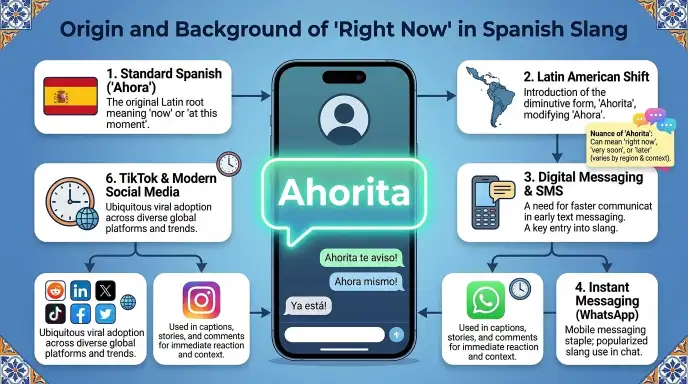
The standard Spanish word “ahora” simply means “now.” Over time, native speakers created more casual versions such as “ahorita,” which became especially popular in Mexico and parts of Central America.
Interestingly, “ahorita” does not always mean this exact second. In some places, it can mean:
- Right now
- In a few minutes
- Soon
- Later today
This flexibility is part of everyday spoken Spanish, so the meaning depends on the speaker’s tone and the situation.
Similarly, “ya” originally meant “already,” but in modern conversation it can also mean:
- Right now
- Immediately
- Go ahead
- Okay, I’m doing it
Understanding these regional differences helps you communicate more naturally with native speakers.
Why Do People Use Right Now in Spanish Slang?
People prefer informal expressions because they sound friendly, natural, and conversational.
Instead of speaking formally all the time, native speakers often choose slang like expressions to make conversations feel relaxed.
Common reasons include:
- Faster texting
- Casual conversations with friends
- Social media captions
- Everyday speech
- Regional identity
- Sounding more like a native speaker
These expressions also make conversations feel warmer and less robotic.
Real Life Examples of Right Now in Spanish Slang
Friendly Tone
Friend: Are you coming?
Reply:
“Voy ahorita.”
Meaning:
“I’m coming right no
Casual Conversation
Parent:
Can you help me?
Reply:
“Sí, ya voy.”
Meaning:
“Yes, I’m coming right now.”
Social Media
A creator might write:
“Subo el video ahorita.”
Meaning:
“I’m uploading the video right now.”
This sounds natural and friendly to followers.
Gaming Context
A teammate says:
“Entra al juego.”
You reply:
“Voy ya.”
Meaning:
“I’m joining right now.”
Short responses like this are common during online gaming.
Work Chat
Coworker:
“Can you send the file?”
Reply:
“Te lo envío ahora mismo.”
Meaning:
“I’m sending it right now.”
This version sounds polite and professional.
Family Conversation
Mom:
“Dinner is ready.”
Child:
“Ya bajo.”
Meaning:
“I’m coming down right now.”
Right Now in Spanish Slang Across Different Countries
Different Spanish speaking countries often use different expressions.
| Country | Common Expression | Typical Meaning |
| Mexico | Ahorita | Right now / Soon |
| Spain | Ahora mismo | Right now |
| Argentina | Ahora | Now |
| Colombia | Ya | Right now / Already |
| Chile | Al tiro (informal) | Right away |
| Central America | Ahorita | Soon or Right now |
Remember that meanings can vary depending on local culture and conversation.
Comparison with Similar Spanish Expressions
| Expression | Meaning | Formal or Casual |
| Ahora | Now | Neutral |
| Ahora mismo | Right now | Neutral |
| Ahorita | Right now / Soon | Casual |
| Ya | Right now / Already | Casual |
| En este momento | At this moment | Formal |
Although these phrases are similar, choosing the right one depends on who you’re talking to and where they are from.
Common Mistakes Learners Make
Many English speakers assume that every Spanish phrase has only one meaning.
That is not true.
For example:
❌ Thinking “ahorita” always means “immediately.”
In reality, a Mexican speaker may use “ahorita” to mean:
- In a minute
- Soon
- Later today
- Right now
Another common mistake is using “ya” only as “already.”
Depending on the situation, “ya” can also mean:
- Right now
- Go ahead
- That’s enough
- Okay
The best way to understand these expressions is by paying attention to the conversation and the speaker’s tone.
When Should You Avoid Using Right Now in Spanish Slang?
Although informal Spanish expressions for “right now” are common, they are not suitable for every situation.
In formal settings, it is usually better to use standard Spanish instead of regional slang.
Avoid slang in situations such as:
- Business meetings
- Job interviews
- Official emails
- Academic writing
- Government documents
- Speaking with someone who may not understand regional expressions
For example, “ahora mismo” is usually a safer choice than a regional phrase like “al tiro” if you’re unsure where the listener is from.
Polite Alternatives to Right Now in Spanish Slang
If you want to sound more professional or respectful, these expressions work well.
| Expression | Meaning | Best Used For |
| Ahora mismo | Right now | Professional and everyday conversations |
| En este momento | At this moment | Formal writing and business |
| Ahora | Now | General conversations |
| Inmediatamente | Immediately | Formal situations requiring urgency |
These alternatives are widely understood across Spanish speaking countries. If you want to say not right now in spanish, a common expression is “ahora no,” which simply means “not now.” A softer response can depend on the situation and tone.
Impact of Using Slang in Communication
Using slang naturally can make conversations feel more relaxed and authentic.
Benefits
- Sounds more like a native speaker
- Helps build friendly conversations
- Makes texting feel natural
- Improves understanding of social media content
- Makes travel conversations easier
Possible Problems
- Some slang changes by country.
- Certain expressions may confuse people from other regions.
- Timing words like “ahorita” can have different meanings depending on local culture.
Because of this, context is always important.
Is Right Now in Spanish Slang Safe for Social Media?
Yes. Most expressions used for right now in Spanish slang are completely safe for social media.
You’ll often see them on:
- TikTok
- X (formerly Twitter)
- Discord
- Snapchat
- YouTube comments
Creators use these expressions because they sound casual and relatable.
For example:
- “Subo el reel ahorita.”
- “Ahora mismo respondo los comentarios.”
- “Ya regreso.”
These phrases are friendly and commonly understood by native speakers.
Tips for Using Right Now in Spanish Slang Naturally
If you’re learning Spanish, these simple tips will help you sound more natural.
- Learn the regional differences before using slang.
- Listen to native speakers on videos and podcasts.
- Match your tone to the situation.
- Use formal expressions in professional settings.
- Avoid copying slang if you’re unsure of its meaning.
- Practice with native speakers whenever possible.
Remember that understanding the context is just as important as learning the words themselves.
Related Spanish Time Expressions
Learning a few similar expressions will make your Spanish sound more fluent.
| Expression | English Meaning |
| Ahora | Now |
| Ahora mismo | Right now |
| Ahorita | Right now / Soon |
| Ya | Right now / Already |
| Enseguida | Right away |
| En este momento | At this moment |
| Inmediatamente | Immediately |
Knowing these phrases helps you understand conversations across different Spanish speaking regions.
Common Situations Where You’ll Hear These Expressions
You may hear these phrases in everyday life, including:
At Home
“Ya voy.”
“I’m coming right now.”
At School
“Lo hago ahorita.”
“I’ll do it right now.”
At Work
“Te envío el archivo ahora mismo.”
“I’m sending you the file right now.”
While Shopping
“Regreso en un momento.”
“I’ll be back in a moment.”
Online Gaming
“Entro ya.”
“I’m joining right now.”
These examples show how flexible and useful these expressions are in daily communication.
Comparison with English “Right Now”
Although English speakers often use “right now” to mean immediately, Spanish speakers have several expressions with slightly different meanings.
| English | Spanish | Notes |
| Right now | Ahora mismo | Direct equivalent |
| Right now | Ahorita | Meaning varies by region |
| Immediately | Inmediatamente | More formal and urgent |
| Already | Ya | Can also mean “right now” depending on context |
Understanding these small differences will help you avoid misunderstandings and communicate more naturally.The phrase just now in spanish can have different translations depending on the intended meaning. “Ahora mismo” can refer to the present moment, while “hace un momento” is commonly used when talking about something that happened a short time ago.
Frequently Asked Questions
1. What does right now in Spanish slang mean?
There is no single Spanish slang word for “right now.” Native speakers commonly use expressions like ahorita, ahora mismo, and ya. The exact meaning depends on the country, context, and tone of the conversation.
2. What is the full form of right now in Spanish slang?
There is no full form because it is not an acronym or abbreviation. It refers to informal Spanish expressions that mean right now, immediately, or very soon.
3. Is ahorita the same as right now?
Not always. In many countries, ahorita means right now, but in places like Mexico it can also mean in a little while or soon. The speaker’s tone and the situation determine the intended meaning.
4. Is right now in Spanish slang rude?
No. Common expressions such as ahorita, ahora mismo, and ya are generally polite and neutral. However, an impatient or angry tone can make even a neutral phrase sound rude.
5. Which expression is most common in Spain?
In Spain, ahora mismo is one of the most common ways to say right now. It clearly means immediately and is appropriate in both casual and professional conversations.
6. Can I use these expressions on social media?
Yes. Expressions like ahorita, ya, and ahora mismo are widely used on platforms such as TikTok, Instagram, WhatsApp, Snapchat, Discord, and X. They sound natural and conversational in posts, captions, and chats.
Final Tips
If you’re learning Spanish, remember that context matters more than direct translation. A phrase that means “right now” in one country may suggest “later” in another. Listening to native speakers and paying attention to regional differences will help you understand the intended meaning.
When you’re unsure, choose ahora mismo. It is one of the clearest and most widely understood ways to express right now across Spanish speaking communities.
Conclusion
Understanding right now in Spanish slang is about more than translating two English words. Native Spanish speakers use several expressions such as ahorita, ahora mismo, and ya to express the idea of “right now,” but each carries slightly different meanings depending on the country, situation, and tone.
Whether you’re texting a friend, chatting on social media, traveling, or learning Spanish, knowing these differences will help you communicate more naturally and avoid misunderstandings. While ahorita may mean immediately in one region and soon in another, ahora mismo is generally the safest choice when you want to clearly express right now.
The key is to focus on context rather than a literal translation. As you become familiar with regional expressions and real life usage, you’ll sound more confident and understand everyday Spanish conversations much better.
DISCOVER MORE

Hey, I’m Emily. I’ve spent way too many hours scrolling TikTok and group chats trying to figure out what people actually mean by half the slang flying around — and somewhere along the way that turned into a whole thing I write about now. I cover internet slang, TikTok trends, and how words shift meaning practically overnight online.