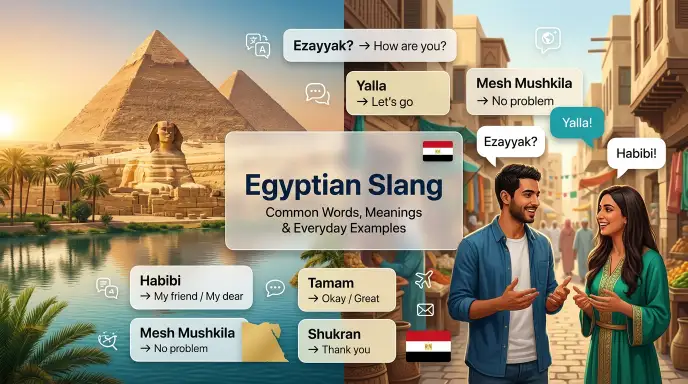
Egyptian slang includes informal words and expressions used in everyday conversations across Egypt. These phrases help people speak naturally and reflect local culture.
Example: When greeting a friend, someone might say “Ezayyak?”, meaning “How are you?”
Egyptian Arabic is one of the most widely spoken and understood Arabic dialects in the world. Thanks to Egypt’s movies, music, TV shows, and social media creators, Egyptian slang has become popular across the Middle East and among Arabic learners worldwide. These informal words and expressions help conversations sound natural, friendly, and authentic.
If you’re planning a trip to Egypt, learning Arabic, chatting with Egyptian friends, or simply curious about local expressions, understanding can make communication much easier. From greetings and compliments to funny phrases and everyday sayings, reflects the country’s rich culture, humor, and daily life.
In this complete guide, you’ll learn the meanings of popular Egyptian slang words, how to pronounce them, where they are commonly used, and real life examples. You’ll also discover when to use these expressions and when it’s better to avoid them.
What Is Egyptian Slang?
It is the collection of informal words, phrases, and expressions used in everyday conversations by people in Egypt. Unlike Modern Standard Arabic, these expressions are casual, relaxed, and commonly heard among friends, family members, classmates, and coworkers.
It is used in:
- Daily conversations
- Social media posts
- Text messages
- Movies and TV shows
- Songs and music
- Online gaming chats
Why Is Egyptian Slang So Popular?
There are several reasons why is recognized far beyond Egypt.
- Egypt has one of the largest entertainment industries in the Middle East.
- Egyptian movies and TV dramas are watched across many Arabic speaking countries.
- Social media influencers and content creators frequently use Egyptian slang.
- The expressions are often easy to remember and fun to use.
As a result, many Arabic learners start with Egyptian Arabic because it is widely understood.
Egyptian Slang at a Glance
| Feature | Details |
| Language | Egyptian Arabic |
| Region | Egypt |
| Type | Informal spoken language |
| Used By | Native speakers, students, travelers |
| Common Places | Texting, social media, daily conversations |
| Formal? | No |
Where Is Egyptian Slang Commonly Used?
You’ll hear Egyptian slang almost everywhere in Egypt, including:
- 📱 Text messages
- 🎵 TikTok
- 💬 Facebook Messenger
- 👻 Snapchat
- 🎮 Gaming communities
- ☕ Cafés and restaurants
- 🏫 Schools and universities
- 👨👩👧 Everyday family conversations
Is Egyptian Slang Different from Standard Arabic?
Yes. Egyptian slang is different from Modern Standard Arabic (MSA). While MSA is used in news, books, official speeches, and formal writing it is used in casual conversations.
For example:
- Modern Standard Arabic is taught in schools.
- Egyptian slang is learned naturally through everyday communication.
If you’re visiting Egypt, knowing a few slang words will often help you connect with locals more easily than using only formal Arabic.
Who Uses Egyptian Slang?
People of all ages use including:
- Teenagers
- College students
- Working professionals
- Families
- Social media creators
- Gamers
- Tour guides
- Local business owners
Although younger people often introduce new slang expressions, many classic Egyptian slang words have been used for generations and remain popular today.
25 Common Egyptian Slang Words and Their Meanings
Here are some of the most popular Egyptian slang words and phrases you’ll hear in everyday conversations.
| Egyptian Slang | Meaning in English | Example |
| Ezayyak? (إزيك؟) | How are you? | “Ezayyak? Long time no see!” |
| Amel Eh? (عامل إيه؟) | How’s it going? | “Amel eh? Everything okay?” |
| Yalla (يلا) | Let’s go / Come on | “Yalla, we’re getting late!” |
| Maashi (ماشي) | Okay / Sounds good | “Meet at 7?” — “Maashi.” |
| Habibi (حبيبي) | My friend / My dear | “Thanks, habibi!” |
| Habibti (حبيبتي) | My dear (female) | “You’re welcome, habibti.” |
| Mesh Mushkila (مش مشكلة) | No problem | “Sorry I’m late.” — “Mesh mushkila.” |
| Khalas (خلاص) | Enough / Done | “Khalas, let’s stop.” |
| Aiwa (أيوة) | Yes | “Aiwa, I understand.” |
| La’a (لأ) | No | “La’a, not today.” |
| Ya Salam! (يا سلام) | Wow! / Amazing! | “Ya Salam! That’s beautiful.” |
| Bravo (برافو) | Well done | “Bravo! Great job.” |
| Tayyeb (طيب) | Okay / Fine | “Tayyeb, let’s do it.” |
| Shokran (شكراً) | Thank you | “Shokran for your help.” |
| Afwan (عفواً) | You’re welcome | “Shukran!” — “Afwan.” |
| Ya Khabar! (يا خبر) | Oh my goodness! | “Ya Khabar! That’s unbelievable.” |
| Feloos (فلوس) | Money | “I don’t have enough feloos.” |
| Gameel (جميل) | Nice / Beautiful | “Your idea is gameel.” |
| Zayy El Fol (زي الفل) | I’m great | “How are you?” — “Zayy El Fol!” |
| Ya Basha (يا باشا) | Boss / Bro | “Thanks, ya basha!” |
| Malesh (معلش) | Never mind / It’s okay | “Malesh, mistakes happen.” |
| Bas (بس) | Stop / That’s enough | “Bas! That’s enough talking.” |
| Fen? (فين؟) | Where? | “Fen your phone?” |
| Leh? (ليه؟) | Why? | “Leh are you laughing?” |
| Tamam (تمام) | Great / Perfect / Okay | “Everything is tamam.” |
Most Popular Egyptian Slang Expressions
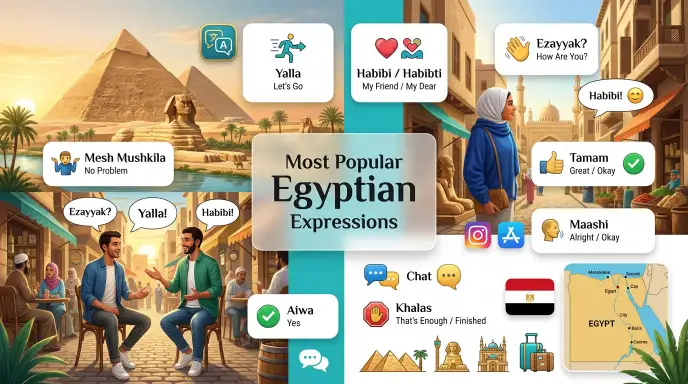
1. Yalla
Meaning: “Let’s go,” “Come on,” or “Hurry up.”
Example:
Friend: “The movie starts in five minutes.”
You: “Yalla, let’s leave!”
2. Habibi
Meaning: A friendly way to say “my friend,” “my dear,” or “buddy.”
Example:
“Thank you, habibi. I really appreciate your help.”
3. Tamam
Meaning: Everything is okay, great, or perfect.
Example:
Friend: “Are you ready?”
You: “Tamam!”
4. Malesh
Meaning: “Never mind,” “It’s okay,” or “Don’t worry about it.”
Example:
Friend: “Sorry I forgot.”
You: “Malesh.”
5. Ya Salam!
Meaning: Used to express surprise, excitement, or admiration.
Example:
“Ya Salam! This food tastes amazing!”
Why Do People Use Egyptian Slang?
People use Egyptian slang because it makes conversations sound more natural and friendly. It also helps speakers express emotions, humor, and personality in a simple way.
Common reasons include:
- Speaking naturally with friends.
- Communicating faster.
- Showing local culture.
- Making conversations more relaxed.
- Understanding Egyptian movies and social media better.
Frequently Asked Questions
1. What are some Egyptian slang words?
Answer: Some popular Egyptian slang words include Yalla (Let’s go), Habibi (My dear), Tamam (Okay), Malesh (Never mind), and Ya Salam (Wow!).
Example:
Friend: “Yalla, we’re late!”
You: “Tamam, let’s go.”
2. What is “I love you” in Egyptian?
Answer: In Egyptian Arabic, “I love you” is “Bahebak” (to a male) and “Bahebek” (to a female). It is commonly used between couples, family members, and close friends.
Example:
Ahmed: “Bahebak.”
Sara: “Ana kaman bahebak.” (I love you too.)
3. How do Egyptians say “Let’s go”?
Answer: Egyptians usually say “Yalla!” to mean “Let’s go,” “Come on,” or “Hurry up.” It is one of the most common slang expressions in Egypt.
Example:
Friend: “The taxi is here.”
You: “Yalla!”
4. What does “Ya Lahwy” mean?
Answer: “Ya Lahwy!” is an expression of shock, surprise, or disbelief, similar to saying “Oh my God!” or “Wow!” in English.
Example:
Friend: “I won the lottery!”
You: “Ya Lahwy! That’s incredible.”
5. How do you say “OK” in Egypt?
Answer: Egyptians often say “Tamam” or “Maashi” to mean “OK,” “Alright,” or “Sounds good.”
Example:
Friend: “Meet at 6 PM?”
You: “Tamam!”
6. Is “A7A” a bad word?
Answer: Yes. A7A (أحا) is considered a vulgar Egyptian slang expression. It is often used to express anger, shock, or frustration and should be avoided in formal settings or polite conversations.
Example:
Someone might say “A7A!” after hearing very surprising or upsetting news, but it is not appropriate to use around strangers, at work, or in professional situations.
Common Mistakes When Using Egyptian Slang
Learning Egyptian slang is fun, but using it incorrectly can cause confusion. Here are some common mistakes to avoid.
1. Using Slang in Formal Situations
Egyptian slang is meant for casual conversations. Avoid using it in business meetings, official emails, or academic writing.
Incorrect: “Yalla, let’s finish the business report.”
Correct: Use formal Arabic or English in professional settings.
2. Using Strong or Offensive Words
Some Egyptian slang words, such as A7A, are considered vulgar. Use them only if you fully understand the context, and avoid them in polite conversations.
Example:
❌ Saying A7A in a formal meeting.
✅ Saying Ya Salam! to express surprise politely.
3. Mispronouncing Common Expressions
Pronunciation matters because changing the sound of a word can change its meaning.
Example:
- ✔️ Yalla = Let’s go
- ✔️ Tamam = Okay
Practice listening to native speakers to improve your pronunciation.
4. Assuming Every Arabic Speaker Uses Egyptian Slang
Not all Arabic speaking countries use the same slang. Egyptians may understand their slang, but people from other countries may use different expressions.
Example:
A phrase common in Egypt may not be commonly used in Morocco or Saudi Arabia.
Tips for Using Egyptian Slang Naturally
- Learn one or two new expressions each day.
- Listen to Egyptian movies and TV shows.
- Watch Egyptian TikTok and YouTube creators.
- Use slang only in casual conversations.
- Pay attention to the context before speaking.
- Avoid offensive slang unless you fully understand it.
Egyptian Slang vs Modern Standard Arabic
| Egyptian Slang | Modern Standard Arabic | Meaning |
| Yalla | Hayya (هيا) | Let’s go |
| Tamam | Hasan (حسنًا) | Okay |
| Malesh | La Ba’s (لا بأس) | Never mind |
| Habibi | Azizii (عزيزي) | My dear |
| Aiwa | Na’am (نعم) | Yes |
Why Is Egyptian Slang So Popular?
It is popular because Egypt has a strong influence on Arabic entertainment. Movies, TV dramas, music, and social media have introduced these expressions to millions of people across the Middle East. Today, many Arabic learners study Egyptian slang because it helps them understand native conversations and connect with Egyptian culture more naturally.
Fun Facts About Egyptian Slang
It is more than just informal language it reflects Egypt’s culture, humor, and everyday life. Here are some interesting facts.
1. Egyptian Arabic Is Widely Understood
Because Egyptian movies, TV shows, and music are popular across the Arab world, many Arabic speakers understand common Egyptian slang even if they are not from Egypt.
2. “Yalla” Is One of the Most Popular Words
The word Yalla is used many times a day in Egypt. It can mean “Let’s go,” “Come on,” “Hurry up,” or simply encourage someone to move.
Example:
“Yalla! The bus is leaving.”
3. Habibi Is More Than Romantic
Although Habibi means “my dear” or “my beloved,” Egyptians also use it with friends, family members, and even strangers in a friendly way.
Example:
“Thank you, habibi!”
4. Slang Changes Over Time
Like English slang, Egyptian slang keeps evolving. Young people often create new expressions that become popular through TikTok, Instagram, Facebook, and YouTube.
5. Body Language Is Important
Many Egyptians naturally use hand gestures and facial expressions along with slang, making conversations more expressive and engaging.
When Should You Avoid Egyptian Slang?
Avoid using Egyptian slang in situations such as:
- Business meetings
- Government offices
- Academic writing
- Legal documents
- Formal speeches
In these situations, Modern Standard Arabic (MSA) or professional English is usually more appropriate.
Quick Recap
| Expression | Meaning |
| Yalla | Let’s go / Come on |
| Tamam | Okay / Perfect |
| Habibi | My dear / My friend |
| Malesh | Never mind / It’s okay |
| Ya Salam | Wow / Amazing |
| Aiwa | Yes |
| La’a | No |
Key Takeaways
- Egyptian slang is used in everyday conversations.
- It is popular because of Egypt’s movies, music, and social media.
- Words like Yalla, Tamam, and Habibi are common across Egypt.
- Some slang expressions are informal or offensive, so always consider the context.
- Learning Egyptian slang helps you communicate more naturally with native speakers and better understand Egyptian culture.
Final Thoughts
Egyptian slang is a fun and practical way to understand how people communicate in everyday life. From common expressions like Yalla, Habibi, and Tamam to culture specific phrases such as Ya Salam and Malesh, these words make conversations sound more natural and friendly. If you’re traveling to Egypt, learning Arabic, or watching Egyptian movies and social media, knowing these slang terms will help you connect with native speakers more confidently.
Quick Practice Exercise
Test your knowledge of Egyptian slang with these simple questions.
1. What does “Yalla” mean?
A) Goodbye
B) Let’s go ✅
C) Thank you
2. Which Egyptian slang word means “OK” or “Perfect”?
A) Habibi
B) Tamam ✅
C) Ya Salam
3. What does “Habibi” usually mean?
A) My dear / My friend ✅
B) Teacher
C) House
4. Which phrase means “Never mind” in Egyptian slang?
A) Aiwa
B) Malesh ✅
C) La’a
5. True or False: Egyptian slang should always be used in formal business meetings.
Answer: False ✅
Key Points to Remember
- ✔ Egyptian slang is used in casual, everyday conversations.
- ✔ Yalla means “Let’s go” or “Come on.”
- ✔ Tamam means “OK,” “Fine,” or “Perfect.”
- ✔ Habibi is a friendly way to say “my dear” or “my friend.”
- ✔ Some slang words can be offensive, so always understand the context before using them.
Related Arabic Slang You May Like
- Levantine Slang – Popular expressions used in Lebanon, Jordan, Syria, and Palestine.
- Gulf Arabic Slang – Common slang from Saudi Arabia, UAE, Kuwait, Qatar, Bahrain, and Oman.
- Moroccan Slang (Darija) – Everyday informal expressions from Morocco.
- Algerian Slang – Frequently used words and phrases in Algeria.
- Tunisian Slang – Common informal language spoken in Tunisia.
- Arabic Texting Slang – Internet abbreviations and chat expressions used across the Arab world.
Now you know the most common words, their meanings, and how to use them correctly in real life conversations. Learning these expressions will make your Arabic sound more natural and help you better understand Egyptian culture.
Read the Complete Guide!

Hi, I’m James Parker, a writer passionate about modern slang, internet culture, and social media language. I enjoy researching trending words and explaining their meanings in simple, easy to understand English. My goal is to help readers confidently understand and use slang in everyday conversations, texting, and online platforms.