“what does valid mean in text” in text usually means reasonable, understandable, acceptable, or worthy of approval. When someone replies “valid,” they often mean that they understand your opinion, feeling, choice, or reason.
If someone sends “valid” in a text, they are usually giving a short response to something you said. The word can mean “that makes sense,” “fair enough,” or “I understand your point.”
Imagine telling a friend, “I don’t want to go out tonight because I’m tired.” If they reply, “Valid,” they are saying that your choice makes sense to them.
The exact meaning depends on the situation. Someone may use valid to support a feeling, recognize an opinion, approve a choice, or show that they understand your reasoning.
You may see this use in text messages, group chats, comments, and other casual online conversations. The response is usually simple and supportive.
Quick Answer about what does valid mean in text
In texting, valid means that something is reasonable, understandable, acceptable, or worthy of recognition. It can show support or agreement without always meaning complete agreement.
For example:
“I don’t feel like going out tonight.”
“Valid.”
Here, the second person means, “I understand why you feel that way.”
What Does “Valid” Mean in Texting?
The word valid often works as a short response to someone’s statement.
A person might use it after hearing an opinion, personal choice, explanation, or feeling. Instead of writing several sentences, they can simply say “what does valid mean in text”
For example:
Aisha: “I don’t like crowded places.”
Sara: “Valid.”
Sara is saying that Aisha’s preference is understandable. She does not necessarily have to feel the same way.
That is an important part of the texting meaning. Valid can show recognition without requiring complete agreement.
What Does “That’s Valid” Mean?
“That’s valid” usually means “That makes sense” or “I understand your point.”
The phrase is often used when someone explains a personal choice or opinion.
For example:
Maya: “I don’t want to join the party because I barely know anyone there.”
Lena: “That’s valid.”
Lena is accepting Maya’s reason as understandable.
The response does not automatically mean Lena would make the same choice. It simply shows that she sees the reasoning as reasonable.
What Does “You’re Valid” Mean?
“You’re valid” is usually a supportive statement directed at a person.
It can communicate that someone’s feelings, experience, or perspective deserves recognition.
For example:
Nora: “I need some time alone today.”
Ella: “You’re valid. Take the time you need.”
Here, Ella is offering support rather than debating Nora’s choice.
The difference is useful to remember. “That’s valid” usually responds to a specific statement, while “you’re valid” focuses more directly on the person.
Does “Valid” Mean “I Agree”?
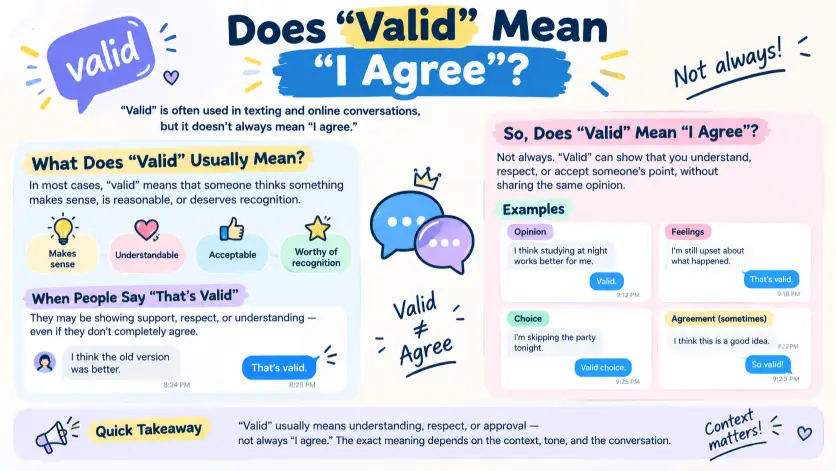
Sometimes, but not always.
A person can think your opinion is reasonable without having exactly the same opinion.
For example:
Sam: “I prefer staying home on weekends.”
Alex: “Valid.”
Alex may agree with Sam. However, Alex could also prefer going out while still understanding Sam’s choice.
So in texting, valid can mean “I understand your point” rather than “I completely agree.”
Is “Valid” Slang?
Valid is a standard English word, but its short online use can feel like slang.
The regular word has meanings connected with being logically sound, acceptable, or legitimate. Online conversations often use it more casually to show approval or recognition. (meaaning.com)
For example:
“That argument is valid.”
This sounds closer to standard English.
But:
“Staying home tonight? Valid.”
sounds much more like casual internet language.
The context tells you which style the speaker intends.
How Is “Valid” Used on Social Media?
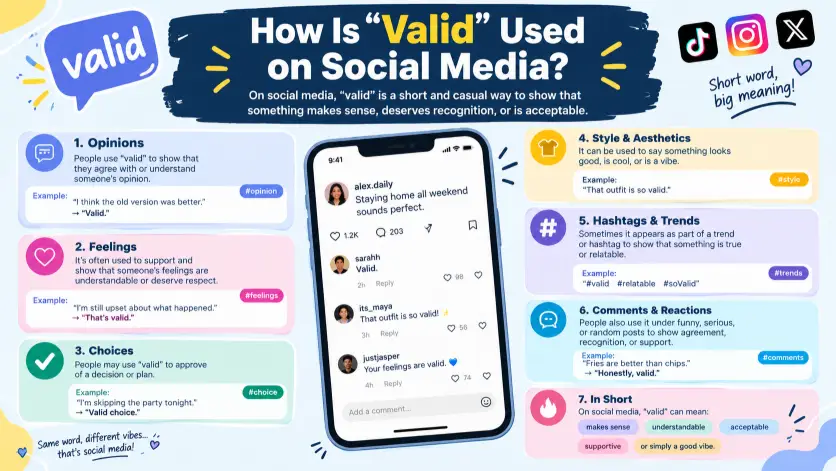
On social media, valid can act as a quick stamp of approval.
People may use it when reacting to:
- An opinion
- A personal choice
- A feeling
- A food preference
- A hobby
- An outfit
- A plan
- A relatable statement
For example:
“Sleeping all weekend sounds perfect.”
A reply might be:
“Valid.”
In another situation, someone could write:
“That outfit is valid.”
Here, the meaning moves closer to “That looks good” or “I approve of that style.”
The subject of the conversation helps reveal the intended meaning.
What Does “Valid” Mean When Talking About Feelings?
When someone says your feelings are valid, they usually mean your reaction is understandable and deserves to be respected.
For example, a friend might share that they felt hurt by something that happened. You could reply, “That’s valid.” Here, you are recognizing their feelings rather than saying they are wrong for having them.
This does not always mean you completely agree with the person. It can simply show that you understand why they feel that way.
What Does “Valid” Mean for an Opinion?
“Valid” can describe an opinion that has a reasonable point behind it.
Imagine someone says, “I think studying in the morning works better for me.” A response such as “That’s valid” can mean, “I understand your point” or “That makes sense.”
The speaker may still have a different opinion. In casual texting, valid often shows respect without requiring complete agreement.
What Does “Valid” Mean for a Choice?
People may use “valid” to show approval of another person’s decision.
For example:
- “You want to stay home tonight? Valid.”
- “Choosing that movie is valid.”
- “Honestly, that outfit choice is valid.”
In these examples, the word gives a casual stamp of approval. The exact feeling can range from simple acceptance to stronger approval.
What Does “Valid” Mean on TikTok and Social Media?
On social media, “valid” often works as a short reaction to someone’s opinion, experience, choice, or comment.
A person might write “valid” under a post when they think the point makes sense or deserves recognition.
You may also see phrases such as:
- “That’s valid.”
- “So valid.”
- “Your feelings are valid.”
- “Valid point.”
- “Honestly, valid.”
The meaning depends on the post and the conversation around it. Sometimes it sounds supportive, while other times it can simply mean that someone has a reasonable point.
Is “Valid” Always Positive?
Usually, casual uses of “valid” carry a supportive or approving tone, but the word does not automatically mean strong praise.
Tone matters.
If someone writes “valid” seriously, they may be showing genuine support. In another conversation, a person could use it jokingly or sarcastically.
For example, “You bought another game? Valid 😂” could be playful rather than a serious statement.
Looking at the surrounding words, emojis, and conversation helps reveal the intended tone.
Valid vs. Agree: What Is the Difference?
These two words are related, but they are not exactly the same.
| Word | Common meaning in conversation |
| Valid | Your point, feeling, or choice makes sense or deserves recognition |
| Agree | I have the same opinion or believe the same thing |
| Understand | I can see why you think or feel that way |
| Accept | I recognize or allow something without necessarily supporting it |
So when someone says “That’s valid,” they do not always mean “I agree with you.”
They may simply be saying that your reasoning or feelings are understandable.
Examples of “Valid” in Text Messages
Seeing the word in different situations makes its casual meaning easier to understand.
Example 1: Opinion
Person A: “I think the old version was better.”
Person B: “Valid.”
Here, “valid” shows that Person B thinks the opinion is reasonable.
Example 2: Feelings
Person A: “I’m still upset about what happened.”
Person B: “That’s valid.”
The response recognizes the person’s feelings.
Example 3: Choice
Person A: “I’m skipping the party tonight.”
Person B: “Valid choice.”
The speaker accepts the decision.
Example 4: Food
Person A: “Fries are better than chips.”
Person B: “Honestly, valid.”
This is a casual way to say the opinion makes sense to them.
Example 5: Social media
Person A: “I would rather stay home and watch movies.”
Person B: “So valid.”
The phrase expresses casual approval or understanding.
Common Mistakes When Using “Valid”
A few misunderstandings can make the word confusing.
Mistake 1: Thinking It Always Means “Correct”
In casual texting, valid does not always mean factually correct.
Someone can call an opinion valid because it is understandable or reasonable, even when another person disagrees with it.
Mistake 2: Assuming It Means Complete Agreement
“That’s valid” can acknowledge someone’s point without saying, “I completely agree.”
The difference becomes clearer when the conversation involves personal opinions or feelings.
Mistake 3: Ignoring Tone
A single word can sound supportive, neutral, or playful depending on the conversation.
Words such as “honestly,” “so,” or an emoji can change the feeling of the message.
Mistake 4: Using It in Every Situation
“Valid” works naturally in casual conversations, texts, comments, and social media.
For formal writing, clearer words such as reasonable, acceptable, justified, or legitimate may fit better depending on the meaning.
What Can You Say Instead of “Valid”?
Several alternatives can work when you want to show understanding or approval.
Common choices include:
- Fair
- Makes sense
- Good point
- I get that
- I respect that
- Reasonable
- Understandable
- Agreed
- True
The best option depends on the situation. For example, “good point” focuses on an argument, while “I respect that” focuses more on recognizing someone’s choice or position.
What Is the Opposite of “Valid” in Texting?
The opposite depends on what is being discussed.
Someone might use invalid, unreasonable, unfair, or wrong when rejecting an idea or argument.
In casual texting, a person might simply say:
- “Not valid.”
- “Nah.”
- “I disagree.”
- “That doesn’t make sense.”
The surrounding conversation helps determine which response fits best.
When Should You Avoid Using “Valid”?
“Valid” is common in casual communication, but it may sound too informal in some situations.
For a school assignment, professional email, official document, or formal discussion, choose a more specific word when possible.
For example, instead of:
“Your concern is valid.”
You could write:
“Your concern is understandable.”
Both can work, but the second may fit certain formal situations more naturally.
Why Is “Valid” Common in Online Conversations?
Online conversations often need short ways to show support or recognition.
“Valid” is useful because one word can acknowledge an opinion, feeling, or choice without requiring a long response.
Its flexible meaning also allows people to use it across many everyday topics, from personal feelings to opinions about food, entertainment, fashion, or decisions.
What Does “Valid” Mean in Text? Key Takeaways
The meaning of valid in text is usually connected to acceptance, understanding, or approval.
It can mean that someone’s:
- Opinion makes sense
- Feelings are understandable
- Choice is acceptable
- Point deserves recognition
- Idea seems reasonable
Remember that “valid” does not always mean “I agree.” A person can recognize your point as reasonable while still having a different view.
Context and tone are the best clues to the exact meaning.
FAQs About “Valid” in Text
Q.1 What does “valid” mean in a text?
In a text message, “valid” usually means something makes sense, seems reasonable, or deserves recognition.
Q.2 What does “valid” mean in Gen Z slang?
In Gen Z slang, “valid” is often a quick way to show approval, understanding, or agreement. It can mean “That makes sense,” “I get it,” or “I respect that.”
Q.3 What does “valid” mean from a girl?
If a girl says “valid” in a text or conversation, the meaning depends on the context. She may be saying that your opinion, feeling, choice, or explanation makes sense or deserves respect. It does not automatically have a romantic meaning.
Q.4 What does “valid” mean?
Valid can mean acceptable, reasonable, correct, or worthy of recognition. In casual online conversations, people often use it to acknowledge someone’s opinion, feelings, or choice.
Q.5 What is valid in slang?
In slang, valid is commonly used as a short reaction meaning reasonable, understandable, acceptable, or approved.
Q.6 What can I say instead of “valid”?
Depending on the situation, you can say “fair,” “makes sense,” “good point,” “I get that,” “I respect that,” or “agreed.”
How Does “Valid” Change With Context?
The same word can carry a slightly different meaning depending on the conversation.
A person might use “valid” to support an opinion, recognize someone’s feelings, or approve a decision. Looking at the words around it usually makes the intended meaning clear.
For example, “Your point is valid” focuses on an argument, while “Your feelings are valid” focuses on an emotional reaction.
What Does “Valid Point” Mean?
“Valid point” means that someone has made a reasonable or understandable argument.
It does not necessarily mean that everyone agrees with the argument.
For example:
“I know we wanted to go out, but staying home will save money.”
A reply such as “Valid point” shows that the speaker recognizes the reasoning behind the statement.
What Does “You’re Valid” Mean?
“You’re valid” is usually a supportive expression.
It can mean that a person’s feelings, perspective, identity, or experience deserves recognition and respect.
The exact meaning depends on the conversation. In casual texting, it often works as a short way to reassure someone that their reaction or perspective is understandable.
What Does “So Valid” Mean?
“So valid” adds emphasis.
Instead of simply saying “valid,” the speaker is showing stronger approval or recognition.
For example:
“I don’t want to spend my weekend doing homework.”
“So valid.”
Here, the response means something like “I completely understand that” or “That makes sense.”
Can “Valid” Be Used Sarcastically?
Yes, although the context is important.
A person may use “valid” sincerely, but it can also appear in jokes or playful conversations.
For example:
“I stayed up all night watching videos.”
“Valid 😂”
The response may be playful rather than a serious statement of agreement.
Without the surrounding conversation, it can be difficult to know if the word is serious or sarcastic.
Does “Valid” Have a Romantic Meaning?
“Valid” does not have a built in romantic meaning.
If someone sends you “valid,” the safest way to understand it is by looking at what you said before that message.
It may simply mean:
- “That makes sense.”
- “I understand.”
- “Fair enough.”
- “I respect that.”
- “Good point.”
The relationship between the people and the wider conversation can affect the tone, but the word itself is not automatically romantic.
Can “Valid” Mean “Cool”?
Sometimes, especially in casual online speech.
When someone describes an outfit, choice, idea, or activity as “valid,” they may be giving it approval.
For example:
“I got these new sneakers.”
“Those are valid.”
In this type of conversation, the word can suggest that the speaker thinks the choice is good, acceptable, or cool.
How Do You Reply When Someone Says “Valid”?
Your response can depend on what you want to communicate.
If you agree, you could say:
- “Exactly.”
- “For real.”
- “I know, right?”
- “Agreed.”
If you want to explain your point, you could say:
- “That’s what I mean.”
- “Exactly my point.”
- “Glad you get it.”
Is “Valid” Formal or Informal?
The word valid itself is standard English, so it is not limited to slang.
However, using “valid” as a short reaction is much more common in casual conversations, texts, comments, and social media.
In formal writing, it is usually better to choose a more precise word based on what you mean.
For example:
- “Your argument is reasonable.”
- “The concern is understandable.”
- “The document is legitimate.”
- “The explanation is well supported.”
What Are Other Ways to Say “That’s Valid”?
Different phrases can express a similar idea.
| Alternative | Meaning |
| That makes sense | I understand your reasoning |
| Fair enough | I accept your point |
| Good point | Your argument has merit |
| I get that | I understand your position |
| I respect that | I recognize your choice or view |
| That’s fair | Your position seems reasonable |
| I hear you | I understand what you are saying |
Choosing the right phrase depends on if you want to show agreement, understanding, respect, or acceptance.
What Should You Remember About “Valid” in Text?
The most important thing is to read the word in context.
In casual texting, “valid” can communicate several closely related ideas. It may show that someone thinks your opinion makes sense, understands your feelings, accepts your choice, or respects your point.
It does not automatically mean complete agreement, and it does not automatically carry a romantic meaning.
A short reply like “valid” can therefore say a lot with very few words.
How Do People Use “Valid” in Everyday Texts?
The word can fit many casual conversations because its meaning changes slightly with the situation.
A person may use valid after hearing an opinion, reading a personal experience, or discussing an everyday choice. It is often a quick way to show that they understand or recognize what someone said.
For example:
- “I need some alone time today.” → “Valid.”
- “I think this movie is underrated.” → “Valid opinion.”
- “I would rather save my money.” → “That’s valid.”
- “I’m not ready to talk about it yet.” → “Your feelings are valid.”
What Does “Valid Opinion” Mean?
A valid opinion is an opinion that has a reasonable basis or makes sense from the speaker’s point of view.
Calling an opinion valid does not mean that everyone must agree with it.
For example:
“I prefer books because I can read at my own pace.”
Someone might reply, “Valid opinion.”
The response recognizes the reasoning behind the opinion without claiming that it is the only correct view.
What Does “Valid Choice” Mean?
A valid choice is a decision that someone considers reasonable or acceptable.
For example:
“I decided not to go because I was too tired.”
“Valid choice.”
Here, the speaker is recognizing the decision rather than criticizing it.
This phrase can also appear in conversations about food, entertainment, clothing, hobbies, or everyday plans.
What Does “Valid Reaction” Mean?
A valid reaction is a response that the speaker considers understandable given the situation.
For example, someone may tell a friend:
“You were surprised by that? Valid reaction.”
The person is saying that the reaction makes sense based on what happened.
This use is especially common when people discuss personal experiences or emotional situations.
Can “Valid” Mean “You Have a Point”?
Yes.
When someone says “valid” after another person’s argument, they may mean “You have a point.”
For example:
“We could buy it now, but waiting for a sale might save money.”
“Valid.”
The reply recognizes that the argument has some merit.
It does not necessarily mean the person has made a final decision.
Can “Valid” Mean “I Understand”?
Yes, depending on the context.
If someone explains why they made a certain choice and you respond with “valid,” you may be communicating that you understand their reasoning.
For example:
“I left early because I had school the next morning.”
“Valid.”
Here, the response is close to “I understand why you did that.”
Why Is “Valid” Useful as a One Word Reply?
Short replies are common in texting because people often want to respond quickly without writing a long explanation.
“Valid” can acknowledge someone’s message while keeping the conversation casual.
Instead of writing:
“I understand why you feel that way, and I can see why your decision makes sense.”
Someone may simply write:
“Valid.”
That makes the response short while still showing recognition.
Is “Valid” the Same as “Right”?
Not always.
Right often suggests that a statement is correct.
Valid can be broader. In casual conversation, it may mean that a person’s reasoning, feeling, or choice is understandable even when there is no single correct answer.
For example:
“I prefer tea over coffee.”
Calling that preference valid does not mean tea is objectively better. It simply recognizes the person’s preference as reasonable.
Final Takeaway about what does valid mean in text
In texting and online conversations, “valid” is usually a short way to show that something makes sense, deserves recognition, or is understandable.
It can describe opinions, feelings, choices, reactions, and arguments. The phrase “that’s valid” often sounds supportive without necessarily meaning complete agreement.
If you are unsure what someone means by “valid,” look at the message they responded to. That context usually tells you if they mean “I agree,” “I understand,” “fair point,” “I respect that,” or simply “that makes sense.”
Find Out More!

Hey, I’m Emily. I’ve spent way too many hours scrolling TikTok and group chats trying to figure out what people actually mean by half the slang flying around — and somewhere along the way that turned into a whole thing I write about now. I cover internet slang, TikTok trends, and how words shift meaning practically overnight online.