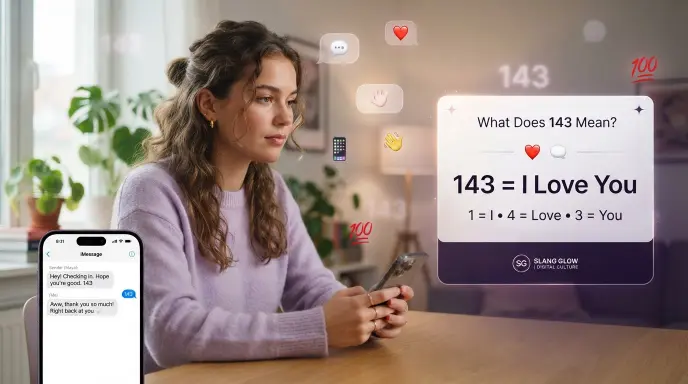
What does 143 mean in a text? 143 usually means “I love you.” It is a numeric code where each number represents the number of letters in each word: 1 = I, 4 = love, and 3 = you. People may use 143 in texts, online messages, social media, and other casual conversations.
The code is a short way to express affection without typing the full phrase. You may see 143 in personal messages, captions, comments, or other informal online conversations.
Quick Answer: What Does 143 Mean in a Text?
143 usually means “I love you” in a text. The numbers represent the number of letters in each word: 1 = I, 4 = love, and 3 = you. It is an informal numeric code used in personal messages and online conversations.
What Does 143 Mean in a Text?
143 commonly means “I love you.” Each number represents the number of letters in the corresponding word:
- 1 = I
- 4 = love
- 3 = you
Together:
1 + 4 + 3 = I love you
For example:
Person A: “Goodnight, 143.”
Here, 143 is being used as a short numeric expression of affection.
The meaning is usually clear when the conversation is personal or affectionate. However, numbers can have different meanings in different contexts, so the surrounding message still matters.
Why Does 143 Mean “I Love You”?
The meaning comes from the letter count of each word.
The phrase has three words:
I → 1 letter
love → 4 letters
you → 3 letters
That creates the number sequence 143.
This type of number code allows someone to communicate a longer phrase in a very short form. It became associated with quick personal communication and later appeared in texting and internet culture.
Is 143 a Texting Code?
Yes. 143 is commonly described as a texting or numeric code for “I love you.”
It is not an abbreviation made from the first letters of words. Instead, it uses the number of letters in each word.
For example:
143
can represent:
1 letter + 4 letters + 3 letters
which gives:
I + love + you
Because it is short, someone can use 143 when they want to communicate the phrase without spelling it out.
What Does 143 Mean in Slang?
In informal slang and digital communication, 143 usually refers to “I love you.”
It is best understood as a numeric expression rather than a traditional slang word.
You may encounter it in:
- Text messages
- Online chats
- Social media
- Comments
- Captions
- Informal conversations
Its meaning is generally connected with affection, but the tone can vary depending on who uses it and why.
What Does 143 Mean From a Friend?
If a friend sends you 143, the meaning depends on the relationship and the conversation.
In many cases, the person is using the familiar code for “I love you” or expressing strong affection.
For example:
Friend: “Thanks for always being there. 143.”
The number is being used as a warm expression of affection or appreciation.
The surrounding conversation still matters because numbers can sometimes have other meanings.
What Does 143 Mean on Social Media?
On social media, 143 can be used as a short expression of affection or as a reference to the phrase “I love you.”
Someone might use it in a caption such as:
“143 ❤️”
The number and heart together make the affectionate meaning easier to understand.
It may also appear in comments, profiles, usernames, or posts because some people like using numeric codes instead of writing common phrases directly.
What Does 143 Mean in a Text Message From Someone?
When someone sends 143 by itself, the most common interpretation is “I love you.”
For example:
“143”
can be understood as:
“I love you.”
If the message appears after a longer conversation, the previous messages can provide additional clues.
For example:
“Thanks for helping me today. 143.”
Here, 143 is being used as an affectionate closing.
Is 143 Still Used Today?
143 can still be recognized as a numeric texting code, although not everyone uses it regularly.
Modern texting often uses emojis, abbreviations, and short phrases instead. Someone may choose 143 because they like older texting codes or want their message to have a nostalgic or playful style.
Recognition can vary between different people and online communities, so someone who has never seen the code may ask what it means.
What Is the History of 143?
The basic explanation for 143 is the letter-count pattern in “I love you.”
The code became associated with quick personal communication and later appeared in texting and internet culture.
There are different claims about the exact history of numeric communication codes, so it is better not to assign 143 to one specific creator or event without reliable evidence.
The established part is the simple letter-count explanation:
1 = I, 4 = love, 3 = you.
Is 143 the Same as “I Love You”?
Yes, 143 is commonly used as a coded way to say “I love you.”
The difference is simply how the message is written.
“I love you” uses the actual words.
“143” uses the number of letters in each word.
| Expression | Meaning |
| 143 | I love you |
| ILY | I love you |
| Love you | Direct expression of affection |
| ❤️ | Often expresses love or affection |
The context can still affect how the message should be interpreted.
What Is the Difference Between 143 and 1432?
143 and 1432 are different numeric codes.
143 is commonly understood as:
1 = I
4 = love
3 = you
So:
143 = I love you
The meaning of 1432 can vary because different number codes may use different systems. You should not automatically assume that adding another number creates a universal meaning.
If you see an unfamiliar number code, check the surrounding conversation before deciding what it means.
What Does 143 Mean With a Heart Emoji?
When 143 appears with a heart emoji, the affectionate meaning becomes even clearer.
For example:
“143 ❤️”
The combination commonly communicates affection.
Similarly:
“143 💕”
can reinforce the same general idea.
The emoji does not change the basic numeric code. It simply provides an additional clue about the tone.
Real Text Examples of 143
Example 1: Short Message
“143”
Meaning: I love you.
Example 2: With a Heart
“Goodnight. 143 ❤️”
Meaning: An affectionate goodnight message.
Example 3: After a Thank-You
“Thanks for being there for me. 143.”
Meaning: An affectionate expression of appreciation.
Example 4: Playful Numeric Code
“You already know. 143.”
Meaning: The sender is using the familiar code to express affection.
Example 5: Social Media Style
“143 ❤️✨”
Meaning: A short affectionate message using the numeric code.
Is 143 Formal or Informal?
143 is informal. It is most appropriate for casual digital communication rather than formal writing.
You may see it in:
- Personal texts
- Casual chats
- Social media
- Comments
- Captions
- Informal messages
It would generally be inappropriate to use 143 in a formal school, business, or official document.
If you need to communicate clearly in a formal setting, write the actual words instead of using a numeric code.
Can 143 Have Another Meaning?
Although “I love you” is the best-known texting meaning of 143, numbers can have different meanings in different situations.
For example, 143 could be:
- A number
- A code
- A reference number
- Part of an address
- A personal number sequence
- A context-specific reference
If someone says:
“My room is 143.”
there is no reason to interpret that as “I love you.”
The surrounding words determine whether 143 is being used as a texting code or as an ordinary number.
How Do You Reply to 143 in a Text?
If someone sends you 143, your response depends on the context and your relationship with that person.
If you want to return the same affectionate message, you might reply:
“143 ❤️”
If you want to respond more clearly, you can write:
“Love you too.”
If you are not sure what the sender means, you can simply ask:
“What does 143 mean here?”
The safest approach is to consider the whole conversation before assuming exactly what the sender intended.
What Does 143 Mean With Other Numbers?
Some people use 143 as part of other numeric expressions. However, not every combination has one universally accepted meaning.
For example:
143 = I love you
The meaning comes from the letter count:
1 = I
4 = love
3 = you
If additional numbers appear, their meaning may depend on the specific code or community using them.
So, do not assume that every number sequence containing 143 has the same meaning.
Is 143 a Romantic Texting Code?
143 can be used as an affectionate or romantic code, because its commonly recognized meaning is “I love you.”
However, the code itself does not tell you exactly what kind of relationship the sender has with the recipient.
People can use affectionate language with family members, close friends, or other people they care about. The relationship and surrounding conversation provide the necessary context.
For example:
“Thanks for everything. 143.”
The message expresses affection, but the exact relationship cannot be determined from the number alone.
What Does 143 Mean From Someone You Know?
If someone you know sends 143, they are likely using the familiar numeric meaning of “I love you.”
For example:
“Goodnight, 143.”
This can be a warm way to end a personal conversation.
However, if you have never seen the code before, it is completely reasonable to ask what the person means.
Numeric slang is not universal, and different people may use numbers differently.
What Does 143 Mean in a Group Chat?
In a group chat, 143 can be used as a quick affectionate message.
For example:
Person A: “Thanks everyone for helping today!”
Person B: “143 ❤️”
Here, the sender is expressing affection or appreciation.
The meaning can also be playful. Someone may use 143 simply because the group understands the code.
If the group is discussing numbers, dates, scores, or other topics, however, 143 could have a literal meaning instead.
What Does 143 Mean on TikTok?
On TikTok, 143 may appear in captions, comments, videos, or usernames as a reference to “I love you.”
For example:
“143 to everyone who supported me ❤️”
The number is being used as a short affectionate message.
You may also see 143 alongside other emojis or short phrases. These additional words and symbols can make the intended tone easier to understand.
What Does 143 Mean on Snapchat?
On Snapchat, 143 can be used in casual messages to express affection.
Someone might send:
“143 ❤️”
as a short way of saying “I love you.”
Because Snapchat conversations are usually informal, numeric codes can fit naturally into short messages.
Still, the number can also be used literally. If someone says:
“Meet me at 143?”
the context would be unusual and could indicate something other than the common texting code.
Is 143 Still Popular in Texting?
143 is a recognizable older texting code, but its use is not universal.
Some people know the meaning immediately, while others may not recognize it.
Modern messaging often relies more on:
- Emojis
- Short abbreviations
- GIFs
- Stickers
- Direct phrases
Even so, 143 can still appear in casual digital communication, especially when someone likes classic texting codes or wants to use a nostalgic expression.
Is 143 the Same as ILY?
143 and ILY can both mean “I love you,” but they use different systems.
143 is based on letter counts:
1 = I
4 = love
3 = you
ILY is made from the first letters:
I = I
L = love
Y = you
| Expression | Meaning | Type |
| 143 | I love you | Numeric code |
| ILY | I love you | Letter abbreviation |
| ❤️ | Love or affection | Emoji |
| Love you | Love you | Direct phrase |
All can communicate affection, but the style is different.
Can 143 Be Used as a Joke?
Yes. 143 can be used playfully or jokingly, depending on the conversation.
For example:
Friend: “Thanks for sharing your snacks. 143 😂”
Here, the sender may be using the familiar code in a humorous way.
The meaning still comes from “I love you,” but the overall message may not be intended as a serious declaration.
This is why tone, emojis, and the surrounding conversation matter.
Can 143 Be Used by Family Members?
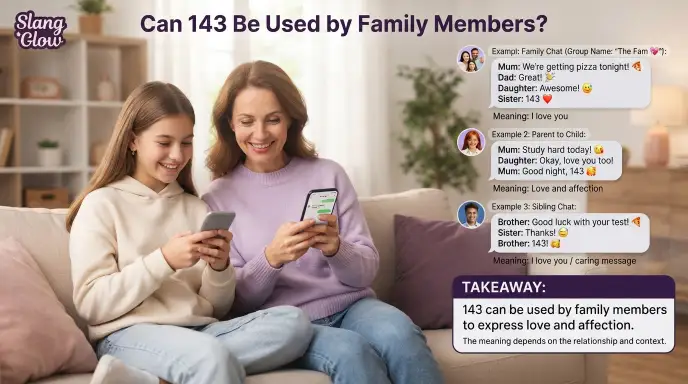
Yes. 143 can be used between family members as an affectionate message.
For example:
“Goodnight, 143 ❤️”
could be a warm message between family members.
The numeric code itself does not specify whether the relationship is romantic, familial, or based on friendship.
It simply provides a short way to communicate affection.
Common Mistakes When Understanding 143
One common mistake is assuming that 143 always has an emotional meaning.
For example:
“Apartment 143.”
Here, 143 is simply a number.
Another mistake is assuming that everyone knows the code.
Someone may receive:
“143”
and have no idea what it means.
A third mistake is assuming that 143 automatically tells you the sender’s exact feelings or relationship with you. The code provides a commonly recognized phrase, but the surrounding conversation provides the deeper context.
When Should You Avoid Using 143?
You may want to avoid using 143 when the other person may not understand numeric texting codes.
It can also be unsuitable for formal communication.
For example, instead of writing:
“143”
in a formal message, it is clearer to use complete words.
In professional or school communication, clarity is usually more important than using casual texting codes.
How Can You Tell If 143 Means “I Love You”?
Look at the surrounding conversation.
Ask yourself:
- Is the conversation personal or affectionate?
- Is 143 used with a heart emoji?
- Does the message contain words such as “love,” “miss,” or “care”?
- Is the sender using other texting codes?
- Could 143 simply be a normal number in this context?
For example:
“Goodnight ❤️ 143”
strongly suggests the common affectionate meaning.
But:
“The address is 143 Main Street.”
clearly uses 143 as a number.
Frequently Asked Questions
What does 143 mean in texting?
143 usually means “I love you.” The numbers represent the letter count of each word: 1 for “I,” 4 for “love,” and 3 for “you.”
What does 143 mean from a girl?
It usually has the same basic meaning regardless of who sends it. In a personal conversation, it can mean “I love you” or express affection.
What does 143 mean from a guy?
A guy using 143 may be using the familiar numeric code for “I love you.” The surrounding conversation helps explain the intended tone.
What does 143 ❤️ mean?
143 ❤️ commonly reinforces the meaning “I love you” or another affectionate message.
Is 143 still used?
Yes. 143 remains a recognizable numeric texting code, although not everyone uses or recognizes it regularly.
Is 143 slang?
143 is best described as a numeric texting code or informal expression rather than a conventional slang word.
Is 143 romantic?
It can be romantic because it commonly means “I love you,” but the same code can also be used to express affection toward friends or family.
What is the difference between 143 and ILY?
Both can mean “I love you.” 143 uses the number of letters in each word, while ILY uses the first letters of the three words.
Final Thoughts
143 in a text usually means “I love you.” The code comes from the letter count of the three words: 1 = I, 4 = love, and 3 = you.
It can appear in texts, social media comments, captions, group chats, and other informal conversations. The code may feel nostalgic or playful, especially because modern messaging often relies on different types of abbreviations and emojis.
Still, context matters. If 143 appears in a personal message, it may have its familiar affectionate meaning. If it appears as part of an address, score, reference number, or another ordinary number, it may simply be the number 143.
LEARN MORE!

Hi, I’m James Parker, a writer passionate about modern slang, internet culture, and social media language. I enjoy researching trending words and explaining their meanings in simple, easy to understand English. My goal is to help readers confidently understand and use slang in everyday conversations, texting, and online platforms.