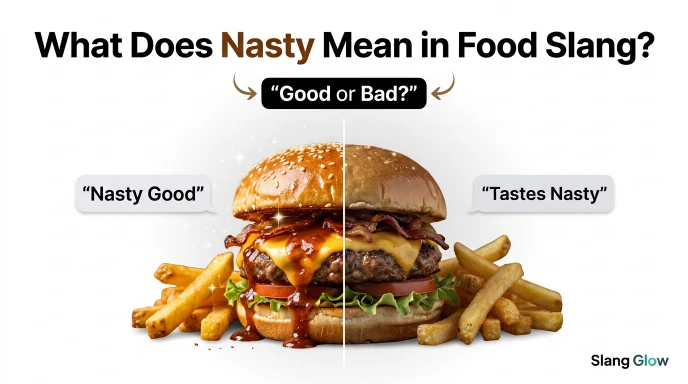
“Nasty” in food slang can mean extremely good, rich, messy, or satisfying, but it can also mean disgusting or unpleasant. The intended meaning depends on the context, tone, and words around it.
For example, if someone says, “This burger is nasty!” while enjoying it, they may mean the burger is incredibly good. But if someone says, “This chicken tastes nasty,” they probably mean the food tastes bad.
This double meaning can make food conversations confusing, especially in texts, comments, and social media posts. The positive use is informal and often playful. People may use it to describe food that feels extra rich, indulgent, messy, or intense.
Understanding the difference helps you know if nasty is being used as a compliment or criticism.
Quick Answer Table
| Question | Answer |
| Food slang meaning | Very good, rich, messy, or satisfying |
| Normal meaning | Disgusting or unpleasant |
| Can it mean delicious? | Yes, in informal speech |
| Tone | Usually playful when positive |
| Main clue | Context and tone |
| Formal word? | No |
What Does Nasty Mean in Food Slang?
When nasty describes food positively, it can mean really good, highly satisfying, rich, or indulgent.
Someone might say:
“Those loaded fries are nasty!”
If they are smiling, enjoying the food, or asking for more, nasty is probably a compliment.
The word can also keep its regular negative meaning:
“This soup tastes nasty.”
Here, the speaker most likely means the soup tastes bad, gross, or unpleasant.
So, you should not automatically translate nasty as either “delicious” or “disgusting.” The surrounding context decides the meaning.
How Nasty Can Mean Something Good
The positive use often comes from exaggeration and playful speech. Instead of simply saying that food tastes good, someone may use a stronger word to show that the food is unusually satisfying.
This is especially easy to understand when the food is:
- Very rich
- Extra cheesy
- Greasy or messy
- Loaded with toppings
- Very indulgent
- Strong in flavor
For example:
“That pizza was nasty!”
In a positive conversation, this can mean the pizza was seriously good.
It does not necessarily mean the pizza was dirty or disgusting.
What Does “Nasty Good” Mean?
“Nasty good” means extremely delicious or satisfying, usually in an informal and playful way.
For example:
“That chocolate cake is nasty good.”
Here, good makes the meaning clear. The speaker is praising the cake.
The phrase can suggest that the food is so rich, messy, or indulgent that it feels almost excessive. It is not a formal description, so it fits better in casual conversations, texts, comments, and social media.
Positive and Negative Meanings of Nasty
The word “nasty” can point in two opposite directions when people talk about food. The positive meaning is informal and playful, while the negative meaning is closer to the word’s usual English meaning.
When Nasty Is Positive
When someone enjoys a meal and says:
“These wings are nasty!”
they may mean the wings are incredibly good.
The speaker may be reacting to strong flavor, a rich sauce, melted cheese, crispy texture, or an especially satisfying combination.
Other examples include:
- “That burger is nasty!”
- “This mac and cheese is nasty.”
- “Those tacos look nasty!”
- “That dessert was nasty good.”
The surrounding reaction usually makes the positive meaning clear.
When Nasty Is Negative
The normal meaning of nasty can describe something unpleasant, foul, or disgusting.
For example:
“This milk tastes nasty.”
Here, the speaker is probably saying the milk tastes bad.
Likewise:
“That fish smells nasty.”
This clearly suggests an unpleasant smell rather than praise.
How to Tell Which Meaning Someone Means
Look at the whole sentence, not just the word “nasty.”
| Clue | Likely Meaning |
| “Nasty good” | Positive |
| “Nasty in the best way” | Positive |
| “I could eat this again” | Positive |
| 🔥 or 😋 with praise | Usually positive |
| “Tastes nasty” | Usually negative |
| “Smells nasty” | Negative |
| “That food made me feel sick” | Negative |
Tone also matters. A person laughing, smiling, or excitedly talking about the food is more likely using nasty as praise.
Is Nasty the Same as Delicious?
Not exactly. When nasty is used positively, it can suggest more than simple deliciousness.
“Delicious” gives a clear positive judgment about taste. Nasty can add a feeling of something being over the top, rich, messy, or indulgent.
Compare:
“This burger is delicious.”
This is a straightforward compliment.
“This burger is nasty.”
This can sound stronger, more playful, and more casual. Depending on the situation, it may mean the burger is ridiculously good or that it is unpleasant.
That is why context is essential.
Why Context Matters So Much
A single sentence can change meaning when only a few words are added.
“That cake is nasty.”
This is unclear by itself.
“That cake is nasty good.”
Now the meaning is clearly positive.
“That cake tastes nasty.”
Now the meaning is likely negative.
Where Is Nasty Used in Food Slang?
Nasty can appear in casual food conversations, texts, comments, and social media posts. Its meaning usually stays the same across platforms, so the context matters more than the app.
| Platform | How It May Be Used | Example |
| TikTok | Reaction to rich, messy, or tempting food | “That sandwich looks nasty 🔥” |
| Food comments or casual captions | “These wings are nasty!” | |
| Text Messages | Quick reaction between friends | “Bro, that pizza was nasty.” |
| YouTube | Informal reaction to food videos | “That recipe looks nasty good.” |
| Casual discussion about unusual or indulgent food | “That combination sounds nasty.” | |
| Discord | Casual food talk among friends | “That burger was nasty good.” |
Not every use is positive. A comment such as “That smells nasty” will normally be negative, even when it appears on social media.
Nasty in Text Messages
In texting, nasty often depends on what the person says before or after it.
For example:
Leo: “I finally tried that loaded chicken sandwich.”
Noah: “Nasty 🔥”
The reaction is likely positive because the fire emoji supports the idea that Noah enjoyed it.
But:
Ava: “Did you try the soup?”
Mia: “Yeah. It tasted nasty.”
Here, the meaning is clearly negative.
Text messages can make the word harder to understand because you cannot hear the speaker’s tone. Extra words and emojis often provide the missing clue.
Nasty on TikTok and Instagram
On visual platforms such as TikTok and Instagram, people may use nasty as a dramatic reaction to food that looks extremely rich, cheesy, saucy, oversized, or indulgent.
For example:
“That cheese pull is nasty!”
If the rest of the comment is positive, the person is probably expressing strong approval.
A creator might also write:
“Made the nastiest burger tonight.”
That could mean the burger was messy and incredibly satisfying, rather than genuinely unpleasant.
Still, you should not assume every social media use is positive. The video, caption, comments, and reaction all help establish the intended meaning.
Nasty in Food Reviews
The word can be risky in a food review because readers may not know if you are praising or criticizing the dish.
Compare:
“The fries were nasty.”
This sounds negative to many readers.
“The fries were nasty good.”
This clearly sounds positive.
“The fries were nasty in the best way.”
This also makes the playful compliment clear.
If your goal is to give a clear review, words such as delicious, flavorful, crispy, rich, or satisfying are easier to understand.
Nasty as a Reaction to Appearance
Sometimes nasty describes how food looks rather than how it tastes.
For example:
“That loaded nacho plate looks nasty!”
The speaker may be reacting to how messy, overloaded, or excessive the food looks.
The phrase can be positive if the speaker wants to eat it. It can be negative if the appearance makes the food look unappetizing.
This is another reason that the surrounding context matters more than the word alone.
Food Slang Examples You May See
Here are a few natural ways the positive slang use can appear:
- “That burger looks nasty good.”
- “Those fries are nasty!”
- “This dessert is nasty in the best way.”
- “That sandwich looks nasty 🔥.”
- “This pasta is nasty good.”
In each positive example, the speaker is using nasty as exaggerated praise, not as a literal statement that the food is disgusting.
Similar Slang for Good Food
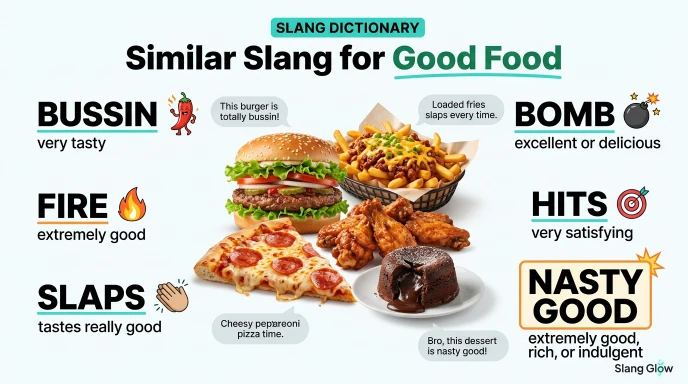
If someone uses nasty as a positive food expression, several other slang terms can express a similar idea. They are not exact replacements in every sentence, but they can help you understand the tone.
| Slang | Meaning When Used for Food |
| Bussin | Very tasty or satisfying |
| Fire | Extremely good |
| Slaps | Tastes or feels really good |
| Bomb | Excellent or delicious |
| Hits | Very satisfying |
| Nasty good | Extremely good in a rich, messy, or indulgent way |
For example, “These wings are fire” is clearly positive. “These wings are nasty” needs more context because nasty can also have a negative meaning.
Nasty vs. Bussin
Bussin is usually easier to understand as positive food slang. It commonly means that something tastes very good or satisfying.
Compare:
“This chicken is bussin.”
This clearly sounds like praise.
“This chicken is nasty.”
This could mean the chicken is amazing or disgusting.
So, if you want a word with a more obvious positive meaning, bussin is less ambiguous.
Nasty vs. Fire
Fire is another common informal way to praise food.
“That pizza is fire.”
Most readers will understand this as the pizza is excellent.
By contrast:
“That pizza is nasty.”
can make the reader stop and wonder if you mean good or bad.
The difference is mainly clarity. Fire has a strongly positive slang use, while nasty can go either way.
Opposite Expressions
When nasty means unpleasant food, its opposite can be expressed with words such as:
- Delicious
- Tasty
- Fresh
- Appetizing
- Flavorful
- Satisfying
If nasty is being used positively to mean extremely good, there is no single fixed opposite slang term. The best choice depends on what you are trying to describe.
Formal Alternatives to Nasty
If you are writing a school assignment, food review, article, or professional message, avoid relying on nasty to express praise.
Instead, choose a word that gives the exact meaning:
| What You Mean | Better Word |
| Tastes very good | Delicious |
| Has strong flavor | Flavorful |
| Very rich | Indulgent |
| Very satisfying | Satisfying |
| Looks appealing | Appetizing |
| Tastes bad | Unpleasant |
| Extremely bad | Disgusting |
This removes the confusion that comes with informal slang.
Can Adults Use Nasty as Food Slang?
Yes, adults can understand or use it in casual settings, but it depends on their speech style and audience.
It works best with friends, casual conversations, texts, and informal social media posts. It is less suitable when you need to sound precise or professional.
If there is any chance someone could misunderstand your meaning, use “nasty good” instead of simply “nasty.”
When Should You Avoid Using It?
Avoid the positive slang use when the listener may take nasty literally.
For example, telling someone:
“Your cooking is nasty.”
could easily sound like an insult.
Instead, say:
“Your cooking is nasty good!”
That small change makes the compliment much clearer.
The same rule applies to teachers, professional settings, formal reviews, and written work. Clear language is better than slang when the meaning needs to be unmistakable.
Common Misunderstandings About Nasty
Because nasty can have both positive and negative meanings, readers can easily misunderstand it when they see it in a food comment or conversation.
“Nasty” Always Means Bad
This is not always true in casual food slang.
If someone says:
“That burger is nasty good.”
they are clearly praising it.
But the standard meaning of nasty is still negative, so the positive meaning depends on informal context.
“Nasty” Always Means Delicious
This is also incorrect.
If someone says:
“The fish smells nasty.”
they almost certainly mean the smell is bad or unpleasant.
Never assume that nasty means “delicious” just because you have seen it used positively online.
Nasty and Gross Always Mean the Same Thing
Not necessarily.
Gross is normally negative. It describes something unpleasant or disgusting.
Nasty can also be negative, but in informal food slang it can sometimes become playful praise.
That makes nasty more context dependent than gross.
Can Nasty Be Misunderstood as an Insult?
Yes. This is one of the biggest problems with using the word by itself.
Imagine someone cooks dinner for you and you say:
“This is nasty!”
They may think you disliked the meal.
If you actually mean that the food is excellent, a clearer version would be:
“This is nasty good!”
or:
“This is nasty in the best way!”
The added words show that you are complimenting the food.
Is Nasty Rude When Talking About Food?
It can sound rude, but it is not automatically offensive.
Among friends, calling an extremely rich meal “nasty” can be playful. With someone you do not know well, the same word may sound like criticism.
The safest approach is to consider your relationship with the listener and make your meaning obvious.
Is Nasty Still Popular Food Slang in 2026?
Nasty is still understood in 2026, but its positive food use is informal and context dependent. It should not be treated as a universal slang meaning.
Different communities may use the word differently. Some people may immediately understand “nasty good” as praise, while others may interpret “nasty” in its usual negative sense.
There is no reliable single popularity ranking that can show how often this specific food slang use appears across all speakers or platforms. So it is better to describe the usage as informal rather than claim that it is universally trending.
When Should You Use Nasty?
Use the positive food slang meaning when:
- You are talking casually with friends.
- The context clearly shows that you like the food.
- You are making a playful social media comment.
- You use “nasty good” to make the meaning clear.
- The audience understands informal slang.
When Should You Avoid Nasty?
Avoid using nasty alone when:
- You are giving a formal food review.
- You are speaking in a professional setting.
- You are complimenting someone’s cooking and do not know how they will interpret it.
- You are writing for an audience unfamiliar with the slang.
- Your meaning needs to be completely clear.
In these situations, delicious, flavorful, excellent, rich, or satisfying will communicate your idea better.
Key Takeaways
- Nasty usually means unpleasant, disgusting, or bad.
- In food slang, nasty can sometimes be positive and mean extremely good, rich, messy, or satisfying.
- “Nasty good” clearly expresses a positive meaning.
- “This tastes nasty” usually means the food tastes bad.
- Context and tone are important when understanding nasty.
- The word is informal and can be misunderstood when used alone.
- For formal writing, clearer words such as delicious, flavorful, satisfying, or unappetizing are better.
Frequently Asked Questions About What Does Nasty Mean in Food Slang
Q.1 What does nasty food mean?
“Nasty food” usually means food that tastes, smells, or looks unpleasant. However, in casual slang, someone may also use “nasty” playfully for food that is extremely rich, messy, loaded, or indulgent. The surrounding words and tone help determine which meaning the speaker intends.
Q.2 What does nasty mean in slang?
In slang, nasty can have several meanings depending on context. It may describe something unpleasant, extreme, messy, or impressive. When used about food, it can sometimes be a playful way to say that something is very good, rich, or satisfying.
Q.3 What is nasty 19 slang?
“Nasty 19” is not a standard or widely recognized food slang expression. Its meaning can depend on where the phrase appears, such as a social media post, username, joke, or specific online community. It should not be treated as a fixed meaning of “nasty” without the original context.
Q.4 What is the meaning of nasty taste?
A nasty taste means an unpleasant, bad, or disgusting taste. For example, if food tastes spoiled or leaves an unpleasant flavor, someone might describe it as having a nasty taste. Here, nasty normally has its negative meaning.
Q.5 What are nasty foods?
Nasty foods are not an official category of food. People may call foods nasty when they dislike their taste, smell, texture, or appearance. In playful slang, the phrase can also describe very rich, messy, or indulgent food that someone actually enjoys.
Q.6 How do you describe nasty food?
If nasty means bad, you can describe the food as disgusting, unpleasant, unappetizing, foul tasting, or spoiled. If it is being used positively, you can say rich, indulgent, extremely tasty, messy but delicious, or satisfying.
Q.7 Can nasty mean good when talking about food?
Yes. In casual food slang, nasty can sometimes mean extremely good. Someone might use it to praise food that is rich, messy, cheesy, loaded, or highly satisfying. Adding “good” makes the positive meaning much easier to understand.
Q.8 Is nasty a positive or negative word for food?
Nasty can be either positive or negative when describing food. Its normal meaning is negative, but informal slang can use it as playful praise. “This food tastes nasty” is negative, while “This food is nasty good” is clearly positive.
Final Thoughts
Nasty has two possible meanings in food conversations. Its standard meaning is unpleasant or disgusting, while informal food slang can use it to describe something extremely good, rich, messy, or satisfying.
The context makes the difference. “Nasty taste” is normally negative, while “nasty good” is positive. If you want to avoid confusion, use “nasty good” for praise and clearer words such as delicious or unappetizing in formal writing.
Browse Related Terms!

Hey, I’m Emily. I’ve spent way too many hours scrolling TikTok and group chats trying to figure out what people actually mean by half the slang flying around — and somewhere along the way that turned into a whole thing I write about now. I cover internet slang, TikTok trends, and how words shift meaning practically overnight online.