Quick Answer
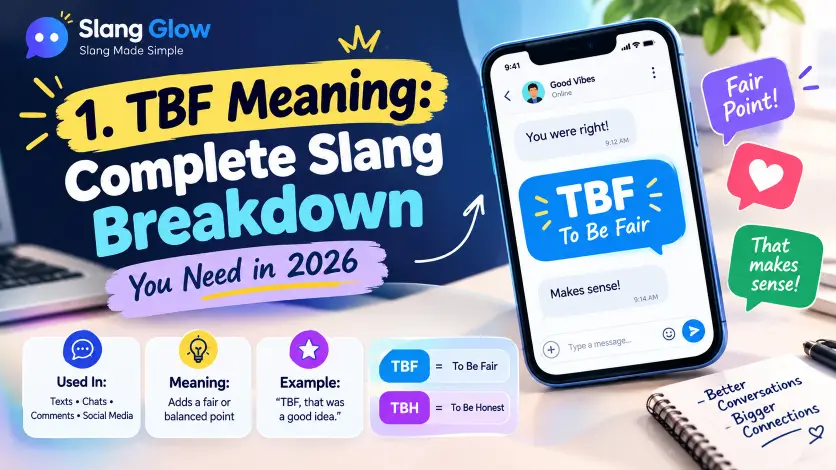
TBF slang means “to be fair.” People use this abbreviation in texting, social media, comments, and online conversations when they want to add a fair point, acknowledge another side, or make a statement more balanced. For example, someone might say, “TBF, you did warn me,” meaning “To be fair, you did warn me.”
The expression is usually casual and conversational. You may see TBF before an opinion, explanation, defense, or observation.
What Does TBF Stand For?
TBF stands for “to be fair.” It is a shortened form commonly used in digital communication because typing three letters is quicker than writing the complete phrase.
The abbreviation does not usually change the meaning of the original expression. Instead, it gives the sentence a more relaxed texting style.
For example:
- TBF, that was a difficult question.
- TBF, she tried her best.
- I was annoyed, but TBF, he apologized.
- TBF, the movie was better than I expected.
In each case, the speaker is recognizing a reasonable point before continuing with an opinion or judgment.
TBF Slang Meaning in Texting
In texting, TBF often introduces a thought that adds balance to the conversation. Someone may use it when they initially criticize a person or situation but then recognize something positive or understandable about it.
Consider this example:
“The restaurant was expensive. TBF, the food was really good.”
Here, TBF signals that the speaker is considering another side of the situation.
A message can also use the abbreviation when someone wants to defend another person:
“TBF, he didn’t know about the change.”
The writer is basically saying that, given the circumstances, blaming him may not be completely fair.
Because texting tends to favor short expressions, TBF fits naturally into informal conversations between friends, classmates, online communities, and social media users.
How People Use TBF on Social Media
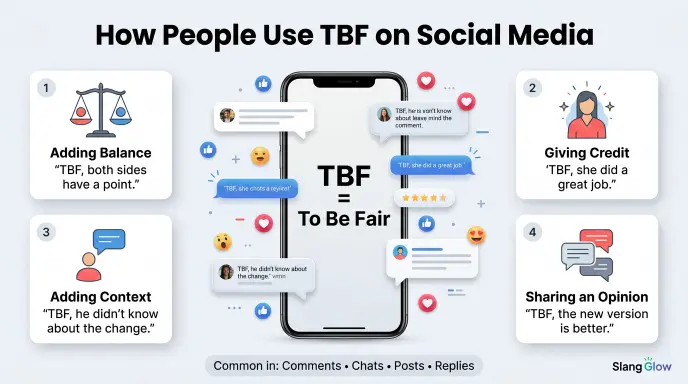
Social media users often place TBF at the beginning of a comment or sentence. It can make an opinion sound more balanced instead of completely one sided.
For instance, a comment might say:
“TBF, the new version isn’t that bad.”
The person is acknowledging that others may dislike it while giving their own fair assessment.
You can also find TBF in discussions where people compare two opinions. The abbreviation helps introduce a point that supports, explains, or slightly challenges what was said earlier.
Common social media patterns include:
- TBF, I understand why people like it.
- TBF, that wasn’t his fault.
- TBF, the first episode was pretty good.
- TBF, they gave everyone enough time.
The exact tone depends on the surrounding conversation. It can sound supportive, neutral, defensive, or mildly argumentative.
Examples of TBF in Everyday Conversations
Understanding the abbreviation becomes easier when you see how it works in different situations.
Example 1: Talking about school
“The assignment was long, but TBF, we had a whole week to finish it.”
The speaker admits that the assignment was lengthy while recognizing that there was plenty of time.
Example 2: Discussing a friend
“I was upset with her, but TBF, she didn’t mean to hurt me.”
Here, TBF introduces an explanation that makes the situation more balanced.
Example 3: Reviewing something
“The game has some problems. TBF, the graphics are amazing.”
The writer points out a weakness and then acknowledges a strength.
Example 4: Online discussion
“I don’t agree with his opinion, but TBF, he explained it well.”
This usage shows that someone can disagree while still recognizing something positive.
TBF vs TBH
TBF and TBH look similar, but they have different meanings.
TBF means “to be fair.” It is mainly used to introduce a balanced point or acknowledge another side.
TBH means “to be honest.” It usually introduces a personal opinion or a straightforward statement.
Compare these examples:
TBF:
“TBF, the book was pretty long, but it was interesting.”
TBH:
“TBH, I didn’t enjoy the book.”
The first sentence focuses on fairness and balance. The second emphasizes honesty and personal opinion.
Both abbreviations are common in casual digital communication, but they serve different purposes.
TBF Meaning in Casual Internet Language
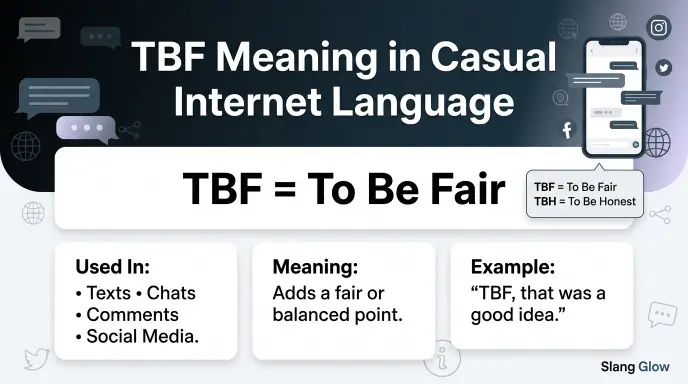
Within internet slang, TBF is generally used as a conversational shortcut rather than a completely new word. Its meaning remains connected to the phrase “to be fair.”
Someone might use it when responding to another person’s statement:
“Yeah, I see your point. TBF, I hadn’t thought about it that way.”
The abbreviation can also soften criticism:
“TBF, the design isn’t terrible. It just needs a few changes.”
This makes the expression useful when someone wants to acknowledge a positive or reasonable point without completely changing their original opinion.
You do not normally need to capitalize the phrase when writing it out. In informal messages, people may use tbf in lowercase, while TBF is also very common.
Where You Might See TBF
The abbreviation appears in many forms of informal online communication. Typical places include:
- Text messages
- Social media comments
- Group chats
- Online forums
- Gaming conversations
- Casual posts
- Direct messages
- Informal discussions
Its use is especially natural when people are reacting quickly to someone else’s opinion.
A person might write “TBF…” at the beginning of a reply to show that they are about to add a point that deserves consideration.
Does TBF Always Sound Positive?
Not necessarily. TBF does not automatically mean that the speaker agrees with someone.
Instead, it signals that the person wants to recognize a fair point.
For example:
“TBF, she worked hard, but I still don’t think the result was good.”
The writer acknowledges the effort while maintaining a different opinion about the result.
That is why the abbreviation can appear in both positive and negative discussions. Its main purpose is to introduce balance or fairness, not agreement.
Key Meaning to Remember
When you see TBF in a message, the simplest interpretation is usually “to be fair.”
It tells the reader that the speaker is about to recognize another side of a situation, give someone credit, add context, or make an opinion more balanced.
TBF = To Be Fair
The abbreviation is informal, so it works best in casual communication rather than formal academic or professional writing.
When Should You Use TBF?
TBF works best when you want to acknowledge a reasonable point before giving your main opinion. It can help show that you are looking at a situation from more than one side.
For example:
- TBF, he did apologize.
- TBF, we didn’t give her much time.
- I didn’t like the ending, but TBF, the rest was good.
- TBF, that’s a fair argument.
The abbreviation fits naturally into casual conversations. In formal writing, however, spelling out “to be fair” is usually clearer.
TBF in Gen Z Conversations
You may notice TBF in casual conversations among younger internet users, especially when people react to posts, opinions, videos, or comments.
A message such as “TBF, that’s actually true” shows that the writer is admitting that another person’s point has some merit.
The expression does not belong exclusively to Gen Z. It has been used in informal internet communication for years, so people from different age groups may recognize and use it.
Its short format makes it convenient for quick replies, especially when someone wants to add context without writing a long explanation.
Similar Expressions to TBF
Several informal expressions can serve a similar purpose, although their meanings are not exactly identical.
| Expression | Meaning | Typical use |
| TBF | To be fair | Adding balance to an opinion |
| TBH | To be honest | Giving a direct personal opinion |
| IMO | In my opinion | Introducing a personal view |
| TBQH | To be quite honest | Emphasizing an honest opinion |
| Fair enough | That is reasonable | Accepting or acknowledging a point |
| Honestly | In an honest way | Introducing a sincere statement |
Among these, “fair enough” is particularly close in conversational tone, while TBH is often confused with TBF because both appear frequently in texting.
Common Mistakes With TBF
One common mistake is assuming that TBF means agreement. It does not necessarily show that the writer agrees with the entire argument.
Another misunderstanding happens when people interpret TBF as “to be honest.” That meaning belongs to TBH, not TBF.
The abbreviation can also be overused. Adding TBF to every sentence may make a message sound repetitive, so it is most useful when you genuinely want to recognize another side of an issue.
Keep the context in mind as well. Informal abbreviations such as TBF are suitable for casual chats and social media, but a formal report or school assignment generally calls for the full phrase.
Is TBF Formal or Informal?
TBF is an informal abbreviation. It is most common in texting, social media, online discussions, and other casual communication.
The full phrase “to be fair” is much more flexible. You can use it in ordinary conversation as well as in more formal writing when the context calls for it.
For example:
Casual:
“TBF, that was a good idea.”
More formal:
“To be fair, the team had very little time to prepare.”
The meaning stays the same even though the writing style changes.
TBF vs “To Be Fair” in Writing
There is no major difference in meaning between TBF and to be fair. The main difference is the level of formality.
TBF is convenient when speed and casual tone matter. The complete phrase is better when you want your writing to look polished or professional.
For a text message, “TBF, you were right” sounds natural.
In an article, report, or formal explanation, “To be fair, you were right” is usually the better choice.
Key Takeaways
- TBF means “to be fair.”
- It is commonly used in texts, chats, comments, and social media.
- The abbreviation introduces a fair, balanced, or reasonable point.
- TBF does not always mean agreement.
- TBH means “to be honest,” so it has a different meaning.
- The full phrase “to be fair” works better in formal writing.
- TBF can appear in both lowercase (tbf) and uppercase (TBF).
Frequently Asked Questions About TBF Slang
Q.1 What does TBF mean in slang?
TBF means “to be fair” in slang and informal online communication. People use it when they want to acknowledge another side of an argument, give someone credit, or make a statement more balanced.
Q.2 What does “TBF” mean in chat?
In chat, TBF means “to be fair.” Someone may use it before adding a reasonable point or explaining why a person or situation should not be judged too harshly.
Q.3 What does TBH and TBF mean?
TBH means “to be honest,” while TBF means “to be fair.” TBH usually introduces a sincere personal opinion, whereas TBF introduces a point that adds fairness or balance.
Q.4 Is TBF to be fair?
Yes. TBF is a common abbreviation for “to be fair.” The meaning can usually be understood from the surrounding sentence.
Q.5 What does TBF mean on Snapchat?
On Snapchat, TBF generally means “to be fair.” It has the same basic meaning it has in texting and other social media conversations. A person might use it when replying to a Snap or chat message with a balanced observation.
Q.6 What does “isf tbf” mean?
“ISF TBF” does not have one universal slang meaning as a fixed phrase. TBF commonly means “to be fair,” but the meaning of ISF depends on the context where it appears. If you see “ISF TBF” in a specific message, the words around it can help determine what the sender intended.
TBF in Different Types of Messages
The meaning of TBF stays the same across most casual messages, but the way people use it can change with the conversation.
In a friendly chat, someone may use it to admit that another person has a valid point. A social media commenter might add it before a short opinion. During an online debate, the abbreviation can introduce a point that makes an argument more balanced.
Here are a few examples:
- Friend: “TBF, you did tell me about it.”
- Comment: “TBF, this update is better than the old one.”
- Discussion: “TBF, both sides have reasonable arguments.”
- Reply: “TBF, I can understand why you chose that.”
These examples show that TBF is usually connected with fairness, context, or acknowledgment.
How TBF Changes the Tone of a Sentence
Adding TBF can make a statement sound less harsh. Instead of making a direct judgment, the writer recognizes something that deserves consideration.
Compare these two sentences:
“He was late again.”
“TBF, he was late because of the traffic.”
The second version gives additional context. It does not necessarily excuse the person, but it makes the statement more balanced.
A similar effect can happen when discussing products, movies, games, schoolwork, or everyday situations. TBF signals that the writer is considering more than one factor.
TBF in Online Arguments
Online discussions can become strongly opinionated, so TBF is sometimes used to introduce a more measured response.
Someone might disagree with another person while still accepting part of their argument. In that situation, TBF helps separate the point they agree with from the opinion they do not share.
For example:
“TBF, your main point makes sense, but I don’t agree with the conclusion.”
This shows that the writer is not completely rejecting the other person’s argument.
The abbreviation can therefore be useful when someone wants to acknowledge a valid point without fully changing their position.
Can TBF Be Used at the End of a Sentence?
Yes, TBF can sometimes appear later in a sentence, although placing it at the beginning is more common.
For example:
“The first part was confusing, but the ending was good, TBF.”
Here, TBF works as a brief closing comment. It still carries the idea of “to be fair.”
Another example is:
“I wasn’t expecting much, but it was actually fun, TBF.”
The writer adds the abbreviation at the end to reinforce the balanced opinion.
TBF in Lowercase and Uppercase
Both TBF and tbf can mean “to be fair.”
Uppercase is common because abbreviations are often written in capital letters:
“TBF, that makes sense.”
Lowercase is also natural in casual texting:
“tbf, that makes sense.”
There is generally no important difference in meaning between the two forms. The choice usually depends on the person’s typing style.
Why People Use TBF slang Instead of the Full Phrase
Short abbreviations make online conversations quicker. Writing TBF takes less space than typing “to be fair,” which is useful in fast moving chats and comments.
The abbreviation also fits the informal style of internet communication. Similar shortcuts include TBH, IMO, IDK, FYI, and BTW.
Even so, the full phrase remains completely natural. A person can write “to be fair” whenever they want a clearer or more polished style.
Final Takeaway About TBF slang
TBF slang means “to be fair.” It is an informal abbreviation used to introduce a balanced observation, acknowledge another person’s point, provide context, or give credit where it is deserved.
When you see TBF in a text, comment, or social media post, read it as “to be fair” unless the surrounding context clearly suggests another meaning.
The most important distinction is simple:
TBF = To Be Fair
TBH = To Be Honest
That difference helps you understand most everyday uses of these two common texting abbreviations.
Explore the Meaning!

Hey, I’m Emily. I’ve spent way too many hours scrolling TikTok and group chats trying to figure out what people actually mean by half the slang flying around — and somewhere along the way that turned into a whole thing I write about now. I cover internet slang, TikTok trends, and how words shift meaning practically overnight online.