Quick Answer
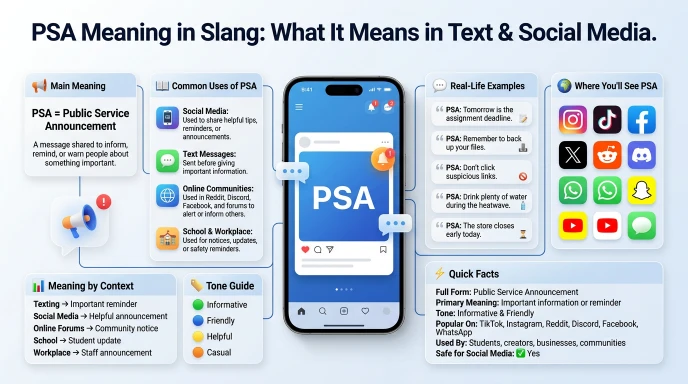
PSA stands for Public Service Announcement. In slang, texting, and social media, people use PSA to share an important notice, friendly reminder, warning, or helpful tip. It is commonly seen on TikTok, X (Twitter), Instagram, Reddit, Snapchat, Discord, and in group chats.
Simple Definition
A PSA is a short message that tells people something useful or important. It can be serious or funny, depending on the context.
Example:
- “PSA: Bring an umbrella today. It’s going to rain.”
- “PSA: Stop replying to scammers.”
- “PSA: The new game update is live now.”
What Does PSA Mean in Slang?
In modern slang, PSA introduces a message that the speaker believes everyone should know. While the original meaning is Public Service Announcement, online users often say it before giving advice, reminders, opinions, or humorous warnings.
For example:
- “PSA: Drink more water.”
- “PSA: Don’t spoil the movie for others.”
- “PSA: Charge your phone before traveling.”
PSA Meaning in Text Messages
In texting, PSA usually means:
- Important notice
- Friendly reminder
- Helpful advice
- Quick warning
- General announcement
Text Example:
Friend: “PSA: Our meeting starts 30 minutes earlier today.”
Here, the sender is simply making sure everyone knows the important information.
PSA on Social Media
People use PSA on platforms like:
- TikTok
- X (Twitter)
- Snapchat
- Discord
Many posts begin with “PSA:” followed by advice, life tips, jokes, or announcements.
Examples:
- “PSA: Always read the comments before buying online.”
- “PSA: Be kind to customer service workers.”
- “PSA: Save your work before updating your computer.”
Is PSA Positive or Negative?
PSA is usually neutral. Its tone depends on the message.
- Positive: “PSA: Take care of your mental health.”
- Neutral: “PSA: The store closes at 8 PM.”
- Funny: “PSA: Don’t text your ex after midnight.”
It is rarely considered offensive unless the message itself is rude.
Different Meanings of PSA
Although PSA usually means Public Service Announcement in slang, it can have different meanings depending on the situation.
| Meaning | Where It’s Used | Example |
| Public Service Announcement | Social media, texting | “PSA: Don’t forget to lock your doors.” |
| Friendly Reminder | Group chats | “PSA: Homework is due tomorrow.” |
| Important Notice | Online posts | “PSA: The website will be down tonight.” |
| Helpful Advice | TikTok, Instagram | “PSA: Back up your photos regularly.” |
How People Use PSA in Everyday Conversations
People often start a sentence with “PSA:” when they want others to notice an important message. It grabs attention and tells readers that the information is worth reading.
Examples
At School
- “PSA: The exam has been moved to Friday.”
At Work
- “PSA: Please submit your reports before 5 PM.”
In a Group Chat
- “PSA: We’re meeting at the restaurant at 7.”
On Social Media
- “PSA: Always check the source before sharing news.”
Real Life Examples of PSA Slang
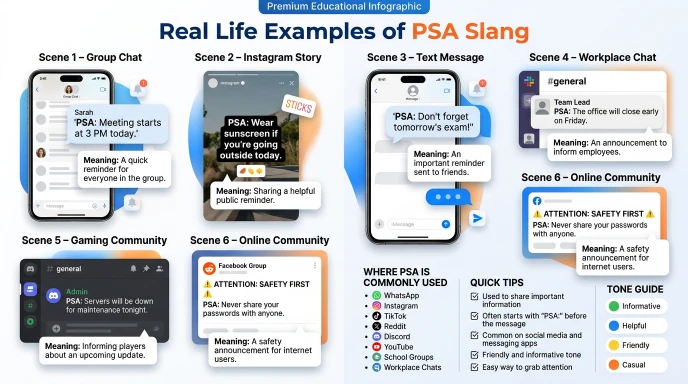
Here are some common examples you may see online:
- “PSA: Drink enough water today.”
- “PSA: Update your apps for better security.”
- “PSA: Don’t post spoilers without a warning.”
- “PSA: Bring a jacket it’s colder than expected.”
- “PSA: Be respectful in the comments.”
These examples show that PSA is often used to share useful information in a quick and friendly way.
Why Do People Say “PSA”?
People use PSA because it helps make an announcement stand out. Instead of writing a long explanation, adding “PSA:” at the beginning tells readers that something important follows.
Common reasons include:
- Sharing important updates
- Giving friendly reminders
- Offering useful tips
- Warning others about problems
- Posting humorous advice
- Announcing events or schedule changes
PSA vs Similar Slang Terms
| Slang | Meaning | Difference |
| PSA | Public Service Announcement | Shares important information or reminders. |
| FYI | For Your Information | Gives information without asking for action. |
| Heads up | Advance warning | Alerts someone before something happens. |
| Reminder | Helps people remember | Focuses on something already known. |
| Notice | Official announcement | Often more formal than PSA. |
Frequently Asked Questions About PSA Meaning in Slang
What is a PSA on social media?
On social media, PSA stands for Public Service Announcement. People use it before posting an important notice, friendly reminder, helpful tip, warning, or opinion they want others to see. It is common on TikTok, Instagram, X (Twitter), Reddit, Snapchat, and Facebook.
Example: “PSA: Don’t forget to drink water today.”
What does “PSA” mean on TikTok?
On TikTok, PSA is used to introduce useful advice, trend warnings, life hacks, or funny reminders. Creators often start a video or caption with “PSA:” to grab attention before sharing something important.
Example: “PSA: This trend can damage your phone.”
What does “PSA” mean on IG?
On Instagram (IG), PSA means Public Service Announcement. Users include it in captions, Stories, or Reels to share updates, reminders, announcements, or helpful information with their followers.
Example: “PSA: New products drop tomorrow at 10 AM.”
What is PSA short for?
PSA is short for Public Service Announcement. While it originally referred to official public messages, today it is widely used online as a casual way to share important information or advice.
Example: “PSA: Always double check links before clicking.”
Why do people say “PSA”?
People say “PSA” to make their message stand out. It signals that what follows is worth reading, whether it’s a reminder, warning, helpful tip, or announcement.
Example: “PSA: Please arrive 15 minutes early.”
What is a PSA message?
A PSA message is a short announcement designed to inform or remind people about something important.
Example: “PSA: Remember to save your work before updating your computer.”
What is PSA slang in Urban Dictionary?
In Urban Dictionary, PSA generally keeps the same meaning Public Service Announcement. However, internet users often use it humorously or sarcastically before sharing opinions, jokes, or obvious advice.
Example: “PSA: Stop texting your ex after midnight.”
What is a PSA on the internet?
On the internet, a PSA is an online announcement that shares useful information, warnings, reminders, or tips. It may be serious, educational, or humorous depending on the context and platform.
Example: “PSA: This website is temporarily offline for maintenance.”
Does PSA always mean Public Service Announcement?
Most of the time, yes. In texting, social media, and online conversations, PSA almost always means Public Service Announcement. In professional or medical settings, however, it can have other meanings depending on the topic.
Example: “PSA: The meeting has been moved to Friday.”
Is PSA considered Gen Z slang?
Not exactly. PSA is an internet abbreviation rather than exclusive Gen Z slang. People of all ages use it online to introduce important messages, reminders, and announcements.
Example: “PSA: Be respectful in the comments section.”
Origin and Background of PSA
The term PSA originally stood for Public Service Announcement. It was first used by government agencies, nonprofit organizations, and public broadcasters to share important information about health, safety, education, and community issues.
As the internet and social media grew, the meaning of PSA expanded. Today, people use it in everyday conversations, text messages, memes, and social media posts to introduce helpful advice, reminders, warnings, or even humorous opinions.
Instead of being limited to official announcements, PSA has become a popular internet phrase that quickly tells readers, “Pay attention this is something worth knowing.”
Is PSA Offensive?
No. PSA is generally considered neutral and polite. The abbreviation itself is not offensive.
However, the tone depends on the message that follows. A PSA can be:
- Helpful
- Funny
- Serious
- Sarcastic
- Informative
For example:
- Helpful: “PSA: Wear sunscreen when you’re outside.”
- Funny: “PSA: Don’t text your crush at 2 AM.”
When Should You Use PSA?
You can use PSA whenever you want to share useful information with others.
Common situations include:
- Giving a friendly reminder
- Sharing safety advice
- Posting an important update
- Warning people about scams
- Announcing schedule changes
- Sharing helpful life tips
- Posting humorous observations online
When Should You Avoid Using PSA?
Although PSA is widely accepted, there are situations where another phrase may sound more appropriate.
Avoid using PSA when:
- Writing formal business documents
- Sending legal or official notices
- Communicating sensitive information
- Writing academic papers
- Giving emergency instructions that require official wording
In these situations, phrases like Official Notice, Important Announcement, or Formal Update may be better choices.
Similar Slang and Internet Abbreviations
If you understand PSA, you may also come across these internet abbreviations:
| Abbreviation | Meaning | Common Use |
| FYI | For Your Information | Sharing information |
| IMO | In My Opinion | Expressing opinions |
| BTW | By The Way | Adding extra information |
| TL;DR | Too Long; Didn’t Read | Short summary |
| TIL | Today I Learned | Sharing new knowledge |
| ICYMI | In Case You Missed It | Highlighting older news |
Common PSA Examples
Here are a few examples of how people use PSA online:
- “PSA: Update your passwords regularly.”
- “PSA: Drink plenty of water during hot weather.”
- “PSA: Be careful of fake giveaway scams.”
- “PSA: Always read the full article before sharing it.”
- “PSA: Respect other people’s opinions online.”
Final Thoughts
PSA stands for Public Service Announcement. While it originally referred to official public messages, today it is widely used in texting, social media, and online communities as a simple way to share an important notice, reminder, warning, or helpful tip. Whether you’re browsing TikTok, Instagram, Reddit, Discord, or texting friends, you’ll often see “PSA:” at the beginning of posts that aim to grab attention and share useful information.
Example: “PSA: Don’t forget to update your apps today.”
Key Takeaways
- PSA means Public Service Announcement.
Example: “PSA: The event starts at 7 PM.” - It is commonly used in texting and on social media.
Example: “PSA: Check your email for today’s update.” - People use it to share important notices, reminders, tips, or warnings.
Example: “PSA: Always lock your bike in public places.” - The term is usually neutral and not offensive.
Example: “PSA: Please be respectful in the comments.” - PSA can be serious, humorous, or sarcastic depending on the context.
Example: “PSA: Stop buying snacks when you’re hungry.” - It is popular on TikTok, Instagram, X (Twitter), Reddit, Snapchat, and Discord.
Example: “PSA: This filter is available for a limited time.”
Related Slang Terms You May Also Like
FYI Meaning
FYI means “For Your Information.” It is used when sharing useful information without expecting a reply.
ICYMI Meaning
ICYMI stands for “In Case You Missed It.” It is used to highlight news, updates, or posts that people may not have seen.
TIL Meaning
TIL means “Today I Learned.” People use it when sharing a new or surprising fact they recently discovered.
BTW Meaning
BTW stands for “By The Way.” It is used to introduce an additional comment or piece of information.
IMO Meaning
IMO means “In My Opinion.” It lets readers know that the statement is a personal opinion.
FOMO Meaning
FOMO stands for “Fear Of Missing Out.” It describes the feeling of missing an exciting event, trend, or experience.
YOLO Meaning
YOLO means “You Only Live Once.” It encourages people to enjoy life or take opportunities.
TL;DR Meaning
TL;DR stands for “Too Long; Didn’t Read.” It is used to provide a short summary of long content.
IYKYK Meaning
IYKYK means “If You Know, You Know.” It refers to an inside joke or experience understood only by certain people.
POV Meaning
POV stands for “Point Of View.” It introduces content from a specific person’s perspective or viewpoint.
Exercise: Test Your Understanding of PSA Meaning
Choose the correct answer for each question.
1. What does PSA stand for in slang?
A) Personal Status Alert
B) Public Service Announcement
C) Private Social Account
D) Public Safety Alert
Answer: B) Public Service Announcement
2. Where is PSA commonly used?
A) TikTok and Instagram
B) Text messages
C) Reddit and Discord
D) All of the above
Answer: D) All of the above
3. What is the main purpose of using PSA?
A) To tell a joke
B) To share an important notice, reminder, or helpful tip
C) To ask a question
D) To send a private message
Answer: B) To share an important notice, reminder, or helpful tip
4. Is PSA usually considered offensive?
A) Yes
B) No
C) Only on TikTok
D) Only in text messages
Answer: B) No
5. Which sentence uses PSA correctly?
A) “PSA: Don’t forget your meeting at 3 PM.”
B) “I PSA you yesterday.”
C) “She is very PSA.”
D) “Let’s PSA to the store.”
Answer: A) “PSA: Don’t forget your meeting at 3 PM.”
Fill in the Blank
- PSA stands for __________________________.
Answer: Public Service Announcement - People often use PSA before sharing an important __________________.
Answer: notice (or reminder) - PSA is commonly seen on __________________ and other social media platforms.
Answer: TikTok
True or False
- PSA is mainly used to share helpful information.
Answer: True - PSA is a rude slang term.
Answer: False - PSA can be used in text messages and on social media.
Answer: True - PSA always refers to an official government announcement.
Answer: False
READ MORE ABOUT!

Hey, I’m Emily. I’ve spent way too many hours scrolling TikTok and group chats trying to figure out what people actually mean by half the slang flying around — and somewhere along the way that turned into a whole thing I write about now. I cover internet slang, TikTok trends, and how words shift meaning practically overnight online.